Empathic or empathetic which word is correct, and is there actually a difference between them? The answer may be simpler than you expect: both are correct.
These adjectives come from the same idea of empathy and describe the ability to understand or relate to another person’s feelings, experiences, or point of view.
The confusion comes from their similar meanings and different endings, which often makes writers wonder whether one is a mistake or more appropriate than the other.
In this guide, you’ll learn what empathic and empathetic mean, how they differ in usage, which form is more common, and how to use both correctly in clear, natural English.
Quick Answer
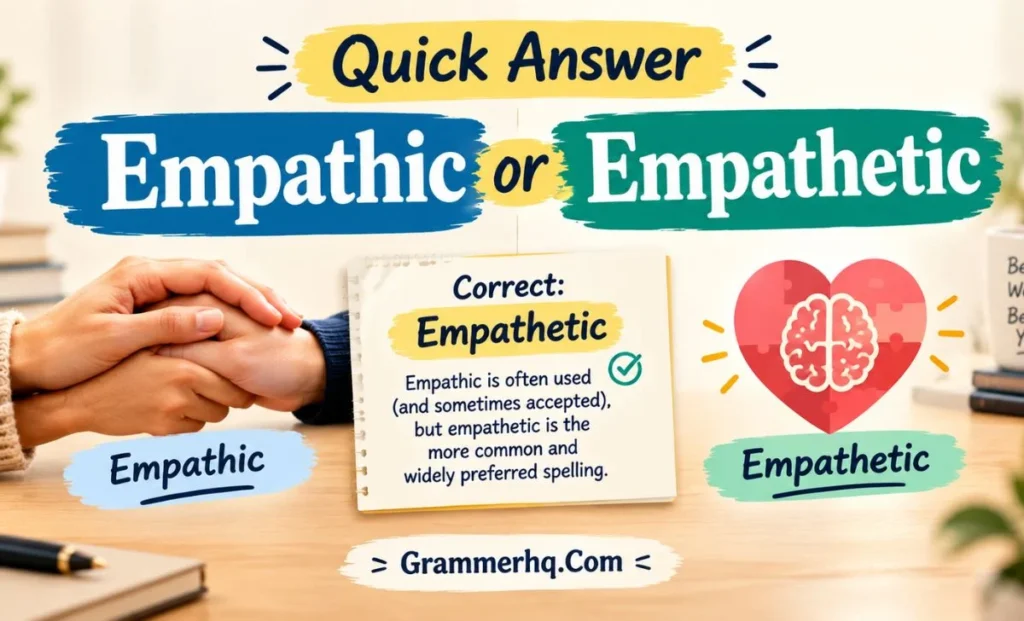
| Feature | Empathic | Empathetic |
|---|---|---|
| Correct spelling? | Yes | Yes |
| Part of speech | Adjective | Adjective |
| Core meaning | Related to or showing empathy | Related to or showing empathy |
| Meaning difference | No major difference | No major difference |
| Common contexts | General, professional, psychological | General, professional, everyday |
| Example | an empathic response | an empathetic response |
Cambridge lists empathic as a synonym of empathetic, while Oxford gives empathic as another form of empathetic.
So, if you have been wondering whether empathic is simply a misspelling of empathetic, the answer is no.
What Does “Empathic” Mean?
Empathic is an adjective describing someone who can understand another person’s feelings or perspective, particularly by imagining what that person is experiencing.
For example:
- The counselor gave an empathic response.
- She is an empathic listener.
- The doctor showed empathic concern for his patient.
- His empathic approach helped the team communicate more openly.
Cambridge uses empathic with expressions such as empathic understanding, empathic concern, and empathic responsiveness, showing that the word is well established in professional usage.
Is “Empathic” a Real Word?
Yes. Empathic is a standard English adjective.
It is not an error, typo, or shortened form that should be avoided. If you see a sentence such as:
The therapist was warm and empathic.
there is nothing grammatically wrong with it.
What Does “Empathetic” Mean?
Empathetic is an adjective meaning able to understand how another person feels, especially by imagining what it would be like to be in that person’s situation. Cambridge and Oxford both give this meaning and recognize empathic as an alternative form.
Examples:
- She is an empathetic friend.
- The teacher took an empathetic approach to the student’s problem.
- He is an empathetic listener.
- The doctor was empathetic toward the patient’s concerns.
Oxford specifically gives examples involving an empathetic listener and doctors being empathetic towards their patients.
Is There a Difference Between Empathic and Empathetic?
Not a major difference in meaning.
In ordinary English, empathic and empathetic can often be used interchangeably:
She gave an empathic response.
She gave an empathetic response.
Both sentences communicate essentially the same idea.
The difference is more about usage and familiarity than definition. Empathic is particularly well established in psychological and professional terminology, while empathetic is a very familiar choice in general English. That does not make one correct and the other incorrect.
It is therefore better to think of them as two accepted adjective forms related to empathy, rather than two words with completely separate meanings.
Why Are There Two Forms?
The two adjectives developed from the noun empathy.
Historical sources date empathy and the adjective forms to the early 20th century. Etymonline records empathy from 1908 and both empathic and empathetic from 1909, with empathetic formed from empathy on the model of words such as sympathetic.
That history helps explain why English ended up with two adjective forms.
It also explains why there is no good reason to treat empathic as a spelling mistake. Both forms have a long history of use.
Which Is More Common: Empathic or Empathetic?
Empathetic is a very familiar choice in general English, especially when describing a person’s character or behavior:
- an empathetic friend
- an empathetic teacher
- an empathetic manager
- an empathetic response
Empathic is also standard and appears naturally in professional and psychological contexts:
- empathic listening
- empathic understanding
- empathic response
- empathic concern
The important point is that frequency and context do not determine correctness. A word can be less familiar to a particular reader and still be completely standard English.
Empathic or Empathetic in American and British English
Both empathic and empathetic are used in American and British English.
There is no reliable rule saying:
British English = empathic
American English = empathetic
That is too simplistic.
Cambridge’s English entries recognize both forms, and Oxford likewise lists empathic as an alternative to empathetic.
So you can use either form without treating the choice as an American-versus-British spelling issue.
“I Am Empathic” or “I Am Empathetic”?
Both are grammatically correct.
I am empathic. ✓
I am empathetic. ✓
You can also say:
She is an empathetic person. ✓
She is an empathic person. ✓
The important distinction is between these adjectives and the related verb empathize.
I empathize with you. ✓
I empathetic with you. ✗
Use empathize when you need a verb.
Empathic or Empathetic Listening
Both empathic listening and empathetic listening are acceptable expressions.
They describe listening with attention to another person’s feelings, perspective, and experience rather than simply processing the words they say.
For example, imagine a manager speaking with an employee who has just experienced a difficult situation.
A dismissive response might focus only on solving the immediate problem.
An empathic or empathetic response first acknowledges what the employee may be feeling and gives them space to explain.
Both adjective forms work:
The manager practiced empathic listening.
The manager practiced empathetic listening.
Empathic, Empathetic, Empathy, and Empathize
These words belong to the same word family, but they do different grammatical jobs.
| Word | Part of speech | Example |
|---|---|---|
| empathy | Noun | She showed empathy. |
| empathize | Verb | I can empathize with him. |
| empathic | Adjective | She gave an empathic response. |
| empathetic | Adjective | She gave an empathetic response. |
| empathically | Adverb | He listened empathically. |
| empathetically | Adverb | She responded empathetically. |
The noun empathy refers to the ability to share or understand another person’s feelings or experiences by imagining what it would be like to be in that person’s situation.
What About “Empath”?
Empath is different again.
It is a noun used for a person believed to have an unusually strong ability to sense or experience other people’s emotional states.
So:
- empathy = the concept or ability
- empath = a person
- empathize = the verb
- empathic = adjective
- empathetic = adjective
Don’t use empath as though it were another spelling of empathetic.
Empathetic or Sympathetic
Empathy and sympathy are related, but they are not identical.
Cambridge defines empathy around sharing or understanding another person’s feelings or experiences by imagining their situation. Sympathy, meanwhile, involves understanding and caring about another person’s suffering.
Consider someone who has just lost a job.
An empathetic response might be:
“I can understand why you’re feeling anxious about what happens next.”
A sympathetic response might be:
“I’m really sorry you’re going through this.”
The first emphasizes understanding the person’s experience; the second expresses concern for their difficulty.
In real conversations, however, empathy and sympathy can overlap.
Common Mistakes With Empathic and Empathetic
1: Calling “empathic” a misspelling
Empathic is correct.
an empathic response ✓
2: Assuming “empathetic” is the only correct form
It isn’t. Both forms are standard.
an empathetic response ✓
an empathic response ✓
3: Inventing a strict meaning difference
It is misleading to claim that empathic and empathetic always describe two different kinds of empathy. Major dictionaries treat them as equivalent or alternative forms.
4: Using “empathetic” as a verb
Don’t write:
I empathetic with her. ✗
Write:
I empathize with her. ✓
5: Treating the choice as purely American vs. British
Both forms are used across English varieties, so there is no simple US/UK spelling rule here.
Which Word Should You Use?
If you’re writing for a general audience, empathetic is a natural and familiar choice.
If you’re writing about psychology, counseling, healthcare, or another professional subject where empathic is already common terminology, that form may fit naturally.
But there is no need to change a sentence simply because you used one instead of the other.
For example, both are fine:
The nurse gave an empathetic response.
The nurse gave an empathic response.
Your choice can come down to context, audience, and style.
Empathic or Empathetic: Examples in Real-Life Contexts
Healthcare
The doctor took an empathetic approach when discussing the patient’s concerns.
The doctor demonstrated empathic understanding during the consultation.
Education
An empathetic teacher listens before judging a student’s behavior.
The counselor used an empathic approach when speaking with the student.
Workplace
A good manager should be empathetic when an employee is dealing with a difficult situation.
Her empathic communication helped the team discuss the problem openly.
Everyday Conversation
My sister is very empathetic; she always notices when someone is having a bad day.
He gave me an empathic response instead of immediately telling me what to do.
These examples show why the two forms are usually a matter of wording preference rather than a change in basic meaning.
FAQs
1: Is “empathic” a correct word?
Yes. Empathic is a standard English adjective related to empathy. Cambridge lists it as a synonym of empathetic.
2: Is “empathetic” a correct word?
Yes. Empathetic is a standard adjective meaning able to understand how another person feels or what they are experiencing.
3: Is empathic a misspelling of empathetic?
No. Empathic is not a misspelling. Both forms are accepted English adjectives.
4: Are empathic and empathetic synonyms?
Yes. In their core meaning, empathic and empathetic are essentially synonymous. Cambridge explicitly lists empathetic as a synonym for empathic.
5: Which is more common: empathic or empathetic?
Empathetic is a very familiar choice in general English. Empathic is also well established, particularly in professional and psychological contexts. Familiarity should not be confused with correctness.
6: Can I say “I am empathic”?
Yes.
I am empathic. ✓
The same is true of:
I am empathetic. ✓
7: Can I say “I am empathetic”?
Yes. I am empathetic is grammatically correct.
8: Is “empathetic listener” correct?
Yes. Empathetic listener is standard English, and empathic listener is also correct.
9: Is “empathic” formal?
Empathic is well established in professional and psychological writing, but it is not restricted to formal English. It can be used in ordinary writing as well.
10: Is “empathetic” more informal?
Not necessarily. Empathetic is widely used in everyday and professional English. It should not be treated as an exclusively informal alternative to empathic.
11: Are both words used in British English?
Yes. Both empathic and empathetic are recognized in British English.
12: What is the difference between empathy and sympathy?
Empathy involves understanding or sharing another person’s feelings or experience, while sympathy generally expresses understanding and care for someone’s suffering.
13: What is the difference between an empath and an empathetic person?
An empath is a noun for a person believed to have an unusually strong sensitivity to other people’s emotional states. Empathetic is an adjective describing someone or something characterized by empathy.
14: Is “empathic response” correct?
Yes. Empathic response is a standard expression, particularly common in psychological and professional contexts. Cambridge provides examples of empathic response and related phrases.
Final Answer
Both “empathic” and “empathetic” are correct.
They are adjectives related to empathy and have essentially the same core meaning. Empathetic is a familiar choice in general English, while empathic is also well established and appears frequently in psychological, clinical, and professional contexts.
So:
- Empathic ✓
- Empathetic ✓
- Empathic is a misspelling ✗
- Empathetic is the only correct form ✗
When either works, choose the form that best fits your audience and writing style.
Read More Blogs
- Steam vs Steem: What’s the Difference? Meaning, Spelling?
- Shakey or Shaky: Which Spelling Is Correct?