Inequity vs. inequality can be confusing because both words describe situations where things are not equal. The key difference is what the speaker wants to emphasize.
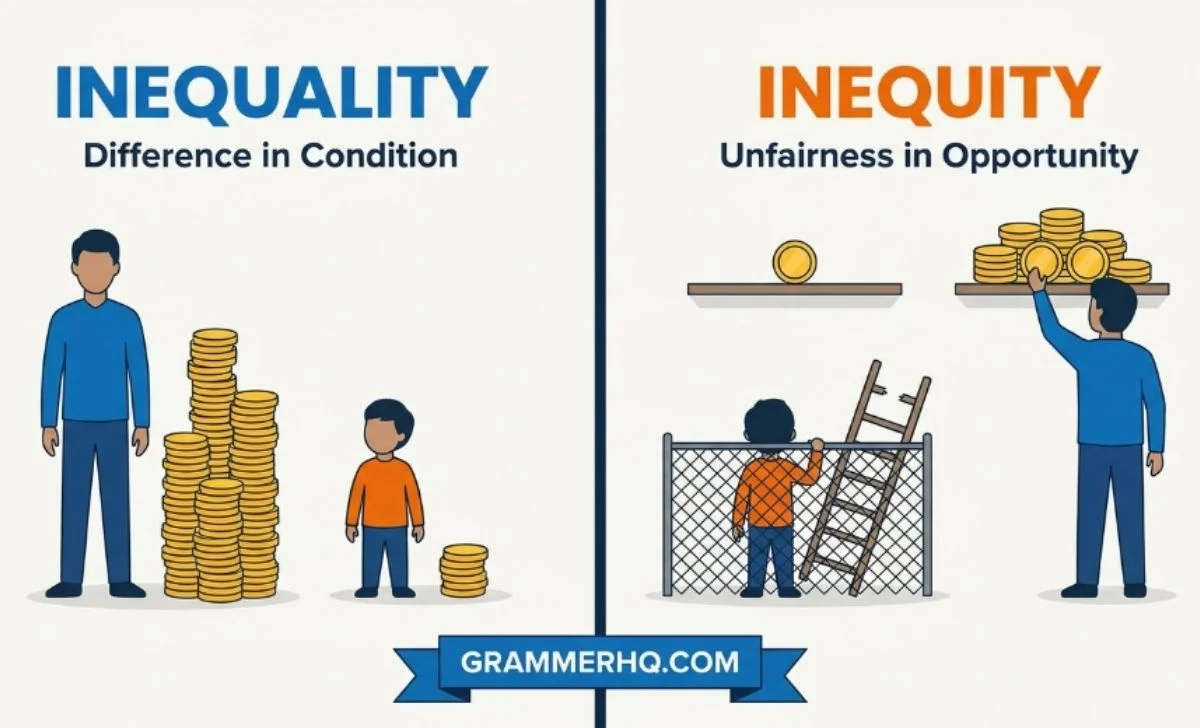
Inequality generally describes a difference, unequal condition, or uneven distribution. Inequity usually adds the idea that the difference is unfair, unjust, or unreasonable.
For example, different incomes represent income inequality; if unfair barriers help create that difference, the situation may also involve inequity.
The distinction is not absolute, however. In everyday English, the words can overlap, while fields such as healthcare and mathematics use them more precisely.
Quick Answer
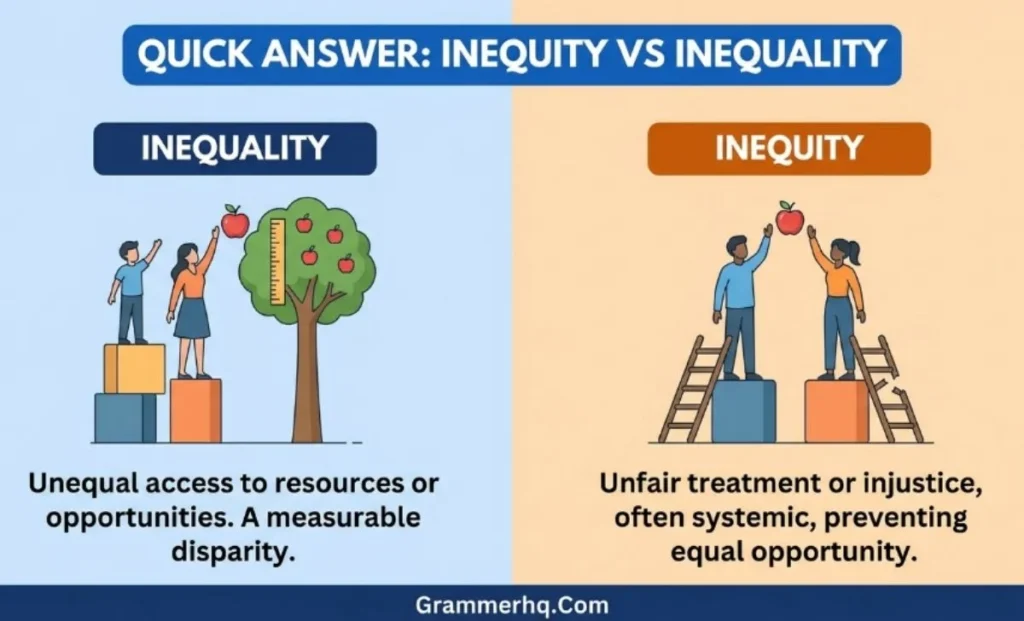
Inequality means a state of being unequal or a measurable difference between people, groups, quantities, or outcomes.
Inequity usually means an unfair or unjust inequality, especially when unequal treatment, access, opportunity, or resources are involved.
A simple way to remember them is:
Inequality describes the difference; inequity highlights the unfairness behind the difference.
For example, a difference in income is income inequality. If that difference is linked to discriminatory practices or unfair barriers, it may also be described as economic inequity.
Inequity vs. Inequality at a Glance
| Feature | Inequality | Inequity |
|---|---|---|
| Core meaning | A difference or unequal condition | An unfair or unjust condition |
| Main focus | What is unequal | What is unfair |
| Moral judgment | Not necessarily | Usually implied |
| Can describe measurable differences? | Yes | Yes, depending on context |
| Used in mathematics? | Yes | No, not normally |
| Used in social discussions? | Yes | Yes |
| Common example | Income inequality | Healthcare inequity |
| Related idea | Unequal distribution | Fairness and justice |
The distinction becomes clearer when you ask a simple question:
Are you describing a difference, or are you judging that difference as unfair?
If you are simply describing the difference, inequality is usually appropriate. If you are emphasizing unfairness or injustice, inequity may be the better choice.
What Does Inequality Mean?
Inequality is the condition of being unequal. It can describe differences in size, amount, income, opportunity, treatment, resources, or outcomes.
The word is broad and has several important uses.
Inequality in Everyday English
In general English, inequality refers to a lack of equality or a difference between people or things.
For example:
- The report examines income inequality.
- There is considerable inequality between the two regions.
- The study found educational inequality among different communities.
- The organization is working to reduce social inequality.
These examples identify a difference. They do not necessarily tell us whether the difference is fair or unfair.
Social Inequality
Social inequality refers to differences between individuals or groups in areas such as wealth, status, education, power, resources, or opportunities.
Common forms include:
- income inequality
- wealth inequality
- gender inequality
- educational inequality
- social inequality
- inequality of opportunity
Social inequality can have many causes, including economic circumstances, geography, historical conditions, institutions, education, and social structures.
Economic Inequality
Economic inequality usually refers to differences in income, wealth, or access to economic resources.
For example:
The country has experienced growing income inequality.
The sentence tells us that income is distributed unevenly. It does not, by itself, explain why that difference exists or whether every aspect of it is unjust.
Inequality in Mathematics
Inequality also has a technical meaning in mathematics.
A mathematical inequality compares two expressions that are not necessarily equal.
Common symbols include:
- > greater than
- < less than
- ≥ greater than or equal to
- ≤ less than or equal to
For example:
x > 5
means that x is greater than 5.
This mathematical meaning is important because inequality, not inequity, is the standard term.
What Does Inequity Mean?
Inequity refers to unfairness, injustice, or an unfair difference.
It is closely connected to the idea of equity, which concerns fairness and just treatment.
For example:
The organization is working to reduce inequity in healthcare access.
This sentence suggests more than a measurable difference. It implies that the difference in access is unfair or unjust.
Inequity and Unfair Treatment
An inequity can occur when people or groups receive unfair treatment or face unjust barriers.
Examples might include:
- discriminatory hiring practices
- unequal access to essential services
- unfair educational barriers
- discriminatory housing practices
- unequal treatment by institutions
The word therefore often carries a stronger ethical or social meaning than inequality.
Inequity and Unequal Access
Imagine that one community has five hospitals while another has only one.
The difference in healthcare resources is an inequality.
But suppose the second community consistently receives fewer essential resources because of an unfair policy or discriminatory system.
The issue may then be described as inequity.
The difference is still an inequality, but the word inequity draws attention to its unfairness.
The Real Difference Between Inequity and Inequality
The most useful distinction is simple:
Inequality asks:
“What is different?”
Inequity asks:
“Is that difference unfair?”
Consider two employees who earn different salaries.
The difference in their pay is a form of inequality.
Now imagine that one employee receives less pay because of discriminatory treatment despite having comparable qualifications and responsibilities.
The situation may also involve inequity.
This distinction helps explain why the two words are related but not identical.
However, it is important not to turn this into an absolute rule. Inequality can sometimes be used to discuss unfair social conditions, and inequity and inequality may overlap in ordinary language.
The intended meaning and context matter.
Are Inequity and Inequality the Same?
No—not always.
The words overlap, but they usually emphasize different aspects of an unequal situation.
Inequality primarily identifies an unequal state or difference.
Inequity usually emphasizes that the difference is unfair, unjust, or unreasonable.
For example:
There is inequality in access to education.
This focuses on the difference in access.
There is inequity in access to education.
This wording places greater emphasis on the unfairness of that difference.
In everyday writing, either term may sometimes appear depending on the author’s intended meaning. In specialized areas such as public health, however, the distinction can be much more deliberate.
Equality vs. Equity vs. Inequality vs. Inequity
These four terms are closely connected, so understanding them together is often easier than studying them separately.
| Term | Simple meaning | Main idea |
|---|---|---|
| Equality | Giving people equal treatment or equal shares | Same |
| Equity | Fairness while recognizing different circumstances | Fair |
| Inequality | A difference or unequal condition | Different |
| Inequity | An unfair or unjust difference | Unfair |
Equality
Equality generally focuses on equal treatment, equal status, or equal distribution.
For example, giving every student the same textbook is an equal distribution of books.
Equity
Equity focuses on fairness.
If students have different needs, providing additional support to students facing greater barriers may be considered an equity-based approach.
Inequality
Inequality describes the resulting difference or unequal condition.
For example, if two groups have different levels of access to educational resources, that difference is an inequality.
Inequity
Inequity emphasizes that an unequal condition is unfair or unjust.
This four-word framework is worth remembering:
Equality = same
Equity = fair
Inequality = different
Inequity = unfair
It is a useful shortcut, although real-world usage can be more nuanced.
Inequality vs. Inequity in Real-Life Examples
The easiest way to understand the distinction is to see how the words work in context.
1: Income
Suppose one group has an average annual income of $30,000 and another has an average income of $70,000.
That difference represents income inequality.
If research shows that members of the lower-income group face unfair barriers to employment or advancement, the situation may also involve inequity.
2: Education
Imagine that students in one neighborhood attend schools with significantly more educational resources than students in another.
The difference represents educational inequality.
If the unequal access results from unfair policies or systemic barriers, it may be described as educational inequity.
3: Healthcare
Suppose two population groups have different rates of access to medical care.
That difference is a health inequality.
If the difference is unfair, avoidable, or connected to unjust barriers, it may be described as health inequity.
4: Employment
If two groups have different rates of employment, that is an employment inequality.
If discriminatory hiring practices systematically prevent one group from accessing jobs, the issue may also be considered an employment inequity.
5: Housing
Different communities may have different levels of access to safe and affordable housing.
That is a housing inequality.
If a particular group faces unjust barriers to housing because of discrimination or systemic practices, the situation can also be described as housing inequity.
6: Opportunities
Two students may have different opportunities to attend university.
The difference is an inequality of opportunity.
If one student is denied opportunities because of an unfair institutional barrier, the issue may be described as an inequity.
Inequality vs. Inequity in Healthcare
Healthcare is one field where the distinction is especially important.
The World Health Organization (WHO) distinguishes between measurable differences in health and differences that are considered unfair or unjust.
For example, if one population has a higher rate of a particular health condition than another population, researchers can describe that difference as a health inequality.
If the difference is associated with unfair, unjust, or avoidable conditions—such as unequal access to healthcare, poor living conditions, discrimination, or other social barriers—it may be described as a health inequity.
Important related concepts include:
- health inequality
- health inequity
- health disparities
- healthcare access
- social determinants of health
- socioeconomic status
- population groups
- public health
- social justice
This distinction is useful because it separates measuring a difference from evaluating that difference in terms of fairness.
Can an Inequality Exist Without Inequity?
Yes.
A difference does not automatically mean that something is unfair.
For example, people naturally have different heights, ages, preferences, abilities, and other characteristics. These differences can be described as inequalities in a broad sense, but they are not necessarily inequities.
Social examples can be more complicated.
Suppose two regions have different average incomes. That is an income inequality.
To describe it as an inequity, the writer is making a stronger claim that the difference is unfair, unjust, unreasonable, avoidable, or connected to problematic circumstances.
Therefore:
Not every inequality is necessarily an inequity.
This distinction is particularly useful when writing about economics, public policy, education, and healthcare.
Can an Inequality Also Be an Inequity?
Yes.
An unequal condition can also be an inequity when the difference is considered unfair or unjust.
Think of the relationship this way:
Inequality → identifies the difference
Inequity → identifies the unfairness associated with the difference
For example:
Group A has better access to healthcare than Group B.
That is an inequality in healthcare access.
If Group B has poorer access because of an unjust and preventable barrier, the situation may also be called a health inequity.
This is why the two concepts can overlap without being identical.
Inequity vs. Inequality in Mathematics:
If you are talking about algebra or mathematical comparison, use inequality.
For example:
Solve the inequality: 3x + 2 < 14.
This is correct.
You would not normally say:
Solve the inequity: 3x + 2 < 14.
The standard mathematical term is inequality.
Common inequality symbols include:
x > 4
x < 4
x ≥ 4
x ≤ 4
So there is an easy rule here:
Mathematics → inequality.
This meaning is separate from discussions about social inequality or unfairness.
Common Mistakes With Inequity and Inequality
1: Assuming Every Difference Is an Inequity
A difference does not automatically establish unfairness.
Use inequality when you are simply describing an unequal condition.
2: Assuming Every Inequality Is Unfair
The word inequality can describe a difference without making a moral judgment.
3: Using Inequity in Mathematics
For mathematical relationships, use inequality.
4: Treating the Words as Perfect Synonyms
They overlap, but inequity generally carries a stronger sense of unfairness or injustice.
5: Ignoring Context
A word that is appropriate in mathematics may not be the right choice in healthcare, and terminology in public health may be more precise than everyday English.
6: Confusing Inequity With Iniquity
These words look and sound similar but have different meanings.
Inequity = unfairness or lack of equity.
Iniquity = serious wrongdoing or wickedness.
For example:
The policy created economic inequity.
But:
The story explores the iniquity of corruption.
How to Choose Between Inequity and Inequality
Use this simple decision process.
Am I describing a difference?
If yes, inequality is usually the natural choice.
The report examines income inequality.
Am I emphasizing unfairness?
If yes, inequity may be more precise.
The report examines inequity in access to healthcare.
Is this mathematics?
If yes, use inequality.
Solve the inequality x ≥ 10.
Is this a specialized field?
If you are writing about healthcare, education, economics, or public policy, consider the terminology used by respected organizations and researchers in that field.
The best word is the one that accurately communicates your intended meaning.
Inequity vs. Inequality Examples in Sentences
Inequality Examples
- The report examines income inequality across the country.
- Researchers studied gender inequality in the workplace.
- Educational inequality can affect students’ future opportunities.
- The study measured wealth inequality between households.
- The region has significant inequality in access to resources.
- The teacher explained how to solve a mathematical inequality.
Inequity Examples
- The program aims to reduce inequity in healthcare.
- Researchers identified serious inequities in educational access.
- The policy was criticized for creating inequity between communities.
- The organization works to address racial inequity.
- The report examines inequity in access to essential services.
- The initiative focuses on reducing social and economic inequities.
Examples Where Both Can Work
Consider:
There is inequality in healthcare access.
This emphasizes the difference.
Now compare:
There is inequity in healthcare access.
This emphasizes the unfairness of the difference.
The underlying situation may be the same, but the speaker’s focus changes.
Inequity and Inequality: Word Origins
Both words are historically connected to the idea of equality.
Inequality is built around equal and refers to a condition of being unequal.
Inequity is connected to equity, a word associated with fairness and just treatment.
This shared background helps explain why the terms are closely related.
It also explains why learners sometimes confuse inequity with iniquity.
Remember:
- Inequity → unfairness or lack of equity
- Iniquity → serious wrongdoing or wickedness
Although the words look similar, they belong to different semantic categories.
Inequity vs. Inequality: Synonyms and Related Words
Words Related to Inequality
Depending on context, related terms include:
- disparity
- difference
- imbalance
- unevenness
- disproportion
- unequal distribution
- gap
For example:
income inequality
income disparity
wealth gap
These expressions may overlap, but they do not always carry exactly the same meaning.
Words Related to Inequity
Related terms include:
- unfairness
- injustice
- unjustness
- discrimination
- bias
- unequal treatment
- partiality
Again, context matters.
For example, disparity generally highlights a difference or gap. It does not automatically prove that the difference is unjust.
Why the Difference Matters
The distinction between these words matters because language can communicate more than a simple fact.
If you say:
There is inequality in access to healthcare.
You are identifying a difference.
If you say:
There is inequity in access to healthcare.
You are drawing attention to the fairness of that difference.
That extra meaning can matter in journalism, academic writing, public health, education, economics, and public policy.
Choosing the right word helps readers understand whether you are simply reporting a difference or highlighting an unfair condition.
FAQs
1: What is the main difference between inequity and inequality?
Inequality generally describes a difference or unequal condition. Inequity usually emphasizes an unfair or unjust difference. The two words can overlap, particularly in discussions of social conditions.
2: Is inequity worse than inequality?
Not necessarily. Inequity simply carries a stronger sense of unfairness or injustice. Inequality can describe an unequal condition without necessarily judging it as unfair.
3: Can inequality exist without inequity?
Yes. An inequality can simply describe a difference. To call it an inequity generally adds the idea that the difference is unfair, unjust, or unreasonable.
4: Can an inequality also be an inequity?
Yes. If an unequal condition is considered unfair or unjust, it can be described as both an inequality and an inequity.
5: Is inequity a synonym for inequality?
Not perfectly. The words overlap, but inequality focuses on unequal conditions or differences, while inequity usually emphasizes unfairness or injustice.
6: What is an example of inequity?
Unequal access to healthcare caused by discriminatory policies or unfair barriers can be an example of inequity.
7: What is an example of inequality?
A measurable difference in income between two groups is an example of income inequality.
8: Is inequality used in math?
Yes. Inequality is a standard mathematical term for relationships involving symbols such as >, <, ≥, and ≤.
9: What is the difference between equality and equity?
Equality generally means providing equal treatment or equal resources. Equity focuses on fairness and may recognize that different people or groups face different needs or barriers.
10: What is the difference between health inequality and health inequity?
Health inequality generally refers to an observable difference in health between population groups. Health inequity emphasizes that the difference is unfair, unjust, or potentially avoidable.
11: What is the difference between inequity and iniquity?
Inequity means unfairness or lack of equity. Iniquity means serious wrongdoing, wickedness, or immoral behavior.
Final Takeaway
Inequity vs. inequality is easier to understand when you focus on the difference between description and fairness.
Inequality generally describes an unequal condition, difference, gap, or measurable variation. Inequity usually highlights an unfair or unjust difference.
The terms can overlap, so they should not be treated as completely separate categories. In mathematics, inequality is the standard term.
In social, educational, economic, and healthcare discussions, inequity can be more precise when unfairness is central to the issue.
When choosing between them, ask one simple question: Am I describing a difference, or am I emphasizing that the difference is unfair?
Read More Blogs: