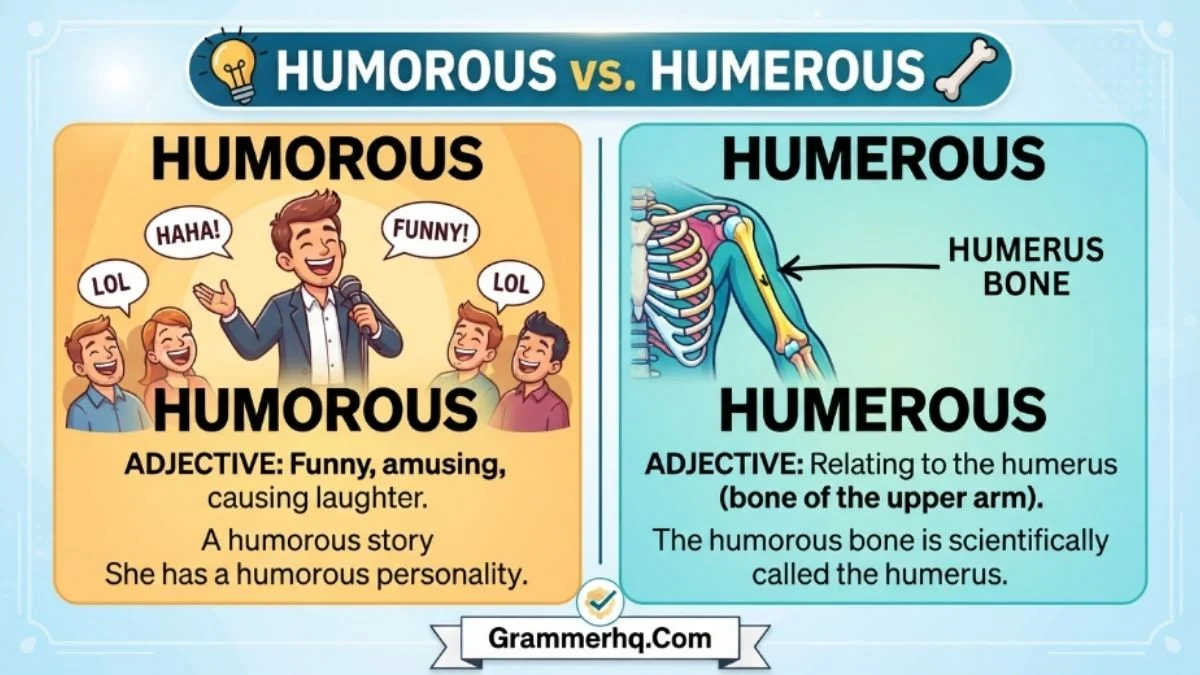
Humorous vs. Humerous is a common spelling confusion that can make even confident English writers stop and think.
If you mean something funny, amusing, or entertaining, the correct word is humorous. The spelling humerous is not the standard modern form, while humerus is an entirely different word for the long bone in your upper arm.
The confusion is understandable because humorous and humerus sound alike, and British English adds another twist with humour instead of humor.
So, which spelling should you actually use? In this guide, we’ll clearly explain the meanings, pronunciation, origins, British and American usage, common mistakes, and easy memory tricks so you can confidently choose the right word every time you write or speak.
Quick Answer
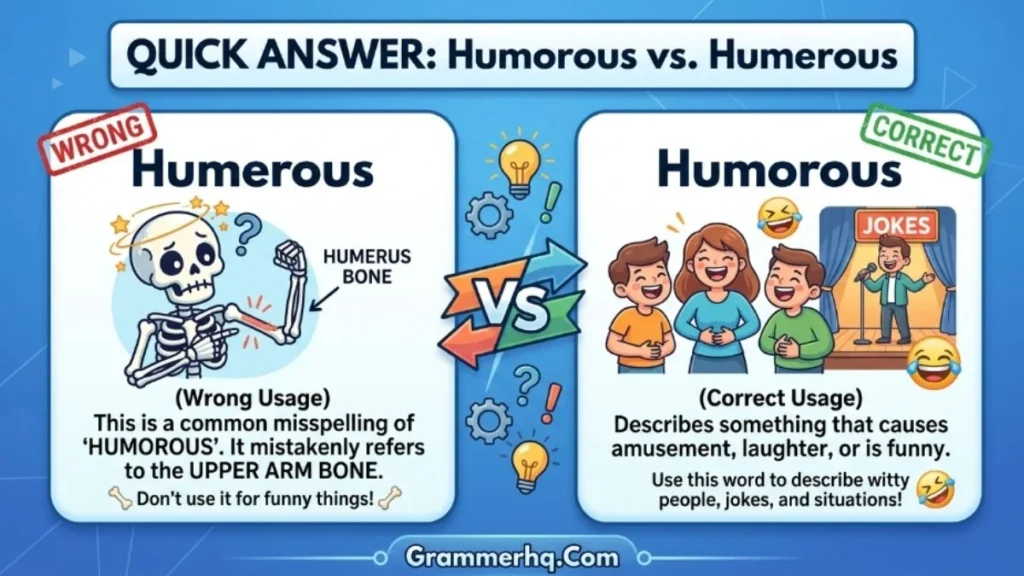
Humorous is the correct spelling when you mean funny, amusing, or making people laugh.
Humerus is the correct spelling for the upper-arm bone.
Humerous is not the standard spelling of either word.
| Word | Meaning | Correct? |
|---|---|---|
| humorous | Funny or amusing | ✅ Yes |
| humerous | Common misspelling | ❌ No |
| humerus | Upper-arm bone | ✅ Yes |
| humeral | Relating to the humerus | ✅ Yes |
So, if you want to describe a funny story, write:
The movie was humorous.
Not:
The movie was humerous.
What Does “Humorous” Mean?
Humorous is an adjective meaning funny, amusing, or likely to make people laugh. It can describe a person, story, comment, book, movie, situation, or style of writing.
Cambridge defines humorous as something that is funny or makes you laugh, while Merriam-Webster also uses it for something characterized by humor. (Cambridge Dictionary)
Pronunciation
The word humorous is commonly pronounced with three syllables. Cambridge gives the pronunciation as /ˈhjuː.mə.rəs/ in both UK and US English. (Cambridge Dictionary)
humorous (/ˈhjuː.mə.rəs/)
Examples of “Humorous”
- She wrote a humorous article about college life.
- His humorous comments made everyone laugh.
- The teacher used a humorous example to explain the lesson.
- It is a serious film with a few humorous moments.
Synonyms
Depending on the context, synonyms for humorous include:
- funny
- amusing
- comical
- comic
- entertaining
- witty
- playful
- hilarious
Antonyms
Common opposites include:
- serious
- humorless
- solemn
- unamusing
- dull
Is “Humerous” a Word? Here’s the Clear Answer
No. “Humerous” is not the standard English spelling you should use.
If you mean funny or amusing, the correct word is humorous.
If you mean the upper-arm bone, the correct word is humerus.
This is important because humerous can look like a reasonable combination of the two words. It resembles humorous while also looking connected to humerus. But standard English does not use humerous as the normal adjective for either meaning.
For example:
❌ The comedian was humerous.
✅ The comedian was humorous.
And:
❌ The doctor examined the humerous bone.
✅ The doctor examined the humerus.
The adjective related to the humerus is humeral, not humerous. Merriam-Webster defines humeral as relating to or being situated in the region of the humerus or shoulder. (Merriam-Webster)
Why Do People Confuse Humorous and Humerous?
There are several reasons these spellings are easy to mix up.
1. They Sound the Same
This is the biggest trap.
Humorous and humerus are homophones in standard dictionary listings. Merriam-Webster specifically lists humerus as a homophone of humorous. (Merriam-Webster)
That means you can hear the correct pronunciation without knowing which spelling belongs to which meaning.
For example:
The comedian was humorous.
versus:
The doctor examined his humerus.
The context tells you which word is intended.
2. “Humerus” Is a Real Word
Because humerus is a genuine anatomical term, people sometimes accidentally create humerous by blending its spelling with humorous.
The humerus is the long bone that extends from the shoulder to the elbow. (Merriam-Webster)
3. The Spelling Looks Almost Identical
Compare:
humorous
humerous
Only one vowel changes position.
That tiny difference is easy to overlook when typing quickly.
4. British “Humour” Adds More Confusion
British English commonly uses humour, while American English uses humor. (Merriam-Webster)
That makes some writers assume that the adjective must be:
humourous
But standard English uses:
humorous
in both British and American English.
Humerus vs. Humorous: The Bone vs. the Funny Word
These two words have completely different meanings.
Humerus
Humerus is a noun referring to the long bone of the upper arm, extending from the shoulder to the elbow. Its plural is humeri. (Merriam-Webster)
Example:
The X-ray showed a fracture in his humerus.
Humorous
Humorous is an adjective meaning funny or amusing. (Merriam-Webster)
Example:
She gave a humorous speech at the event.
Humeral
The adjective connected with the humerus is humeral.
Example:
The patient suffered a humeral fracture.
Merriam-Webster defines humeral as relating to the humerus or shoulder region. (Merriam-Webster)
The Word-Family Difference
| Word | Part of Speech | Meaning | Family |
|---|---|---|---|
| humorous | Adjective | Funny or amusing | humor/humour |
| humor | Noun/verb | Comedy, amusement; to indulge | humor family |
| humour | Noun/verb | British spelling of humor | humor family |
| humerus | Noun | Upper-arm bone | Anatomy |
| humeri | Noun, plural | More than one humerus | Anatomy |
| humeral | Adjective | Relating to the humerus | Anatomy |
| humerous | — | Nonstandard/misspelled form | Neither |
This is why humerous does not fit neatly into either word family.
Where Does “Humorous” Come From?
The history of humorous is surprisingly interesting.
The word is connected to humor, which ultimately comes from Latin humor, meaning moisture or fluid.
In medieval medicine, people believed that the human body contained four important fluids, or humors, that influenced health and temperament. (Merriam-Webster)
These four humors were traditionally:
- blood
- phlegm
- yellow bile
- black bile
Over time, humor developed meanings connected with a person’s mood, temperament, and eventually the ability to recognize or create something funny.
From this history came the modern sense of humorous: something that is funny or amusing.
Merriam-Webster records the first known use of humorous in the 15th century. (Merriam-Webster)
Is “Humourous” Correct in British English?
No. This is an important exception to the usual British-American spelling rule.
British English normally spells the noun as:
humour
American English normally spells it:
humor
But the adjective is:
humorous
in both varieties.
So:
| Meaning | American English | British English |
|---|---|---|
| Noun | humor | humour |
| Adjective | humorous | humorous |
| Adverb | humorously | humorously |
| Opposite | humorless | humourless |
The tempting spelling humourous has appeared historically and can still be encountered occasionally, but it is not the standard spelling recommended for modern formal English.
Historical evidence shows that humourous was used in older English, but modern usage treats it as nonstandard or an error. (Wiktionary)
So don’t assume:
humour + ous = humourous
Instead, remember:
humour → humorous
This is one of those English spelling patterns that simply has to be learned.
How to Remember the Correct Spelling
Here are two easy memory tricks.
1: Think “Humor + OUS”
When you mean funny, remember:
humor + ous = humorous
Even when writing British English, where the noun is humour, the adjective remains humorous.
2: Save “-us” for the Bone
Think:
humerUS = anatomy
The word humerus ends in -us because it is the anatomical noun.
Then remember:
humorOUS = funny
So:
Funny → humorous
Bone → humerus
Related to the bone → humeral
This three-word distinction solves most of the confusion.
Quick Reference: Humorous, Humerous, and Humerus
| Word | Part of Speech | Meaning | Example | Correct? |
|---|---|---|---|---|
| humorous | Adjective | Funny or amusing | It was a humorous story. | ✅ |
| humerous | — | Nonstandard spelling | — | ❌ |
| humerus | Noun | Upper-arm bone | He fractured his humerus. | ✅ |
| humeri | Noun, plural | More than one humerus | The skeletons had intact humeri. | ✅ |
| humeral | Adjective | Relating to the humerus | The scan showed a humeral injury. | ✅ |
| humor | Noun/verb | Funny quality; to indulge | I like his sense of humor. | ✅ |
| humour | Noun/verb | British form of humor | She has a great sense of humour. | ✅ |
Common Mistakes to Avoid
Mistake 1
❌ The comedian was humerous.
✅ The comedian was humorous.
Mistake 2
❌ The X-ray showed damage to his humerous.
✅ The X-ray showed damage to his humerus.
Mistake 3
❌ She wrote a humourous story.
✅ She wrote a humorous story.
Mistake 4
❌ The doctor described it as a humerous fracture.
✅ The doctor described it as a humeral fracture.
Mistake 5
❌ British English always uses humourous.
✅ British English uses humour as the noun, but humorous as the adjective.
Mistake 6
❌ Humerous is another adjective for the humerus.
✅ Humeral is the standard adjective relating to the humerus. (Merriam-Webster)
Quick Self-Check: Can You Choose the Right Word?
Test yourself before looking at the answers.
1. Which word means “funny”?
A. humerus
B. humorous
C. humerous
2. Which word refers to the upper-arm bone?
A. humorous
B. humerous
C. humerus
3. Which sentence is correct?
A. She told a humerous joke.
B. She told a humorous joke.
C. She told a humerus joke.
4. Which adjective means “relating to the humerus”?
A. humeral
B. humerous
C. humorous
5. Which spelling is standard in both British and American English?
A. humourous
B. humorous
C. humerous
Answer Key
- B — humorous
- C — humerus
- B — humorous
- A — humeral
- B — humorous
If you got all five right, you have the distinction down.
FAQs
1: Is “humerous” a real word?
Humerous is not the standard spelling you should use in modern English. Use humorous for “funny” and humerus for the upper-arm bone.
2: What is the difference between humorous and humerus?
Humorous is an adjective meaning funny or amusing. Humerus is a noun referring to the long bone between the shoulder and elbow. They are pronounced alike in standard English but have different spellings and meanings. (Merriam-Webster)
3: What is the adjective form of humerus?
The standard adjective is humeral, meaning relating to the humerus or shoulder region. (Merriam-Webster)
4: Is “humourous” correct in the UK?
No, not in standard modern British English. British English uses humour as the noun, but the adjective is humorous. The spelling humourous has historical usage, but it is now considered nonstandard. (Wiktionary)
5: How do you pronounce humorous?
Humorous is commonly pronounced with three syllables, with the stress on the first syllable. Cambridge gives /ˈhjuː.mə.rəs/ for both UK and US English. (Cambridge Dictionary)
6: Is humorous the same in British and American English?
Yes. The noun changes from humor in American English to humour in British English, but the standard adjective remains humorous in both varieties. (Merriam-Webster)
Key Takeaways
- Humorous = funny, amusing, or entertaining. ✅
- Humerus = the long bone in the upper arm. ✅
- Humeral = relating to the humerus. ✅
- Humerous = not the standard spelling. ❌
- Humourous is an old/nonstandard spelling, not the standard British form.
- Humorous and humerus are homophones, which explains much of the confusion. (Merriam-Webster)
The easiest rule to remember:
Funny = humorous
Bone = humerus
Related to the bone = humeral
Read More Blogs:
- Deselect vs Unselect: Which One Is Actually Correct?
- Broach or Brooch? Meaning, Difference, and Correct Usage