Many people wonder whether wack or whack is the correct spelling because both words appear online and sound almost the same.
The short answer is that whack is the standard English spelling found in dictionaries, while wack is an informal slang spelling often used to describe something as bad, boring, or low quality.
In this guide, you’ll learn the difference between these words, their pronunciation, origin, common mistakes, real-life examples, and when each spelling is appropriate. By the end, you’ll know exactly which word to use in every situation.
Wack or Whack – Quick Answer
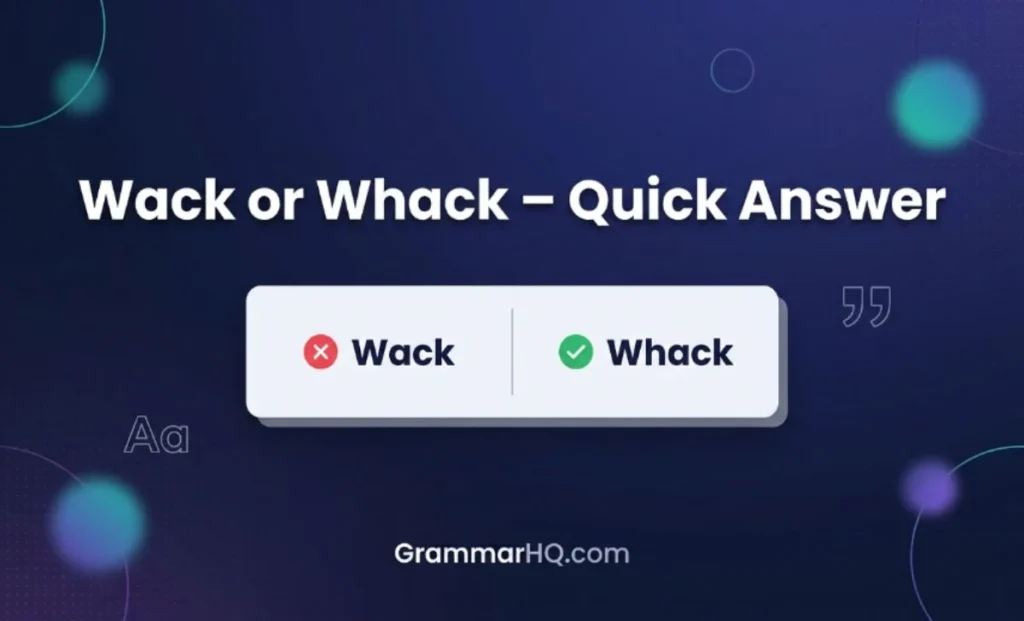
The correct answer depends on what you mean.
- Whack is the standard English word recognized by major dictionaries. It usually means to hit something with force. In informal English, it can also describe something as poor, strange, or disappointing.
- Wack is an informal slang spelling. It became popular in hip-hop culture and casual online conversations to describe something as bad, uncool, weak, or low quality. It is not the preferred spelling in formal writing.
| Word | Meaning | Standard English | Best Used In |
|---|---|---|---|
| Whack | To hit; also poor or strange (informal) | ✅ Yes | Formal and informal writing |
| Wack | Slang for bad, weak, or uncool | ❌ No | Casual conversations, music, and social media |
Examples
✅ The player whacked the ball over the fence.
✅ That movie was really whack. (Informal slang)
✅ The old computer is whack compared to modern laptops. (Casual English)
❌ The teacher said my essay was wack. (Avoid in formal writing.)
Quick Tip
If you’re writing an email, report, article, school assignment, or business document, choose whack whenever possible. Use wack only when quoting slang or writing in a casual tone.
Pronunciation of Wack or Whack
Both wack and whack are pronounced exactly the same.
Pronunciation: /wæk/ (rhymes with “back,” “track,” and “black”)
Because they sound identical, many people assume they are simply two accepted spellings. This is one of the biggest reasons for the confusion.
How It Sounds
| Word | Pronunciation | Sounds Like |
|---|---|---|
| Whack | /wæk/ | Back, Track, Black |
| Wack | /wæk/ | Back, Track, Black |
The silent “h” in whack does not change the pronunciation. English has many words where extra letters are not strongly pronounced, so the spoken forms remain identical.
Pronunciation Examples
- He gave the door a whack.
- That idea is whack.
- The joke sounded whack to everyone.
- The hammer made a loud whack against the nail.
When speaking, listeners usually understand the meaning from the context, not the spelling.
Why People Confuse Wack or Whack
There are several reasons why these words are mixed up.
They Sound Exactly the Same
Since wack and whack share the same pronunciation, people often spell the word the way they think it sounds.
Slang Became Popular Online
The slang spelling wack spread through hip-hop music, internet culture, text messages, and social media. Many younger speakers saw wack more often than whack, making it seem like the standard spelling.
Informal Writing Influences Everyday English
People frequently copy spellings they see on social platforms without checking a dictionary. As a result, wack appears in comments, memes, and online discussions, even though whack remains the standard dictionary spelling.
Different Meanings Overlap
Another reason for confusion is that whack has two common uses:
- It means to strike or hit.
- In informal English, it can also mean bad, ridiculous, or disappointing.
Because wack is almost always used with the second meaning, people sometimes believe both spellings are interchangeable. In reality, whack is the safer and more widely accepted choice.
Dictionary Recognition
Major dictionaries such as Merriam-Webster, Cambridge Dictionary, Collins Dictionary, and the Oxford English Dictionary recognize whack as the standard spelling. While some dictionaries mention wack as slang or a variant used in informal contexts, it is not recommended for professional writing.
Easy Trick to Remember Wack or Whack
A simple memory trick can help you choose the right spelling every time.
Remember This:
Whack begins with “Wh,” just like “Wham!”
When you imagine someone hitting something, you might also imagine the sound “Wham!” Since both words begin with “Wh,” it becomes easier to remember that whack is the standard spelling for English.
Another Easy Trick
- Whack = Dictionary word
- Wack = Slang on social media
If you’re unsure which spelling to choose, ask yourself:
“Am I writing for school, work, or publication?”
If the answer is yes, use whack.
If you’re quoting slang, writing dialogue, or posting casually online, wack may fit the tone.
Memory Table
| Situation | Correct Choice |
|---|---|
| School essay | Whack |
| Business email | Whack |
| News article | Whack |
| Social media slang | Wack or Whack (depending on intended style) |
| Formal writing | Whack |
This simple rule helps you avoid one of the most common spelling mistakes while keeping your writing clear and professional.
The Origin of Wack or Whack
Understanding the history of these words makes the spelling difference much easier to remember.
The Origin of Whack
The word whack has been part of English for centuries. It originally referred to a sharp blow or strike and later developed into both a verb (“to hit”) and a noun (“a hard hit”). Over time, speakers also began using whack informally to describe something as odd, ridiculous, or poor in quality.
Examples:
- He whacked the ball into the field.
- The plan sounds a little whack. (Informal)
Today, whack appears in major dictionaries and is accepted in both American English and British English.
The Origin of Wack
The spelling wack appeared much later. It became popular during the 1980s and 1990s, especially in hip-hop culture, street slang, and informal speech.
Instead of meaning “to hit,” wack almost always describes something that is:
- Bad
- Weak
- Boring
- Unfashionable
- Low quality
Because it grew from slang rather than standard English, wack is rarely recommended in formal writing.
Why Two Spellings Exist
The two spellings exist because language changes over time.
- Whack is the traditional dictionary spelling.
- Wack developed as a simplified slang spelling used in casual conversation.
This is a good example of language evolution, where informal speech creates new spelling patterns without replacing the original standard word.
| Word | Origin | Modern Usage |
|---|---|---|
| Whack | Traditional English | Standard English, formal and informal |
| Wack | Modern slang | Informal speech, music, internet culture |
British English vs American English Spelling
Unlike words such as colour/color or organise/organize, wack and whack are not an American-versus-British spelling difference.
Both varieties of English recognize whack as the standard spelling.
Comparison Table
| Feature | American English | British English |
|---|---|---|
| Standard spelling | Whack | Whack |
| Informal slang | Wack (sometimes) | Wack (sometimes) |
| Formal writing | Whack | Whack |
| Dictionaries | Whack | Whack |
Examples
| Sentence | Correct |
|---|---|
| He whacked the door with his fist. | ✅ |
| That excuse sounds whack. | ✅ Informal |
| The newspaper described the policy as wack. | ❌ Better: whack |
Key Point
Whether you write for readers in the United States, Canada, Australia, New Zealand, or the United Kingdom, whack remains the safer and more professional choice.
Which Spelling Should You Use?
The best spelling depends on who will read your writing.
Use Whack When:
- Writing school assignments
- Creating blog posts
- Publishing news articles
- Sending business emails
- Writing academic papers
- Preparing professional documents
Because whack is recognized by standard dictionaries, it works in almost every situation.
Use Wack When:
You may use wack only if you’re:
- Quoting slang
- Writing realistic dialogue
- Posting casually on social media
- Referring to hip-hop lyrics or internet culture
Even then, many professional writers still prefer whack for consistency.
Quick Decision Guide
| Audience | Best Choice |
|---|---|
| Students | Whack |
| Teachers | Whack |
| Journalists | Whack |
| Businesses | Whack |
| Casual texting | Wack or Whack |
| Social media | Usually Wack |
Professional Advice: If you are ever unsure, choose whack. It is the standard spelling understood by everyone.
Common Mistakes with Wack or Whack
These mistakes appear frequently in everyday writing.
1: Using wack in Formal Writing
❌ The report looks wack.
✅ The report looks whack. (if using the informal meaning “poor”)
2: Thinking Both Spellings Are Always Equal
❌ Both spellings are correct in every situation.
✅ Whack is the standard spelling. Wack is mainly slang.
3: Using wack to Mean “Hit”
❌ He wacked the ball.
✅ He whacked the ball.
Only whack carries the meaning to strike or hit.
4: Assuming It Is a British vs American Difference
❌ Americans write wack while British people write whack.
✅ Both American and British English use whack as the standard spelling.
5: Ignoring Context
The correct spelling depends on the situation.
| Context | Better Choice |
|---|---|
| Business report | Whack |
| School assignment | Whack |
| News article | Whack |
| Text message | Wack or Whack |
| Social media meme | Usually Wack |
Using the right spelling helps your writing look more accurate, professional, and trustworthy.
Wack or Whack in Everyday Examples
Seeing these words in real situations makes the difference much clearer.
In Emails
✅ The proposal looks a little whack. Let’s revise it before sending it.
In News Writing
✅ The coach dismissed the rumor as whack and focused on the team’s performance.
Professional publications almost always prefer whack because it follows standard English.
On Social Media
That new update is wack.
This casual slang spelling is common on platforms where users write informally.
In Everyday Conversation
- That movie was whack.
- The comedian’s jokes were whack.
- Don’t whack the table so hard.
Context tells you whether whack means to hit or poor quality.
In Formal Writing
Formal documents should avoid slang whenever possible.
Instead of writing:
❌ The presentation was whack.
Consider:
✅ The presentation was disappointing.
or
✅ The presentation was poorly prepared.
Choosing precise vocabulary makes formal writing stronger and more professional.
Wack or Whack – Google Trends & Usage Data
Search interest in wack or whack remains steady because English learners, students, writers, and native speakers often want to know which spelling is correct.
Where Is It Most Common?
Interest is strongest in English-speaking countries, including:
- United States
- Canada
- United Kingdom
- Australia
- New Zealand
Most searches come from people comparing the spellings rather than looking up the meaning of a single word.
Common Search Queries
People frequently search for:
- wack or whack
- wack vs whack
- is wack a real word
- what does whack mean
- whack meaning
- wack meaning
- which spelling is correct
Usage Pattern
- Whack appears much more often in dictionaries, books, newspapers, educational websites, and professional writing.
- Wack appears mainly in song lyrics, online forums, text messages, gaming communities, and social media.
For anyone writing articles, reports, emails, or academic content, whack remains the recommended spelling because it is clearer, more widely recognized, and accepted across standard English.
Wack or Whack Comparison Table
| Feature | Whack | Wack |
|---|---|---|
| Standard English spelling | ✅ Yes | ❌ No (informal slang) |
| Found in major dictionaries | ✅ Yes | ⚠️ Sometimes listed as slang or variant |
| Means “to hit” | ✅ Yes | ❌ No |
| Means “bad” or “poor quality” | ✅ Informal meaning | ✅ Common slang meaning |
| Suitable for formal writing | ✅ Yes | ❌ No |
| Suitable for business emails | ✅ Yes | ❌ Avoid |
| Suitable for school assignments | ✅ Yes | ❌ Avoid |
| Common on social media | ✅ Sometimes | ✅ Very common |
| Best choice when unsure | ✅ Whack | ❌ Wack |
FAQ,s
1. Is it wack or whack?
Whack is the standard English spelling. Wack is an informal slang spelling mainly used in casual conversations, music, and social media.
2. Is wack a real word?
Yes. Wack is a real slang word used to describe something as bad, boring, weak, or uncool. However, it is not considered the standard spelling in formal English.
3. What does whack mean?
Whack has two common meanings:
- To hit something with force.
- Informally, to describe something as poor, strange, or disappointing.
The intended meaning depends on the context.
4. What does wack mean in slang?
In slang, wack means something that is:
- Bad
- Low quality
- Weak
- Uncool
- Disappointing
Example:
That game update was wack.
5. Why do people spell whack as wack?
People often use wack because both words are pronounced the same. The slang spelling also became popular through hip-hop culture, online communities, and social media.
6. Can I use wack in professional writing?
No. For business emails, academic papers, articles, and formal documents, whack is the better and more professional choice.
7. Is wack an American spelling?
No. It is not an official American English spelling. It is simply an informal slang variant that appears mostly in casual writing.
8. Do British and American English use different spellings?
No. Both British English and American English use whack as the standard spelling. This is not a regional spelling difference like colour and color.
9. Which spelling should English learners use?
English learners should use whack because it is recognized by dictionaries and accepted in formal and informal standard English.
10. How can I remember the correct spelling?
Think of “Wham!” before a hard hit. Both Wham and Whack begin with “Wh,” making it easier to remember the standard spelling.
Conclusion
Choosing between wack or whack is easier once you understand their meanings and usage. Whack is the standard English spelling recognized by major dictionaries.
It can mean to hit something or, in informal English, something of poor quality or unusual. Wack, on the other hand, is a slang spelling that became popular through music, internet culture, and casual conversation.
While it works in informal settings, it is not the best choice for professional or academic writing. If you are writing for school, work, or publication, use whack with confidence.
Reserve wack only for slang, quoted speech, or casual social media posts where an informal tone is appropriate.
Read More Bloogs:
- Already or All Ready: What’s the Difference and Which Is Correct?
- Canvas or Canvass: A Simple Guide to Correct English Usage