Brake and break sound exactly the same, but they have completely different meanings. Use brake when talking about slowing down or stopping a vehicle. Use break when you mean to separate, damage, interrupt, or take a pause.
Because they are homophones, many writers choose the wrong spelling, especially in everyday writing. This guide explains the difference in simple language, shows real examples, shares an easy memory trick, and answers the most common questions.
By the end, you’ll know exactly when to use brake and when to use break with confidence in emails, schoolwork, business writing, and daily conversations.
Brake or Break – Quick Answer
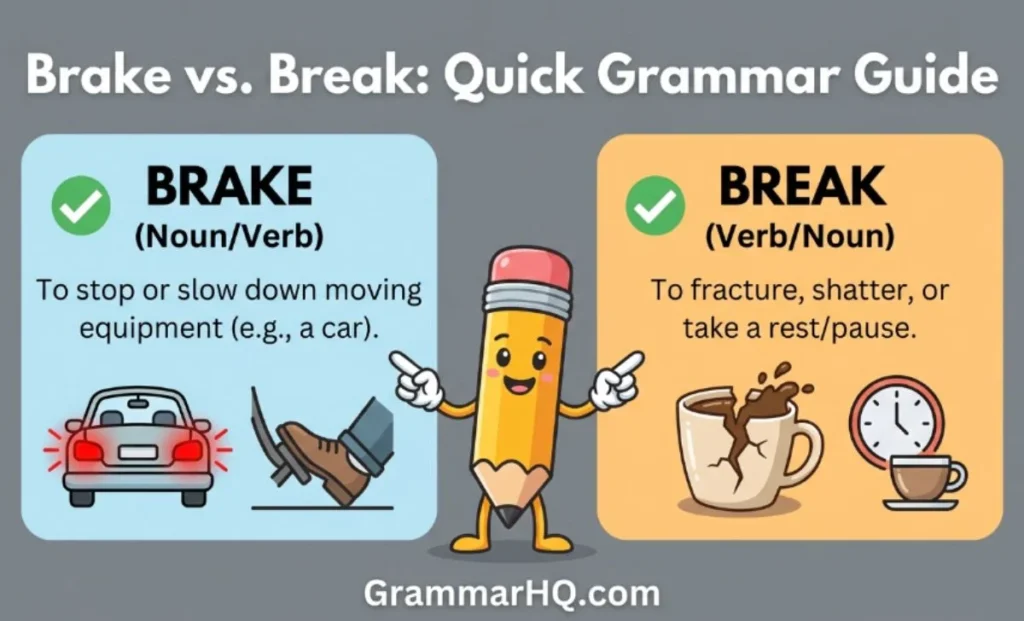
Although brake and break are pronounced the same, they are never interchangeable because they describe different actions.
- Brake relates to slowing down or stopping movement, especially in vehicles.
- Break means to separate, damage, interrupt, pause, or stop something temporarily.
Quick Examples
✅ Brake: Press the brake before the traffic light.
✅ Break: Be careful not to break the glass.
The easiest way to remember the difference is to think about the situation. If it involves driving, stopping a bicycle, or controlling speed, choose brake. If something is damaged, interrupted, divided, or paused, choose break.
Brake vs Break at a Glance
| Word | Meaning | Common Context | Example |
|---|---|---|---|
| Brake | To slow or stop movement | Driving, cycling, vehicles | She pressed the brake to avoid the deer. |
| Break | To separate, damage, interrupt, or pause | Everyday actions, work, objects, conversations | Let’s take a break after the meeting. |
Pronunciation of Brake or Break
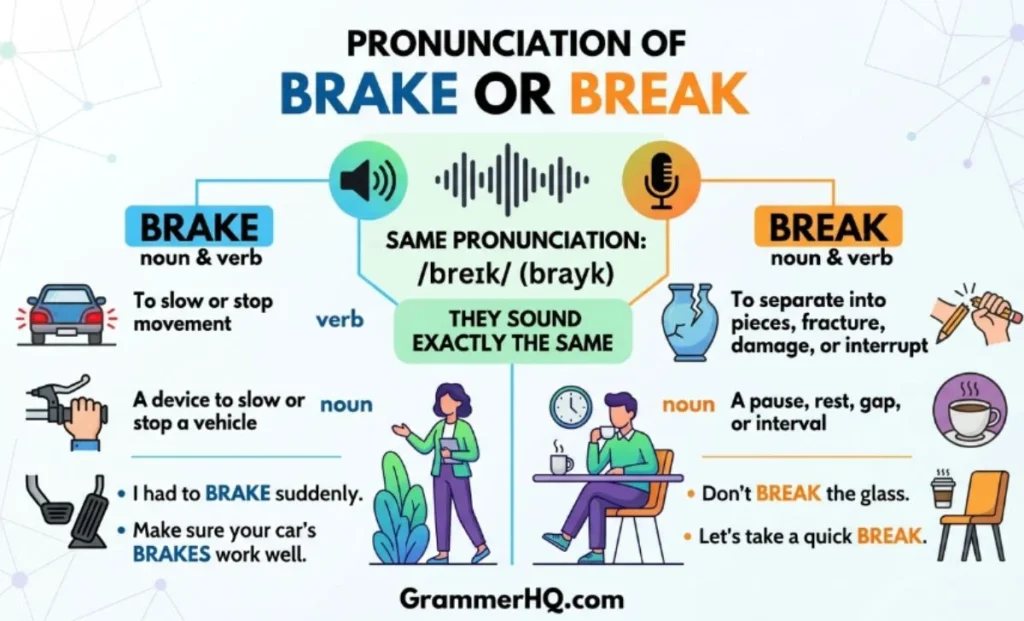
Both brake and break are pronounced exactly the same:
IPA: /breɪk/
This makes them homophones—words that share the same pronunciation but have different spellings and meanings.
How They Sound
- Brake → /breɪk/
- Break → /breɪk/
When someone says either word aloud, you cannot tell which spelling they mean without hearing the rest of the sentence.
For example:
- “Please brake before the curve.”
- “Please don’t break the vase.”
The pronunciation is identical, but the surrounding context immediately reveals the intended meaning.
This is why spell check cannot always catch mistakes such as:
❌ Please break slowly.
Although break is spelled correctly, the sentence actually needs brake because it refers to slowing a vehicle.
Understanding the context is much more important than relying on pronunciation.
Why People Confuse Brake or Break
Many English learners—and even native speakers—mix up brake and break because several factors make them easy to confuse.
They Sound Exactly the Same
The biggest reason is pronunciation.
Since both words are pronounced /breɪk/, people often write whichever spelling comes to mind first.
For example:
“Don’t forget to break before the stop sign.”
The sentence sounds correct when spoken, but the spelling is wrong because the action involves stopping a car.
Their Meanings Are Completely Different
The confusion becomes greater because both words describe an action.
Brake means controlling movement by slowing or stopping it.
Examples:
- Apply the brakes carefully.
- The cyclist used the front brake.
Break means separating, damaging, interrupting, ending, or taking time away from something.
Examples:
- Don’t break your phone.
- We need a short break before lunch.
- She accidentally broke the plate.
Since both words function as verbs—and break is also commonly used as a noun—writers often substitute one for the other without noticing.
Context Changes Everything
The easiest way to choose the correct spelling is to ask yourself one question:
Am I talking about driving or stopping a vehicle?
If yes, use brake.
If not, you probably need break.
Compare these sentences:
- The driver hit the brakes immediately.
- The child broke the toy.
- We took a coffee break.
- The train’s braking system worked perfectly.
- The company decided to break the contract.
Notice how the surrounding words make the correct choice obvious.
ESL Learners Often Translate Literally
People learning English sometimes translate directly from their first language.
Many languages use a single word for “stop” or “damage,” making it difficult to distinguish between brake and break.
The safest approach is to connect brake only with vehicles, driving, bicycles, motorcycles, trains, and anything related to controlling speed. Reserve break for every other meaning, such as damaging objects, ending activities, pausing work, or separating something into parts.
Easy Trick to Remember Brake or Break
The simplest memory trick is to focus on the letter A in brake.
Think:
A = Automobile.
If you’re talking about a car, bicycle, motorcycle, bus, or any vehicle, the correct spelling is almost always brake.
Examples:
- Press the brake pedal.
- The brake pads need replacing.
- The driver applied the brakes safely.
Now think about break.
It contains the word “break”, which people commonly associate with breaking something or taking a break.
Examples:
- Don’t break the mirror.
- Let’s break for lunch.
- She broke the record.
Visual Memory Technique
Imagine two pictures:
🛑 Brake → A car stopping at a red traffic light.
💥 Break → A glass falling and shattering into pieces.
Whenever you hesitate, picture the scene first. If you see a vehicle slowing down, choose brake. If you see something damaged, interrupted, or paused, choose break.
This simple mental image helps many writers choose the correct spelling instantly without memorizing grammar rules.
The Origin of Brake and Break
Although brake and break look similar today, they developed from different historical roots. Their identical pronunciation is the result of how English pronunciation changed over time—not because the words are related.
The Origin of Brake
The word brake comes from Middle English brake and was originally used for a tool or device that crushed, pressed, or restrained something. As transportation evolved, the meaning shifted to a mechanism that slows or stops a moving vehicle.
Today, brake is closely associated with transportation and road safety.
Common uses include:
- Brake pedal
- Brake pads
- Brake fluid
- Disc brake
- Drum brake
- Emergency brake
- Parking brake
- Braking system
It can be both a noun and a verb.
Noun: The brake needs repair.
Verb: Always brake gently on wet roads.
The Origin of Break
The word break comes from Old English brecan, meaning to split, shatter, divide, or destroy. Over centuries, its meaning expanded beyond physical damage to include pauses, interruptions, endings, and even achievements.
Today, break is one of the most versatile words in English.
It can describe:
- Breaking an object
- Taking a break
- Breaking the rules
- Breaking the silence
- Breaking a promise
- Breaking a record
- Breaking news
Like brake, it functions as both a noun and a verb.
Noun: We need a short break.
Verb: Don’t break the window.
Why They Became Confusing
The confusion exists because modern English pronounces both words as /breɪk/. Even though they have different histories and meanings, they sound identical in conversation.
As a result, many people accidentally write:
❌ Please break slowly.
Instead, the correct sentence is:
✅ Please brake slowly.
Remember this simple rule:
- Brake controls movement.
- Break changes, damages, interrupts, or separates something.
British English vs American English Usage
Unlike many spelling pairs such as colour/color or centre/center, brake and break are spelled exactly the same in both British and American English.
The difference is meaning, not regional spelling.
Whether you’re writing in the United States, the United Kingdom, Canada, Australia, New Zealand, or any other English-speaking country, the correct spellings remain unchanged.
Does the Meaning Change?
No.
Both varieties of English use the words in exactly the same way.
- Brake always relates to slowing or stopping movement.
- Break always refers to separating, damaging, interrupting, or pausing.
The vocabulary, grammar, and pronunciation are consistent across major English dialects.
British vs American Usage Comparison
| Feature | British English | American English |
|---|---|---|
| Spelling of brake | Brake | Brake |
| Spelling of break | Break | Break |
| Pronunciation | /breɪk/ | /breɪk/ |
| Meaning of brake | Stop or slow a vehicle | Stop or slow a vehicle |
| Meaning of break | Damage, divide, interrupt, or pause | Damage, divide, interrupt, or pause |
The only thing that changes is the context of the sentence—not the spelling.
Which Word Should You Use?
The correct choice depends entirely on what you want to say, not on where your audience lives.
If your sentence involves driving, cycling, or controlling speed, use brake.
If it involves breaking something, pausing, ending, interrupting, or dividing, use break.
American English
Use the standard spellings:
- Apply the brakes before turning.
- Let’s take a break after the presentation.
British English
The same spellings apply.
Examples:
- The cyclist checked the brakes before the race.
- We stopped for a tea break.
Academic Writing
Accuracy is essential in academic writing because brake and break have completely different meanings.
Correct:
- The study examined the effectiveness of modern braking systems.
- Students were given a short break between exams.
Business Writing
In professional communication, using the wrong word can confuse readers.
Correct:
- Please schedule a short break during the workshop.
- The delivery truck required new brake pads.
Everyday Communication
Ask yourself one quick question:
Am I talking about stopping a vehicle?
- Yes → Brake
- No → Break
This simple habit helps you choose the correct word almost every time.
Common Mistakes with Brake or Break
Because these words sound identical, writers often choose the wrong spelling even when the sentence seems correct. The following examples show the mistakes people make most often.
| Incorrect | Correct | Why? |
|---|---|---|
| Please break before the traffic light. | Please brake before the traffic light. | The sentence is about slowing a vehicle. |
| My bicycle breaks are worn out. | My bicycle brakes are worn out. | The noun is brakes, not breaks. |
| The mechanic replaced the break pads. | The mechanic replaced the brake pads. | Vehicle parts use brake. |
| Let’s take a brake after lunch. | Let’s take a break after lunch. | A pause is a break. |
| Be careful not to brake the glass. | Be careful not to break the glass. | Damaging an object uses break. |
| She breaked the plate. | She broke the plate. | The past tense of break is broke. |
Tips to Avoid These Errors
- Associate brake with vehicles, traffic, and speed control.
- Associate break with objects, pauses, rules, records, and interruptions.
- Read the sentence once more before publishing or sending it. Context usually reveals the correct spelling immediately.
Google Trends & Usage Data
People search “brake or break” because the two words sound identical but have different meanings. This confusion appears frequently in search engines, especially among English learners, students, and writers who want to avoid spelling mistakes.
Search interest often increases during the school year, writing assignments, and language-learning activities. Users typically want a quick answer first, followed by examples that show the correct word in context.
English-speaking countries such as the United States, the United Kingdom, Canada, Australia, and India commonly generate searches for this word pair because both words are used regularly in everyday communication.
Most searches fall into these categories:
- Which word is correct?
- What’s the difference between brake and break?
- How do you use each word in a sentence?
- Why do they sound the same?
- How can I remember the correct spelling?
Although break appears more often in general English because it has many meanings, brake is essential whenever the topic involves vehicles, cycling, transportation, or road safety.
Brake vs Break Comparison Table
| Feature | Brake | Break |
|---|---|---|
| Meaning | To slow or stop movement | To separate, damage, interrupt, or pause |
| Part of Speech | Noun, Verb | Noun, Verb |
| Pronunciation | /breɪk/ | /breɪk/ |
| Homophone | Yes | Yes |
| Main Context | Driving, cycling, transportation | Everyday life, work, school, communication |
| Common Collocations | Brake pedal, brake pads, brake fluid, parking brake, apply the brakes | Break a record, break the rules, break the news, coffee break, lunch break |
| Example | The driver pressed the brake. | She didn’t want to break the vase. |
| Memory Tip | Think A = Automobile | Think Break = Broken or Pause |
FAQs
Is it brake or break when stopping a car?
Use brake because it refers to slowing down or stopping a vehicle.
Why do brake and break sound the same?
They are homophones, meaning they share the same pronunciation but have different spellings and meanings.
Can brake be both a noun and a verb?
Yes. It can describe the stopping device on a vehicle or the action of slowing down.
Can break be both a noun and a verb?
Yes. It can mean a pause, damage, separation, or the action of breaking something.
Is break pedal correct?
No. The correct term is brake pedal because it is part of a vehicle’s braking system.
Which word is more common in everyday English?
Break is generally more common because it has many everyday meanings, such as taking a break, breaking rules, or breaking objects.
Are the spellings different in British and American English?
No. Both brake and break are spelled the same in British and American English.
What is the easiest way to remember the difference?
Remember A = Automobile. If you’re talking about a vehicle, use brake. For everything related to damage, interruption, or a pause, use break.
Conclusion
Choosing between brake and break becomes simple once you understand their meanings. Brake is always connected with slowing or stopping a vehicle, while break refers to damaging, separating, interrupting, or taking a pause.
Even though both words are pronounced the same, their meanings are completely different, so context is the key to selecting the correct spelling. A helpful memory trick is to remember A = Automobile, making brake easy to associate with driving.
For all other situations involving broken objects, pauses, or interruptions, use break. With regular practice and attention to context, you’ll use both words confidently and avoid one of the most common spelling mistakes in English.
Read More Bloogs:
- “Brought vs. Bought, Learn the Difference Quickly” (Grammarly)
- Hoping or Hopeing ,Which Spelling Is Correct?GrammerHQ