Bougie or boujee? If you have seen both spellings online, you may wonder whether one is correct and the other is a mistake.
The short answer is that both are used, but bougie is the more established and common spelling, while boujee is a recognized informal variant.
The two words usually refer to someone or something associated with a fancy, luxurious, or status-conscious lifestyle. However, their tone and cultural associations can differ depending on the context.
Understanding that difference can help you choose the spelling that sounds natural rather than simply assuming that one is “right” and the other is “wrong.” (Dictionary.com)
Quick Answer
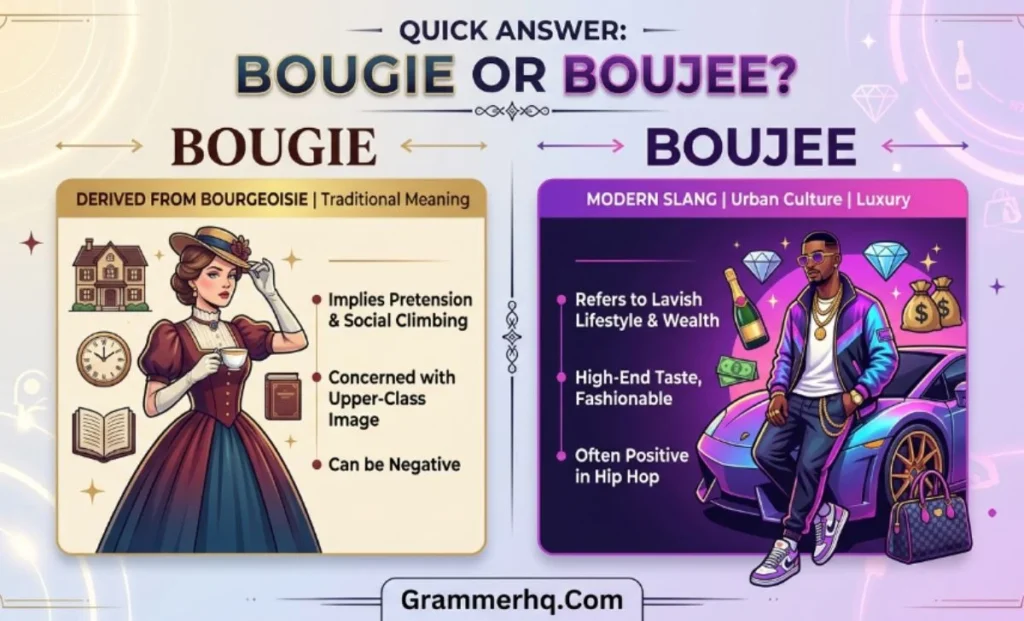
Bougie is the safest default spelling when you are using the modern slang word in general writing.
Boujee is also a real spelling and is commonly used as an informal, stylized variant. It became especially recognizable through hip-hop and popular culture, including Migos’ 2016 song “Bad and Boujee.”
Dictionary.com lists boujee as a variation of bougie, so calling it simply a misspelling is inaccurate. (Dictionary.com)
| Word | Typical use | Status |
|---|---|---|
| bougie | General modern slang | Main/common spelling |
| boujee | Casual, playful, stylized slang | Recognized variant |
| bourgie | Older/alternate form | Less common |
| boogie | Dancing/music or other meanings | Different word |
The important point is that bougie and boujee often overlap in meaning. There is no universal grammar rule saying that one must always mean “old money” and the other must always mean “new money.”
Are Bougie and Boujee the Same Word?
For most everyday situations, bougie and boujee refer to essentially the same idea: something fancy, luxurious, expensive, upscale, or associated with a particular kind of affluent lifestyle.
For example:
That new restaurant is so bougie.
You could also see:
That new restaurant is so boujee.
Both sentences can suggest that the restaurant is stylish, expensive, or more luxurious than an ordinary place.
The difference is often more about spelling, tone, cultural context, and personal style than a fixed difference in definition.
Some explanations distinguish bougie and boujee by saying that bougie describes someone pretending to be upper-class while boujee describes someone who has achieved wealth but remains connected to their roots.
That distinction can be useful for understanding certain cultural uses, but it should not be treated as a universal rule. Dictionary sources recognize substantial overlap between the two forms. (Dictionary.com)
What Does Bougie Mean?
Bougie is informal slang used to describe someone or something associated with luxury, expensive tastes, comfort, sophistication, or an aspirational lifestyle.
Depending on the speaker and context, it can be:
- complimentary
- playful
- teasing
- mildly critical
- strongly disparaging
For example:
We booked a bougie hotel for our anniversary.
Here, bougie probably means luxurious or upscale.
But:
He has become too bougie for his old neighborhood.
Here, the word may suggest that someone has become pretentious, snobbish, or overly concerned with status.
Dictionary.com notes several modern senses, including luxury and comfort, upper-middle-class aspirations, and flaunting newly acquired wealth.
It also notes that the word can carry a negative or offensive tone depending on context. (Dictionary.com)
Bougie as a compliment
Someone might jokingly say:
This coffee shop is expensive, but it’s wonderfully bougie.
The speaker may actually like the expensive atmosphere.
Bougie as criticism
Someone could also say:
She won’t eat anywhere that doesn’t have a five-star rating. She’s getting bougie.
Here, the word carries a critical tone.
Bougie for things and places
The word does not have to describe a person.
You can talk about:
- a bougie restaurant
- a bougie hotel
- a bougie apartment
- a bougie coffee shop
- a bougie vacation
- a bougie brunch
- a bougie lifestyle
- bougie furniture
The exact meaning comes from context.
What Does Boujee Mean?
Boujee is an informal variant of bougie. It generally describes someone or something luxurious, stylish, expensive, or associated with wealth and an elevated lifestyle. (Dictionary.com)
The spelling has a particularly strong connection with modern slang and hip-hop culture.
For example:
She loves finding boujee cafés with designer interiors.
Or:
They planned a boujee weekend at a luxury resort.
The word can be positive, humorous, self-aware, or critical.
You might even describe yourself as boujee without intending it as an insult:
I’m not spoiled. I just have boujee taste.
So, like bougie, boujee depends heavily on tone.
Is Boujee a Misspelling of Bougie?
No, not necessarily.
This is one of the most common misconceptions about these words.
Boujee is recognized as a variation of bougie. Dictionary.com directly lists it as a variant, while its slang explanation connects the spelling with the modern development of the term. (Dictionary.com)
That does not mean the two spellings are equally suitable in every situation.
If you are writing a general article and want the most established spelling, bougie is usually the better choice.
If you are writing a social media caption, casual dialogue, or a pop-culture reference, boujee can sound completely natural.
So the better rule is:
Bougie = common/default spelling
Boujee = accepted informal variant
Bougie vs Boujee at a Glance
| Feature | Bougie | Boujee |
|---|---|---|
| Meaning | Fancy, luxurious, status-conscious | Similar |
| Part of speech | Usually adjective in slang | Usually adjective in slang |
| Tone | Can be positive or negative | Often playful or stylized |
| Formality | Informal | Informal |
| General writing | Better default | Less conventional |
| Social media | Natural | Very natural |
| Pop culture | Common | Strong association |
| Is it a real word? | Yes | Yes, as a variant |
The table should not be read as a strict dictionary rule. In real-world English, the meanings overlap considerably.
Which Spelling Should You Use?
If you are unsure, choose bougie.
It is the more established spelling and is the safest choice for general readers. Dictionary.com lists bougie as the main slang form and identifies boujee and other spellings as variants. (Dictionary.com)
Use “bougie” when:
- you are writing a general article
- you want the most familiar spelling
- you are writing for a broad audience
- you want a neutral modern-slang form
- the context is not specifically tied to pop culture
Example:
The hotel has a slightly bougie atmosphere.
Use “boujee” when:
- you are writing casually
- the tone is playful
- you are creating social media content
- the spelling fits a person’s voice
- you are discussing hip-hop or pop culture
- you are reproducing a title or quotation
Example:
This outfit is giving boujee vibes.
Neither choice automatically changes the basic meaning.
Bougie vs Boujee Pronunciation
Both words are commonly pronounced roughly like:
BOO-zhee or BOO-jee
The exact pronunciation can vary.
Dictionary.com gives pronunciations for bougie including versions close to “boo-zhee” and “boo-jee,” while boujee is listed as “boo-jee.” (Dictionary.com)
This pronunciation is one reason people sometimes create different spellings when writing the word.
A useful point to remember is that pronunciation does not tell you that boujee is wrong. It is a recognized variant spelling.
Where Does Bougie Come From?
The modern slang bougie is connected to bourgeois, a word historically associated with the middle class and, more broadly, social status and material concerns.
Dictionary.com dates the modern American slang bougie to around 1965–70, describing it as a shortening and alteration of bourgeois. (Dictionary.com)
The older history is more complicated than simply saying “bougie is a French word.”
The French bourgeoisie referred historically to the social class of townspeople and merchants. Over time, bourgeois developed broader associations with middle-class values, conventionality, materialism, and social status.
The slang form bougie later developed a more specific cultural meaning, often describing someone who was seen as aspiring to a wealthier or more sophisticated lifestyle.
So the word’s journey can be simplified as:
bourgeois / bourgeoisie → bougie → modern slang
How Did Boujee Become Popular?
The spelling boujee became especially visible through hip-hop and popular culture.
A major turning point was Migos’ “Bad and Boujee,” released in 2016. The song brought the spelling to a much wider mainstream audience and helped establish boujee as a recognizable form of the slang word.
Dictionary.com specifically connects the song with the popularization of the spelling. (Dictionary.com)
The phrase also helped shape the modern association of boujee with success, luxury, style, and enjoying expensive things without necessarily abandoning one’s roots.
That cultural background matters because boujee is not simply a random alternative spelling invented by people who did not know how to spell bougie.
Its popularity has a real linguistic and cultural history.
Bougie, Boujee, and Bourgie: What’s the Difference?
You may also encounter bourgie.
These forms are related, but they are not equally common.
Bougie
The most established modern slang spelling.
She loves the bougie side of city life.
Boujee
A recognized variant that is particularly common in informal and pop-culture contexts.
Their vacation looked incredibly boujee.
Bourgie
A less common spelling that stays visually closer to bourgeois.
The neighborhood was criticized as increasingly bourgie.
The three forms can overlap, but bougie and boujee are the spellings most people are likely to encounter in contemporary slang.
Is Bougie Formal or Informal?
The modern slang sense of bougie is informal.
It works naturally in:
- conversations
- social media
- blogs
- entertainment writing
- casual messages
- lifestyle content
- dialogue
It is less suitable for highly formal academic or professional writing unless you are specifically discussing the word, slang, culture, or language.
For example, instead of:
The restaurant provides a bougie dining experience.
A formal report might say:
The restaurant provides an upscale dining experience.
But in a lifestyle article, bougie may be exactly the right word because it adds personality and captures a particular social attitude.
Bougie in American and British English
Bougie is especially associated with American English slang, although it is now recognizable well beyond the United States.
It should not be treated like a spelling pair such as color/colour or organize/organise.
In other words:
Bougie is not the American spelling and boujee the British spelling.
That is not how the distinction works.
The modern slang has spread through music, entertainment, social media, and internet culture, so speakers in different English-speaking regions may encounter and use either spelling.
Common Mistakes With Bougie and Boujee
1. Thinking “boujee” is always wrong
It is not. Boujee is recognized as a variant of bougie. (Dictionary.com)
2. Assuming the meanings are completely different
There can be differences in tone and cultural use, but the meanings overlap heavily.
3. Treating “bougie” as a formal word
In its modern slang sense, bougie is informal.
4. Assuming “bougie” is always an insult
It can be complimentary, humorous, teasing, or critical.
5. Confusing bougie with boogie
These are different words.
Boogie can refer to dancing or musical styles, while bougie has a completely different history and set of meanings. (Dictionary.com)
6. Assuming spelling determines tone
A sentence can sound playful or insulting with either spelling. Context and speaker intention matter more than the final letters.
Bougie vs Boujee: Real-Life Examples
Here are examples showing how the words work naturally.
Examples with “bougie”
We found a bougie little café downtown.
Her apartment is stylish but a little bougie.
They chose a bougie hotel for their anniversary.
I love fancy coffee, so maybe I’m a bit bougie.
That restaurant is too bougie for a quick lunch.
Notice that bougie can be affectionate, neutral, or critical depending on the sentence.
Examples with “boujee”
This new rooftop bar is seriously boujee.
She bought a boujee dress for the party.
I want a boujee vacation this year.
That brunch looks expensive and boujee.
The whole event had a boujee vibe.
Again, these examples do not establish a strict rule that boujee always means something different. They show how the spelling commonly appears in casual modern English.
Bougie vs Boujee: Same Sentence, Different Feel
Compare:
This hotel is bougie.
and:
This hotel is boujee.
The basic idea is almost identical: the hotel feels fancy, expensive, stylish, or luxurious.
The second spelling may feel more playful, internet-friendly, or pop-culture influenced, while bougie feels more established.
That is a difference in register and style, not necessarily in dictionary meaning.
Synonyms for Bougie and Boujee
The best synonym depends on the meaning you want.
Neutral synonyms
- upscale
- high-end
- fancy
- sophisticated
Positive synonyms
- luxurious
- elegant
- stylish
- lavish
- classy
Negative or critical synonyms
- pretentious
- flashy
- materialistic
- snobbish
- ostentatious
For example, if you mean that a restaurant is expensive but attractive, upscale may work better than pretentious.
If you mean someone is showing off expensive possessions, flashy or ostentatious may be more precise.
What Is the Opposite of Bougie?
There is no single perfect antonym.
Depending on the context, possible opposites include:
- modest
- simple
- low-key
- down-to-earth
- unpretentious
- practical
For example:
The first restaurant was bougie, while the second was much more low-key and down-to-earth.
The contrast depends on whether you are talking about money, appearance, attitude, or lifestyle.
Other Meanings of “Bougie”
There is an important linguistic detail that is easy to miss: bougie has meanings unrelated to the modern slang.
As a noun, bougie can refer to a medical instrument used to dilate or examine a body passage. It can also refer to a wax candle in another historical sense. Dictionary.com lists these meanings separately from the modern slang adjective. (Dictionary.com)
So when you see bougie in a medical or historical text, do not automatically assume it means “fancy” or “luxurious.”
Context determines the meaning.
This is also why dictionaries can have multiple entries or senses for the same spelling.
FAQ,s
Is bougie or boujee correct?
Bougie is the more established and common spelling, but boujee is also a recognized informal variant. Both are used in modern English slang. (Dictionary.com)
Is boujee a real word?
Yes. Boujee is recognized as a variant of bougie. Its use became especially prominent through modern slang and hip-hop culture. (Dictionary.com)
Do bougie and boujee mean the same thing?
Usually, yes. Both can describe someone or something associated with luxury, expensive tastes, status, or an upscale lifestyle. Differences in tone and cultural context are more important than a strict difference in definition.
Which spelling is more common?
Bougie is generally the more established spelling. Dictionary.com lists boujee and other forms as variants of bougie. (Dictionary.com)
Is bougie formal English?
The modern slang sense is informal. It is common in conversation, social media, entertainment, and lifestyle writing but may not be appropriate for formal academic or professional prose.
How do you pronounce bougie?
It is commonly pronounced approximately BOO-zhee or BOO-jee, with some variation. (Dictionary.com)
How do you pronounce boujee?
Boujee is commonly pronounced BOO-jee. (Dictionary.com)
What does bougie mean in slang?
In slang, bougie generally describes someone or something associated with fancy, luxurious, expensive, or status-conscious tastes. Depending on context, it can be complimentary, playful, or critical. (Dictionary.com)
What does “Bad and Boujee” mean?
The phrase became widely known through Migos’ 2016 song “Bad and Boujee.” In that cultural context, boujee became strongly associated with luxury, success, style, and enjoying wealth while retaining a connection to one’s roots. (Dictionary.com)
Is bougie a French word?
The modern slang bougie is connected to bourgeois, which comes from French. However, the modern slang form developed in American English rather than simply being a direct French word. (Dictionary.com)
Is bougie the same as bourgeois?
They are related but not identical. Bourgeois is the older word, while bougie developed as an informal shortened form used in modern slang.
Conclusion
So, bougie or boujee? If you need one spelling for general writing, go with bougie. It is the more established form and the safer default.
But boujee is not simply a spelling mistake. It is a recognized informal variant that became particularly prominent through hip-hop and popular culture. (Dictionary.com)
The easiest way to remember the difference is:
Bougie = established/default spelling
Boujee = informal, stylized variant
And remember: the two forms usually share the same core idea. Whether the word sounds complimentary, playful, or insulting depends far more on context and tone than on whether you write bougie or boujee.
Read More Blogs:
- Better Than vs Better Then: Which Is Correct?
- And vs Or: What’s the Difference and When Should You Use Each?

Hi, I’m Amelia Parker, a grammar enthusiast and writer at GrammarHQ.com. I specialize in explaining spelling differences, confusing words, and common English mistakes through simple, practical, and easy-to-understand guides.