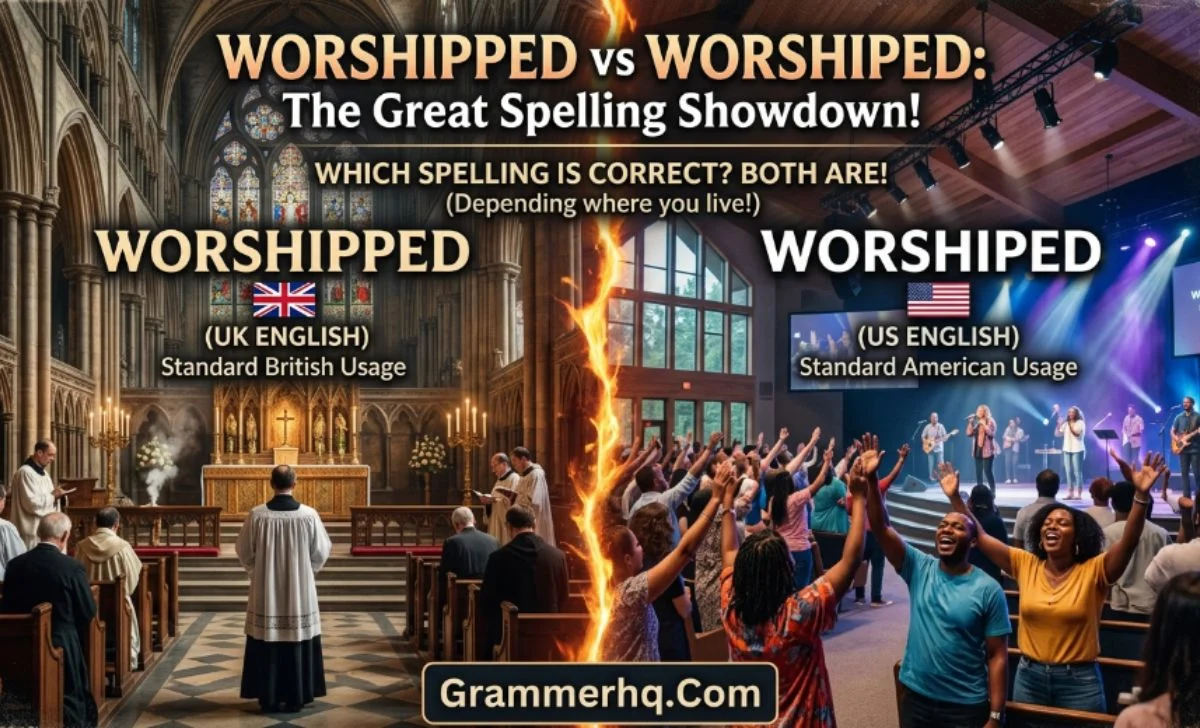
If you are confused about Worshipped vs Worshiped, both spellings are correct. Worshiped is widely used in American English, while worshipped is especially common in British English.
Both forms are the past tense and past participle of worship, and they have the same meaning and pronunciation. The main difference is the spelling convention used by different varieties of English.
In this guide, you’ll learn why both forms exist, when to use each one, and how related forms such as worshiping and worshipping differ.
Quick Answer
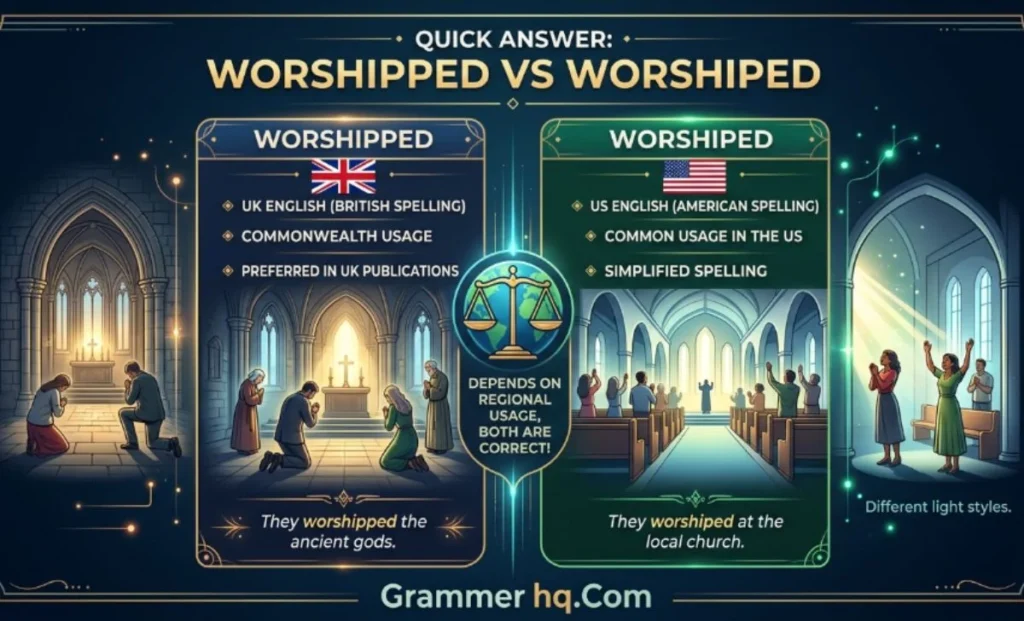
Worshiped and worshipped are both standard spellings.
- Worshiped — common in American English
- Worshipped — especially common in British English
- Meaning: exactly the same
- Grammar: both are past tense and past participle forms of worship
- Pronunciation: essentially the same
The easiest rule
If you are following American English, worshiped is generally the safer choice.
If you are following British English, worshipped is generally preferred.
The important point is that worshipped is not automatically wrong in American English, and English spelling conventions can overlap.
What Is the Difference Between Worshiped and Worshipped?
There is no difference in meaning between the two spellings.
Both come from the verb worship, which can mean to show reverence or devotion toward a deity or sacred figure. It can also be used more broadly to describe intense admiration or devotion.
For example:
The ancient people worshiped several gods.
The ancient people worshipped several gods.
The meaning of both sentences is the same. Only the spelling of the past-tense verb changes.
Worshiped
Worshiped uses one p before the -ed ending.
It is particularly common in American English.
Example:
The community worshiped together every Sunday.
Worshipped
Worshipped doubles the p before adding -ed.
This is the conventional spelling in British English and other varieties that generally follow British spelling conventions.
Example:
The community worshipped together every Sunday.
Why Does Worship Have Two Spellings?
The difference comes from the way English spelling conventions developed on different sides of the Atlantic.
When -ed is added to a verb, English sometimes doubles the final consonant. The pattern is influenced by factors such as pronunciation, syllable structure, stress, and established spelling conventions.
That is why English has pairs such as:
- canceled / cancelled
- modeled / modelled
- traveled / travelled
- worshiped / worshipped
But there is an important catch: English spelling rules are not completely mechanical. A spelling pattern that helps explain one word does not necessarily predict every other word perfectly.
That is why it is better to learn worshiped and worshipped as established spelling variants rather than assuming that one form must always be wrong.
Is Worshiped or Worshipped Correct in American English?
Worshiped is the spelling you will commonly see in American English.
For example:
The family worshiped at the church every Sunday.
American dictionaries also recognize worshipped, so it would be misleading to say that the doubled-p form is simply “incorrect” in American writing.
This is an important distinction for writers: common preference is not the same thing as exclusive correctness.
If your article, website, or publication follows American English, however, worshiped is usually the most natural choice.
Is Worshipped or Worshiped Correct in British English?
Worshipped is the conventional British spelling.
For example:
The villagers worshipped the deity for generations.
British English commonly retains the doubled consonant in this form, just as it does in several other words ending in -ed.
If you are writing for a British audience or following British spelling throughout a publication, worshipped is the better choice.
Do Worshiped and Worshipped Mean the Same Thing?
Yes. They have the same meaning.
The verb worship can be used in a religious sense:
They worshiped God in the temple.
It can also be used figuratively:
Fans worshipped the singer as a cultural icon.
In the second example, worshipped means admired or idolized intensely rather than necessarily referring to religious practice.
So the spelling difference does not create a difference in meaning.
Worshiped vs Worshipped in Grammar
Both forms are derived from the same verb:
| Form | Use |
|---|---|
| worship | base form |
| worshiped | past tense / past participle |
| worshipped | past tense / past participle |
| worshiping | present participle / gerund |
| worshipping | present participle / gerund |
For example:
They worship together every Friday.
They worshiped together last Friday.
They have worshipped there for many years.
The tense and grammatical function do not change simply because the spelling contains one or two p’s.
Worshiping vs Worshipping
The same spelling difference appears in the -ing form.
Both worshiping and worshipping are used.
Worshiping is commonly associated with American English, while worshipping is especially common in British English.
Examples:
They were worshiping at the temple.
They were worshipping at the temple.
Again, the meaning is identical.
If you choose American spelling for your article, use worshiping. If you are following British spelling, worshipping is generally the better fit.
Worshiper vs Worshipper
The related noun also has two common spellings:
- worshiper
- worshipper
The first is common in American English, while the doubled-consonant form is especially associated with British English.
For example:
The worshipers gathered before sunrise.
The worshippers gathered before sunrise.
Both refer to people who worship.
This is another example of how regional spelling conventions can affect related forms of the same word.
Worshiped vs Worshipped: Examples in Real Sentences
Seeing both forms in context makes the difference easier to remember.
Examples With Worshiped
The people worshiped their gods for centuries.
She worshiped at the local church as a child.
The singer was worshiped by millions of fans.
They worshiped together during the festival.
Examples With Worshipped
The people worshipped their gods for centuries.
She worshipped at the local church as a child.
The singer was worshipped by millions of fans.
They worshipped together during the festival.
Notice the important point: the sentences mean the same thing. The spelling simply follows different conventions.
Which Spelling Should You Use?
The best choice depends on the variety of English you are writing.
Use “Worshiped” for American English
Choose worshiped when:
- your audience primarily uses American English;
- you are following an American style guide;
- the rest of your writing uses American spellings such as canceled and traveled.
Use “Worshipped” for British English
Choose worshipped when:
- your audience primarily uses British English;
- you are following British spelling conventions;
- your article already uses forms such as cancelled and travelled.
What If You Write for an International Audience?
Consistency matters more than trying to find one universally “correct” version.
If your website uses American English, stick with worshiped. If it follows British English, use worshipped.
What you should avoid is switching spelling systems randomly within the same piece.
Common Mistakes With Worshiped and Worshipped
1: Thinking One Spelling Is Wrong
Neither spelling is inherently wrong.
They represent established spelling conventions.
2: Treating the Difference as Absolute
It is useful to remember:
American English → worshiped
British English → worshipped
But this is a practical guideline, not a claim that real-world usage never overlaps.
3: Giving Them Different Meanings
Worshiped does not mean something different from worshipped.
The extra p does not change the definition.
4: Mixing Spelling Styles
Using worshiped in one paragraph and worshipped in another is not ideal if there is no reason for the change.
Choose a style and stay consistent.
5: Confusing the Past and -ing Forms
Remember:
- worshiped / worshipped = past forms
- worshiping / worshipping = -ing forms
Worshiped or Worshipped: Easy Way to Remember
A simple memory trick is:
American English → one P → worshiped
British English → double P → worshipped
This is a useful shortcut for everyday writing.
Just remember that English usage is more flexible than a simple two-column rule. When accuracy matters, follow the spelling convention required by your audience, publisher, school, or style guide.
Related American and British Spelling Differences
Worshiped/worshipped belongs to a larger pattern of spelling differences between American and British English.
| American English | British English |
|---|---|
| canceled | cancelled |
| modeled | modelled |
| traveled | travelled |
| worshiped | worshipped |
| worshiping | worshipping |
| worshiper | worshipper |
These differences do not mean one variety is “more correct” than the other. They are simply different standard conventions.
FAQ,s
Is worshiped or worshipped correct?
Both are correct. Worshiped is widely used in American English, while worshipped is especially common in British English.
Is worshipped British or American?
Worshipped is particularly associated with British English, although the spelling is also found in American usage.
Is worshiped acceptable in British English?
It can be encountered, but worshipped is the conventional choice in British English.
Is worshipped acceptable in American English?
Yes. Although worshiped is widely preferred in American English, worshipped is also found in American usage.
What is the past tense of worship?
The past tense can be worshiped or worshipped, depending on the spelling convention being followed.
What is the past participle of worship?
The past participle can also be worshiped or worshipped.
For example:
They have worshiped there for years.
They have worshipped there for years.
Is worshiping or worshipping correct?
Both are correct. Worshiping is common in American English, while worshipping is especially common in British English.
Is worshiper or worshipper correct?
Both spellings are used. Worshiper is common in American English, while worshipper is especially common in British English.
Do worshiped and worshipped have different meanings?
No. They have the same meaning, pronunciation, and grammatical function.
Which spelling should I use in formal writing?
Use the form that matches your chosen variety of English and style guide. The most important thing is to remain consistent.
Conclusion
Worshiped and worshipped are both correct spellings. The main difference is regional convention: worshiped is widely preferred in American English, while worshipped is especially common in British English.
The two forms have the same meaning and grammatical function. The same pattern appears in worshiping/worshipping and worshiper/worshipper.
If you are writing for a specific audience, follow its preferred spelling system. For American English, choose worshiped; for British English, worshipped is generally the natural choice.
Read More Blogs: