You write optimize, while someone else writes optimise, so which spelling is actually correct? The answer is clear: both are correct. The difference between optimize vs optimise is mainly based on regional English.
Optimize is the standard spelling in American English, while optimise is the usual form in British English. Both words have the same meaning: to make something as good, effective, or efficient as possible.
The confusion often comes from seeing one spelling marked differently by a spell checker, dictionary, or writing tool.
British English also has a little more nuance than the simple “-ize versus -ise” rule suggests. In this guide, you’ll learn which spelling to use, why they differ, how related forms change, and which choice is best for your audience.
Quick Answer
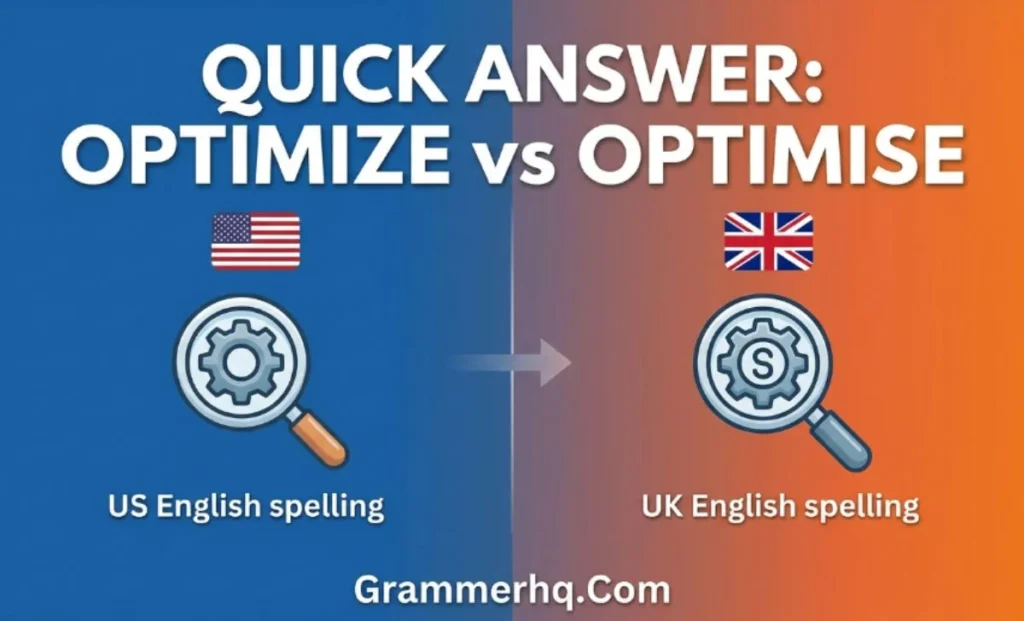
Optimize and optimise are two spellings of the same verb.
| Spelling | Common usage | Meaning |
|---|---|---|
| optimize | American English | To make something as good or effective as possible |
| optimise | British English | To make something as good or effective as possible |
The simple rule
American English → optimize
British English → optimise
For example:
- US English: We need to optimize the website.
- UK English: We need to optimise the website.
There is no difference in meaning between the two.
Cambridge lists optimize as the main form and says the UK usually uses optimise. Its Business English entry also notes optimise as the UK form.
Quick answer: If you are writing for Americans, choose optimize. If you are following ordinary British English, choose optimise.
What Does Optimize Mean?
Optimize is a verb meaning to make something as good, effective, or efficient as possible.
It is commonly used in areas such as:
- business
- technology
- engineering
- science
- websites
- software
- digital marketing
- search engine optimization
For example:
We need to optimize the website for mobile users.
Here, optimize means to improve the website so it performs as effectively as possible for people using mobile devices.
Oxford also gives a computing sense: to change data or software so that it works more efficiently or is better suited to a particular purpose.
Optimize Pronunciation
Optimize and optimise are essentially pronounced the same way, although the exact pronunciation naturally varies between accents.
Cambridge gives both UK and US pronunciations for optimize, showing the expected regional accent differences.
The spelling changes, but the word’s basic sound and meaning do not.
Examples With Optimize
- We need to optimize the website before launch.
- The software was designed to optimize battery life.
- The company wants to optimize its production process.
- The developer is trying to optimize the code.
- The team changed its schedule to optimize productivity.
What Does Optimise Mean?
Optimise has the same meaning as optimize.
It is the spelling usually preferred in British English.
For example:
We need to optimise the website for mobile users.
This means exactly the same thing as:
We need to optimize the website for mobile users.
Cambridge explicitly describes optimise as the usual UK form.
Optimise Pronunciation
Optimise is pronounced essentially like optimize.
The difference is primarily written:
- optimize → -ize
- optimise → -ise
The pronunciation does not turn the two into different words.
Examples With Optimise
- We need to optimise the website before launch.
- The software was designed to optimise battery life.
- The company wants to optimise its production process.
- The developer is trying to optimise the code.
- The team changed its schedule to optimise productivity.
Optimize vs Optimise: What’s the Difference?
The easiest way to understand these words is to separate meaning from spelling.
Meaning
There is no meaningful difference.
Both words mean:
to make something as good, effective, or efficient as possible
Spelling
The main difference is the ending:
- optimize → -ize
- optimise → -ise
Grammar
Both are verbs and can be used in the same grammatical situations.
We optimize our workflow.
We optimise our workflow.
Pronunciation
They are essentially pronounced alike, with normal differences between regional accents.
Formality
Neither spelling is automatically more formal or more professional.
The correct choice depends on the English variety, publication, audience, or style guide you are following.
Optimize vs Optimise in American and British English
The US-versus-UK distinction is the most useful rule for everyday writing.
| American English | British English |
|---|---|
| optimize | optimise |
| optimized | optimised |
| optimizing | optimising |
| optimization | optimisation |
For example:
American English:
The developer optimized the website for mobile devices.
British English:
The developer optimised the website for mobile devices.
Both sentences mean the same thing.
The same spelling pattern appears in other words:
- organize / organise
- realize / realise
- recognize / recognise
- modernize / modernise
This is why optimize vs optimise is a spelling-variation question rather than a difference in vocabulary.
Is “Optimise” the Only Correct British Spelling?
This is where the subject needs a little more care.
A common rule says:
American English uses -ize, while British English uses -ise.
That is a useful shortcut, but it is not the whole story.
Cambridge says the UK usually uses optimise.
Oxford Learner’s Dictionaries takes a slightly different presentation: it lists optimize as the headword and identifies optimise as a British English form. Oxford also gives the word’s origin as early 19th-century English from Latin optimus (“best”) plus -ize.
That means it would be too strong to say:
“Optimize is incorrect in British English.”
A more accurate statement is:
Optimise is the usual British form, but British usage can also include -ize forms depending on the dictionary or style convention.
For normal British English writing, optimise is the safest familiar choice when no specific style guide tells you otherwise.
Why Does This Matter?
Imagine you are writing for a UK publication that consistently uses -ise spellings. In that context, optimise will fit naturally with words such as organise and realise.
On the other hand, a publisher or institution may follow a style system that permits or prefers -ize spellings.
So the best professional practice is not to memorize an absolute rule. Instead:
Know your audience, check the required style, and remain consistent.
Why Are Optimize and Optimise Spelled Differently?
The difference is part of a wider history of English spelling.
Oxford traces optimize to the early 19th century and to Latin optimus, meaning “best,” with the suffix -ize.
Over time, English developed different regional spelling preferences. American English commonly uses forms ending in -ize, while British English often uses -ise forms.
You can see the same pattern in:
- organize / organise
- realize / realise
- recognize / recognise
- modernize / modernise
The important point is that these pairs normally do not represent different meanings.
They represent different spelling conventions.
Optimize vs Optimise Around the World
English is used across many countries, so the simple US-versus-UK rule does not explain every situation perfectly.
United States
Optimize is the standard choice in American English.
The team optimized the software.
United Kingdom
Optimise is the usual choice in British English.
The team optimised the software.
Australia and New Zealand
British-influenced spelling conventions make optimise a natural choice in many contexts.
Canada
Canadian English reflects both British and American influences. Usage can vary according to the publication, organization, or style guide.
For professional writing, follow the convention expected by your specific audience rather than treating one form as universally mandatory.
International English
If you write for an international audience, either spelling can work.
The important thing is to choose a consistent style and avoid switching between regional spellings without a reason.
Which Spelling Should You Use?
The right choice depends on your readers.
Use “Optimize” for American English
Choose optimize when writing for:
- US readers
- American companies
- US-focused websites
- American publications
- organizations using American English
Example:
Our team helps businesses optimize their websites.
Use “Optimise” for British English
Choose optimise when writing for:
- UK readers
- British companies
- UK-focused websites
- British publications
- organizations using British English
Example:
Our team helps businesses optimise their websites.
What If Your Audience Is Global?
Pick a consistent English variety.
You do not need to use both spellings in every article. If your website primarily follows American English, optimize can be your default. If it follows British English, use optimise.
Consistency makes your writing easier to read and easier to edit.
Optimize vs Optimise in SEO
The word appears frequently in digital marketing because of terms such as search engine optimization (SEO).
American English commonly uses:
search engine optimization
British English commonly uses:
search engine optimisation
The underlying concept is the same.
Does Google Prefer Optimize or Optimise?
There is no good reason to assume that Google universally prefers one spelling simply because it uses z or s.
Your spelling should reflect your intended audience.
If your website targets US readers, optimize is natural.
If it targets UK readers, optimise is natural.
For SEO content, focus on:
- satisfying search intent
- accurate information
- natural language
- regional relevance
- consistent spelling
- useful examples
- genuinely helpful content
Do not repeat both variants unnaturally just to include more keywords.
For example, this is awkward:
We optimize and optimise websites to help businesses optimize and optimise their content.
A natural sentence is better:
We help businesses optimize their websites for better performance.
Or, for a British audience:
We help businesses optimise their websites for better performance.
Optimize vs Optimise Word Forms
The regional spelling difference continues through the word family.
| American English | British English |
|---|---|
| optimize | optimise |
| optimized | optimised |
| optimizing | optimising |
| optimization | optimisation |
Cambridge lists optimization and notes that the UK usually uses optimisation.
Examples
American English:
The website was optimized for mobile devices.
British English:
The website was optimised for mobile devices.
American English:
Website optimization can improve performance.
British English:
Website optimisation can improve performance.
Once you understand the main pattern, the related forms become much easier to remember.
Optimize vs Optimise in Real-Life Examples
The difference becomes much clearer when you see both forms used in familiar situations.
Business
US:
We need to optimize our workflow before the next project.
UK:
We need to optimise our workflow before the next project.
Technology
US:
The update is designed to optimize battery performance.
UK:
The update is designed to optimise battery performance.
SEO
US:
The agency helps small businesses optimize their websites.
UK:
The agency helps small businesses optimise their websites.
Education
US:
Students can optimize their study time by planning ahead.
UK:
Students can optimise their study time by planning ahead.
Manufacturing
US:
Engineers optimized the production line to reduce waste.
UK:
Engineers optimised the production line to reduce waste.
Everyday English
US:
She changed her routine to optimize her time.
UK:
She changed her routine to optimise her time.
Notice the pattern: the meaning stays the same while the regional spelling changes.
Common Mistakes With Optimize and Optimise
1: Assuming one spelling is wrong
Optimize is not simply a misspelling of optimise, and optimise is not a misspelling of optimize.
They are established spelling forms associated with different usage conventions.
2: Mixing regional styles
A page that uses mostly American spelling but suddenly switches to British spelling can feel inconsistent.
Choose your preferred English variety and maintain it.
3: Forgetting the noun form
American English:
optimization
British English:
optimisation
The spelling difference continues beyond the verb.
4: Assuming pronunciation changes completely
The written form changes, but the basic pronunciation remains essentially the same.
5: Using both forms just for SEO
Repeating optimize and optimise unnaturally does not make content better.
Use the form that fits your audience and write naturally.
Optimize vs Optimise: Easy Way to Remember
Need a quick memory trick?
Z → optimize → American English
S → optimise → British English
You can remember the same pattern with:
- organize → organise
- realize → realise
- recognize → recognise
So when you are unsure:
US → optimize
UK → optimise
Just remember that the UK rule is a useful guide, not an absolute ban on every -ize spelling.
What Do Major Dictionaries Say?
When two spellings cause confusion, reliable dictionaries provide a much stronger answer than an unsourced grammar blog.
Cambridge Dictionary
Cambridge defines optimize as making something as good as possible and marks optimise as the usual UK form. Its Business English entry also uses the UK label “also optimise.”
Oxford Learner’s Dictionaries
Oxford lists optimize as the main headword and explicitly gives “British English also optimise.” It also includes a computing definition relating to making software or data work more efficiently.
What Does This Evidence Tell Us?
The dictionaries support a more accurate conclusion than the simple “US versus UK” rule:
Optimize is the standard American form, while optimise is the usual British form; however, British English can also use optimize depending on the convention being followed.
That is why calling one spelling universally “wrong” would be misleading.
FAQs
1: Is optimize or optimise correct?
Both are correct. Optimize is the standard American English spelling, while optimise is the usual British English form.
2: Is optimise British or American?
Optimise is commonly associated with British English. Cambridge specifically identifies it as the usual UK form.
3: Is optimize used in British English?
Yes. British English can use optimize, depending on the dictionary, publisher, or style convention. Oxford lists optimize as its headword and gives optimise as a British English form.
4: Do optimize and optimise mean the same thing?
Yes. Both mean to make something as good, effective, or efficient as possible.
5: Which spelling should I use in American English?
Use optimize.
6: Which spelling should I use in British English?
Use optimise in ordinary British English unless your required style guide specifies another convention.
7: Is it optimization or optimisation?
Both are established forms. Optimization is the American form, while optimisation is the usual British form.
8: Does Google prefer optimize or optimise?
There is no universal “better” spelling for SEO. Use the form that matches your target audience and maintain consistent language throughout your website.
Final Verdict
Optimize and optimise are two spelling forms of the same word.
Use optimize when following American English.
Use optimise when following ordinary British English.
Both mean to make something as good, effective, or efficient as possible, and their pronunciation is essentially the same.
The one nuance worth remembering is that British English is not simply “-ise only.” Major dictionaries show that optimise is the usual UK form, while optimize can also appear in British usage depending on the convention or style being followed.
So if you are choosing between the two, ask one simple question:
Who am I writing for?
US audience → optimize
UK audience → optimise
Choose the spelling your readers expect, keep your style consistent, and you will be using the word correctly.
Read More Blogs: