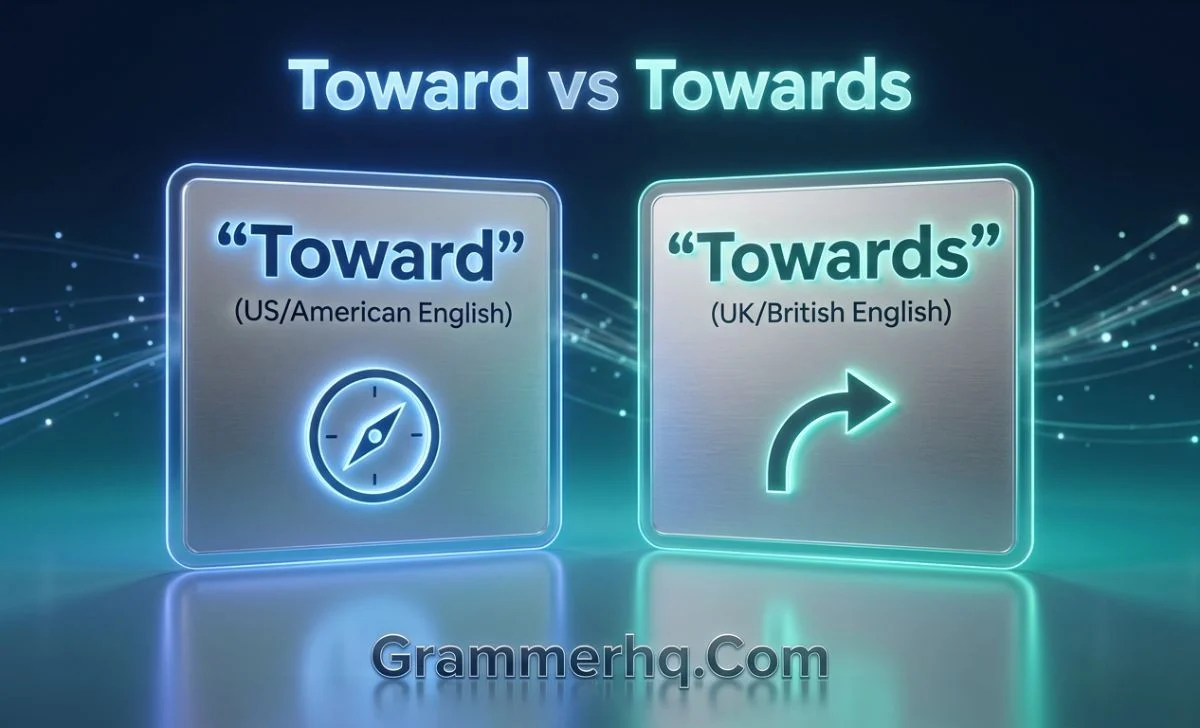
Toward vs Towards is a common English usage question because both forms are correct, but English speakers do not use them with the same frequency everywhere.
Toward is mainly associated with American English, while towards is mainly associated with British English. Both words work as prepositions and can express movement, relationships, position, time, purpose, or progress.
The key point is simple: the extra -s does not normally change the meaning. Instead, regional preference and writing style usually determine the choice.
So, if you write for a US audience, toward will generally sound more natural. For a UK audience, towards is usually the more familiar form.
Quick Answer
Toward and towards are both correct. They normally carry the same meaning and work in the same grammatical situations.
- Toward is mainly associated with American English.
- Towards is mainly associated with British English.
- Both can describe direction, progress, attitude, position, time, and purpose.
- Neither form automatically becomes wrong in the other variety of English.
- Your audience, style guide, and overall consistency can determine which form you should use.
| Feature | Toward | Towards |
|---|---|---|
| Correct form | Yes | Yes |
| Part of speech | Preposition | Preposition |
| Main regional preference | American English | British English |
| Meaning | Essentially the same | Essentially the same |
| Example | She walked toward the door. | She walked towards the door. |
Cambridge identifies toward as mainly US and towards as mainly UK, while recognizing both forms.
Toward vs Towards: The Main Difference
The main difference involves regional usage rather than meaning.
For example:
The child ran toward his mother.
The child ran towards his mother.
Both sentences describe movement in the same direction. Adding -s does not create a different grammatical meaning.
The same idea applies to abstract goals:
We are working toward a solution.
We are working towards a solution.
Again, the meaning stays essentially the same.
Instead, the preferred form often depends on the variety of English. Cambridge lists both toward and towards as prepositions and gives the two forms the same main groups of meanings.
Toward vs Towards in American English
Toward is the main form associated with American English.
For example:
- The storm is moving toward the coast.
- She walked toward the exit.
- We are working toward a solution.
- His attitude toward the proposal changed.
- The deadline is getting toward the end of the month.
Cambridge’s American Dictionary labels toward as mainly US and lists towards as the alternative form.
However, American English speakers can also use towards. The important point is that toward generally feels more typical of American usage.
Toward vs Towards in British English
Towards is the main form associated with British English.
For example:
- She walked towards the station.
- The dog ran towards the gate.
- They are working towards a solution.
- His attitude towards the change was positive.
- The weather improved towards the end of the day.
Cambridge labels towards as mainly UK and identifies toward as the mainly US alternative.
Therefore, if your website, publication, or audience follows British English, towards will usually feel more natural.
Toward vs Towards: How to Use Them
Both forms can perform the same grammatical jobs. In particular, they commonly describe direction, relationships, position, time, purpose, and progress.
1. Direction and Movement
The most familiar use describes movement in the direction of someone or something.
- Maya walked toward the door.
- Maya walked towards the door.
- The car was heading toward the bridge.
- The car was heading towards the bridge.
In each pair, the basic meaning remains the same.
For example:
The dog ran toward its owner.
The sentence tells us that the dog moved in the owner’s direction. British English can use towards in the same sentence without changing that meaning.
2. Progress Toward a Goal
Toward(s) can also describe progress toward an objective rather than physical movement.
- The team is working toward a solution.
- The team is working towards a solution.
- She is taking steps toward her goal.
- She is taking steps towards her goal.
This use appears frequently in business, education, personal development, and everyday writing.
For example:
After months of testing, the engineers are moving toward a workable design.
Here, the engineers are not physically moving toward the design. Instead, they are making progress toward an intended result.
3. Attitude, Feelings, and Behavior
Toward(s) can also describe someone’s attitude, feelings, or behavior in relation to another person or thing.
- His attitude toward his coworkers was respectful.
- His attitude towards his coworkers was respectful.
- She has strong feelings toward the issue.
- She has strong feelings towards the issue.
In other words, toward(s) does not only describe physical direction.
Cambridge also lists relationship and attitude as established uses of both forms.
4. Time and Position
The word can also refer to a time or place that is approaching.
- Toward the end of the year, sales increased.
- Towards the end of the year, sales increased.
- Our seats were toward the back of the theater.
- Our seats were towards the back of the theater.
In these examples, toward(s) means something like near, around, or just before a particular time or position.
For example:
Sales usually increase toward the end of the year.
The sentence refers to a period close to the end of the year rather than physical movement.
Cambridge includes time and position among the established meanings of toward(s).
5. Purpose or Contribution
Another common use describes money, effort, or another contribution made for a particular purpose.
- She put $20 toward the gift.
- She put $20 towards the gift.
- The payment counts toward your final grade.
- The payment counts towards your final grade.
Here, toward(s) means something like contributing to or helping achieve something.
For example:
She saved $500 toward the cost of a new laptop.
The money contributes to the total amount needed to buy the laptop.
Cambridge lists this purpose-related use for contributions, costs, and grades.
Toward vs Towards: Examples Side by Side
| Meaning | Toward | Towards |
|---|---|---|
| Movement | He walked toward the door. | He walked towards the door. |
| Goal | We are moving toward success. | We are moving towards success. |
| Attitude | Her attitude toward change improved. | Her attitude towards change improved. |
| Time | Toward the end of winter, temperatures rose. | Towards the end of winter, temperatures rose. |
| Position | They moved toward the back. | They moved towards the back. |
| Contribution | She paid $50 toward the cost. | She paid $50 towards the cost. |
| Progress | The project is moving toward completion. | The project is moving towards completion. |
As you can see, the grammatical function and basic meaning stay essentially the same. The main difference lies in regional preference and editorial style.
Toward vs Towards in Formal Writing
Formal writing does not make towards incorrect.
Instead, ask yourself: Which form matches the English variety and style you are using?
American English
For American professional, academic, and general writing, toward will usually fit naturally.
The research is moving toward a clearer conclusion.
British English
For British writing, towards generally fits more naturally.
The research is moving towards a clearer conclusion.
Following a Style Guide
If a publisher, school, employer, or publication has a house style, follow its preferred form.
However, remember that a style preference is not the same as a grammar rule. A publication may consistently prefer one form even though both forms remain grammatically correct.
The Associated Press makes this distinction clear in its guidance on quotations. When a speaker says “towards,” AP says not to change it to “toward” simply for style.
Common Toward vs Towards Mistakes
Treating One Form as Wrong
One common mistake involves assuming that one spelling must be incorrect.
In reality, both toward and towards are established English forms. Their frequency varies by region, but neither form automatically counts as a spelling error.
Assuming the -s Changes the Meaning
The -s does not normally create a different meaning.
She moved toward the window.
She moved towards the window.
Both sentences tell us that she moved in the direction of the window.
Limiting the Word to Physical Movement
Another mistake involves thinking that toward(s) only describes someone moving from one place to another.
Instead, the word can also describe:
- progress toward a goal
- an attitude toward someone
- a position toward the back
- a time toward the end of a period
- a contribution toward a cost
Switching Forms Without a Style Reason
Using both forms in one document does not automatically create a grammar error. Still, unnecessary switching can make your writing look inconsistent.
For example, an American-focused article might normally use toward, while a British-focused article might normally use towards.
Therefore, choose the form that fits your audience and keep your usage consistent.
Which Form Should You Use?
The simplest approach is to match the form to your audience.
Writing for American readers?
Use toward as your normal choice.
Writing for British readers?
Use towards as your normal choice.
Writing for a publication with a house style?
Follow its preferred usage.
Writing for an international audience?
Choose the English variety that matches the rest of your content and use it consistently.
Already used the other form?
Do not assume you made a grammar mistake. Both forms are standard, so your sentence may still be completely correct.
FAQs
Is Toward or Towards Correct?
Both toward and towards are correct. Toward is mainly associated with American English, while towards is mainly associated with British English.
Is Towards Grammatically Correct?
Yes. Towards is a standard English preposition that can describe direction, relationships, position, time, purpose, and progress.
Is Toward American English?
Yes. Toward is mainly associated with American English, although British English also uses it.
Is Towards British English?
Yes. Towards is mainly associated with British English, although American English also uses it.
Do Toward and Towards Mean the Same Thing?
Yes. In ordinary usage, the two forms have essentially the same meaning and can generally replace each other.
Which Is Correct: Working Toward or Working Towards?
Both are correct. Working toward is more typical of American English, while working towards is more typical of British English.
Which Is Correct: Toward the End or Towards the End?
Both are correct. The choice mainly depends on your preferred variety of English and the style you follow.
Can Toward and Towards Be Used Interchangeably?
Generally, yes. Both forms normally perform the same grammatical function and express the same basic meaning. However, regional preference or a house style may determine which form you should choose.
Conclusion
Toward vs Towards is not simply a case of correct versus incorrect spelling. Both forms are standard English prepositions, and both can express direction, progress, attitude, position, time, and purpose.
The main distinction is regional: toward is mainly associated with American English, while towards is mainly associated with British English. Therefore, match your choice to your audience and follow any relevant style guide.
Most importantly, do not treat the extra -s as a change in meaning. If your sentence works with one form, it will usually work with the other as well. Choose the form that fits your English variety, then use it consistently throughout your content.
Read More Blogs