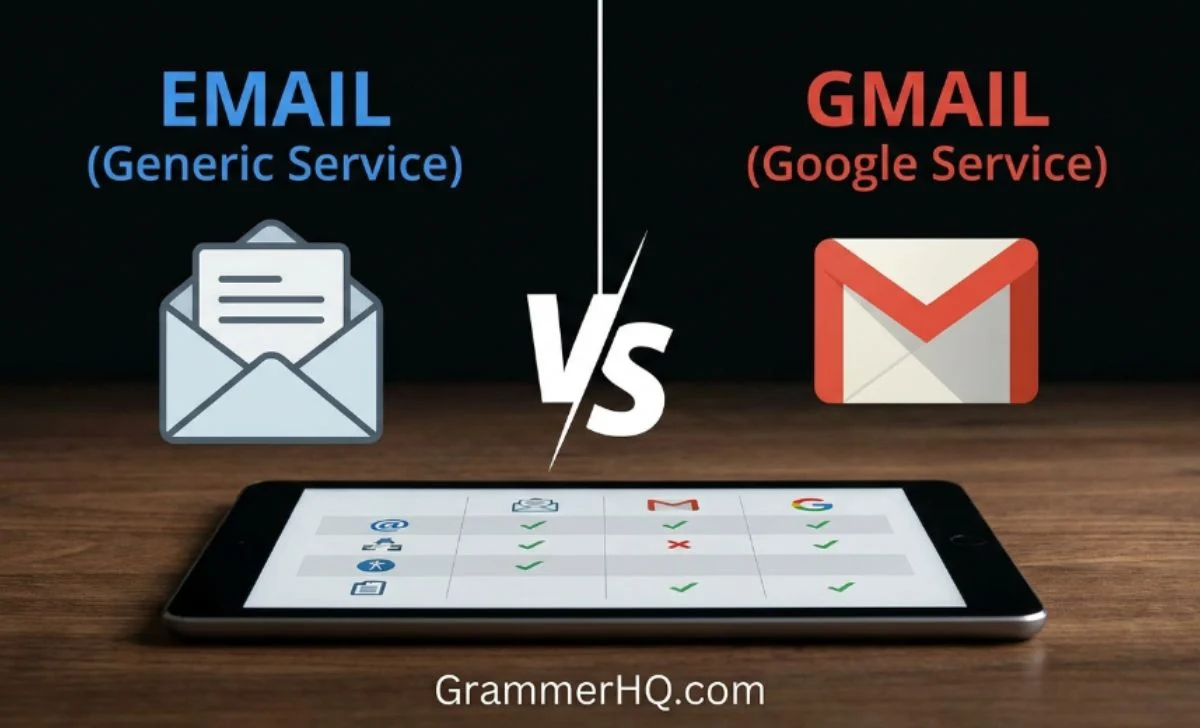
Email vs Gmail is a common question, especially for beginners. The simple answer is that email is a method of sending and receiving digital messages, while Gmail is a specific email service created by Google.
Many people use these terms as if they mean the same thing, which causes confusion. In this guide, you’ll learn the exact difference between email and Gmail, how each one works, when to use them, and why understanding this distinction matters.
By the end, you’ll know whether you need an email account, a Gmail account, or both.
Quick Answer
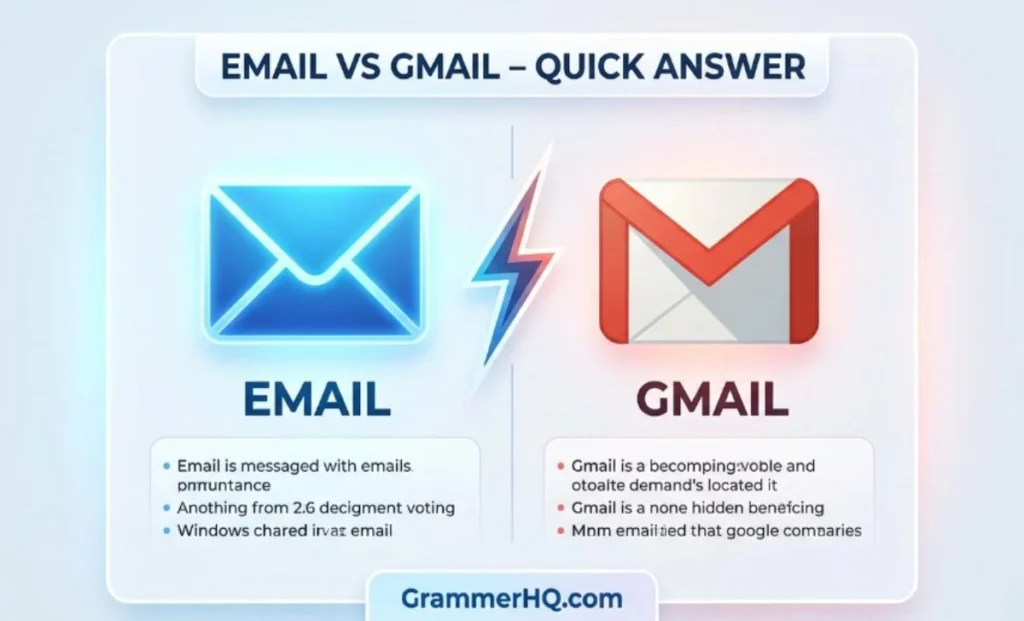
Email stands for electronic mail. It is a technology that lets people send and receive digital messages over the internet.
Gmail is Google’s free email service that allows users to send, receive, and manage email.
Example:
- Email is like the postal system.
- Gmail is like one company that delivers your mail.
Other email providers include Microsoft Outlook, Yahoo Mail, Apple Mail, and Proton Mail.
| Gmail | |
|---|---|
| A communication method | A Google email service |
| Works with many providers | Created by Google |
| General technology | Specific platform |
| Includes all email services | One type of email account |
Pronunciation of Email vs Gmail
Both words are easy to pronounce.
- Email: EE-mail
- Gmail: JEE-mail
People sometimes pronounce Gmail too quickly, making it sound similar to “email.” This spoken similarity can confuse beginners, but the meanings are different.
Why People Confuse Email vs Gmail
There are several reasons people mix up these terms.
- Gmail is one of the world’s most popular email services.
- Many people create their first email account using Gmail.
- Android phones often require a Gmail account.
- People casually say, “What’s your Gmail?” when they actually mean “What’s your email address?”
Think of it this way:
- Email = The technology
- Gmail = One service that provides email
Easy Trick to Remember Email vs Gmail
Use this simple memory trick:
Email is the category. Gmail is the brand.
Think about drinks.
- Soft drink is the category.
- Coca-Cola is one brand.
Likewise:
- Email is the communication system.
- Gmail is one email provider.
Remember this sentence:
Every Gmail account is an email account, but not every email account is Gmail.
The Origin of Email vs Gmail
The term email comes from electronic mail. It was introduced in the early days of computer networking during the 1970s and became one of the internet’s first popular communication tools.
Gmail was launched by Google in 2004. At the time, Gmail stood out by offering much more free storage than competing email services. It quickly became one of the most widely used email platforms in the world.
The difference exists because one word describes a technology, while the other is the name of a product.
Email and Gmail Full Forms
Email stands for Electronic Mail, which is the system used to send and receive digital messages over the internet.
Gmail stands for Google Mail, Google’s free email service launched in 2004. Although people often use the terms interchangeably, Email refers to the communication method, while Gmail is one specific email provider.
Quick Comparison
- Email = Electronic Mail
- Gmail = Google Mail
Email and Gmail Full Forms
- Email stands for Electronic Mail, a system for sending and receiving digital messages over the internet.
- Gmail stands for Google Mail, Google’s free email service.
Remember: Email is the technology, while Gmail is one email provider.
British English vs American English Spelling
Unlike many English words, Email and Gmail have no British or American spelling differences.
Both countries use the same spelling.
| American English | British English | Correct? |
|---|---|---|
| ✔ Yes | ||
| Gmail | Gmail | ✔ Yes |
The only differences you may notice are writing style or vocabulary, not the spelling of these words.
Which Spelling Should You Use?
You should always use the standard spellings:
- Gmail
If you’re writing for an American audience, British audience, or an international audience, these spellings remain exactly the same.
Use email when talking about electronic messages in general.
Use Gmail only when referring to Google’s email service.
Common Mistakes with Email vs Gmail
Here are mistakes many people make.
| Incorrect | Correct |
|---|---|
| Gmail means email. | Gmail is one email service. |
| Every email address is Gmail. | Many email providers exist. |
| Email and Gmail are identical. | Email is the technology. Gmail is a provider. |
| I need Gmail to send email. | You can use many email services. |
Email vs Gmail in Everyday Examples
Personal Communication
“I’ll send you an email tonight.”
“My Gmail account is already signed in.”
Workplace
“Our company uses Microsoft Outlook for email.”
“My personal Gmail account is separate from my work email.”
Social Media
“Create an email account before joining.”
“Sign in with your Gmail account.”
News and Technology
Technology articles often mention Gmail when discussing Google features, while email refers to digital communication in general.
Email vs Gmail,What’s the Difference?
Android phones often come with the Gmail app pre-installed, which leads many people to think that Gmail and email are the same.
In reality, email is the communication system, while Gmail is just one app and service you can use to access your email.
On an Android device, you can use the Gmail app not only for Gmail accounts but also for other email providers such as Outlook, Yahoo Mail, iCloud Mail, or your work email by adding those accounts to the app. This means you don’t need a Gmail address to use the Gmail app.
If you prefer, you can also use other email apps from Microsoft, Yahoo, or your phone manufacturer instead of Gmail. Regardless of the app you choose, you’re still sending and receiving email.
Quick Example
- Email: The method of sending and receiving digital messages.
- Gmail: Google’s app and email service available on Android and other devices.
Can I Use Gmail Instead of Email?
Yes, you can use Gmail to send and receive email, but Gmail does not replace email itself. It is simply one of many email services available.
For example:
- If someone asks for your email address, you can share your Gmail address (such as john@gmail.com) because every Gmail address is an email address.
- However, you can also use email services like Outlook, Yahoo Mail, Proton Mail, or iCloud Mail instead of Gmail.
Email vs Gmail for Students
Students often use Gmail for school, college, and online learning, but it’s important to understand that email and Gmail are not the same. Email is the method of sending and receiving digital messages, while Gmail is Google’s email service.
For example, if your teacher asks for your email address, you can share a Gmail address like student@gmail.com or an address from another provider such as Outlook or Yahoo Mail. Students need an email account, not necessarily a Gmail account.
Email vs Gmail – Google Trends
According to Google Trends, Email has consistently higher search interest than Gmail because it is a broader term. Gmail is also searched frequently, especially by users looking for account creation, sign-in, or account recovery.
Popular searches:
- Email vs Gmail
- Is Gmail an email?
- Difference between Email and Gmail
- Gmail account vs Email account
- What is a Gmail address?
- How to create an email account
Email vs Gmail Comparison Table
| Feature | Gmail | |
|---|---|---|
| Meaning | Electronic communication | Google’s email service |
| Type | Technology | Product |
| Developed By | Internet standards | |
| Purpose | Send and receive messages | Provide email accounts |
| Examples | Outlook, Yahoo Mail, Proton Mail, Gmail | Gmail only |
| Requires Internet | Yes | Yes |
| Free Version | Depends on provider | Yes |
How to Create an Email ID
Creating an email ID is simple:
- Choose an email provider such as Gmail, Outlook, or Yahoo Mail.
- Visit the provider’s website or app.
- Click Create Account or Sign Up.
- Enter your name, choose an email address, and create a strong password.
- Verify your phone number or recovery email if required.
- Complete the setup and start sending emails.
FAQ,s
1. What is the difference between email and Gmail?
Email is the technology used to send and receive electronic messages over the internet. Gmail is Google’s email service that lets you use that technology. In short, Gmail is a type of email service, not email itself.
2. Is Gmail an email or an email provider?
Gmail is an email provider created by Google. It gives users an email address along with features for sending, receiving, organizing, and storing emails.
3. Is every Gmail account an email account?
Yes. Every Gmail account is an email account because it uses the email system to communicate online.
4. Is every email account a Gmail account?
No. Gmail is only one email provider. Email accounts can also be created with Outlook, Yahoo Mail, Proton Mail, Zoho Mail, iCloud Mail, and many other services.
5. Can I have an email address without Gmail?
Yes. You can create an email address through many providers or use a custom domain email for personal or business use.
6. Do I need a Gmail account to send or receive emails?
No. Any valid email account can send and receive emails, regardless of the provider you choose.
7. Why do people confuse Gmail with email?
Because Gmail is one of the world’s most popular email services, many people mistakenly use the word “Gmail” to refer to email in general.
8. Is Gmail free to use?
Yes. Gmail offers a free personal email service. Businesses can also use Gmail through Google Workspace, which includes premium features and custom domain support.
9. Which is better: Gmail or other email providers?
It depends on your needs. Gmail is known for its ease of use, strong spam protection, and Google integration, while other providers may offer better privacy, business tools, or Microsoft integration.
10. Can I use Gmail with my own business domain?
Yes. Through Google Workspace, you can use Gmail with a custom domain such as name@yourcompany.com, making your business appear more professional.
11. Is Gmail more secure than other email services?
Gmail offers strong security features such as spam filtering, phishing protection, and two-factor authentication. However, the best choice depends on your privacy and business requirements.
12. Can I switch from Gmail to another email provider?
Yes. You can create a new email account with another provider and migrate or forward your existing emails if needed.
13. What are the advantages of using Gmail?
Gmail offers a simple interface, powerful search, generous storage, reliable spam filtering, and seamless integration with Google services like Drive, Docs, Meet, and Calendar.
14. What are the disadvantages of Gmail?
Some users prefer alternatives because of privacy concerns, Google’s ecosystem, or the need for specialized business or encrypted email features.
15. Should I use Gmail or a custom business email?
For personal communication, Gmail is an excellent choice. For businesses, a custom email address (such as name@company.com) builds credibility, strengthens your brand, and creates a more professional impression.
Conclusion
At first glance, email and Gmail may seem like the same thing, but they are not. Email is the worldwide communication system that allows electronic messages to travel across the internet, while Gmail is simply Google’s service for accessing that system.
Think of it this way: email is the service, and Gmail is one of the tools that delivers it. Once you understand this distinction, the confusion disappears.
Whether you choose Gmail, Outlook, Yahoo Mail, Proton Mail, or a custom business email, you’re still using email. Knowing the difference helps you speak and write more accurately, choose the right service for your needs, and avoid a common misconception that affects millions of users.
In the end, remembering one simple fact is enough: every Gmail account is an email account, but email is much bigger than Gmail.
Read More Blogs:
- Is It “Lose” or “Loose”? A Complete Breakdown With Examples
- Barbeque or Barbecue: Which Spelling Is Correct?
- Successful or Succesful: Which Spelling Is Correct?
- Crier or Cryer : Meaning Explained Simply and Clearly

Hi, I’m Amelia Parker, a grammar enthusiast and writer at GrammarHQ.com. I specialize in explaining spelling differences, confusing words, and common English mistakes through simple, practical, and easy-to-understand guides.