Have you ever wondered whether crier or cryer is the correct spelling? The short answer is simple: crier is the standard English spelling, while cryer is usually considered a misspelling.
This confusion happens because both words sound identical, making it difficult to know which one to use in writing.
Many people also search to learn whether cryer is ever correct, what crier means, how the word is used in modern English, and whether it refers to someone who cries or a public announcer.
This guide answers all of those questions with clear explanations, pronunciation, grammar rules, real examples, common mistakes, and easy memory tips so you can choose the correct spelling with confidence every time.
Quick Answer
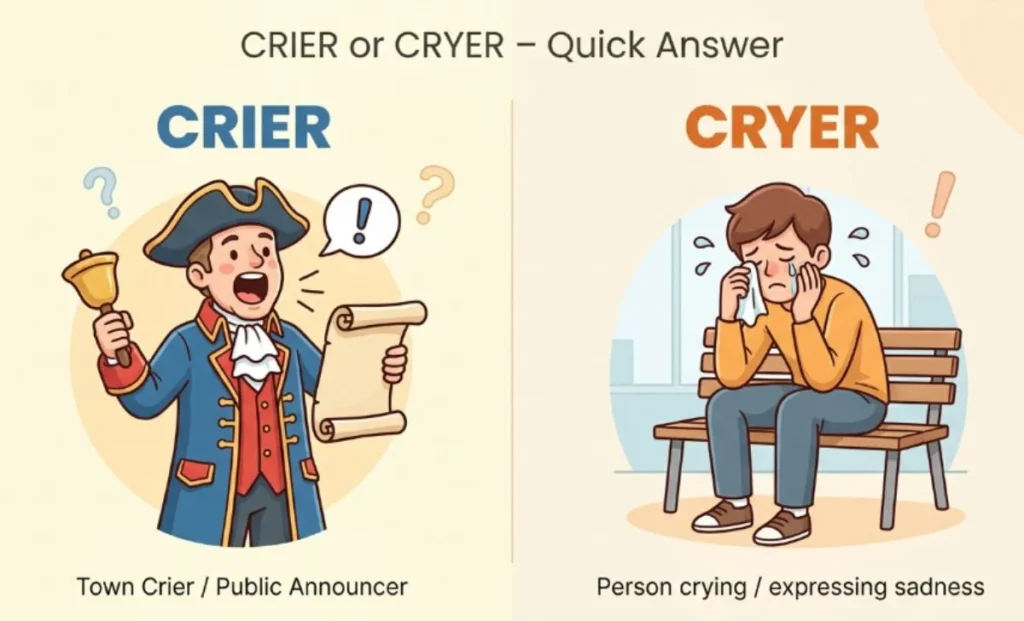
The simplest way to understand:
Crier = A person who makes public announcements (standard English)
Cryer = A person who cries easily or frequently (less common usage)
✔ Examples:
- The town crier announced the festival in the square.
- The baby is a frequent cryer at night.
👉 Easy rule:
- Crier = Information (announcement)
- Cryer = Emotion (tears)
Pronunciation of Crier vs Cryer
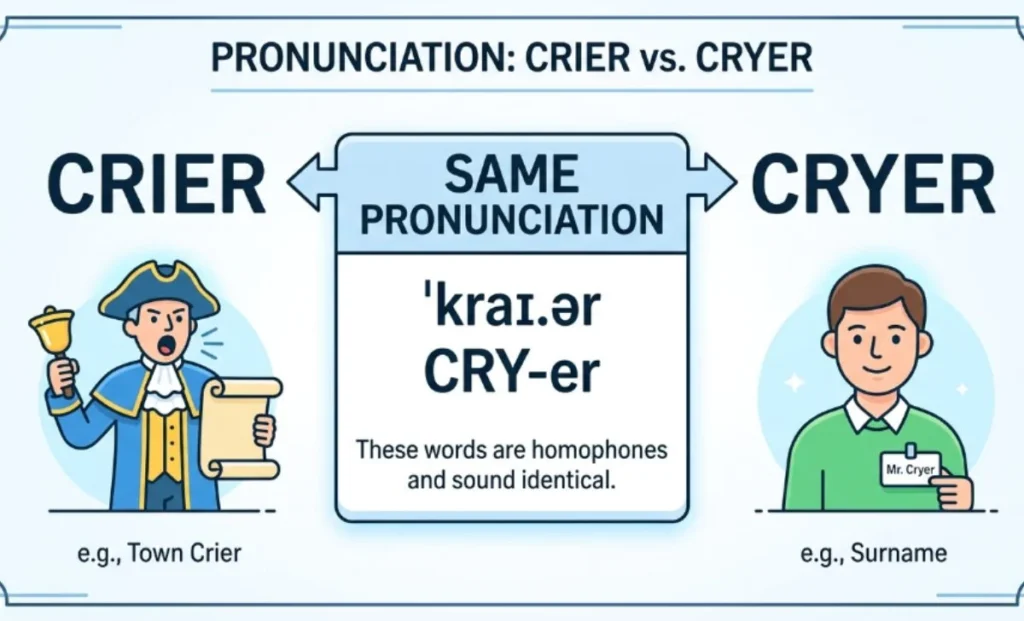
Both words are pronounced the same:
👉 /ˈkraɪər/ (KRIE-er)
Breakdown:
- “Cry” → sounds like krai
- “-er” → sounds like er
- Together → krai-er
Important Note:
Even native speakers do NOT pronounce any difference.
👉 Only spelling and meaning change.
Why People Confuse Crier vs Cryer
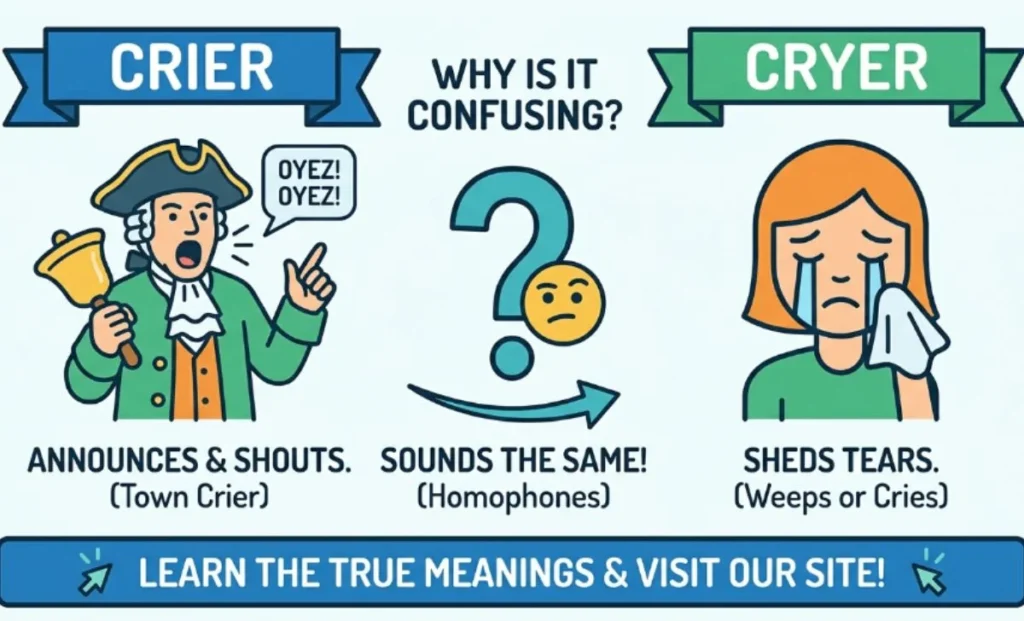
This confusion happens because:
- Both words sound identical
- Only one letter changes (i vs y)
- Both come from the word “cry”
- English spelling is inconsistent
- Online sources sometimes misuse them
👉 Result: learners assume both are correct in all contexts.
Easy Trick to Remember the Difference
Use this simple memory trick:
👉 “I = Information, Y = Tears”
- Crier (i) → gives information (announces news)
- Cryer (y) → shows emotion (crying person)
Another trick:
- Crier = City announcer
- Cryer = Crying baby
👉 This removes confusion instantly.
Origin of Crier vs Cryer
The word “crier” comes from Old French crier, meaning “to shout or proclaim publicly.”
Historically, towns had official criers who:
- announced news
- shared royal orders
- informed public events
The word “cryer” developed from the verb “cry,” meaning:
- to shed tears
- to express strong emotion
👉 Over time, English separated both meanings:
- public shouting → crier
- emotional crying → cryer
British vs American English Usage
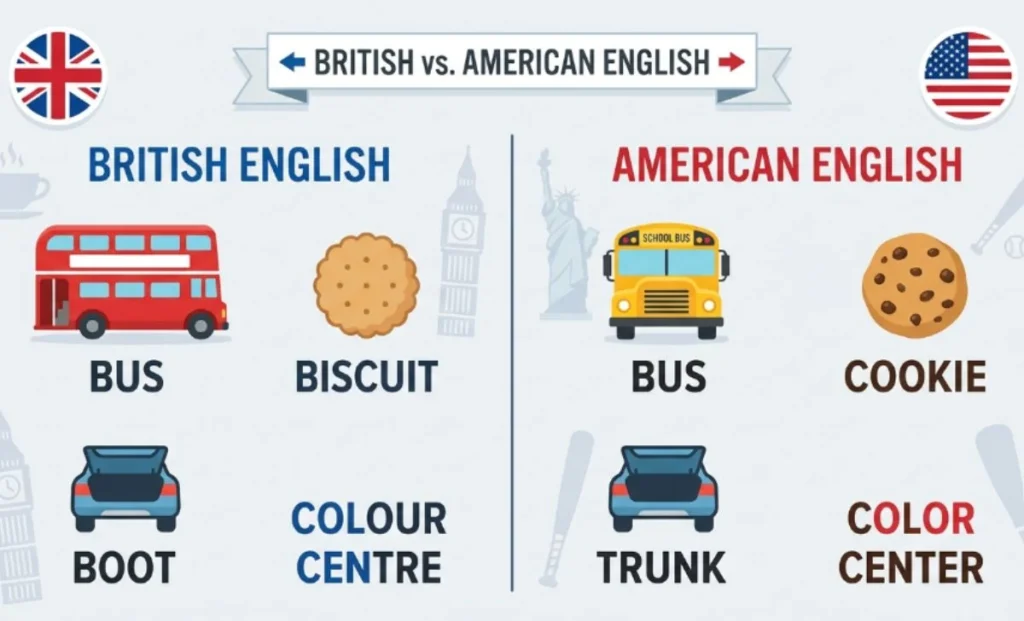
Both British and American English mostly prefer “crier” for official announcers.
| Feature | British English | American English |
|---|---|---|
| Public announcer | Crier | Crier |
| Emotional usage | Rare cryer | Occasional cryer |
| Formal writing | Crier | Crier |
| Standard usage | Same globally | Same globally |
👉 Conclusion:
“Crier” is universally standard. “Cryer” is informal and less used.
Which One Should You Use?
It depends on your writing purpose:
✔ Use “Crier” when:
- Writing academic content
- Writing news articles
- Describing historical roles
- Formal communication
✔ Use “Cryer” when:
- Describing emotional crying (informal writing)
- Creative storytelling
- Casual descriptions
👉 Safe rule:
Always prefer “crier” unless emotion is specifically intended.
Common Mistakes with Crier vs Cryer
Here are frequent errors learners make:
The cryer announced the news.
The crier announced the news.
Don’t be such a crier (meaning announcer).
Don’t be such a crybaby.
Mixing both meanings in formal writing
👉 Tip:
Ask yourself:
- Is this person announcing something? → Crier
- Is this person emotional? → Cryer
Crier vs Cryer in Real-Life Usage
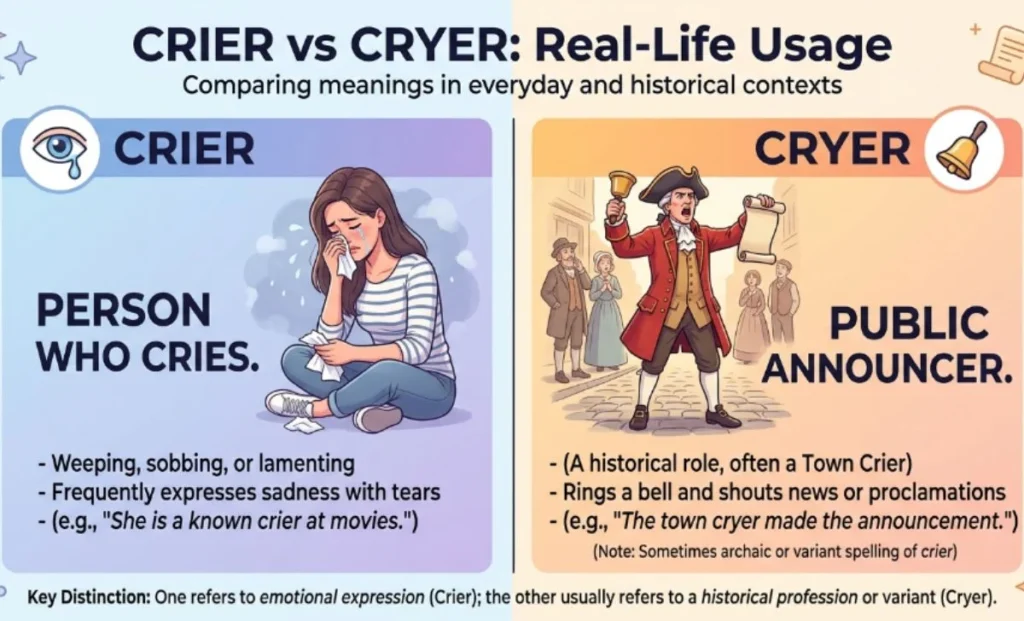
Formal usage:
- The court crier read the verdict aloud.
- The official crier announced the event schedule.
Informal usage:
- She is a cryer during emotional movies.
- The baby is a constant cryer at night.
Media usage:
- The town crier gathered attention in the square.
Comparison Table: Crier vs Cryer
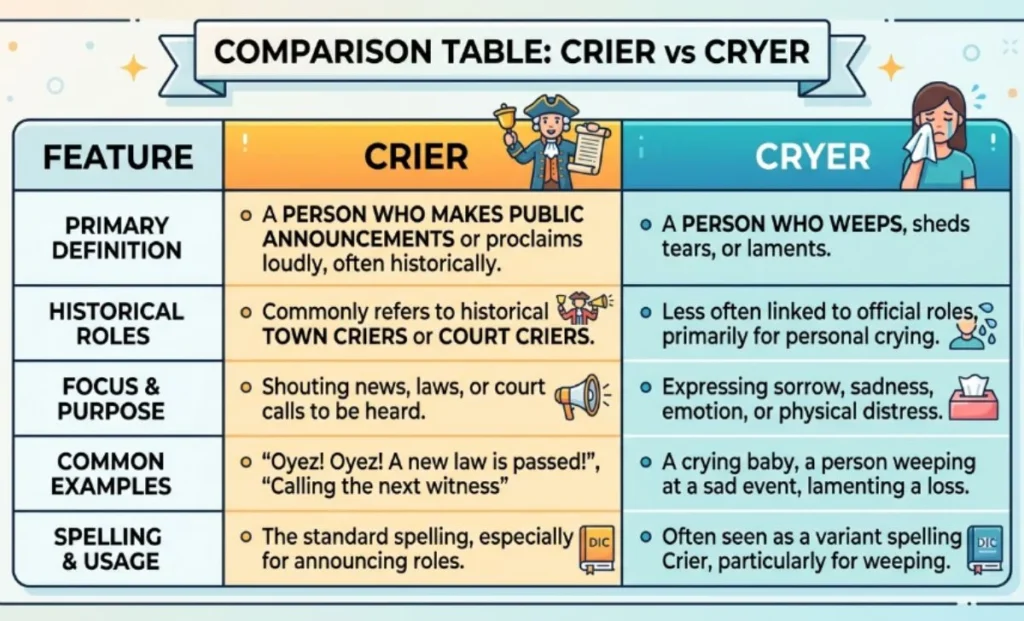
| Feature | Crier | Cryer |
|---|---|---|
| Meaning | Public announcer | Emotional person |
| Usage | Formal & standard | Informal |
| Context | News, law, history | Emotion, personality |
| Correctness | Always correct | Limited usage |
| Example | Town crier | Crying baby |
Crier vs Cryer – Advanced Insight
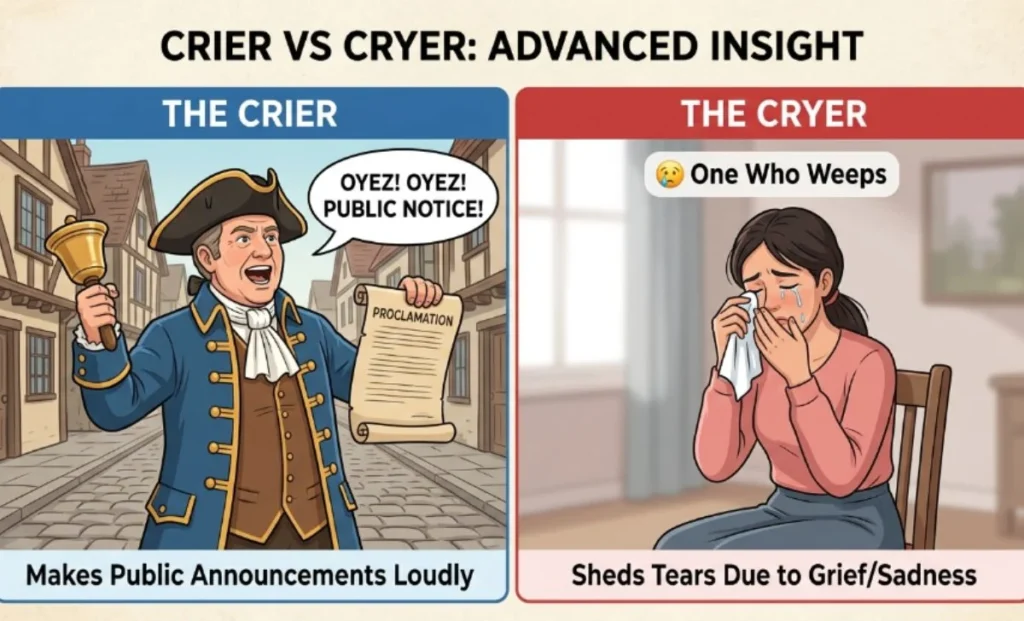
In modern English linguistics:
- “Crier” is classified as a functional noun
- “Cryer” is considered a descriptive/emotive form
👉 That means:
- Crier = job/role
- Cryer = behavior/personality
Crier or Cryer Slang
In slang and everyday English, crier is the correct word for someone who cries easily or becomes emotional. Cryer is usually a misspelling and is rarely accepted in standard dictionaries.
On social media, people may jokingly call someone “a crier” after an emotional movie or touching moment. If you want grammatically correct writing, always choose crier instead of cryer.
Examples:
- After watching the ending, everyone realized I was a crier.
- My friends call me a crier because I tear up during happy moments.
Crier meaning in French
In French, crier is a verb that means “to shout,” “to yell,” “to cry out,” or “to call loudly.” Depending on the context, it can describe raising your voice, calling someone, or expressing strong emotions.
It is a regular -er verb and is commonly used in everyday French conversations. Do not confuse the French verb crier with the English noun crier (such as a town crier), as they have different meanings. The pronunciation is approximately /kree-ay/.
Examples:
- Elle aime crier quand elle est en colère. (She likes to shout when she is angry.)
- Ne criez pas, s’il vous plaît. (Please don’t shout.)
- Il a commencé à crier pour demander de l’aide. (He started to shout for help.)
- Les enfants criaient de joie pendant le match. (The children were shouting with joy during the game.)
I am a crier
“I am a crier” means I cry easily or I tend to cry when I feel strong emotions. It can refer to crying because of sadness, happiness, stress, or touching moments.
The phrase is natural and commonly used in everyday English to describe someone who is emotionally expressive.
It does not necessarily mean the person is weak—it simply describes their emotional response. Similar expressions include “I cry easily” and “I’m an emotional person.”
Examples:
- I am a crier, so emotional movies always make me cry.
- I am a crier, especially at weddings and happy endings.
- Don’t be surprised if I tear up—I am a crier.
- She laughed and said, “I am a crier, even during commercials.”
Pretty crier meaning
A pretty crier is someone who still looks attractive or photogenic while crying. The phrase is popular on TikTok, Instagram, and other social media, where people jokingly compare how they look when they cry.
It is slang, not a formal English expression, and is usually used in a lighthearted or humorous way. The opposite is often called an ugly crier, referring to someone whose face becomes red, puffy, or messy while crying.
Whether someone is a pretty crier is completely subjective and based on personal opinion.
Examples:
- Everyone says she’s a pretty crier because her makeup barely smudges.
- I’m definitely not a pretty crier—my eyes get red and swollen.
- The actress looked like a pretty crier even during the emotional scene.
- The video jokingly asked, “Are you a pretty crier or an ugly crier?”
FAQ,s
1. What is the correct spelling: crier or cryer?
Both exist, but “crier” is the standard correct form.
2. Is cryer a real English word?
Yes, but it is informal and less commonly used.
3. Are crier and cryer pronounced differently?
No, both are pronounced /ˈkraɪər/.
4. Which word should I use in exams?
Always use crier unless context is emotional description.
5. What is a town crier?
A person who historically announced public news loudly in towns.
6. Why are these words confusing?
Because they sound identical and differ by only one letter.
7. Can I replace crier with cryer?
No, it will be grammatically incorrect in formal writing.
Conclusion
The confusion between crier and cryer is common, but once understood, it becomes very simple.
The word crier is the correct and standard form used in modern English for someone who makes public announcements, especially in historical or formal contexts.
On the other hand, cryer refers to a person who cries easily, but it is informal and less widely accepted.
The key to mastering this difference is understanding context. If it involves announcements, news, or official roles, always use “crier.”
If it involves emotions or crying behavior, “cryer” may appear in informal writing. With practice, this distinction becomes natural and helps improve your grammar accuracy and writing clarity.
Read More Blogs:
- Carmel vs Caramel: The Ultimate Guide to Using the Right Word
- Humour or Humor UK vs US English Guide in 2026.
- Successful or Succesful: Which Spelling Is Correct?
- Capital or Capitol: Which Word Is Correct and Why Does It Matter?