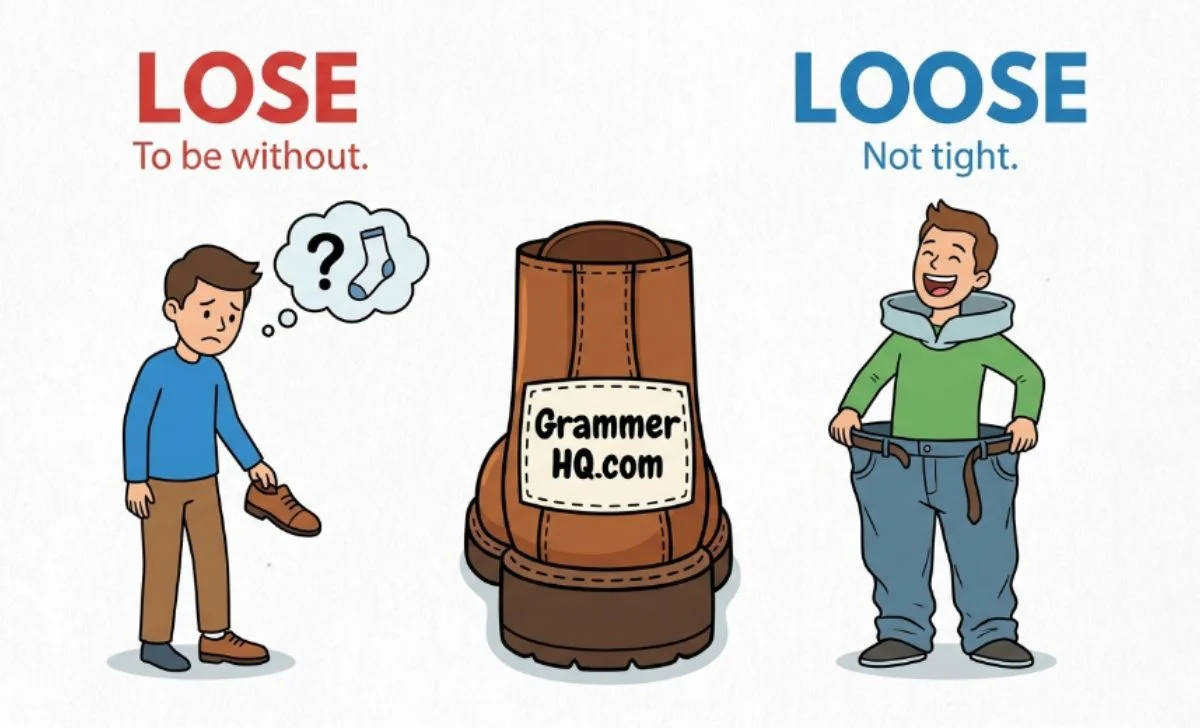
Picture this: you’re writing an important email, and your fingers hover over the keyboard. Should it be “lose” or “loose”? For a split second, doubt creeps in — and you’re far from alone.
This tiny one-letter mix-up is one of the most common spelling traps in the English language, tripping up students, professionals, and even fluent speakers alike.
Here’s the twist: this isn’t just a spelling issue — it’s a meaning issue. Say “I don’t want to lose you” and you’re expressing fear of loss. Say “This shirt feels loose on me” and you’re simply describing fit. One wrong letter, and your entire message changes.
In this guide, we’ll finally put this confusion to rest. No dry grammar rules, no memorization drills — just clear explanations, relatable examples, and clever memory tricks that make the difference between “lose” and “loose” impossible to forget.
By the time you finish reading, you’ll spell it right every single time, without even thinking twice.
Quick Answer
| Feature | Lose | Loose |
|---|---|---|
| Part of Speech | Verb | Adjective |
| Meaning | To misplace something, fail to win, or no longer have something | Not tight, free, or not securely fastened |
| When to Use | When talking about losing an item, game, or opportunity | When describing clothing, objects, or anything that isn’t tight |
| Easy Memory Trick | Lose has one “o” because you lose something | Loose has two “o”s because there’s extra room |
| Example | Don’t lose your keys. | These shoes are too loose. |
Examples
- I don’t want to lose my passport before the trip.
- Our team didn’t want to lose the championship game.
- This jacket is too loose around the shoulders.
- Tie the rope tightly so it doesn’t become loose.
British English vs American English
There is no difference between British English and American English when it comes to lose and loose.
Both varieties use the same spelling, pronunciation, meaning, and grammar for these words. Lose is always a verb meaning to misplace something or fail to win, while loose is always an adjective meaning not tight or free.
Many learners think this is a UK vs US spelling difference, but it is actually a common spelling confusion, not a regional one.
Whether you’re writing in British or American English, using the correct word depends on its meaning in the sentence.
Examples:
- UK: I don’t want to lose my umbrella.
- US: We might lose the game tonight.
- UK: This jacket is too loose for me.
- US: The rope became loose after the storm.
Why Do People Confuse Lose and Loose?
- People often confuse lose and loose because the words look very similar and are only one letter apart. Their pronunciations are also close enough that many English learners and even native speakers mix them up while writing.
- Another common reason is that lose is a verb, while loose is an adjective, so they serve different grammatical purposes. Typing quickly or relying on autocorrect can also lead to spelling mistakes.
- Learning the meaning, pronunciation, and grammar of each word makes it much easier to use the correct spelling every time.
Examples:
✅ The screw became loose after a few weeks.
❌ I always loose my keys. → ✅ I always lose my keys.
❌ Don’t loose the game. → ✅ Don’t lose the game.
✅ These pants are too loose around the waist.
Loose vs lose pronunciation
- Loose is pronounced “looss” (/luːs/), with an “s” sound at the end, while lose is pronounced “looz” (/luːz/), with a “z” sound.
- Although the two words look very similar, their final sounds are different, which changes both pronunciation and meaning.
- Loose means not tight, while lose means to misplace something or fail to win. Learning this pronunciation difference helps you speak and write English more accurately.
Examples:
- Don’t lose your passport before the flight.
- These shoes are too loose for running.
- Our team doesn’t want to lose the final match.
- The screw is loose, so tighten it carefully.
Lose vs Loose Weight
- The correct phrase is lose weight, not loose weight. Lose is a verb that means to reduce body weight, while loose is an adjective meaning not tight or free-fitting.
- If you’re talking about dieting, exercise, or becoming lighter, always use lose weight. Using loose weight is a common spelling mistake because the two words look similar but have different meanings.
Examples:
- She wants to lose weight before her vacation.
- Regular exercise can help you lose weight naturally.
- I started eating healthier to lose weight.
- After losing weight, my old jeans became loose.
Lose vs Loose Power
- The phrase “lose power” is correct because lose is a verb meaning to no longer have something. You lose power when electricity goes out, your phone battery runs down, or a vehicle’s engine becomes weaker.
- Loose power is incorrect because loose means not tight and cannot describe losing electricity or strength. Remember: if something disappears or stops working, always use lose.
Examples:
- We lost power during the storm.
- My phone will lose power if I don’t charge it.
- The car began to lose power while climbing the hill.
- The factory lost power because of a power outage.
Lose vs Loose Quiz
- A Lose vs Loose Quiz is one of the best ways to test whether you can correctly choose between these commonly confused words.
- Each question helps you understand the difference through real-life sentences and practical examples. Remember that lose means to misplace something or fail to win, while loose describes something that is not tight.
- Regular practice improves your grammar, writing accuracy, and confidence in English. Take the quiz and check your answers to avoid making this common spelling mistake in the future.
Examples:
- I don’t want to (lose / loose) my wallet. → Lose
- These shoes are too (lose / loose) for me. → Loose
- If we play well, we won’t (lose / loose) the match. → Lose
- The screw is (lose / loose) and needs to be tightened. → Loose
Lose vs Loose Examples
- I don’t want to lose my passport before the flight.
- Our team may lose the championship if we don’t play well.
- Be careful not to lose your house keys.
- If you don’t study, you could lose valuable marks on the exam.
- These shoes are too loose for running.
- The screw is loose and needs to be tightened.
- She prefers loose clothing during the summer.
- The dog’s collar became loose while playing in the park.
Idioms and Phrases Using Both Words
Idioms with “lose”:
- Lose your temper — to become angry
- Lose track of — to stop keeping count or awareness of something
- Lose face — to be embarrassed publicly
- Lose heart — to become discouraged
- Lose your nerve — to become too afraid to do something
“loose”:
- On the loose — free, especially after escaping
- Loose ends — unfinished details of a task
- Footloose — free from responsibility or commitment
- Cut loose — to relax completely, or to separate from something
- Play fast and loose — to behave carelessly with rules or facts
FAQs
1. Is it lose or loose?
Lose is a verb that means to misplace something or fail to win, while loose is an adjective that means not tight or free-fitting. These two words are often confused because they look and sound similar, but they have different meanings and grammar. Using the correct word makes your writing clearer and more accurate. Remember: you lose your keys, but your shoes can be loose.
Examples:
- I don’t want to lose my phone.
- These jeans are too loose.
- Our team might lose the match.
2. How do you remember the difference between lose and loose?
A simple trick is to remember that loose has two “o”s, just like something has extra room. Lose has only one “o” because when you lose something, it’s gone. This memory trick helps you choose the correct spelling quickly. Practicing with real sentences also makes the difference easier to remember.
Examples:
- Don’t lose your wallet.
- The belt is too loose.
- I hope we don’t lose again.
3. Why do people confuse lose and loose?
People confuse lose and loose because they are spelled similarly and have related pronunciations. Many writers accidentally add an extra “o” when typing lose. However, their meanings are completely different. Learning the grammar rule and seeing examples helps avoid this common mistake.
Examples:
- Never lose hope.
- My shirt feels loose.
- Try not to lose your ticket.
Conclusion
- The entire “lose vs loose” confusion comes down to one idea: lose is an action of losing something, loose is a description of something not being tight or contained.
- Say the word out loud — if it ends in a Z sound, you want “lose.” If it ends in a soft S sound, you want “loose.”
- Keep this guide bookmarked, run through the mnemonics a few times, and this mix-up will disappear from your writing for good.
Read More Blogs: