Coozie vs Koozie can be confusing because both spellings are commonly used for an insulated drink holder that helps keep a beverage cold.
However, Koozie is the established trademarked brand name, while coozie is widely used as a generic spelling for the same type of product.
If you are unsure which word to use, the answer depends on your context. In this guide, you’ll learn the difference between Coozie vs Koozie, what each term means, where the spellings come from, how they are used in.
American English, and which form is best for everyday or formal writing. Clear examples will also help you choose the right term with confidence.
Quick Answer
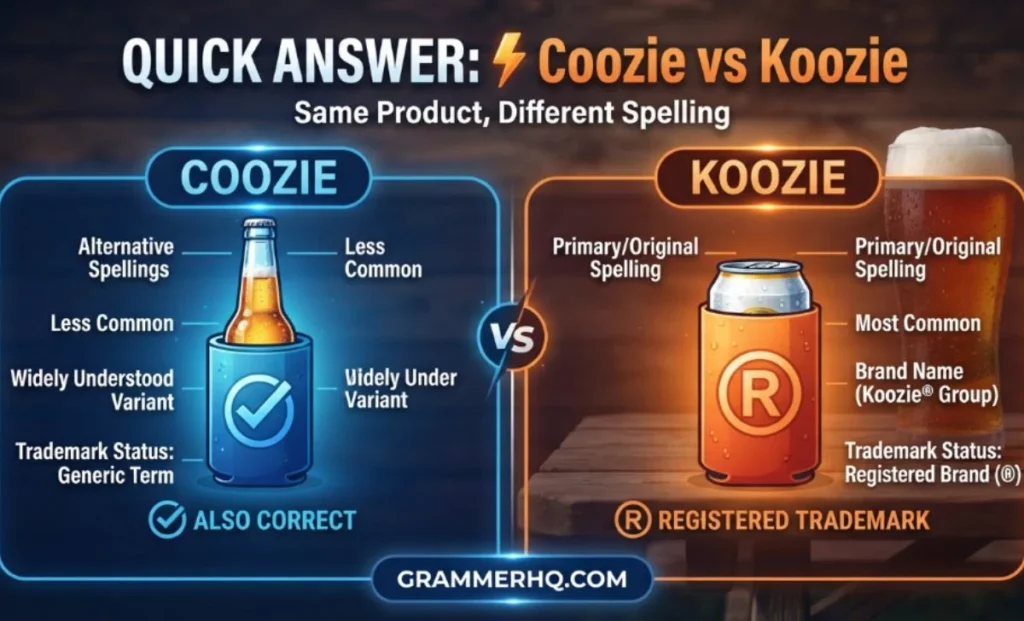
Koozie® is the trademarked brand name. Coozie is a recognized alternative form. Both are pronounced the same and refer to an insulated beverage sleeve in this context.
For a neutral, generic description, can cooler or drink sleeve is usually clearer.
| Term | Meaning | Best use |
| Koozie® | Trademarked brand | Referring specifically to the brand |
| coozie | Alternative form | Everyday or informal usage |
| can cooler | Generic product description | Neutral writing and product listings |
| drink sleeve | Descriptive term | General references |
The easiest rule to remember:
Koozie® = the brand
Coozie = an alternative form
Can cooler = the generic product term
That is more accurate than simply saying “Koozie is correct and coozie is wrong.”
What Is a Coozie or Koozie?
A coozie or Koozie® is an insulated sleeve designed to fit around a beverage container, usually a can or bottle.
Its purpose is simple: it helps keep a cold drink insulated while making the container easier and more comfortable to hold.
It can also reduce the amount of condensation that collects on the outside of a cold can or bottle.
You may see these sleeves at:
- Barbecues
- Tailgate parties
- Picnics
- Beaches
- Sporting events
- Weddings
- Camping trips
- Corporate events
- Promotional events
They can be made from materials such as foam, neoprene, fabric, or other insulating materials.
The product is simple. The spelling is what creates the confusion.
Is Coozie a Misspelling of Koozie?
No—not automatically.
This is where many quick spelling guides oversimplify the answer.
Cambridge Dictionary lists Koozie as a US trademark and specifically gives coozie as an alternative form. Cambridge also lists coozy as a related form.
So calling every use of coozie a spelling mistake would ignore dictionary evidence.
However, there is an important distinction.
If you are referring specifically to the Koozie® brand, then Koozie® is the appropriate branded spelling. If you are using the word casually to describe the familiar drink sleeve, coozie is an established alternative form.
So the real issue is not simply:
Correct vs. incorrect
It is:
Alternative form vs. trademarked brand vs. generic product description
That distinction makes the whole question much easier to understand.
Is Koozie a Trademark?
Yes. Koozie® is a trademarked brand.
Koozie Group identifies KOOZIE® among its brands and provides specific brand standards for how the name should be used.
Its official guidelines make an important point: Koozie should not be used as the generic noun for every drink cooler. Instead, the brand should be paired with the generic product name.
For example:
Koozie® can coolers
is a brand-specific reference.
By contrast:
can coolers
is a generic product description.
This matters particularly in:
- Advertising
- E-commerce
- Promotional merchandise
- Product descriptions
- Business writing
- Brand-related content
In ordinary conversation, people may use koozie more loosely. But when accuracy matters, distinguishing the brand from the product category is the better approach.
Coozie vs Koozie: What’s the Actual Difference?
The physical object may be essentially the same type of product, but the status of the words is different.
| Feature | Coozie | Koozie® |
| Pronunciation | KOO-zee | KOO-zee |
| Refers to an insulated drink sleeve | Yes | Yes |
| Recognized by Cambridge | Yes, as an alternative | Yes |
| Trademarked brand form | No | Yes |
| Best for official brand reference | No | Yes |
| Generic alternative | Can cooler | Can cooler |
The biggest difference is therefore not pronunciation or function.
It is branding and context.
For example:
“Pass me a coozie.”
This is natural informal usage.
But:
“The company ordered Koozie® can coolers.”
This specifically identifies the Koozie® brand. Koozie Group’s own standards recommend this kind of brand-plus-product construction.
How Do You Pronounce Coozie and Koozie?
Both coozie and Koozie are pronounced:
KOO-zee
Cambridge Dictionary gives Koozie the pronunciation /ˈkuː.zi/.
Changing the first letter from K to C does not create a meaningful pronunciation difference.
That identical pronunciation is one reason the spelling is so easy to confuse.
You could hear:
“Where’s the coozie?”
or:
“Where’s the Koozie?”
The spoken words sound the same.
Why Are Coozie and Koozie Spelled Differently?
The difference is largely connected to brand spelling and everyday language use.
Koozie® is the established brand form. Because people hear the word rather than see it written, coozie is an intuitive alternative spelling: the opening sound naturally suggests coo-.
This is common with unfamiliar words. Speakers may create a spelling that seems logical from pronunciation, even when an established written form already exists.
There is also a linguistic connection between koozie and forms related to cozy/cosy, although the exact history does not need to be overexplained to answer today’s spelling question.
The practical takeaway is enough:
Koozie® is the trademarked brand spelling, while coozie is a recognized alternative form.
Koozie vs Can Cooler: Are They the Same Thing?
They can refer to the same type of physical product, but they are not identical terms in branding.
A can cooler is a generic description. It tells the reader what the product is.
Koozie® identifies a specific brand.
Compare these:
Generic: We ordered 100 insulated can coolers.
Brand-specific: We ordered Koozie® can coolers.
Everyday: I need a coozie for my soda.
All three sentences are understandable, but they communicate slightly different things.
Koozie Group’s official standards specifically distinguish Koozie®-branded products from non-branded can coolers.
So if you are writing a neutral product description, can cooler is often the safest and clearest choice.
Which Should You Use in Your Writing?
The best choice depends on what you mean.
In casual conversation
Coozie is a natural alternative.
“Can you pass me a coozie?”
The meaning is clear from context.
When describing the product generally
Use can cooler, drink sleeve, or another descriptive term.
“Our neoprene can coolers fit standard cans.”
This makes the product category clear without relying on a brand name.
When referring to the brand
Use Koozie®.
“The company ordered Koozie® can coolers for the event.”
Koozie Group’s brand standards recommend using the trademark with a generic product name and not using the brand as a generic noun.
In a spelling article
Use both coozie and Koozie®.
Since the spelling itself is the subject, discussing both forms gives the reader the complete answer.
Coozie vs Koozie: Real-Life Examples
Context makes the distinction easier to remember.
Everyday conversation
“Grab a coozie before you head outside.”
Here, coozie is being used informally.
Generic product description
“These neoprene can coolers help reduce condensation.”
Here, can coolers clearly describes the product category.
Official brand reference
“The company ordered Koozie® can coolers with its logo.”
Here, Koozie® identifies the brand, while can coolers identifies the product.
Party
“Everyone got a personalized coozie.”
The alternative form works naturally in casual writing.
Online store
“Our insulated drink sleeves come in several sizes.”
The seller is using a neutral descriptive term.
Business proposal
“We recommend custom can coolers as event giveaways.”
The generic term avoids unnecessary brand ambiguity.
Other Names for a Coozie or Koozie
Depending on the product and region, you may encounter several related terms:
- Can cooler
- Drink sleeve
- Beverage sleeve
- Can sleeve
- Bottle cooler
- Beverage insulator
- Insulated drink holder
- Beer sleeve
- Stubby holder
These terms are not perfect synonyms in every situation. A bottle cooler, for example, may have a different design from a sleeve made specifically for a standard can.
Regional vocabulary can also vary. Stubby holder, for example, is a familiar term in Australian English.
If you simply want a clear generic term in American English, can cooler is an excellent choice.
Is “Koozie” Capitalized?
When you are referring to the trademarked brand, use Koozie® according to the brand’s usage standards.
Koozie Group specifically instructs users to capitalize the brand and use the registration symbol in appropriate branded references. Its guidelines also recommend using the trademark as an adjective with a generic product name.
For example:
Koozie® can cooler → branded reference
can cooler → generic reference
coozie → recognized alternative form
You may see koozie in lowercase across informal websites and social media. That does not automatically mean the writer is following the official trademark style.
Is Koozie an American English Word?
Koozie is strongly associated with American English usage.
Cambridge Dictionary labels Koozie as a US trademark and defines it as a brand name for a sleeve used with a drink bottle or can.
But coozie vs Koozie is not a British-versus-American spelling difference.
It is not like:
- color / colour
- center / centre
- organize / organise
You should therefore not describe coozie as the British version of Koozie.
The more useful distinction is:
Koozie® → trademarked brand
coozie → alternative form
can cooler → generic description
Common Mistakes With Coozie and Koozie
1: Saying “Coozie is always wrong”
That is too absolute. Cambridge Dictionary explicitly lists coozie as an alternative form.
2: Calling every drink sleeve a Koozie®
Koozie® is a trademarked brand. Not every generic can cooler is automatically a Koozie® product.
3: Assuming the two spellings sound different
They are normally pronounced the same:
KOO-zee
4: Treating this as a US-vs-UK spelling issue
It is not comparable to color/colour or center/centre.
5: Using Koozie as a generic product name in formal brand usage
Koozie Group’s own standards specifically caution against treating the trademark as a generic noun and recommend constructions such as Koozie® can coolers.
Coozie vs Koozie: Which One Is Correct?
If someone asks, “Is it coozie or Koozie?”, the most accurate answer is:
Both forms are used, but they do not have exactly the same status.
Koozie® is the trademarked brand name.
Coozie is a recognized alternative form.
Can cooler is a clear generic term for the product.
That is why simply saying “Koozie is correct and coozie is wrong” does not fully answer the question.
Likewise, saying “they are exactly the same in every context” misses the trademark distinction.
The context matters.
FAQs
1: Is coozie or Koozie correct?
Both forms are used. Koozie® is the trademarked brand name, while Cambridge Dictionary recognizes coozie as an alternative form. For a neutral product description, can cooler is often clearer.
2: Is coozie a real word?
Yes. Cambridge Dictionary lists coozie as an alternative form of Koozie, so it should not automatically be treated as a spelling mistake.
3: Is Koozie a trademark?
Yes. Cambridge identifies Koozie as a US trademark, and Koozie Group identifies KOOZIE® as one of its brands.
4: Why is Koozie spelled with a K?
Koozie is the established trademark spelling. Coozie is an alternative form that naturally reflects the same pronunciation.
5: How do you pronounce Koozie?
Koozie is pronounced KOO-zee, represented by Cambridge as /ˈkuː.zi/.
6: Is a Koozie the same as a can cooler?
A Koozie® can be a type of can cooler, but Koozie® is a brand name, while can cooler is a generic product description.
7: What is another word for Koozie?
Common alternatives include can cooler, drink sleeve, beverage sleeve, can sleeve, bottle cooler, insulated drink holder, and stubby holder, depending on the product and region.
8: Should Koozie be capitalized?
When referring to the trademarked brand, Koozie® is the appropriate branded form. Koozie Group’s standards also recommend using the trademark with a generic product name.
9: What is a Koozie used for?
A Koozie® is an insulated sleeve used around a beverage can or bottle. It helps insulate the drink and makes the container easier to hold.
10: Is coozie the same as cozy?
No. In this context, coozie refers to an insulated beverage sleeve, while cozy means comfortable, warm, or snug.
11: Is Koozie an American spelling?
Not exactly. Cambridge identifies Koozie as a US trademark, but coozie is not simply its British spelling. The distinction is about trademark and alternative usage, not American versus British English.
Final Verdict
Coozie and Koozie are not simply a “wrong versus right” spelling pair.
Koozie® is the trademarked brand name.
Coozie is a recognized alternative form.Can cooler is the clearest generic description when you are not referring to a specific brand.So when you see coozie vs Koozie, remember three simple rules:
Koozie® = the brand.
Coozie = an alternative form.
Can cooler = the generic product term.
Once you understand that distinction, the spelling becomes much less confusing, and you no longer have to force the answer into a simple “right or wrong” rule.
Read More Blogs:
- Which or Wich? Correct Spelling, Meaning, Origin & Examples
- Humorous vs. Humerous: Which Spelling Is Correct?