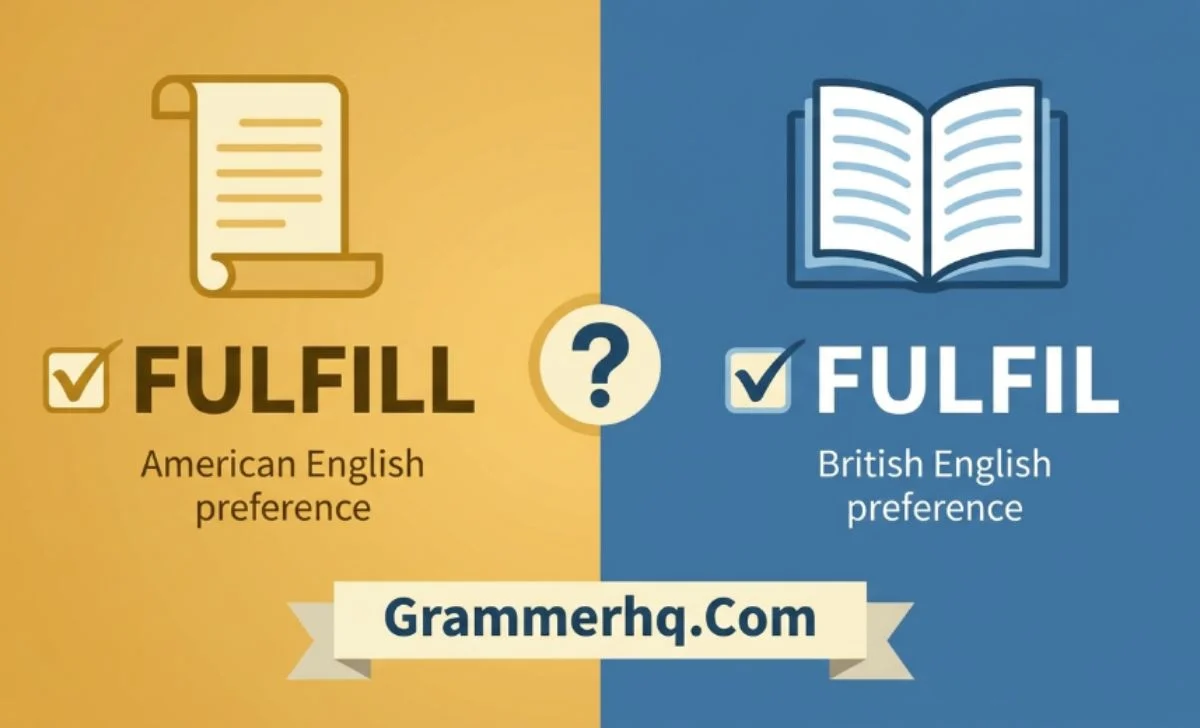
When deciding between Fulfill or Fulfil 2026, many English learners wonder which spelling is correct. Both fulfill and fulfil have the same meaning and pronunciation, but they follow different regional spelling conventions.
Fulfill is the standard spelling in American English, while fulfil is preferred in British English and other varieties that follow British spelling.
Understanding this difference can help you choose the right spelling for emails, academic writing, professional documents, and everyday communication.
In this guide, you’ll learn the meaning, pronunciation, origin, usage, examples, synonyms, and key differences between fulfill and fulfil.
Quick Answer
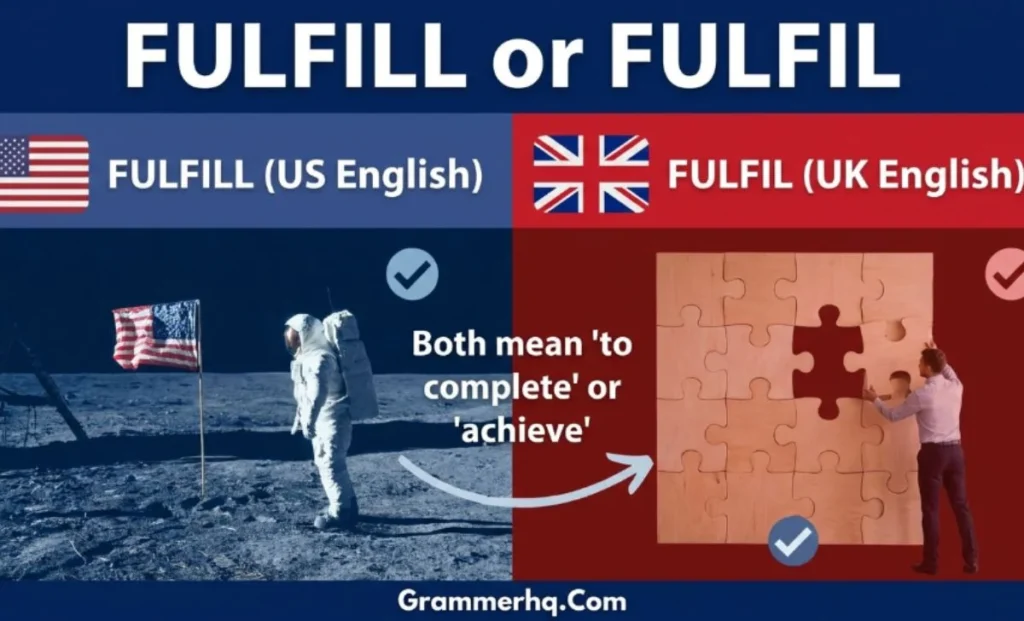
Both “fulfill” and “fulfil” are correct spellings.
- Fulfill is the preferred spelling in American English.
- Fulfil is the preferred spelling in British English and many Commonwealth countries.
Examples:
- American English: The company will fulfill your order tomorrow.
- British English: The company will fulfil your order tomorrow.
The meaning stays exactly the same in both forms.
Pronunciation of Fulfill or Fulfil
The words fulfill and fulfil are pronounced the same way.
Pronunciation: ful-FIL
Phonetic spelling: /fʊlˈfɪl/
The stress falls on the second part of the word: FIL.
Examples:
- She hopes to fulfill her dream.
- They promised to fulfil all customer requests.
There is no pronunciation difference between American and British English. The only difference is spelling.
Because the words sound identical, many learners become confused when writing them.
Why People Confuse Fulfill or Fulfil
People mix up these spellings for several reasons.
1. Both Spellings Are Correct
Unlike many commonly confused words, neither spelling is wrong. This often creates uncertainty.
2. The Words Sound Identically
Since both forms are pronounced exactly the same, writers cannot rely on pronunciation to choose the correct spelling.
3. Regional English Differences
American English and British English often use different spellings.
Examples include:
| American English | British English |
|---|---|
| color | colour |
| traveled | travelled |
| fulfill | fulfil |
| organize | organise |
These regional variations make writers unsure which version to use.
4. Online Content Uses Both Forms
The internet contains articles from different countries. A reader may see “fulfill” on one website and “fulfil” on another.
5. Spellcheck Tools Vary
Many writing programs automatically suggest spellings based on language settings.
For example:
- US English settings usually suggest fulfill.
- UK English settings usually suggest fulfil.
Easy Trick to Remember Fulfill or Fulfil
You can remember the difference using these simple tricks.
1: Think of the Audience
- Writing for Americans? Use fulfill.
- Writing for British readers? Use fulfil.
2: the Double “L”
American English often prefers simplified or doubled endings.
US = fulfill = double “ll”
3: Match Your Existing Style
If your document already uses:
- color → use fulfill
- colour → use fulfil
Keeping spelling consistent makes your writing look professional.
The Origin of Fulfill or Fulfil
The word fulfill dates back to Old English. It developed from the combination of full, meaning “complete,” and fillan, meaning “to fill.”
The original idea was to make something full or complete, which later developed into meanings such as carrying out a duty, meeting a requirement, or satisfying a promise.
As English evolved, spelling conventions began to differ between regions. Fulfil became the preferred spelling in British English and remains standard in the UK and many other varieties of English. In American English, fulfill became the established spelling, with a double l.
Today, both fulfil and fulfill are correct spellings. The main difference is regional: fulfil is generally preferred in British English, while fulfill is standard in American English.
British English vs American English Spelling
English spelling differs across regions. The difference between fulfill and fulfil follows this pattern.
Regional Preferences
| Region | Preferred Spelling |
|---|---|
| United States | fulfill |
| United Kingdom | fulfil |
| Canada | both used, fulfil slightly common in formal contexts |
| Australia | fulfil |
| New Zealand | fulfil |
| International audiences | depends on style guide |
Comparison Table
| Feature | Fulfill | Fulfil |
|---|---|---|
| Meaning | Complete or carry out | Complete or carry out |
| Correct? | Yes | Yes |
| Pronunciation | Same | Same |
| English Variety | American English | British English |
| Formal Writing | Yes | Yes |
| Common In | USA | UK, Australia |
| Dictionary Status | Standard | Standard |
Examples:
American English
- We will fulfill all orders within two days.
- She fulfilled every requirement.
British English
- We will fulfil all orders within two days.
- She fulfilled every requirement.
Notice that the past tense, fulfilled, remains the same.
Which Spelling Should You Use?
Choosing the right spelling depends on your audience.
Use “Fulfill” If:
- You write for readers in the United States.
- Your website targets American traffic.
- Your company follows American style guides.
- You use American spelling throughout your content.
Use “Fulfil” If:
- Your audience lives in the United Kingdom.
- You write for Australia or New Zealand.
- Your publication follows British style conventions.
For Global Websites
Choose one spelling and use it consistently.
Consistency matters more than the specific choice.
Many international companies select either US English or UK English and apply it across all pages.
Common Mistakes With Fulfill or Fulfil
Writers often make these mistakes.
| Incorrect Usage | Correct Usage |
|---|---|
| Mixing both spellings in one article | Choose one spelling style |
| The company will fulfil orders. (US website) | The company will fulfill orders. |
| The company will fulfill orders. (UK publication) | The company will fulfil orders. |
| Fulfilled all duties | Fulfilled all duties |
| Fulfiled all duties | Fulfilled all duties |
| Fulfill requirement | Fulfill requirements |
| He fulfilleded the promise | He fulfilled the promise |
| Using random spellings | Follow your style guide |
Example of Inconsistent Writing
❌ Our company will fulfill all orders. We also promise to fulfil every request.
✔ Our company will fulfill all orders. We also promise to fulfill every request.
Consistency creates professionalism.
Fulfill or Fulfil in Everyday Examples
The spelling depends on the variety of English you are using. Fulfill is standard in American English, while fulfil is preferred in British English. Here are some natural examples from everyday, professional, academic, and casual situations.
Email Example
American English:
“We are pleased to confirm that we will fulfill your order by Friday.”
British English:
“We are pleased to confirm that we will fulfil your order by Friday.”
Business Writing
- “The company fulfilled all of its contractual obligations.”
- “The supplier has fulfilled the terms of the agreement.”
- “The new service is designed to fulfill customer needs.” (American English)
Academic Writing
- “Students must fulfil all course requirements before graduation.” (British English)
- “The research project fulfilled the study’s objectives.”
- “Applicants must fulfill all admission requirements.” (American English)
News Headlines
- “Company Fulfills Thousands of Holiday Orders”
- “Charity Helps Fulfil Children’s Wishes”
Social Media Examples
- “I finally fulfilled my lifelong dream!”
- “It feels amazing to have fulfilled one of my biggest goals.”
- “She fulfilled her dream of running a marathon.”
Casual Conversation
- “I hope you fulfill all your ambitions.”
- “She fulfilled her promise to help me.”
- “He worked hard to fulfil his dream of becoming a teacher.” (British English)
Quick Tip
When writing for an American audience, use fulfill. When writing for a British audience, use fulfil. The meaning is the same; only the preferred spelling differs.
Fulfill or Fulfil Synonyms
Fulfill and fulfil have the same meaning, so they can be replaced by many of the same words depending on the context.
Common synonyms include complete, accomplish, achieve, perform, execute, carry out, satisfy, meet, and realize.
The best synonym depends on how the word is being used:
- Accomplish — for goals, tasks, or objectives
- Achieve — for goals, ambitions, or desired results
- Satisfy — for requirements, conditions, or needs
- Meet — for expectations, requirements, or obligations
- Complete — for tasks, projects, or duties
- Carry out — for plans, instructions, or responsibilities
- Realize — for dreams, ambitions, or hopes
Remember that fulfill is the standard spelling in American English, while fulfil is preferred in British English. The meaning remains the same; only the spelling differs.
Fulfill vs Fulfil Comparison Table
| Feature | Fulfill | Fulfil |
|---|---|---|
| Meaning | To carry out, achieve, or complete | To carry out, achieve, or complete |
| Part of Speech | Verb | Verb |
| Pronunciation | /fʊlˈfɪl/ | /fʊlˈfɪl/ |
| Region | United States | United Kingdom and Commonwealth |
| Correct Spelling | Yes | Yes |
| Formal Writing | Accepted | Accepted |
| Preferred In | American English | British English |
| Example | Fulfill a promise | Fulfil a promise |
FAQ,s
1. Is “fulfill” or “fulfil” correct?
Both fulfill and fulfil are correct spellings. Fulfill is the standard spelling in American English, while fulfil is the preferred spelling in British English and other varieties that follow British spelling conventions.
2. What is the difference between fulfill and fulfil?
There is no difference in meaning or pronunciation between fulfill and fulfil. The only difference is spelling. American English generally uses fulfill, while British English generally uses fulfil.
3. Is “fulfil” British or American English?
Fulfil is the standard British English spelling. It is also commonly used in other English varieties influenced by British spelling, including Australian and New Zealand English.
4. Is “fulfill” American English?
Yes. Fulfill is the standard spelling in American English. It is commonly used in US books, newspapers, websites, dictionaries, and professional writing.
5. Is “fulfil” wrong in American English?
No. Fulfil is not a misspelling that Americans cannot understand. However, fulfill is the conventional spelling in American English, so it is the better choice when writing specifically for a US audience.
6. Which is more common: fulfill or fulfil?
The answer depends on the variety of English. Fulfill is generally more common in American English, while fulfil is more common in British English.
Because American English is widely used online, fulfill may appear more frequently across global web content.
7. How do you spell the past tense of fulfill or fulfil?
The past tense and past participle of both forms are fulfilled. For example: “She fulfilled her promise.” The spelling fulfilled uses a double l in both British and American English.
8. How do you spell fulfilling: fulfill or fulfil?
The correct form is fulfilling in both British and American English. For example, “Teaching can be a very fulfilling career.” The spelling does not become fulfiling.
9. Should I use fulfill or fulfil on my website?
Use the spelling that matches your target audience and remain consistent. If your website primarily targets readers in the United States, use fulfill. If you target the UK or another audience that follows British English, use fulfil.
10. Does Google prefer fulfill or fulfil?
Google does not require one spelling over the other. Both fulfill and fulfil are valid English spellings. For SEO, it is more important to create useful, natural content and use the spelling that fits your target audience and chosen variety of English.
Conclusion
The debate over fulfill or fulfil is easy to solve once you understand regional spelling rules. Both spellings are correct and carry exactly the same meaning. The only real difference is geography.
Use fulfill if you write for an American audience. Use fulfil if your readers are mainly in the United Kingdom or other Commonwealth countries.
Most importantly, stay consistent. Mixing spellings within the same article, email, or document can reduce professionalism.
Whether you choose fulfill or fulfil, your audience will understand your message clearly as long as you follow one style throughout your writing.
Read More Blogs:
- Insite or Insight? Correct Spelling, Meaning & Usage Explained
- Honor or Honour: Which Spelling Is Correct In 2026

Hi, I’m Amelia Parker, a grammar enthusiast and writer at GrammarHQ.com. I specialize in explaining spelling differences, confusing words, and common English mistakes through simple, practical, and easy-to-understand guides.