Have you ever written dryer or drier and stopped because both look right? You are not alone. The two words are closely related, sound alike in many varieties of English, and are both connected with the idea of becoming dry.
But they do not usually do the same job in a sentence.The most common distinction is simple: drier means “more dry” or “less wet,” while dryer usually refers to a machine or device that dries something.
For example, the air can become drier, while your clothes go into a dryer. There is, however, a useful detail that many quick grammar guides leave out: drier can also be a noun in certain contexts.
This guide explains the difference clearly, including spelling, grammar, pronunciation, British and American usage, common mistakes, and real-life examples.
Quick Answer
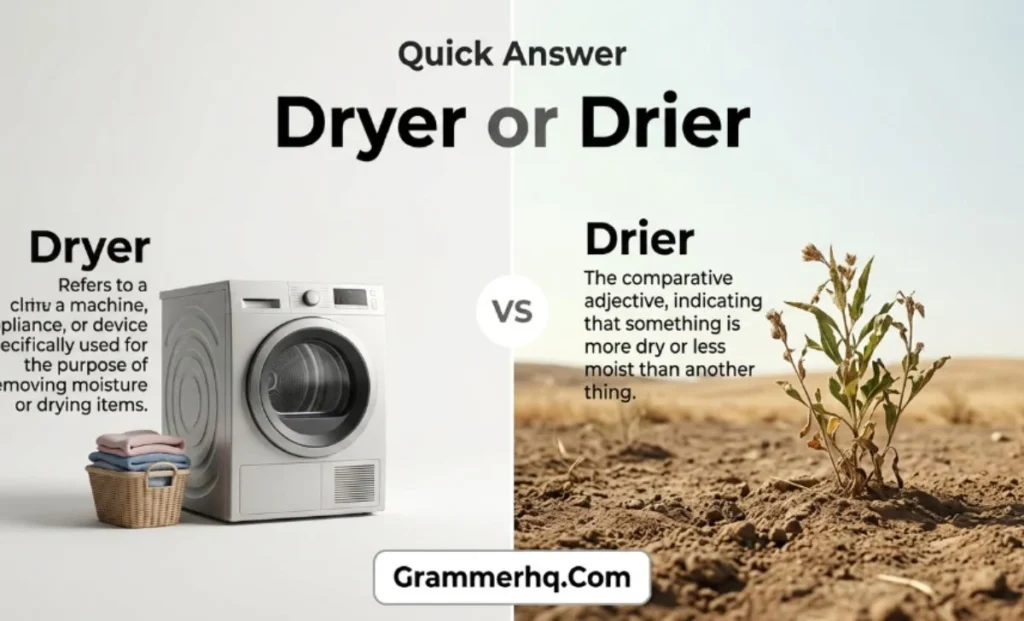
Drier is usually the comparative form of dry, meaning “more dry” or “less wet.”
Dryer is usually a noun for a machine or device that dries something, such as a clothes dryer, hair dryer, or hand dryer. Cambridge also recognizes drier as a noun variant of dryer.
| Word | Usual use | Part of speech | Example |
|---|---|---|---|
| drier | More dry or less wet | Comparative adjective | The air is drier today. |
| dryer | Something that dries | Noun | Put the clothes in the dryer. |
The easiest practical rule is:
A dryer makes things drier.
So if you are describing a change in dryness, choose drier. If you are naming an everyday drying appliance, dryer is normally the clearest choice.
What Does Drier Mean?
Drier Means “More Dry”
Drier is the comparative form of the adjective dry.
It tells us that one thing has less moisture than another thing or than it had before.
The pattern is:
dry → drier → driest
For example:
- The weather is drier this week.
- This towel is drier than that one.
- The soil becomes drier during hot weather.
- The air is drier in the desert.
- My skin feels drier during winter.
In each example, drier describes a condition. It does not name a machine.
Why Is It “Drier” Instead of “Dryer”?
This is a spelling rule rather than a special exception.
When dry forms its comparative, the final y changes to i before -er:
dry → drier
You see the same pattern in:
- happy → happier
- easy → easier
- busy → busier
- heavy → heavier
So when you mean “more dry,” the standard comparative spelling is drier, not dryer. Grammarly also gives dry → drier as the comparative pattern.
What Does Dryer Mean?
Dryer Usually Names Something That Dries
Dryer is commonly a noun for a machine or device designed to remove moisture.
Examples include:
- clothes dryer
- hair dryer
- hand dryer
- tumble dryer
- grain dryer
- spin dryer
Cambridge defines dryer as a machine that dries things and gives examples such as a hair dryer and grain dryer.
Consider these sentences:
- The clothes are still in the dryer.
- My hair dryer stopped working.
- The restroom has an automatic hand dryer.
- The hotel provides a hair dryer.
- The farmer uses a grain dryer.
The important idea is not “dryer means clothes machine.” It is broader:
A dryer is something designed to dry something else.
Drier vs Dryer: The Real Difference
The difference becomes much easier when you ask what role the word plays.
Use Drier for a Comparison
Use drier when you mean more dry or less wet.
The weather is drier today.
This towel is drier than the other one.
The climate is becoming drier.
Here, the word describes the level of dryness.
Use Dryer for a Drying Device
Use dryer when you are talking about a device that dries something.
Put the towels in the dryer.
I need a new hair dryer.
The hand dryer is not working.
Here, dryer names a thing.
One Sentence That Makes the Difference Obvious
The dryer made the clothes drier.
This sentence is worth remembering because both words appear together:
- dryer = the machine
- drier = less wet
Once you understand that distinction, most dryer-or-drier questions become easy.
Why Are Drier and Dryer So Easy to Confuse?
👉 There are several reasons why these two words are easy to confuse.
They Come From the Same Root
Both words are connected to dry, so their spelling and meaning naturally overlap.
They Sound the Same or Nearly the Same
In ordinary speech, drier and dryer are pronounced alike or very similarly. That means listening alone often cannot tell you which spelling is intended.
Both Are Connected With Drying
A dryer makes something drier, so the two words can appear together in the same sentence.
Their Spellings Differ by Only One Letter
The visual difference is small:
drier
dryer
That single i/y difference can cause hesitation, especially when typing quickly.
Is Drier or Dryer Correct for a Machine?
For an ordinary household appliance, dryer is usually the clearest and most familiar choice.
Write:
- clothes dryer
- hair dryer
- hand dryer
- tumble dryer
However, there is an important nuance.
It would be incorrect to claim that drier can never be a noun. Cambridge lists drier as a noun meaning a machine that dries things and marks it as an alternative form of dryer.
So the practical advice is:
Use dryer for common household and everyday appliance names.
At the same time, do not assume that every occurrence of the noun drier is a spelling error. You may encounter it in technical, specialized, historical, or regional usage.
This is one reason the simple rule “drier is an adjective and dryer is a noun” is useful for learners but not the complete picture.
Is Drier British and Dryer American?
Not exactly. That distinction is too simple.
It is tempting to memorize this as:
British English = drier
American English = dryer
But that rule is too broad.
The words can overlap across English varieties. Cambridge, for example, lists dryer (also drier) for the noun referring to a drying machine.
For everyday writing, dryer is a very familiar spelling for appliances, particularly in American English. British English commonly uses terms such as tumble dryer as well.
The more useful distinction is therefore based on meaning and grammatical function, not nationality:
- drier = usually “more dry”
- dryer = usually a drying device
Regional preferences can affect the noun spelling, but they do not change the standard comparative form:
dry → drier
How Do You Pronounce Drier and Dryer?
Drier and dryer are normally pronounced the same or very similarly.
Cambridge gives the same pronunciation for its noun entries, with UK and US phonetic forms.
That explains why this confusion is mainly a spelling and context problem, not a pronunciation problem.
Compare:
“The air is getting drier.”
with:
“The dryer is running.”
When spoken aloud, the context carries much of the meaning. In writing, however, you need to choose the appropriate spelling.
Drier Can Also Be Used Figuratively
Drier does not always describe physical moisture. It can also describe a style, tone, or sense of humor.
It can also describe a style, tone, or sense of humor.
For example:
Her writing has a drier tone than her earlier work.
He has a drier sense of humor than his brother.
In this use, drier suggests something more restrained, understated, or deadpan rather than literally containing less water.
GrammarBook also notes this figurative use of drier with humor and writing style.
This is a useful reminder that the word dry has meanings beyond physical moisture, and its comparative form drier can follow those meanings too.
Common Mistakes With Drier and Dryer
1: Using Dryer for “More Dry”
❌ The air is dryer today.
✅ The air is drier today.
The sentence compares the dryness of the air, so drier is needed.
2: Using Drier for the Everyday Appliance
❌ Put the clothes in the drier.
✅ Put the clothes in the dryer.
For a normal household appliance, dryer is the usual and clearer spelling.
3: Confusing “Drier Clothes” With “Dryer”
Consider:
I want the drier clothes.
Here, drier means clothes that are more dry.
But:
I put the clothes in the dryer.
Here, dryer is the machine.
The difference is small in spelling but significant in meaning.
4: Thinking Dryer Is Never an Adjective
In the sentence:
The dryer clothes were packed first.
the word may look confusing because dryer can appear before a noun. But the intended comparative adjective is normally drier when the meaning is “more dry.”
So:
The clothes are drier.
is the clear standard form for the comparative adjective.
5: Assuming Drier Is Never a Noun
This is the opposite error.
Dictionaries recognize drier as a noun in certain contexts. So saying “drier is always wrong when referring to a device” goes too far.
For ordinary household appliances, dryer remains the safer everyday choice.
Drier or Dryer: An Easy Memory Trick
Here is the simplest way to remember the difference:
A dryer makes things drier.
Think about laundry.
The dryer is the machine.
After the cycle finishes, your clothes are drier.
You can also use the “more dry” test.
If you can replace the word with more dry, use drier:
The air is more dry today.
→ The air is drier today.
If you mean a device that performs the drying, use dryer:
I put the clothes in the dryer.
This quick test works for most everyday situations.
Drier and Dryer in Everyday Examples
Examples With Drier
Compared with last week, the weather is drier.
Along the coast, the air is usually less dry than in the desert.
After sitting in the sun, this towel feels drier.
Several hot days left the soil drier than before.
During winter, my skin often becomes drier.
With the heater running, the room feels drier.
Compared with yesterday’s batch, this cake was drier than I expected.
In this review, his writing has a drier sense of humor.
Examples With Dryer
After washing, the clothes are in the dryer.
For quick styling, I bought a new hair dryer.
Beside the sink, you will find an automatic hand dryer.
Guests can use the hair dryer provided in the hotel room.
Once the cycle ended, the tumble dryer stopped automatically.
A technician repaired the dryer yesterday.
Before using the machine again, clean the lint filter in the dryer.
For removing moisture from grain, the farmer uses a grain dryer.
Examples Using Both
After the cycle ended, the dryer left the towels drier.
Clothes usually become drier faster when the dryer is working properly.
Since the air was already drier, there was little need to use the dryer.
Together, these examples show that drier describes a change in dryness, while dryer usually refers to the device that causes that change.
Drier as a Noun: The Less-Known Meaning
There is one more layer to this spelling question.
Drier is not only the comparative form of dry. It can also function as a noun.
Cambridge recognizes drier as an alternative noun form of dryer.
Merriam-Webster also records noun meanings for drier, including something that extracts or absorbs moisture and a substance that accelerates drying. It notes usually dryer for a device used for drying.
That means these three ideas should not be confused:
- drier — usually the comparative of dry
- dryer — commonly a drying machine or device
- drier — also a legitimate noun in certain contexts
For everyday writing, dryer is normally the most natural spelling for a household appliance. But knowing the broader dictionary usage prevents you from incorrectly labeling every noun use of drier as a spelling mistake.
Which One Should You Use?
When you are unsure, ask yourself one question:
Are you comparing dryness?
Use drier.
The air is drier today.
Are you naming a common drying machine?
Use dryer.
The clothes are in the dryer.
Are you reading a technical or specialized text?
Do not automatically assume drier is wrong. It can be a legitimate noun and may be the preferred term in a particular field or context.
For everyday English, this rule is enough:
Drier describes something as more dry; dryer usually names something that dries.
Drier or Dryer: Quick Quiz
Choose drier or dryer in each sentence.
- The weather is getting ___.
- Put the towels in the ___.
- This soil is ___ than it was yesterday.
- I need a new hair ___.
- My skin feels ___ in winter.
- The hotel provides a hair ___.
- The air is much ___ today.
- The ___ stopped working last night.
- His humor became ___ as the conversation continued.
- The machine made the clothes ___.
Answers
- drier
- dryer
- drier
- dryer
- drier
- dryer
- drier
- dryer
- drier
- drier
If the answer describes more dryness, think drier. If it names the thing doing the drying, think dryer.
FAQ,s
Is drier or dryer correct?
Both are correct words, but they usually have different uses. Drier is normally the comparative form of dry, while dryer is commonly a noun for something that dries.
Is drier a real word?
Yes. Drier is the standard comparative form of dry. It is also recognized as a noun in some dictionaries.
Is dryer a real word?
Yes. Dryer is a standard noun for a machine or device that dries something.
Is drier the comparative form of dry?
Yes.
dry → drier → driest
For example:
The air is drier today than yesterday.
Is dryer always a machine?
No. A dryer can broadly mean something that dries. In everyday English, however, it most commonly refers to a drying machine or appliance.
Is hair dryer or hair drier correct?
Hair dryer is the usual modern spelling for the appliance. Drier is also recognized as a noun variant in dictionaries, but hair dryer is the clearer everyday choice.
Is clothes dryer or clothes drier correct?
Clothes dryer is the usual spelling for the household appliance. Drier can occur as a noun variant, but it is less common as the everyday appliance name.
Are drier and dryer pronounced the same?
They are normally pronounced the same or very similarly, which is one reason they are easy to confuse.
Is drier British and dryer American?
Not as a simple rule. Both forms can occur across varieties of English. The more useful distinction is their usual meaning and grammatical function.
Can drier be a noun?
Yes. Dictionaries recognize drier as a noun in certain contexts, including as a variant of dryer and for substances or devices associated with drying.
Conclusion
The easiest way to remember dryer or drier is to focus on what the word means in the sentence. Drier is normally the comparative form of dry, meaning “more dry” or “less wet.”
Dryer is usually the noun for a machine or device that dries something. So, the dryer makes the clothes drier. That simple sentence captures the everyday distinction.
Just remember that English has a little more flexibility than the basic rule suggests: drier can also be a noun in certain contexts, so not every occurrence of it is a mistake.
Read More Blogs:
- Worshipped vs Worshiped: Which Spelling Is Correct?
- Channeled or Channelled: American vs British English in 2026?