Channeled or Channelled? Both spellings are correct. Channeled is commonly used in American English, while channelled is the conventional British English spelling.
Both forms are the past tense and past participle of channel and have the same meaning. The main difference is the spelling convention used in different varieties of English.
This guide explains which form to use, why the spellings differ, and how related forms such as channeling and channelling are used.
Quick Answer
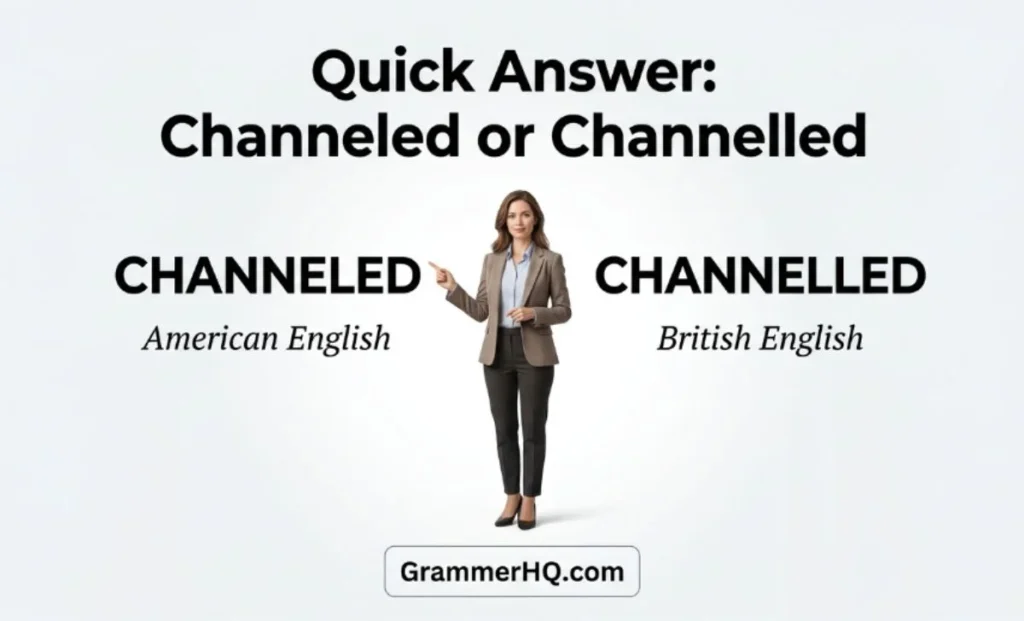
Channeled and channelled are both correct.
| Spelling | Common usage |
|---|---|
| channeled | American English |
| channelled | British English |
Both forms mean the same thing.
For example:
The company channeled more money into research.
The company channelled more money into research.
The only difference is the spelling convention being followed.
Important: Neither form should automatically be treated as a spelling mistake. If you are writing for a particular audience, follow that variety’s preferred spelling and use it consistently.
What Is the Difference Between Channeled and Channelled?
The difference is the extra l.
- Channeled has one l before -ed.
- Channelled has two l’s before -ed.
The two forms have the same grammatical function and meaning.
Both can be the simple past:
She channeled her frustration into exercise.
She channelled her frustration into exercise.
Both can also be the past participle:
He has channeled his experience into his work.
He has channelled his experience into his work.
The choice depends primarily on the spelling system you are following.
What Does Channeled Mean?
Channeled is the past tense and past participle of channel. The verb has several meanings depending on context.
Directing Money or Resources
When resources are directed toward a particular purpose:
The charity channeled donations into emergency relief.
Directing Emotions or Energy
When someone uses an emotion or ability in a productive way:
She channeled her anger into writing.
This use is common in everyday and professional English.
Directing Something Through a Route
The verb can also describe physically directing something:
Engineers channeled the water away from the road.
Using or Reproducing a Particular Quality
It can describe someone drawing on another person’s style, attitude, or characteristics:
The actor channeled the character’s confidence during the performance.
The British spelling channelled works in all of these examples without changing the meaning.
What Does Channelled Mean?
Channelled has the same meaning as channeled.
For example:
The organization channelled its resources into education.
He channelled his frustration into something productive.
The engineers channelled the water into a new drainage system.
These are simply British-style spellings of the same verb form.
The extra l does not create a new meaning, change the pronunciation, or change the tense.
Why Does Channel Have Two Spellings?
The difference comes from regional English spelling conventions.
When English words take endings such as -ed or -ing, British and American spelling sometimes handle a final consonant differently. This is why you can find pairs such as:
- traveled / travelled
- canceled / cancelled
- modeled / modelled
- labeled / labelled
- channeled / channelled
American English often simplifies the doubled consonant in these forms, while British English frequently retains it.
However, spelling rules are not perfectly mechanical. English contains historical spellings, exceptions, and words whose forms became established through usage.
So it is better to treat channeled/channelled as standard regional variants than to assume that every spelling difference follows one universal formula.
Is Channeled American or British Spelling?
Channeled is the standard form you will most commonly encounter in American English.
For example:
The company channeled its profits into renewable energy.
She channeled her creativity into a new project.
If your website, school, publication, or client follows American English, channeled is generally the natural choice.
American English commonly uses the same one-l pattern in related forms such as channeling.
Is Channelled American or British Spelling?
Channelled is the conventional British English spelling.
For example:
The company channelled its profits into renewable energy.
She channelled her creativity into a new project.
If you are writing for a British audience or following British spelling conventions, channelled is generally the better choice.
You will also commonly see the corresponding British form channelling.
Is Channeled Wrong in British English?
Not necessarily.
Channelled is the conventional British spelling, so it is the natural choice when deliberately following British English.
However, English usage is not always divided into perfectly sealed national categories, and encountering the alternative form does not automatically make a sentence meaningless or grammatically wrong.
For formal or edited writing, the better approach is simple: follow the style convention required by your publication or audience.
Is Channelled Wrong in American English?
No.
Channeled is the usual American spelling, but channelled is also an established form that readers may encounter.
If you are writing consistently in American English, however, channeled will usually look more natural to your intended audience.
The goal is not to declare one spelling universally correct and the other universally wrong. The goal is to use the appropriate convention consistently.
Channeled vs Channelled in Grammar
Both forms belong to the same verb family.
| Verb form | American English | British English |
|---|---|---|
| Base form | channel | channel |
| Third-person singular | channels | channels |
| Past tense | channeled | channelled |
| Past participle | channeled | channelled |
| Present participle | channeling | channelling |
For example:
Present:
The program channels donations to local communities.
Past:
The program channeled donations last year.
Past participle:
The program has channeled millions of dollars into relief work.
In British English, the corresponding forms would be channelled and channelling.
Channeling or Channelling?
If you have already understood channeled vs channelled, the -ing forms follow the same general regional pattern.
Channeling or Channelling?
The same spelling difference appears in the -ing form of channel.
Channeling
Channeling is the common American English spelling.
She is channeling her energy into the project.
Channelling
Channelling is the conventional British English spelling.
She is channelling her energy into the project.
Both forms have the same meaning. The choice depends on which variety of English you are using.
Channeled vs Channelled Examples
The easiest way to see the difference is to put both spellings into the same contexts.
Business
American:
The company channeled more money into research.
British:
The company channelled more money into research.
Emotions
American:
He channeled his disappointment into motivation.
British:
He channelled his disappointment into motivation.
Education
American:
The foundation channeled its funds toward scholarships.
British:
The foundation channelled its funds toward scholarships.
Engineering
American:
Engineers channeled the excess water into a drainage system.
British:
Engineers channelled the excess water into a drainage system.
Performance
American:
The actor channeled the confidence of the character he played.
British:
The actor channelled the confidence of the character he played.
In every pair, the meaning stays the same.
Channeled or Channelled: Which One Should You Use?
The answer depends on your variety of English.
Use “Channeled” for American English
Choose channeled when:
- your audience primarily uses American English;
- your publication follows American spelling;
- your existing content uses spellings such as canceled and traveled.
Use “Channelled” for British English
Choose channelled when:
- your audience primarily uses British English;
- your publication follows British spelling;
- your existing content uses forms such as cancelled and travelled.
What About International Writing?
For an international website, either can work. The important thing is consistency.
If the rest of your content follows American spelling, use channeled. If it follows British spelling, use channelled.
A consistent style looks more professional than switching between regional forms without a reason.
Common Mistakes With Channeled and Channelled
Assuming One Form Is Always Wrong
Both spellings are established English forms. The difference is primarily regional.
Thinking the Extra L Changes the Meaning
It does not. Channeled and channelled mean the same thing.
Mixing Spelling Styles
Using channeled in one section and channelled in another can make your writing look inconsistent when there is no contextual reason for the change.
Confusing Past and Present Forms
Remember:
- channeled/channelled = past forms
- channeling/channelling = present participle or gerund
Applying Spelling Rules Too Rigidly
English has useful spelling patterns, but they are not mathematical formulas. Established usage and regional conventions matter too.
Channeled vs Channelled: Easy Way to Remember
Use this simple rule:
American English → channeled
British English → channelled
Think of the British form as retaining the double L.
For the related -ing form:
American → channeling
British → channelling
This shortcut will work for most everyday writing situations, while remembering that real-world English usage can contain regional overlap.
Related American and British Spelling Differences
The difference between channeled and channelled is part of a wider pattern.
| American English | British English |
|---|---|
| canceled | cancelled |
| labeled | labelled |
| modeled | modelled |
| traveled | travelled |
| channeled | channelled |
| channeling | channelling |
These pairs illustrate a broader difference in spelling conventions. Neither variety is inherently “better” English; they simply follow different standard preferences.
FAQ,s
Is channeled or channelled correct?
Both are correct. Channeled is the usual American English spelling, while channelled is the conventional British English form.
Is channeled American or British spelling?
Channeled is primarily associated with American English.
Is channelled American or British spelling?
Channelled is primarily associated with British English and other varieties that commonly follow British spelling conventions.
Is channeled wrong in British English?
No. However, channelled is the conventional British spelling and is generally the better choice when following British English consistently.
Is channelled wrong in American English?
No. Channeled is the usual American form, but the doubled-L spelling can also be encountered.
What is the past tense of channel?
The past tense is channeled in American English and channelled in British English.
What is the past participle of channel?
The past participle is also channeled or channelled, depending on the spelling convention.
Is channeling or channelling correct?
Both are correct. Channeling is the common American form, while channelling is the conventional British form.
Do channeled and channelled have different meanings?
No. They have the same meaning and grammatical function. The difference is spelling.
Which spelling should I use in formal writing?
Use the spelling that matches your chosen variety of English or the style guide you are required to follow. Most importantly, remain consistent.
Conclusion
Channeled and channelled are both correct spellings. The main distinction is regional: channeled is generally preferred in American English, while channelled is the conventional British form.
The two spellings have the same meaning and grammatical function. The same pattern appears in channeling and channelling.
If you are writing for a specific audience, follow its preferred spelling or your publication’s style guide. For American English, choose channeled; for British English, channelled is usually the natural choice.
Read More Blogs:

Hi, I’m Amelia Parker, a grammar enthusiast and writer at GrammarHQ.com. I specialize in explaining spelling differences, confusing words, and common English mistakes through simple, practical, and easy-to-understand guides.