Shinny vs Shiny can be confusing because one extra n completely changes the meaning. If you write that someone has shinny shoes, you may think you are describing something bright and polished, but shinny does not mean that.
The word you need for something that reflects light, looks glossy, or has a polished surface is shiny. Shinny is also a legitimate English word, but it has completely different meanings.
It can refer to an informal type of hockey or, as a verb, to climbing by gripping something with your hands and legs.
Understanding the difference between shinny vs shiny will help you choose the correct word and avoid an easy spelling mistake.
Quick Answer
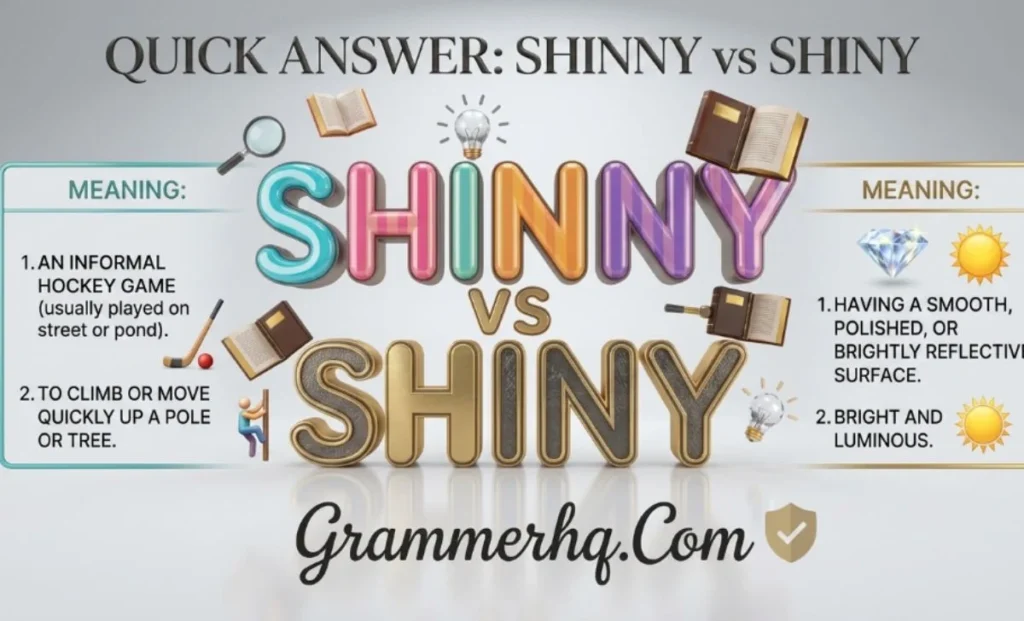
Which word should you use?
| Word | Meaning | Common use |
| Shiny | Bright, glossy, or reflecting light | Everyday English |
| Shinny | Informal hockey or a climbing action | Less common, specific contexts |
If you are describing shoes, a car, jewelry, hair, metal, glass, or another reflective surface, use shiny.
The car looked shiny after it was washed.
If you are talking about an informal hockey game, shinny is the appropriate word.
The children played shinny on the frozen pond.
So the important point is not that one spelling is always wrong. Both words exist, but they have different meanings.
What Does Shiny Mean?
Shiny describes appearance
Shiny is an adjective used for something that is bright, glossy, smooth, or reflective.
Cambridge defines it as describing a surface that is bright because it reflects light. Oxford similarly defines it as something smooth and bright that reflects light.
Real-life examples include:
She wore shiny black shoes.
The kitchen has a shiny marble floor.
His new car has a shiny silver finish.
The child picked up a shiny coin.
It can also describe hair, clothing, polished furniture, metal, paper, and many other surfaces.
Shiny can describe something new or attractive
In expressions such as shiny new, the word can suggest something new and appealing.
They moved into a shiny new office.
Oxford specifically records the expression shiny new for something very new and attractive.
What Does Shinny Mean?
Shinny as a noun
Shinny is a much less common noun. It refers to an informal type of hockey, often played without the formal structure of organized hockey.
Merriam-Webster defines it as a variation of hockey played by children with a curved stick and a ball or block of wood, and also as informal outdoor ice hockey.
For example:
The children played shinny on the frozen pond.
We used to play shinny after school.
This meaning is especially associated with informal hockey traditions in North America.
Shinny as a verb
There is another meaning that many learners never encounter.
As a verb, shinny means to climb up, down, or along something by gripping it with your arms and legs.
Cambridge gives examples involving climbing poles and ledges, while Merriam-Webster records forms such as shinnied and shinnying.
For example:
The boy shinnied up the tree.
He shinnied down the pole.
So shinny is not merely a strange spelling of shiny. It has its own dictionary meanings.
Why Do People Confuse Shinny and Shiny?
They look almost identical
The two words differ by only one letter:
shiny
shinny
That tiny difference is easy to overlook when typing quickly or proofreading.
Their pronunciation is similar
The words are not pronounced exactly the same.
- shiny: /ˈʃaɪni/
- shinny: /ˈʃɪni/
Cambridge lists these pronunciations for the two words.
Because the words are short and similar in sound, someone who has mostly encountered shiny in writing may accidentally add an extra n.
Spellcheck may not catch the mistake
This is where the confusion becomes especially tricky.
If you type:
The table looks shinny.
A spellchecker may not flag the word because shinny is a real dictionary word.
The problem is not necessarily spelling recognition. It is meaning.
That is why good proofreading asks more than “Is this word spelled correctly?”
It also asks:
Does this word mean what I intend?
How to Choose the Right Word
Use shiny for light, gloss, or reflection
Think shine → shiny.
The freshly polished floor looks shiny.
Her hair was clean and shiny.
The new shoes have a shiny finish.
Use shinny for hockey or climbing
Think shinny → sport or climbing.
The boys played shinny on the ice.
He shinnied up the tree.
This simple context test can prevent the mistake immediately.
Shiny vs Shine: Why Is the Spelling Shiny?
The word comes from shine
Shiny is formed from shine with the adjective-forming suffix -y. Dictionary sources trace the word to shine and give its historical development accordingly.
Notice what happens to the final e:
shine → shiny
Not:
shine → shiney
That is why shiney is also a common misspelling.
For example:
❌ The car looks shiney.
✅ The car looks shiny.
Understanding the word’s formation makes the spelling easier to remember.
Real-Life Examples
Everyday objects
The polished table looks shiny.
I bought a shiny new watch.
The floor became shiny after cleaning.
Personal appearance
She has long, shiny hair.
His shoes were clean and shiny.
Informal hockey
The children played shinny on the pond.
Climbing
The cat shinnied up the narrow post.
These examples show why context matters more than simply looking at the letters.
British vs American English
Neither word is a regional spelling of the other
There is no British-versus-American spelling rule that changes shiny into shinny.
Cambridge lists shiny in both UK and US English.
Likewise, shinny remains a separate word with its own meanings.
So if you are writing for British readers, American readers, students, or international English learners, the distinction remains the same:
shiny = bright or glossy
shinny = hockey or climbing
Common Mistakes
Using shinny for something glossy
❌ The new car is shinny.
✅ The new car is shiny.
Adding an extra n
❌ She bought shinny shoes.
✅ She bought shiny shoes.
Using shiney
❌ The table is shiney.
✅ The table is shiny.
Confusing the hockey word
❌ The children played shiny on the frozen pond.
✅ The children played shinny on the frozen pond.
The mistake becomes obvious once you connect each word with its meaning.
FAQs
1: Is shiny or shinny correct?
Both are real English words, but they have different meanings. Shiny describes something bright, glossy, or reflective. Shinny refers to informal hockey or a climbing action.
2: Is shinny a real word?
Yes. Dictionaries recognize shinny as both a noun and a verb.
3: Does shinny mean shiny?
No. Shinny does not mean bright or glossy. That meaning belongs to shiny.
4: Is it shiny or shiney?
Shiny is the standard spelling. The final e in shine is dropped before the -y suffix.
5: What does shinny mean in hockey?
It refers to an informal form of hockey, often played recreationally rather than as an organized competitive game.
6: Can shinny be a verb?
Yes. As a verb, shinny means to climb up, down, or along something by using your hands and legs.
Final Verdict
Remember the meaning, not just the spelling
Shiny is the word you want when something is bright, glossy, polished, or reflecting light. Shinny is a different English word used for an informal hockey game or a particular climbing action.
The easiest memory trick is simple:
Shiny comes from shine.
If it reflects light, looks polished, or glows, choose shiny. If the sentence involves hockey or climbing, shinny may be the word you need.
Once you connect each spelling to its meaning, this one-letter difference becomes much harder to confuse.
Read More Blogs:
- Dual vs Duel: What’s the Difference? Meaning, Usage & Examples
- Trys or Tries: Which Is Correct? Spelling, Meaning, Rules & Examples