Confused between “complement” and “compliment”? You’re not alone — these two words are among the most commonly mixed-up terms in the English language, and getting them wrong in an email or essay can instantly signal a writing mistake.
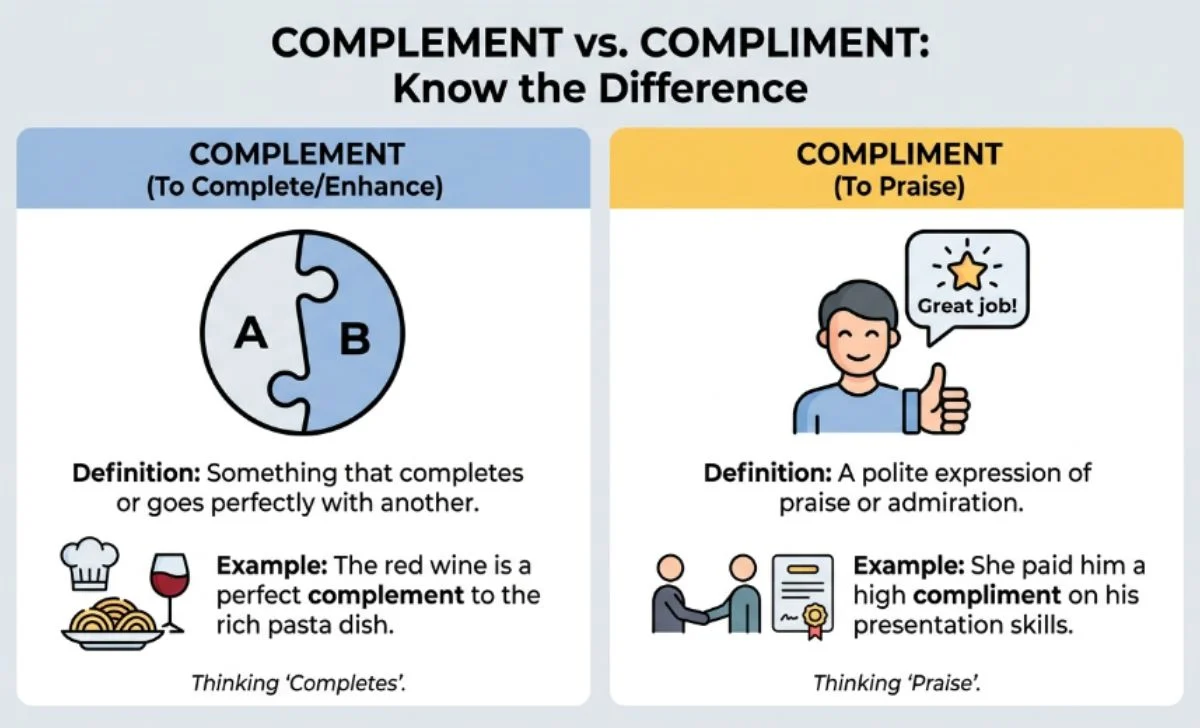
Although they sound exactly the same, their meanings are completely different. A complement (with an “e”) refers to something that completes or enhances something else, like a scarf that complements an outfit.
A compliment (with an “i”) is a kind remark or expression of praise, like telling someone they look great.
In this guide, we’ll break down the difference between complement and compliment with clear definitions, real examples, and easy memory tricks — so you’ll never confuse them again.
Quick Answer
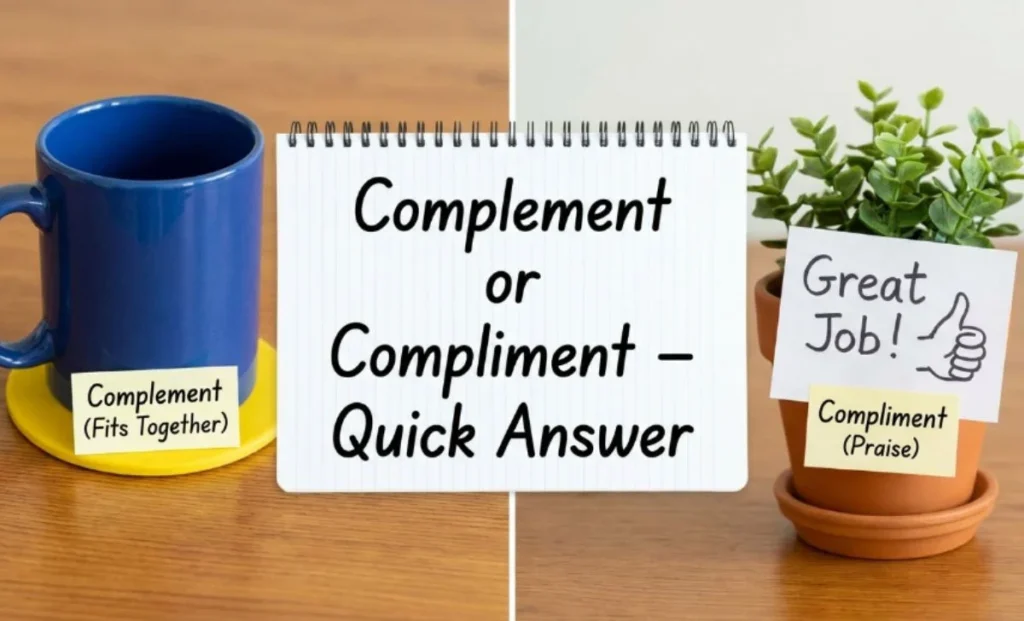
The difference between complement and compliment is their meaning.
- Complement means to complete, improve, or match something well.
- Compliment means to praise or say something nice about someone.
Although the two words are pronounced almost the same, they are never interchangeable because they have different meanings.
Examples:
- The red tie complements his black suit perfectly.
- Fresh herbs are a perfect complement to the soup.
- She gave me a wonderful compliment about my presentation.
- I thanked him for the kind compliment.
Pronunciation of Complement or Compliment
Both complement and compliment are pronounced almost identically:
- Complement: KOM-pluh-ment (/ˈkɒm.plɪ.mənt/ UK, /ˈkɑːm.plə.mənt/ US)
- Compliment: KOM-pluh-ment (/ˈkɒm.plɪ.mənt/ UK, /ˈkɑːm.plə.mənt/ US)
Because they sound the same, they are called homophones—words that share the same pronunciation but have different meanings and spellings.
When speaking, listeners understand the correct word from the sentence’s context.
Examples:
- “Your smile complements your personality.”
- “Your smile is a lovely compliment to everyone around you.”
Easy Trick to Remember Complement or Compliment
A simple memory trick can help you remember the difference forever.
Remember Compliment = “I” = Praise
The word compliment contains the letter I, just like I admire you or I praise you. If someone says something kind, use compliment.
Example:
- She gave me a compliment on my new haircut.
Remember Complement = “E” = Enhance
The word complement contains the letter E, which can remind you of enhance or complete. If one thing improves or completes another, use complement.
Examples:
- The blue curtains complement the white walls.
- A healthy diet complements regular exercise.
Quick Memory Chart:
| Word | Meaning | Easy Memory |
|---|---|---|
| Complement | Completes, matches, improves | E = Enhance |
| Compliment | Praise or kind words | I = I praise you |
British English vs American English Spelling
Unlike many words such as colour/color or centre/center, complement and compliment are spelled exactly the same in both British English and American English.
There is no UK vs US spelling difference. The only choice depends on the meaning you want to express.
| Meaning | British English | American English |
|---|---|---|
| Something that completes or matches | Complement | Complement |
| Praise or kind words | Compliment | Compliment |
Examples:
| Sentence | Correct Word |
|---|---|
| This wine perfectly ______ the meal. | complements |
| She paid me a lovely ______. | compliment |
| His skills ______ the rest of the team. | complement |
| Everyone thanked her for the kind ______. | compliment |
Whether you’re writing for readers in the UK, the US, Canada, Australia, or New Zealand, the spelling remains the same.
Which Spelling Should You Use?
The correct spelling depends entirely on what you mean, not where your audience lives.
Use complement when talking about something that completes, improves, balances, or matches another thing.
Use compliment when talking about praise, admiration, or polite, kind words.
Choose Complement if you’re writing about:
- Matching colors
- Fashion and design
- Food pairings
- Business partnerships
- Grammar or mathematics
- Skills that work well together
Examples:
- These shoes complement your outfit.
- Good communication complements strong leadership.
Choose Compliment if you’re writing about:
- Praising someone
- Kind remarks
- Positive feedback
- Customer reviews
- Professional appreciation
Examples:
- My manager gave me a wonderful compliment.
- She complimented the chef on the delicious meal.
Simple rule:
If you can replace the word with “praise,” use compliment.
If you can replace it with “complete” or “match,” use complement.
Common Mistakes with Complement or Compliment
Because these words are homophones, many writers choose the wrong spelling even though their grammar is correct.
Here are the most common mistakes and their corrections.
| Incorrect | Correct | Why |
|---|---|---|
| She gave me a nice complement. | She gave me a nice compliment. | A compliment is praise. |
| This sauce compliments the pasta. | This sauce complements the pasta. | The sauce matches the pasta. |
| Thank you for your thoughtful complement. | Thank you for your thoughtful compliment. | Someone praised you. |
| His experience compliments the team. | His experience complements the team. | His experience completes the team. |
| I complimented the painting because it matched the room. | The painting complemented the room. | It matched the room, not praised it. |
Tips to Avoid Mistakes:
- Think about the meaning before choosing the spelling.
- Remember Compliment = Praise.
- Remember Complement = Complete or Enhance.
- Read the sentence again and ask, “Am I talking about praise or something that matches?”
Complement or Compliment in Everyday Examples
Knowing the definitions is helpful, but seeing complement and compliment in real-life situations makes the difference much easier to remember.
In Emails
- Thank you for the kind compliment about my work.
- Your experience will complement our existing team.
In Business
- The new software complements our current workflow.
- The manager received many compliments for her leadership.
On Social Media
- Thousands of followers complimented the athlete after the victory.
- The bright colors complement the overall design perfectly.
In News Reports
- Experts say renewable energy complements traditional power sources.
- The actor received many compliments after the award ceremony.
In Everyday Conversation
- Your new glasses complement your face.
- Thanks for the compliment—that means a lot.
- This dessert complements the main course.
- She complimented her friend on the beautiful painting.
Full complement or compliment
The correct word depends on the meaning of the sentence. Full complement means the complete number of people or things needed for a group, team, or organization.
Full compliment is usually incorrect unless you mean a complete expression of praise, which is much less common.
In most everyday writing, the correct phrase is full complement. Remember, complement relates to completing something, while compliment relates to praise.
Examples:
- The ship sailed with its full complement of crew members.
- The hospital has a full complement of medical staff.
- Our team reached its full complement before the tournament.
- The airline hired a full complement of flight attendants.
Complement meaning
A good complement is something that matches, improves, or completes another person or thing. It does not mean praise—that would be a compliment.
The phrase is commonly used to describe people, foods, colors, skills, or objects that work well together.
When one thing makes another more effective or attractive, it is a good complement. This meaning is the same in both British and American English.
Examples:
- Fresh bread is a good complement to homemade soup.
- Her communication skills are a good complement to his technical expertise.
- The blue curtains are a good complement to the white walls.
Use compliment and complement in a sentence
Compliment and complement are often confused because they sound alike, but they have different meanings.
Compliment means to praise someone or express admiration, while complement means to complete, improve, or match something well.
Choosing the correct word depends on the meaning of your sentence. Learning the difference helps you avoid common writing mistakes. A simple rule is: compliment = praise, complement = complete or match.
Examples:
- She gave me a compliment on my presentation.
- Your new shoes complement your outfit perfectly.
- The teacher complimented the student for working hard.
- Fresh vegetables complement a healthy meal.
FAQ,s
1. What is the difference between complement and compliment?
A complement completes or enhances something, while a compliment is a kind remark of praise.
- Example 1: The soft lighting was a lovely complement to the room’s decor.
- Example 2: She gave him a genuine compliment on his presentation.
2. How do you remember complement vs compliment?
The trick is the letter I — “I like compliments.” The letter E in complement matches the E in complete.
- Example 1: I always remember that “I” stands for “I love compliments.”
- Example 2: Complement has an “e,” just like complete — both are about finishing something.
3. Is it “complementary” or “complimentary” colors?
It’s always complementary colors, since they enhance and contrast with each other.
- Example 1: Blue and orange are classic complementary colors.
- Example 2: The designer chose complementary shades of purple and yellow for the logo.
4. Is it “compliments to the chef” or “complements to the chef”?
It’s “compliments to the chef,” since it expresses praise for the meal.
- Example 1: After dinner, the guests sent their compliments to the chef.
- Example 2: “Compliments to the chef — this was the best pasta I’ve had!”
5. Can “complement” and “compliment” be used as verbs?
Yes, both words work as verbs. Complement means to enhance something; compliment means to praise someone.
- Example 1: The scarf complements her blue dress perfectly.
- Example 2: He complimented his colleague on the successful product launch.
6. What does “full complement” mean?
“Full complement” refers to the complete number or amount needed of something.
- Example 1: The ship sailed with a full complement of crew members.
- Example 2: The hospital finally has a full complement of nurses this month.
7. What is a “backhanded compliment”?
A backhanded compliment sounds like praise but actually contains a subtle insult.
- Example 1: “You’re so brave to wear that outfit” can be a backhanded compliment.
- Example 2: Telling someone “You did well for a beginner” is often seen as a backhanded compliment.
8. What does “complimentary” mean when it’s not about praise?
Complimentary can also mean something given free of charge.
- Example 1: The airline offered complimentary snacks and drinks on the flight.
- Example 2: Our hotel room included a complimentary breakfast buffet.
9. What are complementary angles in math?
Complementary angles are two angles whose measures add up to exactly 90 degrees.
- Example 1: A 30-degree angle and a 60-degree angle are complementary angles.
- Example 2: In geometry class, students learned to identify complementary angle pairs.
10. Do “complement” and “compliment” ever mean the same thing?
Historically they shared a Latin root, but in modern English they never overlap in meaning.
- Example 1: Centuries ago, “complement” was sometimes used loosely to mean praise — but that usage is now obsolete.
- Example 2: Today, “The tie complements the suit” and “The tie deserves a compliment” mean two completely different things.
Conclusion
At the end of the day, choosing between complement and compliment comes down to one simple question: are you completing something, or praising someone? If the answer is “completing,” go with complement. If it’s “praising,” go with compliment.
These two words may sound identical, but mixing them up can make even a well-written piece look careless and that’s a mistake worth avoiding.
The good news is, once the “I” and “E” trick clicks in your mind, this confusion disappears for good. Practice spotting them in real sentences, double-check before hitting publish, and soon you’ll be using both words with complete confidence.
Whether you’re writing an email, an essay, or a resume, correct usage of complement and compliment instantly boosts the credibility of your writing and that’s a compliment your work truly deserves.
Read More Blogs:
- Gray or Grey: American vs British English Made Simple?
- What Is the Difference Between Email and Gmail?
- Loot vs Lute: What’s the, Real Difference?
- Putty or Puddy: Which Spelling Is Correct?