Sheath vs sheathe may look almost identical, but one letter can change both the meaning and grammar of your sentence.
If you mean a protective covering for a sword, knife, cable, or another object, sheath is usually the word you need.
If you mean the action of putting something into that covering, sheathe is the correct verb. For example, a sword rests in a sheath, while a warrior sheathes the sword after battle.
The confusion becomes greater because these words also differ in pronunciation, word forms, and usage.
In this guide, you’ll discover the exact difference between sheath vs sheathe, learn how to use each word naturally, and avoid common mistakes in everyday and formal writing.
Quick Answer

The easiest distinction is:
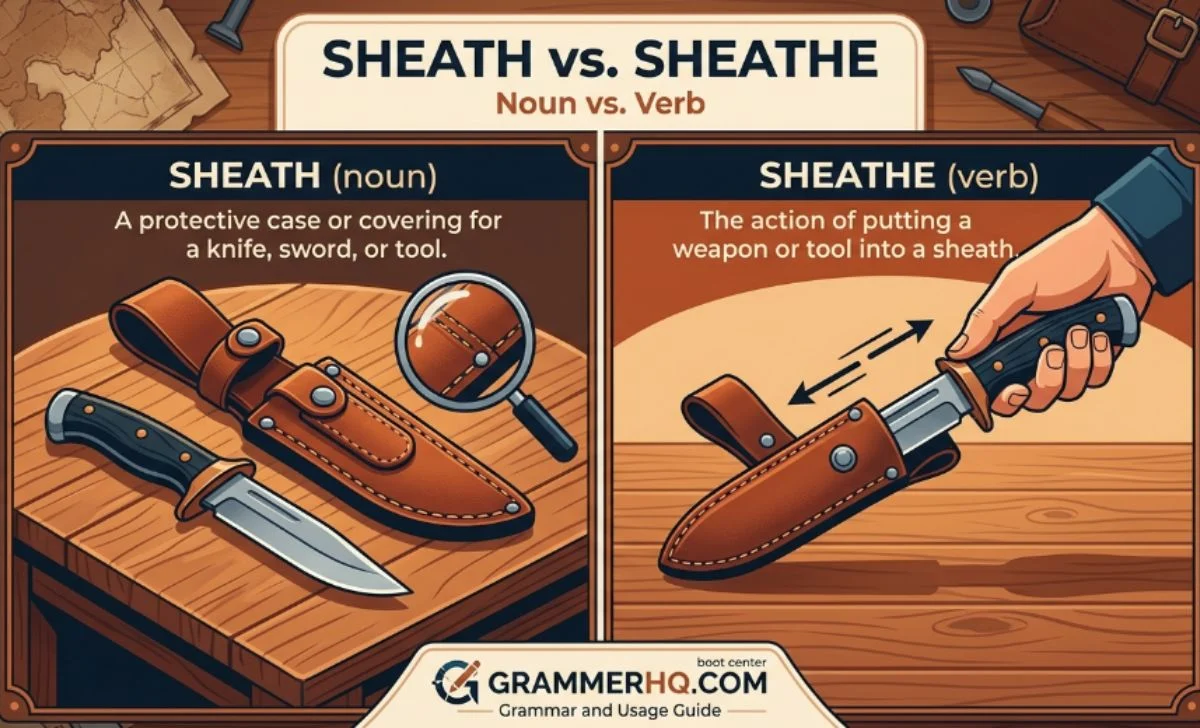
Sheath is normally a noun. It means a protective covering or case.
Sheathe is normally a verb. It means to put something into a sheath or cover it with a protective layer.
Quick comparison
| Word | Grammar | Meaning | Example |
|---|---|---|---|
| sheath | Noun | A protective covering | The knife is in its sheath. |
| sheathe | Verb | To put into a sheath or cover | He sheathed the knife. |
Remember this sentence
The sword goes into the sheath, and the soldier sheathes the sword.
That is the basic difference in one line.
What Is a Sheath?
A sheath is a covering designed to surround or protect something.
The word is often associated with swords and knives, but that is only one part of its meaning.
Sheath for a Sword or Knife
A sheath can protect a blade when it is being carried or stored.
The hunter placed his knife back in its sheath.
The old sword had a beautifully decorated sheath.
She bought a leather sheath for her camping knife.
In these sentences, sheath is the name of the object.
Sheath in Other Contexts
The word also appears in technical and scientific language.
A cable, for example, may have an outer sheath that protects the wires inside. In anatomy, a sheath can refer to a covering around a body structure.
This gives the word a broader central idea:
A sheath is a covering that surrounds or protects something.
It does not have to be made of leather, and it does not have to hold a sword.
What Does Sheathe Mean?
Sheathe is a verb describing an action.
Its most familiar meaning is to put a sword, knife, or another blade into its sheath.
The soldier sheathed his sword.
He carefully sheathed the knife after using it.
The swordsman sheathed the blade and walked away.
The object being put away is the sword or knife; the sheath is the protective covering.
Sheathe Can Mean “Cover”
Sheathe also has a broader meaning: to cover something with a protective or outer layer.
For example:
The electrical cable was sheathed in plastic.
The walls were sheathed with wood.
Here, nothing is being placed inside a traditional sword sheath. Instead, something is being covered or enclosed by a protective material.
That broader meaning is easy to overlook, but it explains why sheathe can appear in technical and construction-related writing as well as descriptions of weapons.
Sheath vs Sheathe: Why Do People Confuse Them?
The confusion is understandable because the two words are closely related.
They:
- look almost identical
- have related meanings
- begin with the same sound
- are associated with covering and protection
- can appear in the same sentence
Consider:
The sword is in its sheath.
The warrior sheathed the sword.
The same object appears in both sentences, but the words perform different jobs.
Sheath identifies the covering.
Sheathed identifies the action that happened to the sword.
This is why looking only at spelling is less useful than understanding the word’s role in the sentence.
Sheath vs Sheathe: Noun or Verb?
This is the most important grammar distinction.
Sheath Is Usually a Noun
Use sheath when you are naming the protective covering.
The knife has a leather sheath.
The sword remained inside its sheath.
I could not find the sheath for the blade.
Because it is a noun, it can appear after words such as:
- a
- the
- this
- that
- my
- its
For example:
the sheath
a sheath
its sheath
Sheathe Is a Verb
Use sheathe when you are describing the action of putting something into a sheath or covering it.
Sheathe the sword.
He sheathed the sword.
They are sheathing the cable.
The verb changes form according to tense and grammatical context.
How Do You Pronounce Sheath and Sheathe?
These words are not pronounced exactly alike.
Sheath Pronunciation
Sheath is pronounced:
/ʃiːθ/
It sounds approximately like “sheeth.”
The final th is the unvoiced sound heard in words such as teeth.
Sheathe Pronunciation
Sheathe is pronounced:
/ʃiːð/
Its final th is voiced, like the sound in breathe.
A Simple Sound Trick
Compare these pairs:
sheath → teeth
sheathe → breathe
The beginning is almost identical, but the final consonant changes.
For English learners, this pronunciation difference is particularly useful because the spelling alone does not make the sound distinction obvious.
Sheath, Sheaths, Sheathe, Sheathes, and Sheathed
Knowing the related forms makes this word pair much easier to handle.
Sheath
Singular noun:
The knife has a protective sheath.
Sheaths
Plural noun:
The shop sells leather sheaths.
Sheathe
Base form of the verb:
The soldier will sheathe his sword.
Sheathes
Third-person singular present form:
He sheathes the sword after practice.
Sheathed
Past tense and past participle:
He sheathed the sword.
The cable is sheathed in protective material.
Sheathing
The present participle or gerund:
Workers are sheathing the structure.
Complete word-form table
| Form | Function | Example |
|---|---|---|
| sheath | Singular noun | a sword sheath |
| sheaths | Plural noun | several sheaths |
| sheathe | Base verb | sheathe the blade |
| sheathes | Third-person verb | she sheathes the blade |
| sheathed | Past / participle | he sheathed it |
| sheathing | -ing form | sheathing the cable |
Sheaths vs Sheathes: Don’t Mix Them Up
This pair creates a separate spelling trap.
Sheaths
Sheaths is the plural of sheath.
The museum displayed several ancient sword sheaths.
The knives came with protective sheaths.
You are talking about more than one covering.
Sheathes
Sheathes is the third-person singular present form of sheathe.
He sheathes his sword after every training session.
The device automatically sheathes the blade.
You are describing an action.
The shortcut
sheaths = things
sheathes = action
This distinction is one of the easiest ways to eliminate a common spelling mistake.
Is Sheath Ever a Verb?
Yes, but this needs a little context.
The basic rule taught to English learners is:
sheath = noun
sheathe = verb
That is still the best rule for normal modern writing.
However, major dictionaries record sheath as a less common or variant verb. In other words, it is not accurate to claim that sheath can never be a verb.
For most readers, though, sheathe is the clearer and more familiar choice when you mean “put into a sheath” or “cover.”
So if you are writing:
He ___ the sword.
The safest standard choice is:
He sheathed the sword.
This small dictionary nuance is useful because English usage is not always as absolute as simplified grammar rules suggest.
Sheathe Does More Than Put Away a Sword
A common misconception is that sheathe can only be used with swords and knives.
Its broader sense is to cover or encase something with a protective material.
Example: Electrical Cables
The wires were sheathed in a durable outer material.
Construction
The exterior walls were sheathed with panels.
General Protection
The metal was sheathed in a protective coating.
In each case, the underlying idea is the same:
Something is being covered or enclosed for protection.
Sheath vs Sheathe in Real-Life Sentences
Here are some natural examples that show how the two words behave in context.
Everyday Example
I put the knife back in its sheath.
The sheath is the object.
Historical Example
The warrior sheathed his sword after the battle.
Sheathed describes the action.
Technical Example
The cable has a thick outer sheath.
Again, sheath is the covering.
Construction Example
The workers sheathed the walls with plywood.
Here, sheathed is the action of covering.
Literary Example
He drew the blade from its sheath.
The blade comes out of the covering.
He then sheathed it again.
The blade goes back into the covering.
These examples show why the words should not be treated as interchangeable.
Common Mistakes with Sheath and Sheathe
1. Writing “sheathe” for the protective case
❌ The sword was in its sheathe.
✅ The sword was in its sheath.
The sentence needs a noun, so sheath is correct.
2. Using “sheath” instead of the standard verb
❌ He sheath the sword.
✅ He sheathed the sword.
The sentence describes an action, so the verb form is needed.
3. Confusing “sheaths” with “sheathes”
❌ The shop sells leather sheathes.
✅ The shop sells leather sheaths.
These are multiple protective coverings, so the plural noun is sheaths.
4. Using “sheathes” for the past tense
❌ Yesterday, he sheathes the sword.
✅ Yesterday, he sheathed the sword.
The past-tense form is sheathed.
5. Assuming the words are pronounced identically
They are very similar, but the final th sounds differ:
- sheath → /θ/
- sheathe → /ð/
Sheathe vs Unsheathe
If sheathe means to put something into its protective covering, unsheathe means to take it out.
Sheathe
The knight sheathed his sword.
Unsheathe
The knight unsheathed his sword.
The two words describe opposite movements.
This distinction appears frequently in:
- historical writing
- fantasy fiction
- military descriptions
- swordsmanship
- literature
- action scenes
A simple way to remember them is:
sheathe = put in
unsheathe = take out
Sheath vs Scabbard: What’s the Difference?
Sheath and scabbard are related, but they are not exact synonyms in every context.
A sheath is a general protective covering, especially for something such as a knife or blade.
A scabbard is more specifically a case for carrying a sword or similar long-bladed weapon.
Compare:
The chef put the knife in its sheath.
The soldier carried his sword in a scabbard.
So sheath is the broader word.
Is There a British vs American Difference?
No major spelling difference separates British and American English here.
Both varieties normally use:
- sheath as the noun
- sheathe as the verb
This is not a regional spelling pair like:
- color / colour
- organize / organise
- center / centre
So whether you are writing for an American audience or a British audience, the same basic distinction applies.
How to Remember Sheath vs Sheathe
Forget complicated rules and remember one sentence:
The sword goes into the sheath, and you sheathe the sword.
Then reduce it to two words:
Sheath = thing
Sheathe = action
There is also a helpful spelling comparison:
breath → breathe
sheath → sheathe
The related words gain an e, and the pronunciation changes as well.
Sheath vs Sheathe: Which Word Should You Use?
Use sheath when you mean the covering, case, or protective layer.
The knife is in its sheath.
Use sheathe when you mean the action of putting something into that covering or covering it.
He sheathed the knife.
If you are unsure, ask yourself:
Am I naming the covering, or am I describing what someone does?
If it is the covering, choose sheath.
If it is the action, choose sheathe.
Sheath vs Sheathe: Final Comparison
| Feature | Sheath | Sheathe |
|---|---|---|
| Usual part of speech | Noun | Verb |
| Main idea | A protective covering | To put into or cover |
| Example | a knife sheath | sheathe the knife |
| Pronunciation | /ʃiːθ/ | /ʃiːð/ |
| Plural | sheaths | — |
| Present verb form | — | sheathes |
| Past tense | — | sheathed |
| -ing form | — | sheathing |
| Related word | sheath | unsheathe |
The one rule worth remembering
A sheath is what protects the object; to sheathe is to put the object inside or cover it.
FAQs
1: Is it “sheath” or “sheathe”?
Both are correct words. Use sheath for the protective covering and sheathe for the action of putting something into it or covering it.
2: Is it “sheath a sword” or “sheathe a sword”?
Sheathe a sword is the standard modern expression.
The warrior sheathed his sword.
4: What is the difference between sheath and sheathe?
Sheath is normally a noun meaning a protective covering. Sheathe is normally a verb meaning to put something into a sheath or cover it.
5: Is sheath a noun?
Yes. Sheath is primarily used as a noun.
The sword is inside its sheath.
6: Is sheathe a verb?
Yes. Sheathe is a verb.
He sheathed the blade.
7: What is the plural of sheath?
The plural is sheaths.
The store sells several leather sheaths.
8: Is it sheaths or sheathes?
Both forms are correct, but they have different meanings. Sheaths is the plural of the noun sheath. Sheathes is the third-person singular form of the verb sheathe.
9: What is the past tense of sheathe?
The past tense is sheathed.
She sheathed the sword.
10: How do you pronounce sheath?
Sheath is pronounced /ʃiːθ/, with an unvoiced final th sound.
11: How do you pronounce sheathe?
Sheathe is pronounced /ʃiːð/, with a voiced final th sound.
12: Can sheath be a verb?
It can be used as a less common verb variant, but sheathe is the normal and clearer verb in modern standard usage.
13: What is the opposite of sheathe?
The usual opposite is unsheathe, meaning to remove something from its sheath.
14: Are sheath and sheathe homophones?
Not exactly. Their pronunciations are very similar, but sheath ends in /θ/, while sheathe ends in /ð/.
15: Is a scabbard the same as a sheath?
They overlap in meaning, but scabbard is more specifically associated with a case for a sword or similar long-bladed weapon, while sheath is a broader term.
Conclusion
Sheath and sheathe are closely related, but they are not normally interchangeable. Sheath is the protective covering itself, while sheathe is the action of putting something into that covering or enclosing it with a protective layer.
The easiest way to remember the difference is:
The sword goes into the sheath; you sheathe the sword.
Once you also recognize sheaths as the plural noun and sheathes, sheathed, and sheathing as forms of the verb, the entire word family becomes much easier to use correctly.
Read More Blogs:
- Meant or Ment: Which Is Correct? Meaning, Spelling & Examples
- SAT or ACT: Which Test Should You Take in 2026?

Hi, I’m Amelia Parker, a grammar enthusiast and writer at GrammarHQ.com. I specialize in explaining spelling differences, confusing words, and common English mistakes through simple, practical, and easy-to-understand guides.