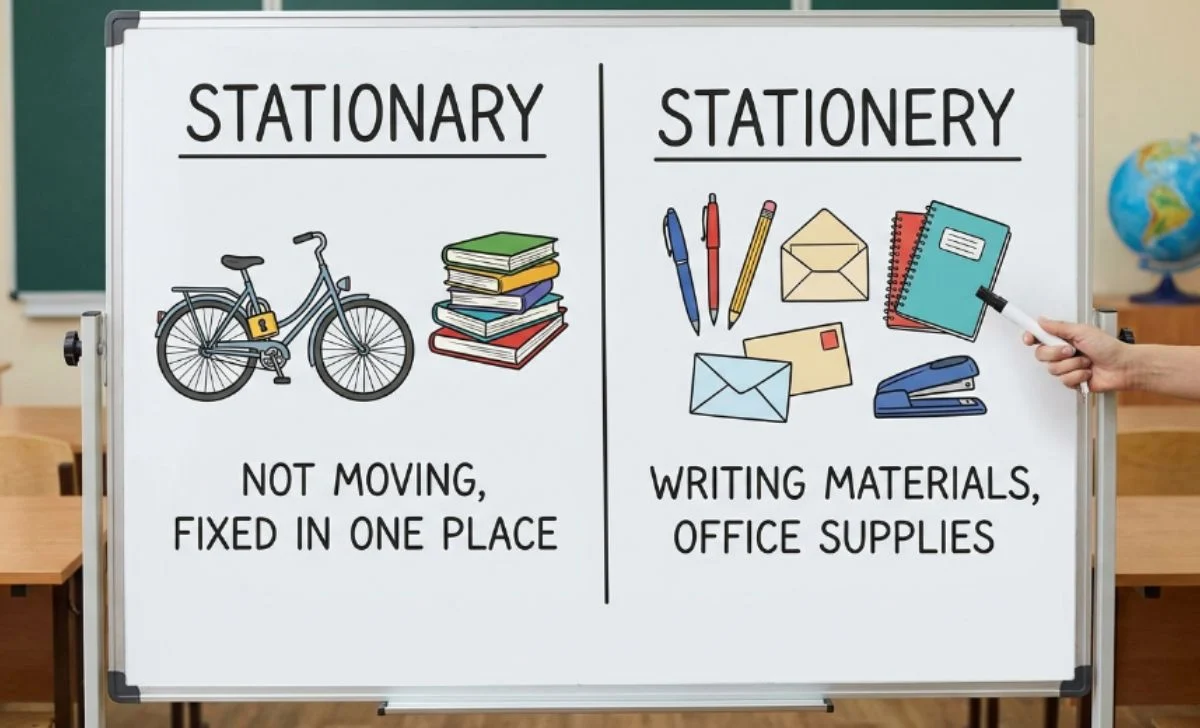
Many people confuse stationary or stationery because the two words look almost identical and sound exactly the same. The quick answer is simple: stationary means not moving, while stationery means writing materials like paper, envelopes, and notebooks.
This confusion happens because they are homophones—words with the same pronunciation but different spellings and meanings.
In this guide, you’ll learn the correct meanings, pronunciation, memory tricks, origins, British and American English usage, common mistakes, comparison tables, and plenty of real-life examples.
Quick Answer
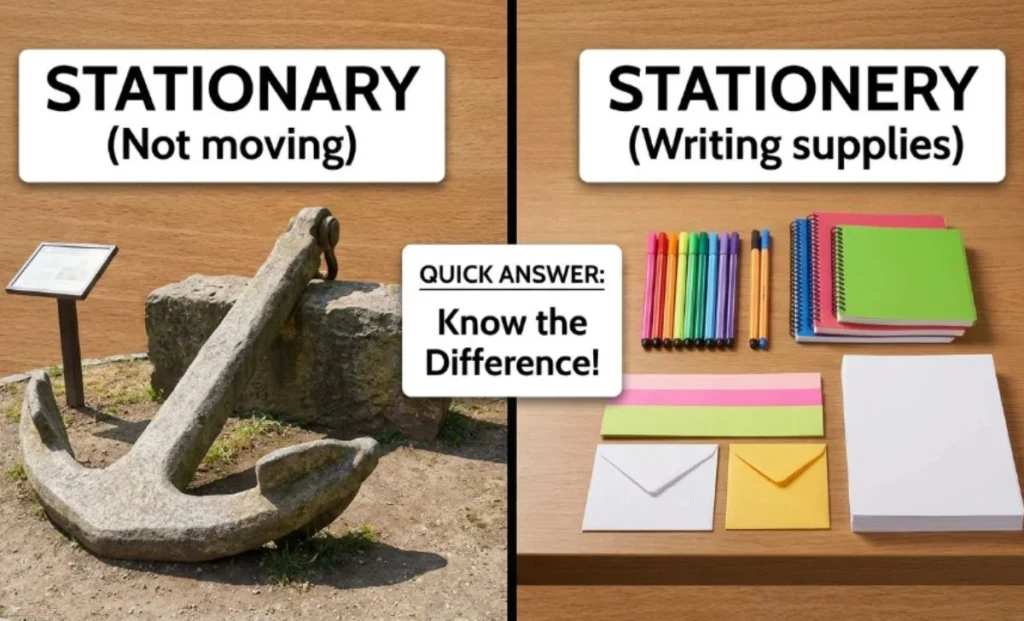
The difference between stationary and stationery is their meaning:
- Stationary is an adjective that means not moving or staying in one place.
- Stationery is a noun that refers to writing supplies, such as paper, pens, envelopes, notebooks, and greeting cards.
Examples
- The car remained stationary at the traffic light.
- I bought new stationery for school.
- The train was stationary because of maintenance.
- She ordered personalized stationery for her business.
Comparison Table
| Word | Part of Speech | Meaning | Example |
|---|---|---|---|
| Stationary | Adjective | Not moving | The bus stayed stationary. |
| Stationery | Noun | Writing materials | I need new stationery for class. |
Pronunciation of Stationary or Stationery
Both stationary and stationery are pronounced the same.
Pronunciation: /ˈsteɪʃəneri/ (STAY-shuh-ner-ee)
Because they sound identical, you cannot tell which word someone means by listening alone. The correct spelling depends entirely on the meaning and context.
Examples
- “The truck is stationary.”
- “Please buy some stationery.”
- “The camera remained stationary.”
- “Our office ordered branded stationery.”
Why People Confuse Stationary or Stationery
People often mix up these words because:
- They have almost identical spellings.
- They are pronounced exactly the same.
- Both are common in school and office writing.
- Many spell checkers cannot detect the mistake if the wrong word is still correctly spelled.
For example, writing office stationary is incorrect because stationary means “not moving.” The correct phrase is office stationery.
Easy Trick to Remember Stationary or Stationery
A simple memory trick makes the difference easy.
- Stationery contains “e”, just like envelope.
- Stationary contains “a”, which reminds you of something at rest.
Remember:
- E = Envelope = Stationery
- A = At rest = Stationary
This trick helps many English learners remember the correct spelling instantly.
The Origin of Stationary or Stationery
Although these words look similar today, they developed different meanings over time.
Stationary comes from the Latin word stare, meaning “to stand.”
Stationery developed from the word stationer, which originally referred to booksellers and writers who worked from fixed market stalls. Over time, the word became associated with writing supplies instead of people.
Although they share historical roots, their meanings separated centuries ago.
British English vs American English Spelling
Unlike many English words, there is no spelling difference between British English and American English.
Both varieties use:
- Stationary for something that is not moving.
- Stationery for writing materials.
Comparison Table
| Meaning | American English | British English |
|---|---|---|
| Not moving | Stationary | Stationary |
| Writing supplies | Stationery | Stationery |
The spelling remains identical in both versions of English.
Which Spelling Should You Use?
Use the word based on its meaning, not your country.
Choose stationary when describing something that does not move.
Choose stationery when referring to paper, notebooks, envelopes, pens, or other office supplies.
Whether you write for the United States, the United Kingdom, Canada, Australia, or other English-speaking countries, these meanings never change.
Common Mistakes with Stationary or Stationery
These mistakes are very common.
| Incorrect | Correct |
|---|---|
| Office stationary | Office stationery |
| School stationary | School stationery |
| The car was stationery | The car was stationary |
| Stationery vehicle | Stationary vehicle |
Correct Examples
- The truck remained stationary for two hours.
- I need more stationery for my office.
- The bicycle stayed stationary during the repair.
- Our company printed custom stationery.
Stationary or Stationery in Everyday Examples
Here is how these words appear in daily communication.
- Please order new stationery for the office.
- The printer stayed stationary during testing.
News
- Traffic remained stationary after the accident.
- The company introduced eco-friendly stationery products.
Social Media
- I love buying colorful stationery.
- My car was completely stationary in traffic today.
Formal Writing
- All company stationery should include the new logo.
- The equipment remained stationary throughout the inspection.
Stationary or Stationery – Google Trends & Usage Data
Search data shows that stationary or stationery is a popular grammar query because people regularly confuse these homophones.
The keyword is commonly searched in:
- United States
- United Kingdom
- Canada
- Australia
- India
Most searches focus on:
- Which spelling is correct
- Difference between stationary and stationery
- Memory tricks
- School and office writing
- Grammar lessons
The word stationery appears frequently in education, business, and office contexts, while stationary is more common in transportation, engineering, and everyday descriptions.
Stationary vs Stationery Comparison Table
| Feature | Stationary | Stationery |
|---|---|---|
| Meaning | Not moving | Writing materials |
| Part of Speech | Adjective | Noun |
| Pronunciation | Same | Same |
| Used For | Cars, trains, people, objects | Paper, pens, notebooks, envelopes |
| Common Mistake | Used instead of stationery | Used instead of stationary |
FAQs
Is it stationery or stationary for office supplies?
The correct word is stationery because office supplies include paper, notebooks, envelopes, and pens.
What does stationary mean?
Stationary means staying in one place or not moving.
Why do stationary and stationery sound the same?
They are homophones, meaning they have the same pronunciation but different meanings and spellings.
How can I remember the difference?
Remember that stationery has an E, just like envelope.
Is stationery a noun?
Yes. Stationery is a noun referring to writing materials.
Is stationary an adjective?
Yes. Stationary is an adjective describing something that does not move.
Do British and American English spell these words differently?
No. Both British English and American English use stationary and stationery with the same spellings and meanings.
Conclusion
Understanding stationary or stationery becomes easy once you remember their meanings. Stationary describes something that is not moving, while stationery refers to writing materials such as paper, notebooks, pens, and envelopes.
Although the words share the same pronunciation, they are never interchangeable because they serve different purposes in English. A simple memory trick—stationery has an “E” like envelope—can help you avoid mistakes every time.
Whether you are writing emails, school assignments, business documents, or social media posts, choosing the correct word makes your writing clearer and more professional. Keep this distinction in mind, and you’ll never confuse stationary and stationery again.
Read More Blogs:
- Advice vs Advise – Learn the Correct Usage in 2026?
- Complement or Compliment: Which Word Is Correct and Why?

Hi, I’m Amelia Parker, a grammar enthusiast and writer at GrammarHQ.com. I specialize in explaining spelling differences, confusing words, and common English mistakes through simple, practical, and easy-to-understand guides.