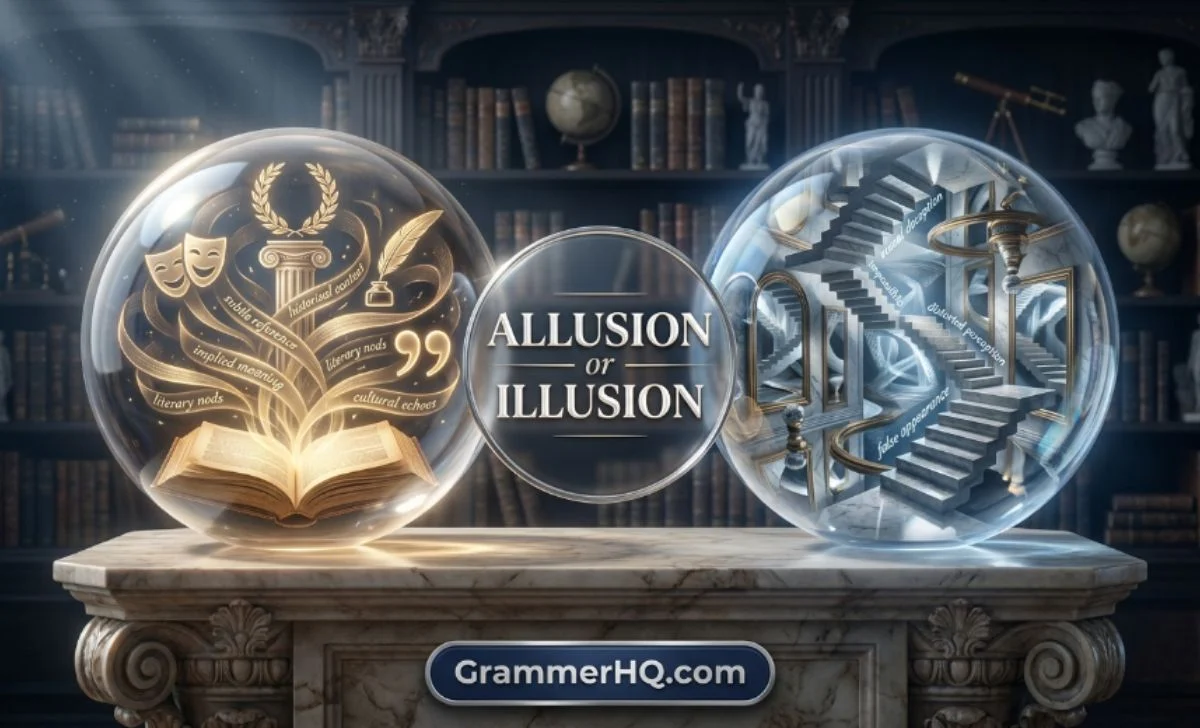
Many English learners confuse allusion and illusion because the two words look and sound similar. However, they have completely different meanings.
An allusion is an indirect reference to a person, event, book, or idea, while an illusion is something that deceives the senses or creates a false impression of reality. Using the wrong word can change the meaning of your sentence and make your writing unclear.
In this guide, you’ll learn the exact difference, correct pronunciation, easy memory tricks, practical examples, common mistakes, and expert tips so you can confidently choose the right word every time.
Quick Answer
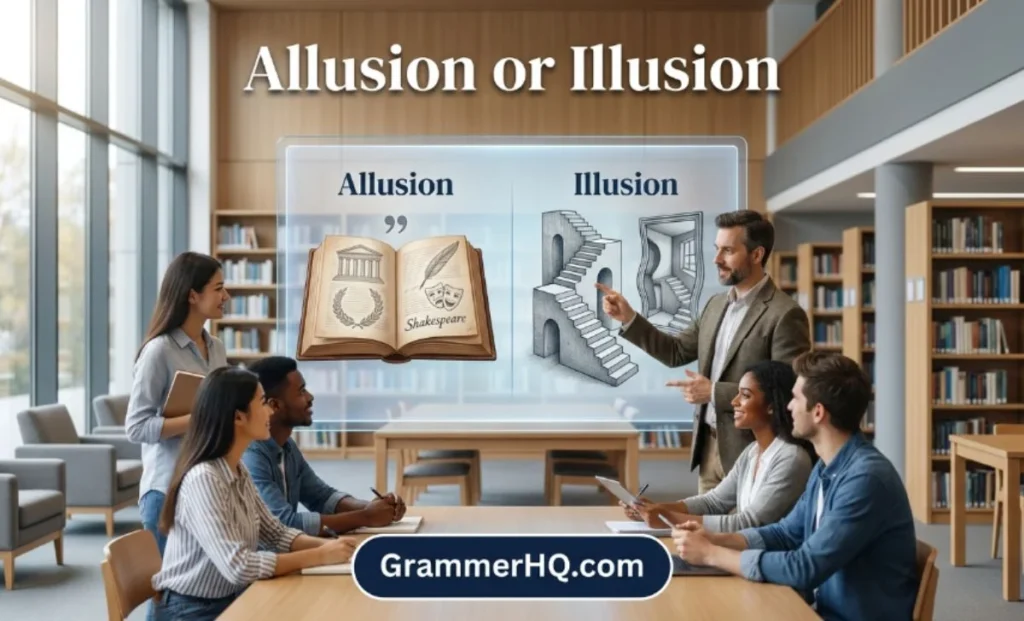
The difference is simple:
- Allusion = an indirect reference to someone or something.
- Illusion = something that appears real but is actually false or deceptive.
Quick Comparison
| Word | Meaning | Example |
|---|---|---|
| Allusion | An indirect reference to a person, event, book, or idea | Her speech included an allusion to Shakespeare. |
| Illusion | A false appearance or something that tricks the mind or eyes | The magician created the illusion that he disappeared. |
If you’re talking about literature, writing, speeches, movies, history, or culture, use allusion.
If you’re talking about optical tricks, false appearances, magic, or mistaken perception, use illusion.
Pronunciation of Allusion or Illusion
Although these words sound similar, their meanings are very different.
| Word | IPA | Pronunciation |
|---|---|---|
| Allusion | /əˈluːʒən/ | uh-LOO-zhən |
| Illusion | /ɪˈluːʒən/ | ih-LOO-zhən |
How They Sound
- Allusion begins with a soft “uh” sound.
- Illusion begins with a short “ih” sound.
In fast conversation, many people hardly notice this small difference, which is one reason these words are often confused.
Spoken English Tip
- Talking about a hidden reference? → Allusion
- Talking about something that isn’t really there? → Illusion
Why People Confuse Allusion and Illusion
Several factors make these words easy to mix up.
Similar Spelling
Both words:
- end with -lusion
- contain nearly the same letters
- differ by only one letter near the beginning
Because of this, people often type the wrong word without noticing.
Similar Pronunciation
The pronunciation is almost identical in everyday speech. When spoken quickly, the first vowel sound is easy to miss.
Different Meanings, Similar Appearance
This is where many writers make mistakes.
An allusion belongs to the world of language, literature, communication, history, and culture.
An illusion belongs to perception, psychology, vision, magic, and false appearances.
Different Contexts
Use allusion when writing about:
- Literature
- Novels
- Poetry
- Speeches
- History
- Mythology
- Famous people
- Cultural references
Use illusion when writing about:
- Magic shows
- Optical illusions
- Visual perception
- Psychology
- False beliefs
- Deceptive appearances
- Human senses
Why This Confusion Matters
Choosing the wrong word changes your message.
❌ The author made an illusion to Greek mythology.
✅ The author made an allusion to Greek mythology.
❌ The painting creates an allusion of depth.
✅ The painting creates an illusion of depth.
Easy Trick to Remember Allusion or Illusion
A simple memory trick can help you choose the correct word every time.
Remember A = Allusion = Author
Think of the letter A in Allusion as standing for Author.
Authors often make allusions by referring to famous people, books, historical events, myths, or movies without explaining them directly.
Example:
The novel makes an allusion to Greek mythology.
The writer is referring to something readers may already know.
Remember I = Illusion = Image
Think of the letter I in Illusion as standing for Image.
An illusion is something your eyes or mind believe, even though it is not real.
Example:
The mirror created the illusion of a larger room.
Quick Memory Chart
| If you mean… | Use… |
|---|---|
| A hidden reference | Allusion |
| A false appearance | Illusion |
| Literature or writing | Allusion |
| Vision or perception | Illusion |
| History, culture, or mythology | Allusion |
| Magic or optical tricks | Illusion |
Once you connect Author → Allusion and Image → Illusion, the difference becomes much easier to remember.
The Origin of Allusion or Illusion
Although these words look alike, they developed from different Latin roots and have always carried different meanings.
Origin of Allusion
Allusion comes from the Latin word alludere, meaning “to refer indirectly,” “to hint,” or “to play with.”
Over time, English writers used allusion to describe an indirect reference that expects readers to recognize a person, event, book, place, or idea without a full explanation.
Today, allusions are common in:
- Literature
- Speeches
- News articles
- Movies
- Academic writing
- Everyday communication
Origin of Illusion
Illusion comes from the Latin word illusio, meaning “mockery,” “deception,” or “false appearance.”
Its meaning gradually expanded to describe anything that creates a misleading impression, especially something that tricks the eyes or the mind.
Today, the word appears frequently in discussions about:
- Optical illusions
- Psychology
- Magic
- Art
- Visual perception
- Human cognition
Why Their Spellings Look Similar
Both words share the ending -lusion, which explains why many people assume they are related.
However, their meanings developed in completely different directions.
- Allusion focuses on language and indirect references.
- Illusion focuses on perception and false appearances.
Understanding their origins makes the difference easier to remember.
British English vs American English
Unlike many English words, allusion and illusion have the same spelling in both British and American English.
There is no regional spelling variation.
Comparison Table
| Feature | British English | American English |
|---|---|---|
| Allusion | ✅ Allusion | ✅ Allusion |
| Illusion | ✅ Illusion | ✅ Illusion |
| Meaning | Same | Same |
| Pronunciation | Nearly identical | Nearly identical |
| Usage | Same | Same |
Unlike words such as colour/color or centre/center, these words never change spelling based on region.
Which Word Should You Use?
Choose the word according to the meaning you want to express—not your location.
Use allusion when your sentence includes an indirect reference to something your audience is expected to recognize.
Examples
- The speaker made an allusion to the Olympic Games.
- The film contains several allusions to classic novels.
- Her article includes an allusion to a famous historical speech.
Use illusion when describing something that creates a false impression or deceives the senses.
Examples
- The artist created the illusion of movement.
- The desert heat produced the illusion of water.
- The magician relied on illusion instead of special effects.
Quick Decision Guide
| Ask Yourself | Correct Word |
|---|---|
| Am I referring to another person, book, event, or idea? | Allusion |
| Am I describing something that only seems real? | Illusion |
Choosing the correct word based on context will make your writing clearer and more precise.
Common Mistakes with Allusion or Illusion
These are some of the most common errors English learners and even experienced writers make.
Mistake 1: Using illusion instead of allusion
❌ The article makes an illusion to Shakespeare.
✅ The article makes an allusion to Shakespeare.
Mistake 2: Using allusion for a visual effect
❌ The painting creates an allusion of depth.
✅ The painting creates an illusion of depth.
Mistake 3: Choosing a word based on pronunciation
Because both words sound very similar, some writers select the wrong spelling while typing.
Instead, think about the meaning first.
- Hidden reference → Allusion
- False appearance → Illusion
Mistake 4: Assuming the Words Are Interchangeable
Although they look and sound alike, they cannot replace each other.
Using the wrong word changes the meaning of your sentence and may confuse readers.
Quick Mistake Checklist
- ✔ Talking about literature? → Allusion
- ✔ Talking about history or culture? → Allusion
- ✔ Talking about magic? → Illusion
- ✔ Talking about vision or perception? → Illusion
- ✔ Unsure? Ask whether the sentence is about a reference or a false appearance before choosing the word.
Allusion or Illusion in Everyday Examples
Understanding the difference becomes much easier when you see both words in real-life situations.
In Everyday Conversation
Allusion
- Her joke was an allusion to a popular movie.
- His speech included an allusion to a famous athlete.
Illusion
- The stage lights created the illusion of floating objects.
- From a distance, the road gave the illusion of being wet.
In Emails
✅ Allusion
Your introduction contains an allusion to the company’s founding story, which makes the message more engaging.
✅ Illusion
The advertisement creates the illusion that the product works instantly.
In News Articles
Allusion
The journalist made an allusion to a historic peace agreement without mentioning it directly.
Illusion
Experts explained why the viral image was only an optical illusion.
In Social Media
Allusion
The meme contains an allusion to a famous scene from a classic film.
Illusion
This photo creates the illusion that the moon is resting on the mountain.
In Academic Writing
Allusion
The poet uses an allusion to Greek mythology to strengthen the poem’s central theme.
Illusion
Researchers examined how visual illusions influence human perception and decision-making.
These examples show that allusion belongs to language, literature, and communication, while illusion is connected with perception, psychology, art, and visual experience.
Allusion or Illusion – Google Trends & Usage Data
Both words are searched worldwide, but people search for them in different contexts.
Allusion
People usually search this word when they want to understand:
- Literary devices
- English vocabulary
- Writing techniques
- School or university assignments
- Famous references in books and speeches
Illusion
Searches commonly relate to:
- Optical illusions
- Psychology
- Magic
- Human perception
- Visual science
Countries Where These Searches Are Common
- United States
- United Kingdom
- Canada
- Australia
- India
- Pakistan
- South Africa
English learners, students, teachers, editors, and professional writers frequently search for these words because confusing them can change the meaning of a sentence.
FAQs
What is the difference between allusion and illusion?
An allusion is an indirect reference to a person, event, book, or idea. An illusion is a false appearance or something that deceives the senses.
What is an example of an allusion?
The novel makes an allusion to Romeo and Juliet.
The writer refers to another work without explaining it directly.
What is an example of an illusion?
The mirror created the illusion of a larger room.
The room only appears larger—it is not actually larger.
What are five common examples of allusion?
Common allusions include references to:
- Shakespeare
- Greek mythology
- The Bible
- Harry Potter
- Historical events
These references rely on the reader’s existing knowledge.
What is another word for allusion?
Depending on the context, possible alternatives include:
- reference
- mention
- hint
- implication
- citation
However, reference is usually the closest everyday synonym.
Can allusion and illusion be used interchangeably?
No. Although the words look and sound similar, they have different meanings and should never replace one another.
Why do people confuse allusion and illusion?
People confuse them because they have similar spellings and nearly identical pronunciation. The easiest way to avoid mistakes is to remember that allusion refers to a reference, while illusion refers to a false appearance.
Conclusion
Although allusion and illusion differ by only one letter, they describe completely different ideas. Allusion is an indirect reference used in writing, literature, speeches, and everyday communication.
Illusion describes something that deceives the senses or creates a false impression of reality. Understanding this distinction will help you write with greater clarity and confidence.
Before choosing either word, ask yourself a simple question: Am I referring to another person, event, or work, or am I describing something that only appears to be real? This quick check will help you select the correct word every time and avoid one of the most common vocabulary mistakes in English.
Read More Bloogs:
- Canvas or Canvass: A Simple Guide to Correct English Usage
- Adapt or Adopt Explained: Difference, Uses, and Examples