Every day, thousands of people search “advice or advise” because this simple word pair continues to trip up writers, students, and professionals alike.
If you’ve ever paused mid-sentence wondering which spelling fits, you’re searching for exactly the right answer, and you’ve landed in the right place.
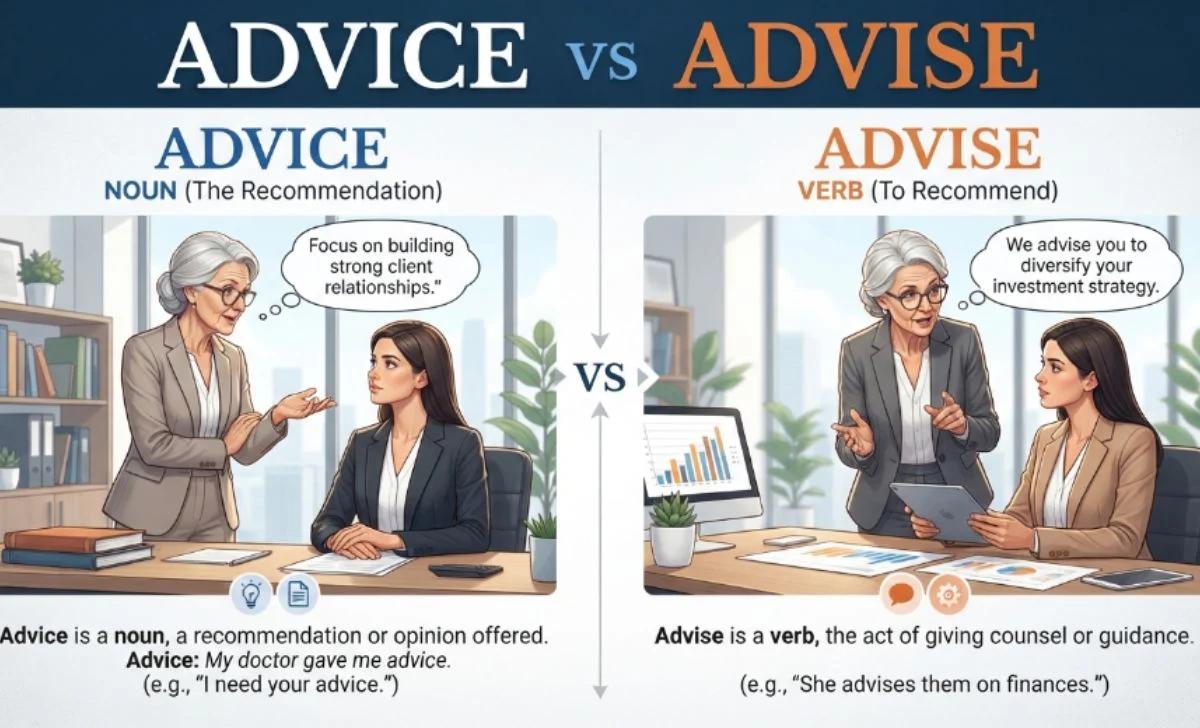
The truth is simple once explained clearly: “advice” is something you receive (a noun), while “advise” is something someone does (a verb).
This tiny difference impacts emails, resumes, exams, and everyday conversations more than most people realize.
In this updated 2026 guide, we’ll walk you through clear definitions, real-world examples, common mistakes to avoid, and simple tricks to remember the difference permanently, so you never second-guess yourself again.
Quick Answer
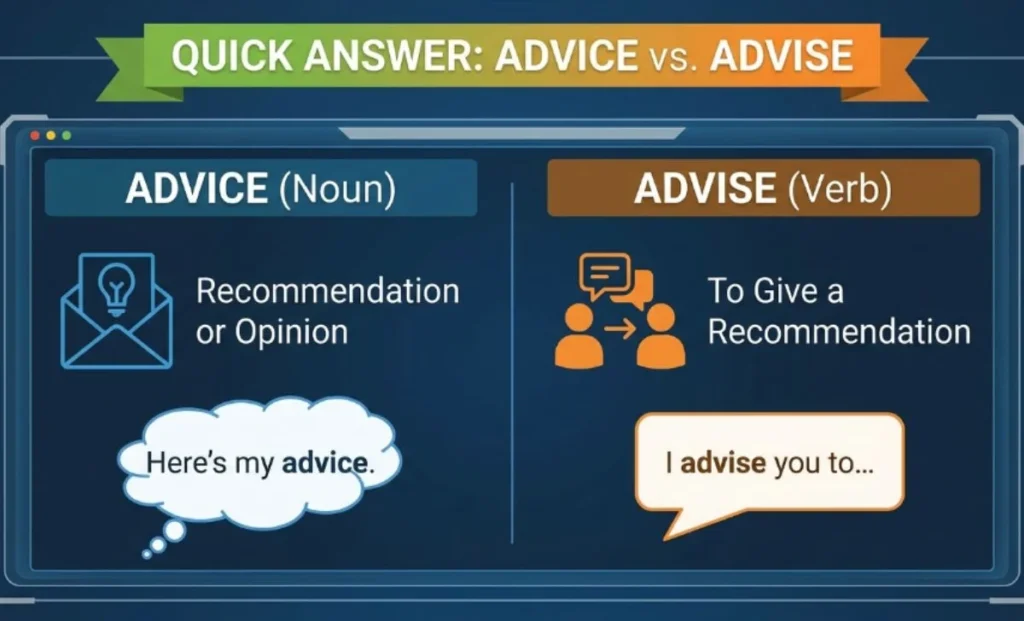
The difference between advice and advise is simple:
- Advice is a noun. It means a suggestion, guidance, or recommendation.
- Advise is a verb. It means to give someone advice or recommend a course of action.
Think of it this way:
- Advice = the thing you receive.
- Advise = the action of giving it.
Correct Examples
| Word | Part of Speech | Meaning | Example |
|---|---|---|---|
| Advice | Noun | A suggestion or recommendation | She gave me useful advice before the interview. |
| Advise | Verb | To give guidance or recommend | I advise you to save your work regularly. |
More Examples
- My teacher gave me helpful advice about improving my writing.
- Doctors often advise patients to exercise regularly.
- His advice helped me make the right decision.
- I strongly advise checking your email before submitting the application.
- Thank you for your valuable advice.
Quick Tip: If you can replace the word with “suggestion,” use advice. If you mean “to recommend” or “to suggest,” use advise.
Pronunciation of Advice or Advise
Although advice and advise have almost identical spellings, they are pronounced differently. The final sound changes because one is a noun and the other is a verb.
| Word | IPA | Sounds Like |
|---|---|---|
| Advice | /ədˈvaɪs/ | ad-VICE |
| Advise | /ədˈvaɪz/ | ad-VIZE |
How to Hear the Difference
- Advice ends with a soft “s” sound, like the word ice.
- Advise ends with a buzzing “z” sound, like the word size.
This pronunciation difference is small but important, especially in spoken English.
Pronunciation Examples
- Advice: Can I ask for your advice?
- Advise: I advise taking an umbrella today.
Common Pronunciation Mistake
Many English learners pronounce both words the same because they differ by only one letter. Remember:
- Advice → “s” sound
- Advise → “z” sound
Listening to native speakers and repeating these words aloud can help you notice and remember the difference.
Why People Confuse Advice or Advise
Many people confuse advice and advise because they are closely related in meaning and differ by only one letter. Both words are used when talking about recommendations or guidance, so it’s easy to mix them up while writing or speaking.
Here are the main reasons for the confusion:
They Look Almost the Same
The only spelling difference is the final letter:
- Advice
- Advise
Because the words are nearly identical, many writers accidentally choose the wrong one.
They Have Related Meanings
Both words refer to guidance or recommendations.
- Advice is the guidance itself.
- Advise is the act of giving that guidance.
Since they describe the same idea from different grammar roles, learners often use one instead of the other.
The Pronunciation Is Very Similar
The words share the same beginning and stress pattern.
- Advice ends with an “s” sound.
- Advise ends with a “z” sound.
If you don’t hear this small difference clearly, it’s easy to confuse them.
Grammar Can Be Tricky
English often has noun-verb pairs with similar spellings, such as:
- Device → Devise
- Practice → Practise (British English)
Advice and advise follow a similar pattern, which can confuse learners who are still building grammar skills.
Fast Typing and Autocorrect
When writing quickly, people often type advise instead of advice, or vice versa. Some spell-check tools also fail to catch the mistake because both are correctly spelled English words.
Easy Trick to Remember Advice or Advise
A simple memory trick can help you choose the correct word every time.
Remember This Rule
- Advice contains C, and C stands for Counsel or Consultation—something you receive.
- Advise contains S, and S stands for Speak or Suggest—something you do.
Another Easy Formula
- Advice = Noun = Thing
- Advise = Verb = Action
If someone gives something, it’s advice.
If someone does the giving, they advise.
Memory Examples
- I need some advice. ✅ (You need a suggestion.)
- My mentor advised me to stay patient. ✅ (Your mentor performed the action.)
One-Line Trick
You receive advice, but people advise you.
This simple sentence helps you remember both the meaning and the grammar instantly.
The Origin of Advice or Advise
The words advice and advise come from the same historical root but developed into different parts of speech over time. Both trace back to the Old French word avis, meaning “opinion” or “view.” That word came from the Latin phrase ad visum, which means “according to what has been seen” or “after considering.”
As English evolved, the language created two separate forms:
- Advice became the noun, referring to the guidance or recommendation itself.
- Advise became the verb, referring to the act of giving guidance.
This noun-and-verb pattern is common in English. The spelling difference helps readers quickly identify whether the word is naming something or describing an action.
Origin Timeline
| Period | Development |
|---|---|
| Latin | ad visum – “after considering” |
| Old French | avis – opinion or judgment |
| Middle English | Advice (noun) and advise (verb) developed separately |
| Modern English | Both words remain standard with different grammatical functions |
Although they share the same origin, advice and advise have never been interchangeable in modern English.
British English vs American English Spelling
Unlike many English words, advice and advise do not have different British and American spellings. The spelling is exactly the same in both varieties of English.
Whether you are writing for readers in the United States, the United Kingdom, Canada, Australia, or New Zealand, the rule is identical:
- Advice = noun
- Advise = verb
The only differences you may notice are in accent and pronunciation, not spelling.
Comparison Table
| Feature | American English | British English |
|---|---|---|
| Noun | Advice | Advice |
| Verb | Advise | Advise |
| Meaning | Same | Same |
| Grammar Rule | Same | Same |
| Spelling Difference | None | None |
Examples
| American English | British English |
|---|---|
| My lawyer gave me good advice. | My solicitor gave me good advice. |
| I advise you to arrive early. | I advise you to arrive early. |
| Thank you for your helpful advice. | Thank you for your helpful advice. |
Key Point: This is not a British vs American spelling issue like color/colour or center/centre. The grammar rule stays exactly the same worldwide.
Which Spelling Should You Use?
The correct choice depends on how you are using the word, not where your audience lives.
Choose advice when you need a noun.
Use it when referring to a recommendation, suggestion, or guidance.
Examples
- I appreciate your advice.
- Her advice helped me avoid a mistake.
- Always listen to professional advice before making important decisions.
Choose advise when you need a verb.
Use it when someone is giving guidance or making a recommendation.
Examples
- I advise checking the instructions first.
- Experts advise saving money for emergencies.
- Teachers often advise students to read every day.
Quick Decision Guide
| If you mean… | Use |
|---|---|
| A suggestion or recommendation | Advice |
| To give a suggestion | Advise |
| A thing | Advice |
| An action | Advise |
If you’re ever unsure, ask yourself:
“Am I naming a suggestion or describing the act of giving one?”
If it’s the suggestion itself, use advice. If it’s the action, use advise.
Common Mistakes with Advice or Advise
Because these words have similar spellings and meanings, writers often use the wrong one. Here are the most common mistakes and their corrections.
| ❌ Incorrect | ✅ Correct | Why? |
|---|---|---|
| She gave me good advise. | She gave me good advice. | “Advice” is the noun. |
| I need your advise. | I need your advice. | You receive advice, not advise. |
| He advice me to wait. | He advised me to wait. | “Advise” is the verb. |
| The doctor gave useful advise. | The doctor gave useful advice. | Guidance is a noun. |
| They advice us to leave early. | They advised us to leave early. | The sentence needs a verb. |
Tips to Avoid These Mistakes
- Remember that advice is always a noun.
- Remember that advise is always a verb.
- Look at the word before it:
- give, need, follow, useful → usually advice
- I, we, they, experts, teachers followed by an action → usually advise
- Proofread carefully because spell check may not catch this mistake. Both words are correctly spelled, but only one fits the sentence.
By learning these patterns, you’ll be able to choose the correct word naturally in both everyday and professional writing.
Advice or Advise in Everyday Examples
Understanding the grammar rule is helpful, but seeing advice and advise in real-life situations makes the difference much easier to remember.
In Emails
- Thank you for your valuable advice.
- I would advise reviewing the report before sending it.
- Your advice helped us improve the proposal.
- We advise all employees to update their passwords regularly.
In News Reports
- Financial experts advise investors to diversify their portfolios.
- The government issued advice on staying safe during extreme weather.
- Doctors advise people to stay hydrated in hot temperatures.
- Public health advice was shared through local media.
On Social Media
- Can anyone give me advice on learning English faster?
- I always advise beginners to practice a little every day.
- Thanks for the helpful advice!
- I’d advise checking the source before sharing the post.
In Everyday Conversations
- My father gave me great advice about saving money.
- I advise you to leave early to avoid traffic.
- Her advice gave me more confidence.
- Teachers often advise students to ask questions whenever they are unsure.
Quick Reminder:
- Advice = the guidance you receive.
- Advise = the act of giving guidance.
Comparison Table:
| Feature | Advice | Advise |
|---|---|---|
| Part of Speech | Noun | Verb |
| Meaning | Guidance, suggestion, recommendation | To give guidance or recommend |
| Function | A thing you receive | An action someone performs |
| Pronunciation | /ədˈvaɪs/ | /ədˈvaɪz/ |
| Ends With | -ce | -se |
| Example | She gave me good advice. | I advise you to arrive early. |
| Can Follow “Give”? | ✅ Yes | ❌ No |
| Can Show an Action? | ❌ No | ✅ Yes |
Advice vs Advise Pronunciation
- Although advice and advise look almost identical, they are pronounced differently because they belong to different parts of speech.
- Advice is a noun and ends with the soft /s/ sound, while advise is a verb and ends with the voiced /z/ sound.
- This pronunciation difference is one of the easiest ways to remember which word to use. Speaking them correctly also helps improve both your English pronunciation and grammar accuracy.
Examples
- She gave me good advice before the interview. (ad-VICE)
- I advise you to save your work regularly. (ad-VYZE)
- His advice helped me make the right decision. (ad-VICE)
- The doctor advised me to get more rest. (ad-VYZD)
Advice (UK English)
- In UK English, advice is the correct noun used to mean guidance, recommendations, or helpful suggestions.
- It is an uncountable noun, so native British speakers say “some advice” or “a piece of advice”, not “an advice.” This usage is standard in British schools, workplaces, legal documents, and everyday conversations.
- If you are writing for a UK audience, always use advice when referring to guidance or recommendations.
Examples:
- My teacher gave me some useful advice before the exam.
- You should seek legal advice before signing the contract.
- Her financial advice helped us save money.
- I appreciate your honest advice about my career.
Advice vs Advise Synonyms
- Advice and advise have different meanings, so their synonyms are different too. Advice is a noun (a suggestion or recommendation), while advise is a verb (to give a recommendation).
- Knowing the correct synonym helps you choose the right word in speaking and writing. This distinction is important in both British and American English.
- Using the proper synonym also improves clarity and avoids common grammar mistakes.
Common synonyms of advice: suggestion, recommendation, guidance, counsel, tip, opinion.
Common synonyms of advise: recommend, suggest, counsel, guide, encourage, instruct.
Examples
- My teacher gave me advice about preparing for the exam. (Guidance)
- I advise you to save money every month. (Recommend)
- Her recommendation was the best advice I received.
- The doctor suggested drinking more water instead of saying he advised it directly.
Doctor Advice or Advise
- The correct phrase depends on how the word is used. Use doctor’s advice when referring to the recommendation or guidance a doctor gives because advice is a noun.
- Use doctor advises when describing the doctor’s action because advise is a verb. This is one of the most common English grammar mistakes. Remember: advice = thing (noun), advise = action (verb).
Examples
- Always follow your doctor’s advice after surgery.
- The doctor advised me to get more rest.
- Her doctor’s advice helped her recover quickly.
- Doctors advise patients to drink plenty of water during hot weather.
FAQs
1. What is the difference between advice and advise?
Advice is a noun that means guidance or a recommendation. Advise is a verb that means to give guidance or recommend something.
2. Is advice a noun or a verb?
Advice is always a noun. It refers to the suggestion or guidance itself.
Example: Her advice was very helpful.
3. Is advise a noun or a verb?
Advise is always a verb. It describes the action of giving advice.
Example: I advise reading the instructions first.
4. How do you remember the difference between advice and advise?
A simple trick is:
- Advice = Noun = Thing
- Advise = Verb = Action
You receive advice, but someone advises you.
5. Do British and American English spell advice and advise differently?
No. Both British English and American English use the same spellings:
- Advice (noun)
- Advise (verb)
The grammar rule is identical in both varieties of English.
6. Which word is more common, advice or advise?
Both are common, but advice appears more frequently because people often talk about receiving or giving guidance in everyday communication.
7. Can I use advice and advise interchangeably?
No. They have different grammatical functions. Using one in place of the other creates a grammar mistake.
Conclusion
The difference between advice and advise is easy to remember once you know their grammatical roles. Advice is the noun, meaning a suggestion or recommendation, while advise is the verb, meaning to give that recommendation.
This rule is the same in British English, American English, and other English-speaking countries. Remember the simple formula: you receive advice, but someone advises you.
Paying attention to the part of speech and practicing with real-life examples will help you avoid one of the most common English grammar mistakes.
Whether you’re writing an email, school assignment, business document, or social media post, choosing the correct word will make your English clearer, more accurate, and more professional.
Read More Blogs:
- Barbeque or Barbecue: Which Spelling Is Correct?
- Affect or Effect: Which One Is Correct? A Complete Breakdown