Have you ever read the sentence, “The musician carried his loot onto the stage,” and felt something was wrong? You’re not alone.
Because loot and lute sound exactly the same, many English learners accidentally use one when they mean the other. Despite their identical pronunciation, these words have completely different meanings.
One belongs to the world of treasure, piracy, and video games, while the other belongs to music, history, and classical instruments.
In this guide, you’ll learn the difference between loot vs lute, their meanings, pronunciation, origins, examples, and simple memory tricks so you’ll never confuse them again.
Loot vs Lute – Quick Answer
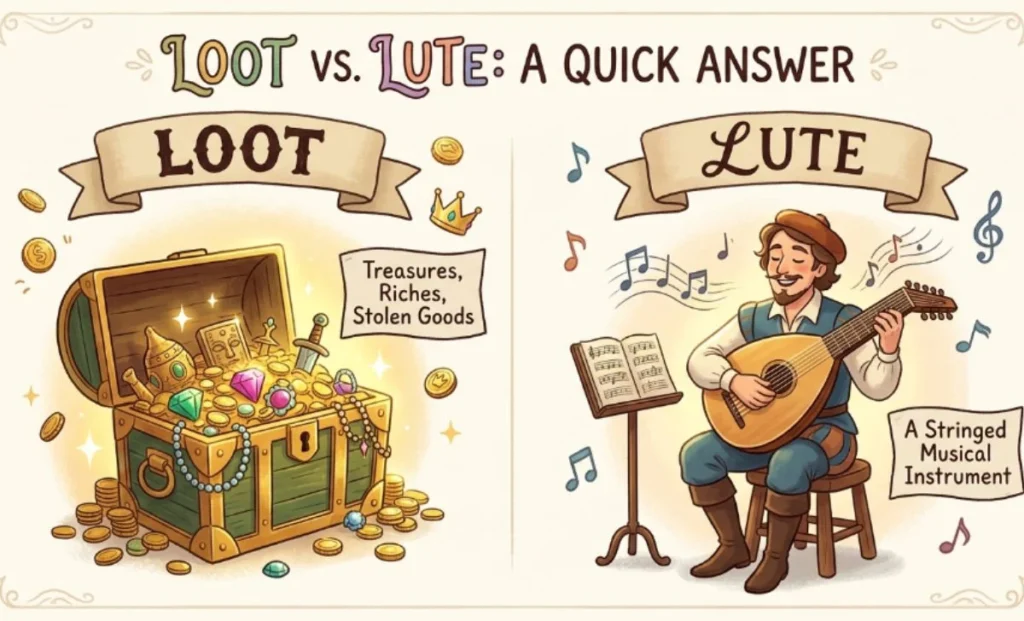
If you’re in a hurry, here’s the simple answer.
| Word | Meaning | Part of Speech | Example |
|---|---|---|---|
| Loot | Stolen goods, treasure, or valuable items taken illegally | Noun / Verb | The pirates buried their loot. |
| Lute | A pear-shaped stringed musical instrument | Noun | The musician played the lute beautifully. |
The Difference in One Sentence
- Loot = Treasure, stolen valuables, gaming rewards
- Lute = A musical instrument played during the Renaissance
Although both words are pronounced /luːt/, their meanings are completely unrelated.
Why Do People Confuse Loot and Lute?
The confusion happens because loot and lute are perfect homophones.
Homophones are words that:
- Sound exactly the same
- Have different spellings
- Have different meanings
Since English contains thousands of homophones, it’s easy to type the wrong word without noticing.
For example:
- Knight / Night
- Flour / Flower
- Sea / See
- Loot / Lute
Spell check often misses these mistakes because both words are correctly spelled English words. Only the context tells you which one is correct.
Loot vs Lute Pronunciation
One of the biggest reasons these words are confused is that they have identical pronunciation.
| Word | IPA | Sounds Like |
|---|---|---|
| Loot | /luːt/ | boot, root |
| Lute | /luːt/ | flute, suit |
You cannot tell the difference by listening alone.
Instead, you must understand the meaning of the sentence.
Example
❌ The pirates played the loot.
✅ The pirates stole the loot.
❌ The orchestra performed with several loots.
✅ The orchestra performed with several lutes.
What Does Loot Mean?
The word loot refers to money, goods, or valuable items stolen during war, robbery, riots, or other illegal acts.
Today, the word is also widely used in video games to describe valuable rewards collected by players.
Loot Definition
Loot (noun):
Property or valuables taken illegally.
Loot (verb):
To steal or carry away valuables during conflict or disorder.
Examples
- The thieves escaped with valuable loot.
- Pirates divided the loot after the battle.
- Players searched for legendary loot after defeating the boss.
- Several shops were looted during the riot.
Notice that every example involves taking valuable items.
Loot in Modern English
Although the word originally referred to stolen treasure, modern English uses it in several different situations.
1. Gaming
Gamers often collect:
- Rare loot
- Epic loot
- Legendary loot
- Loot drops
- Loot chests
Example:
The dungeon rewarded players with powerful loot.
2. Crime Reports
News reports frequently use the word.
Example:
Police recovered most of the stolen loot.
3. Adventure Stories
Books and movies about pirates almost always mention loot.
Example:
The captain hid the loot on a deserted island.
Because of these uses, loot often creates images of treasure, adventure, or stolen riches.
Where Did the Word Loot Come From?
The history of loot is fascinating.
Unlike many English words that come from Latin or French, loot entered English from the Hindi word “lūt,” meaning to rob or plunder.
British soldiers brought the word into English during the colonial period in India.
Over time, it became closely associated with:
- Treasure
- Pirates
- War
- Robbery
- Valuable goods
Today, the meaning has expanded to include gaming rewards as well.
Common Synonyms of Loot
Depending on the context, loot may be replaced with:
| Word | Best Used For |
|---|---|
| Treasure | Hidden valuables |
| Plunder | Goods stolen during war |
| Booty | Pirate treasure |
| Spoils | Rewards after victory |
| Stolen goods | Crime reports |
| Riches | Valuable possessions |
Each synonym carries a slightly different meaning, but all relate to valuable items.
What Does Lute Mean?
Unlike loot, which is connected with treasure and stolen valuables, lute belongs to the world of music.
A lute is a traditional stringed musical instrument with a rounded body, a short neck, and multiple strings. It was one of the most popular instruments in Europe during the Middle Ages and the Renaissance.
Lute Definition
Lute (noun):
A pear-shaped stringed instrument played by plucking its strings with the fingers or a pick.
Unlike the modern guitar, the lute has:
- A rounded back
- Multiple pairs of strings
- A shorter neck
- A softer, warmer sound
Examples
- The musician played the lute during the concert.
- A beautifully decorated lute hung on the castle wall.
- Renaissance composers wrote many pieces for the lute.
- She learned to play the lute before studying the guitar.
Whenever you see the word lute, think about music—not treasure.
The History of the Lute
The lute has a history that stretches back more than a thousand years.
It developed from the Arabic instrument called the oud, which later spread into Europe through cultural exchanges.
During the Renaissance, the lute became one of the most respected musical instruments because of its rich, expressive sound.
Musicians used it for:
- Royal performances
- Classical concerts
- Poetry recitals
- Religious ceremonies
- Court entertainment
Before the piano became popular, the lute was considered one of Europe’s finest instruments.
Interesting Facts About the Lute
| Feature | Details |
|---|---|
| Instrument Family | String instrument |
| Shape | Pear-shaped body |
| Origin | Developed from the Arabic oud |
| Popular Period | Middle Ages and Renaissance |
| Playing Style | Plucked with fingers or a pick |
| Modern Relative | Guitar |
Unlike many modern instruments, historical lutes often had 10 to 15 courses (pairs of strings), producing a rich and elegant sound.
Loot vs Lute: Side-by-Side Comparison
Here’s the easiest way to understand the difference.
| Feature | Loot | Lute |
|---|---|---|
| Meaning | Stolen goods or treasure | Musical instrument |
| Part of Speech | Noun & Verb | Noun |
| Pronunciation | /luːt/ | /luːt/ |
| Context | Crime, pirates, gaming | Music, history, Renaissance |
| Related Words | Treasure, plunder, booty | Music, instrument, melody |
| Example | The pirates buried the loot. | The musician tuned the lute. |
The pronunciation is identical, but the meaning changes completely.
Loot vs Lute in British and American English
One question many learners ask is whether loot and lute are spelled differently in British English and American English.
The answer is simple:
They are exactly the same in both varieties of English.
| English Variety | Loot | Lute |
|---|---|---|
| American English | ✅ Loot | ✅ Lute |
| British English | ✅ Loot | ✅ Lute |
| Canadian English | ✅ Loot | ✅ Lute |
| Australian English | ✅ Loot | ✅ Lute |
Unlike words such as color/colour or center/centre, there are no regional spelling differences for these two words.
Loot vs Lute in Everyday Examples
Reading words in context is the fastest way to remember them.
Loot Examples
- The pirates divided the loot after the battle.
- Police recovered the stolen loot.
- Players collected valuable loot from the dungeon.
- Rioters looted several stores overnight.
- The treasure hunters searched for hidden loot.
Lute Examples
- The young musician played the lute beautifully.
- The museum displayed a sixteenth-century lute.
- Renaissance artists often painted people holding lutes.
- The concert featured several historical instruments, including the lute.
- He spent years learning the lute.
These examples clearly show that loot belongs to treasure, while lute belongs to music.
Common Mistakes People Make
Because these words sound identical, many writers accidentally replace one with the other.
Incorrect
❌ The orchestra performed with beautiful loot.
Correct
✅ The orchestra performed with beautiful lutes.
Incorrect
❌ The pirates buried the lute on the island.
Correct
✅ The pirates buried the loot on the island.
Incorrect
❌ The musician polished his loot.
Correct
✅ The musician polished his lute.
Incorrect
❌ Gamers searched for legendary lutes.
Correct
✅ Gamers searched for legendary loot.
One wrong letter completely changes the meaning of the sentence.
How to Remember Loot vs Lute
These memory tricks make the difference almost impossible to forget.
Memory Trick 1: Treasure vs Music
Loot = Treasure
Think of:
- Pirates
- Gold coins
- Treasure chests
- Robbers
- Video game rewards
Lute = Music
Think of:
- Guitar-like instrument
- Classical music
- Renaissance musicians
- Concerts
- Medieval Europe
Memory Trick 2: Look at the Spelling
Loot
Contains OO, which looks like two gold coins inside a treasure chest.
👉 OO = Gold = Loot
Lute
Ends with TE, reminding you of Tune.
👉 Tune = Lute
Memory Trick 3: Picture Association
Imagine two scenes.
🏴☠️ A pirate carrying a heavy treasure chest.
That’s Loot.
🎼 A musician sitting inside a medieval castle playing beautiful music.
That’s Lute.
Creating mental images helps you remember the correct word much faster than memorizing definitions.
Which Word Should You Use?
Ask yourself one simple question.
Is the sentence about…
Treasure, robbery, gaming rewards, pirates, or stolen property?
➡️ Use Loot
Music, instruments, Renaissance history, or musicians?
➡️ Use Lute
This simple rule works in almost every situation.
Loot vs Lute Quiz
Test your understanding by choosing the correct word.
1. The pirates buried their ______ on a remote island.
- A) Loot
- B) Lute
✅ Answer: Loot
2. The musician carefully tuned her ______ before the performance.
- A) Loot
- B) Lute
✅ Answer: Lute
3. Players collected legendary ______ after defeating the dragon.
- A) Loot
- B) Lute
✅ Answer: Loot
4. During the Renaissance, many composers wrote music for the ______.
- A) Loot
- B) Lute
✅ Answer: Lute
5. The robbers escaped with valuable ______.
- A) Loot
- B) Lute
✅ Answer: Loot
Practice Exercise
Fill in the blanks with loot or lute.
- The museum displayed an ancient __________ from the 16th century.
- The thieves escaped with thousands of dollars in __________.
- The young artist learned to play the __________.
- Gamers searched for rare __________ after completing the mission.
- Pirates fought over the hidden __________.
Answers
- lute
- loot
- lute
- loot
- loot
Loot vs Lute: Quick Comparison
| Feature | Loot | Lute |
|---|---|---|
| Meaning | Stolen valuables or treasure | Stringed musical instrument |
| Pronunciation | /luːt/ | /luːt/ |
| Part of Speech | Noun & Verb | Noun |
| Common Topics | Pirates, crime, gaming | Music, history, Renaissance |
| Origin | Hindi lūt | Arabic al-ʿūd |
| British vs American English | Same spelling | Same spelling |
Quick Recap
Still confused? Remember this:
- Loot = Treasure, stolen goods, gaming rewards
- Lute = Musical instrument, Renaissance music
A simple question can help you choose the correct word:
Is the sentence about treasure or stealing?
➡️ Use loot.
Is it about music or a historical instrument?
➡️ Use lute.
Commonly Confused Words Like Loot vs Lute
If you’re learning English, you may also confuse these word pairs:
- Accept vs Except
- Affect vs Effect
- Stationary vs Stationery
- Complement vs Compliment
- Principal vs Principle
- Peak vs Peek vs Pique
- Brake vs Break
- Bare vs Bear
- Peace vs Piece
- Their vs There vs They’re
Learning these commonly confused words will improve your spelling, writing, and overall confidence in English.
FAQ,s
What is the difference between loot and lute?
Loot refers to stolen valuables, treasure, or rewards collected in games, while lute is a traditional stringed musical instrument popular during the Middle Ages and the Renaissance.
Are loot and lute pronounced the same?
Yes. Both words are pronounced /luːt/, making them perfect homophones.
Is loot a noun or a verb?
Yes. Loot can be used as both:
- Noun: The robbers escaped with the loot.
- Verb: The soldiers looted the village.
Is lute still used today?
Yes. Although it is not common in modern popular music, the lute is still played by musicians who perform Renaissance, Baroque, and early classical music.
Is there a spelling difference between British and American English?
No. Both loot and lute have the same spelling in British English and American English.
Why do people confuse loot and lute?
Because they sound exactly the same but have different meanings and spellings. Without context, it’s impossible to know which word someone is saying.
Can “loot” refer to video game rewards?
Yes. In modern gaming, loot commonly refers to weapons, armor, coins, or other valuable items that players collect during gameplay.
What is the easiest way to remember loot vs lute?
Think of this:
- Loot = Gold
- Lute = Guitar-like Instrument
If you picture a pirate, choose loot.
If you picture a musician, choose lute.
Final Verdict
Although loot and lute sound identical, they belong to completely different worlds. Loot is associated with stolen valuables, treasure, pirates, crime reports, and modern video games, whereas lute refers to a beautiful stringed musical instrument with deep roots in medieval and Renaissance music.
The easiest way to remember the difference is to focus on the context. If the sentence is about treasure, robbery, or gaming rewards, loot is the correct choice. If it discusses music, instruments, or historical performances, lute is the word you need.
By understanding their meanings, origins, pronunciation, and real-life usage, you’ll avoid one of the most common homophone mistakes in English. The next time you encounter loot vs lute, you’ll know exactly which word belongs in your sentence.
Read More Bloogs: