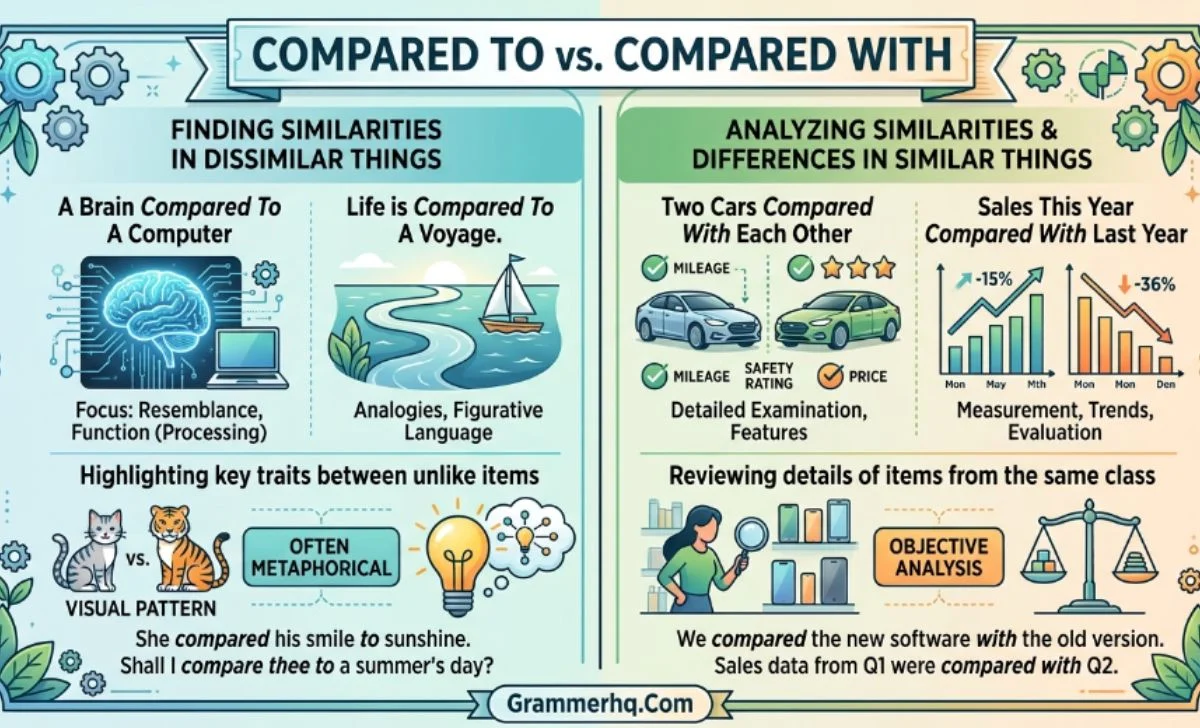
If you are unsure about Compared To vs Compared With, you are not alone. Both expressions are grammatically correct, and in many sentences, either one can work.
The traditional distinction is that compared to is often used when one thing is likened to another, while compared with is more common when two things are examined side by side.
However, modern English does not always follow this distinction strictly. The right choice depends largely on context and the kind of comparison you are making.
This guide explains the difference with clear examples, common mistakes, and practical rules you can actually use.
Quick Answer
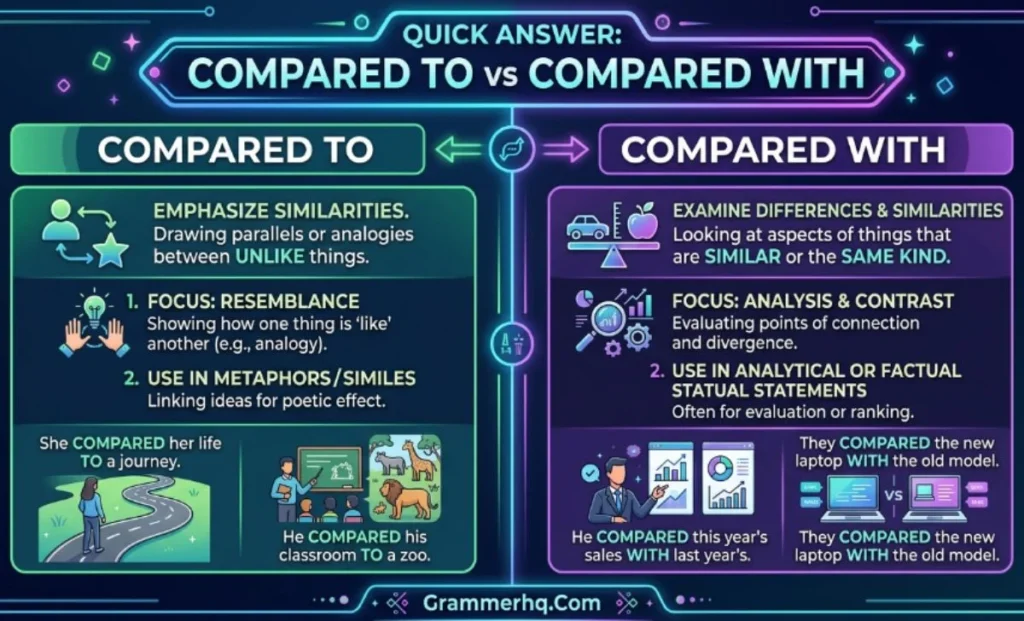
Compared to and compared with are both correct.
Traditionally:
- Compared to is often used to show a likeness, resemblance, or analogy.
- Compared with is often used for a direct comparison involving similarities and differences.
Examples
Compared to:
The singer’s voice was compared to an angel’s.
Here, the focus is on likeness.
Compared with:
This year’s sales are higher compared with last year’s figures.
Here, two sets of results are being examined side by side.
However, this is a useful guideline rather than an absolute grammar rule. In modern English, the two expressions frequently overlap.
What Does “Compared To” Mean?
Compared to is commonly used when you want to liken one person, thing, or situation to another.
It is especially natural when the comparison is figurative or emphasizes resemblance.
When to use compared to
Use compared to when:
- you are highlighting a similarity
- you are making an analogy
- one thing is being likened to another
- the comparison is somewhat figurative
For example:
Her smile was compared to sunshine.
The sentence does not suggest that a smile and sunshine are being measured on the same scale. Instead, one is being likened to the other.
Another familiar example comes from Shakespeare:
“Shall I compare thee to a summer’s day?”
The comparison is clearly about resemblance rather than a statistical evaluation.
More examples of compared to
- The new phone feels tiny compared to my old one.
- The lake looked peaceful compared to the busy city.
- He was often compared to his famous grandfather.
- The task was easy compared to what we had done before.
- Her voice has been compared to that of a professional singer.
Notice that compared to is not limited to figurative comparisons. It is also very common in ordinary comparisons.
What Does “Compared With” Mean?
Compared with traditionally emphasizes a direct, side-by-side comparison.
It is particularly useful when you are evaluating two things and considering how they differ or perform relative to each other.
When to use compared with
Use compared with when:
- two things are being evaluated
- measurable differences matter
- you are discussing results or performance
- the comparison is analytical or formal
For example:
The latest model uses less energy compared with the previous version.
The writer is comparing the performance of two products.
More examples of compared with
- The new system is faster compared with the old one.
- This year’s profits increased compared with last year.
- The treatment produced better results compared with the control group.
- The updated software is easier to use compared with the previous version.
- The company’s expenses were lower compared with the same period last year.
This type of construction is particularly common in academic, scientific, business, and professional writing.
Compared To vs Compared With: The Real Difference
The traditional distinction is useful, but it should not be treated as an unbreakable rule.
The traditional grammar rule
A simple way to remember the traditional distinction is:
Compare to → liken or show resemblance
Compare with → examine side by side
For example:
The child was compared to a little bird.
This emphasizes an image or resemblance.
Compare that with:
The researchers compared the two groups with each other.
Here, the purpose is to examine the groups and identify similarities and differences.
Why the distinction is not absolute
English usage has never maintained this distinction perfectly.
In everyday writing and speech, people regularly use compared to for ordinary, direct comparisons:
The new laptop is lighter compared to my old one.
Likewise, compared with can be used even when the comparison involves similarities:
Compared with her sister, Maria is very quiet.
So, saying that compared to is only for similarities and compared with is only for differences is too strict.
The traditional distinction can help you choose between them, but context matters more than memorizing a rigid rule.
Compared To vs Compared With Examples
Seeing the two expressions in realistic situations makes the difference easier to understand.
Similarity or resemblance
The building was compared to a giant glass box.
The writer is creating an image by showing what the building resembles.
His playing style was compared to that of a professional athlete.
Again, the focus is on likeness.
Direct comparison
This car is cheaper compared with the previous model.
The sentence evaluates two products.
The second experiment produced more reliable results compared with the first.
The focus is on measurable results.
Everyday English
My new apartment is much smaller compared to my parents’ house.
Here, compared to sounds completely natural even though this is a straightforward comparison.
You could also write:
My new apartment is much smaller compared with my parents’ house.
The meaning remains essentially the same.
Formal writing
The participants showed improved performance compared with the control group.
This sounds natural in an academic or scientific context because the writer is making a structured comparison.
Can “Compared To” and “Compared With” Be Interchanged?
Often, yes.
In many sentences, replacing one with the other does not significantly change the meaning.
For example:
The new version is faster compared to the old version.
and:
The new version is faster compared with the old version.
Both are understandable and grammatically acceptable.
The difference is usually one of emphasis and style, rather than correctness.
If you are emphasizing likeness or analogy, compared to is often the more natural choice.
If you are making a careful side-by-side evaluation, especially in formal writing, compared with may be preferable.
Compared To vs Compared With in Formal and Academic Writing
In formal writing, consistency and clarity matter more than following an artificial “to means X, with means Y” rule.
Academic writing
Compared with often fits naturally when researchers are evaluating groups, measurements, treatments, or results.
The experimental group showed a significant improvement compared with the control group.
The construction clearly signals a structured comparison.
Scientific writing
Scientific authors frequently compare measurable variables, outcomes, or conditions.
The sample contained less moisture compared with the untreated material.
Here, compared with works well because the comparison is analytical.
Business writing
The same principle applies to reports and financial analysis:
Revenue increased by 12% compared with the previous quarter.
The two periods are being evaluated against each other.
That does not mean compared to would automatically be wrong. It simply means compared with suits the formal analytical context particularly well.
Compared To vs Compared With in Everyday English
In casual English, speakers are generally less concerned about maintaining the traditional distinction.
You may hear:
This phone is expensive compared to mine.
or:
This phone is expensive compared with mine.
Both sound natural to many English speakers.
The same is true for comparisons involving:
- age
- size
- price
- speed
- distance
- appearance
- performance
For everyday communication, clarity is usually more important than forcing a strict distinction between the two prepositions.
British English vs American English
There is no simple rule saying that compared to belongs to American English while compared with belongs to British English, or vice versa.
Both expressions are used in British and American English.
The choice is mainly influenced by:
- context
- intended meaning
- writing style
- degree of formality
- personal preference
So you should not choose one simply because you are writing for a British or American audience.
Common Mistakes With Compared To and Compared With;
1: Thinking “compared to” is always correct
Incorrect idea:
Use compared to for every comparison.
While compared to is extremely common, compared with is also standard English and can be the better stylistic choice in an analytical context.
2: Thinking “compared with” is only for differences
This is another oversimplification.
A comparison can involve both similarities and differences, and compared with can still be appropriate.
3: Treating one expression as grammatically wrong
Both are established English constructions.
The question is usually not:
Which one is correct?
It is:
Which one better fits the comparison I am making?
4: Following the traditional rule too rigidly
The traditional distinction is useful as a guide, but real English usage is more flexible.
If a sentence sounds natural and its meaning is clear, the choice may not require a strict grammatical correction.
Easy Trick to Remember Compared To vs Compared With
A simple memory trick is:
TO → think “liken”
WITH → think “side-by-side”
So:
The actor was compared to a legend.
Think: likened to a legend.
The two products were compared with each other.
Think: examined side by side.
Just remember that this is a guideline, not an absolute rule.
Which One Should You Use?
Choose based on the context.
Use “compared to” when:
- you are emphasizing resemblance
- you are making a figurative comparison
- you are drawing an analogy
- “likened to” would fit naturally
Example:
The child’s laugh was compared to a ringing bell.
Use “compared with” when:
- you are evaluating two things
- you are discussing measurable results
- you are writing an academic or professional comparison
- the comparison is deliberately analytical
Example:
The new process reduced production time compared with the previous method.
Use either when:
The comparison is ordinary and both forms sound natural.
Example:
The new phone is lighter compared to the old model.
or:
The new phone is lighter compared with the old model.
Both communicate the intended idea clearly.
Compared To vs Compared With: Quick Comparison Table;
| Feature | Compared To | Compared With |
|---|---|---|
| Grammatically correct | Yes | Yes |
| Traditional use | Likeness or resemblance | Side-by-side comparison |
| Figurative comparison | Very common | Less typical |
| Similarities | Can be emphasized | Can be emphasized |
| Differences | Can be discussed | Often emphasized |
| Academic writing | Acceptable | Often a natural choice |
| Everyday English | Very common | Also common |
| British English | Used | Used |
| American English | Used | Used |
| Always interchangeable? | No | No |
| Often interchangeable? | Yes | Yes |
FAQ,s
Is “compared to” grammatically correct?
Yes. Compared to is a standard English construction and is commonly used for both figurative and ordinary comparisons.
Is “compared with” grammatically correct?
Yes. Compared with is also standard English, particularly natural when two things are being examined side by side.
Is “compared to” or “compared with” more common?
Compared to is very common in everyday English, but frequency can vary by context and writing style. Formal and analytical writing often uses compared with as well.
Can “compared to” and “compared with” mean the same thing?
Yes. In many contexts, they can be used interchangeably without a meaningful change in the sentence’s meaning.
Which is better in academic writing?
Compared with is often a good choice for structured comparisons involving groups, measurements, results, or data. However, compared to is not automatically incorrect.
Should I use “compared to” for similarities?
It is a good traditional guideline because compared to often emphasizes likeness or resemblance. But it can also appear in ordinary comparisons.
Should I use “compared with” for differences?
It is often a natural choice when examining differences between two things, especially in formal writing. However, it is not restricted to differences.
What is the difference between “compare to” and “compare with”?
Traditionally, compare to means to liken one thing to another, while compare with means to examine two things side by side. In modern English, however, the distinction often overlaps.
Final Verdict
Compared to and compared with are both correct. Traditionally, compared to is associated with likeness, analogy, or resemblance, while compared with is associated with a direct, analytical comparison.
That distinction is useful, but it is not an absolute rule in modern English. If you are likening something to another thing, compared to is often the natural choice.
For a careful side-by-side evaluation, especially in formal writing, compared with may be preferable. When both work, choose the one that makes your intended meaning clearest.
Read More Blogs:

Hi, I’m Amelia Parker, a grammar enthusiast and writer at GrammarHQ.com. I specialize in explaining spelling differences, confusing words, and common English mistakes through simple, practical, and easy-to-understand guides.