Better Than vs Better Then is a common English spelling confusion. If you are comparing two people, things, or situations, better than is the correct choice: This laptop is better than my old one.
Then is normally used for time, sequence, or a result, so better then is usually not the phrase you need. However, there is one important exception: I felt better then than I do now.
In this sentence, then means “at that time,” while than introduces the comparison. Once you understand this small difference, choosing between than and then becomes much easier.
Quick Answer
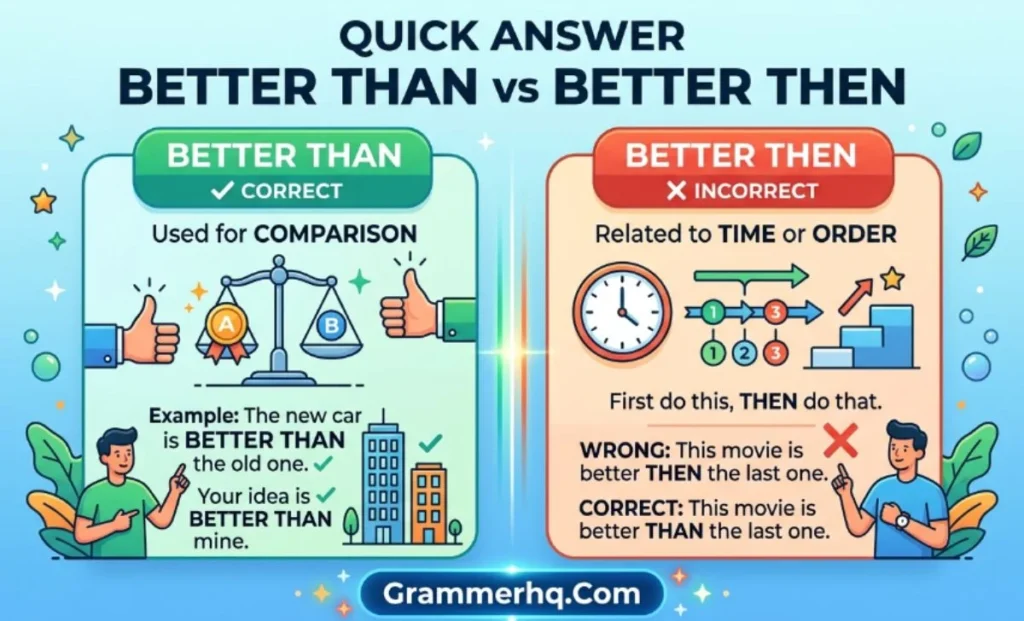
Use “better than” when you are making a comparison.
- ✅ This phone is better than my old one.
- ✅ She is better than me at tennis.
- ❌ This phone is better then my old one.
Use “then” when it refers to a time, sequence, or result.
- I felt better then than I do today.
- We finished dinner, then went home.
- If that’s the case, then we should leave.
So, the easiest rule is:
Comparison = than
Time or sequence = then
The phrase “better then” is not automatically wrong, but it has a different grammatical meaning when then means “at that time.”
What Does “Better Than” Mean?
Better than is the standard expression used to compare one thing with another.
The word better is the comparative form of good, and than introduces the person or thing being compared.
Better Than for Comparisons:
Consider these examples:
- This restaurant is better than the one we visited yesterday.
- My new computer is better than my old one.
- Practice is better than last-minute preparation.
- This solution is better than the first idea.
- Sarah is better than me at chess.
In each sentence, two things are being compared.
A useful sentence pattern is:
Subject + better + than + comparison
For example:
This camera + is better + than + my old camera.
That is why “better than” is the form you will normally need in everyday English.
What Does “Better Then” Mean?
The word then has a different job. It can refer to a particular time, indicate what happens next, or show a consequence.
Because of this, better then can occasionally appear correctly when then means “at that time.”
“Then” Means “At That Time”
Look at this sentence:
I felt better then than I do now.
It contains both words, and each has a different function.
- then = at that time
- than = introduces the comparison
The meaning is:
I felt better at that time compared with how I feel now.
Another example:
He was better then than he is today.
Here, then points to an earlier period, while than makes the comparison.
When “Better Then” Is Actually Correct
This is an important distinction because saying “better then is always wrong” is too broad.
For example:
The patient was better then than he is today.
I was feeling better then than I expected.
She played better then than she does now.
In these sentences, then is connected with a time in the past. It is not replacing than.
So if you see “better then”, don’t automatically assume it is a spelling error. Read the entire sentence and ask what then means.
Better Than vs Better Then: The Key Difference
The difference becomes simple when you look at their functions.
| Word | Main function | Example |
|---|---|---|
| than | Shows comparison | This is better than that. |
| then | Shows time or sequence | I was better then. |
| than | Connects a comparison | She runs faster than I do. |
| then | Shows what happens next | We ate, then we left. |
Compare these two sentences:
1. This car is better than that one.
Here, than compares two cars.
2. I was better then than I am now.
Here, the first then means “at that time,” while the second than introduces a comparison.
That single distinction solves most than vs then mistakes.
Why Do People Confuse Than and Then?
The confusion is understandable. The two words look and sound quite similar, especially in fast speech.
Similar Spelling
Both words contain the same basic letters, with only one letter separating them:
- than
- then
When typing quickly, it is easy to select the wrong one.
Similar Pronunciation
In normal speech, than may have a weak pronunciation, which can make it sound close to then in some contexts.
That means listening alone is not always enough to identify the spelling.
When writing, focus on the meaning of the sentence, not just how the word sounds.
They Have Different Grammar Jobs
This is the real solution.
Than is associated with comparison:
better than
faster than
bigger than
more than
Then is associated with time, sequence, or consequence:
back then
first, then
if so, then
Once you connect each word with its function, the spelling becomes much easier to remember.
Easy Trick to Remember Than vs Then
Use this simple test:
THAN = Comparison
Whenever you are comparing two things, think than.
My new job is better than my old one.
Ask yourself:
“Am I comparing?”
If the answer is yes, than is probably the word you need.
THEN = Time or Next
Think of then as something connected with when or what happens next.
We finished work, then we went home.
I was younger then.
A quick replacement test can help:
If you can replace the word with “at that time,” use then.
I was happier then.
= I was happier at that time.
If the word introduces a comparison, use than.
This is better than that.
= This is better compared with that.
Common “Better Than” Sentence Patterns
The phrase appears in many everyday constructions.
Better Than + Noun
This option is better than the alternative.
Fresh food is often better than fast food.
Better Than + Pronoun
She is better than me at drawing.
This version is better than it was before.
Better Than + Clause
The results were better than I expected.
The movie was better than I thought.
Here, the comparison can involve a complete idea rather than a single noun.
Better Than Before
Better than before means that something has improved compared with an earlier condition.
My English is much better than before.
The website looks better than before.
Better Than Ever
Better than ever means better than at any previous point.
The business is doing better than ever.
She feels better than ever after completing the project.
Better Than Expected
This phrase is common when the actual result exceeds what someone predicted.
The interview went better than expected.
Sales were better than expected this month.
These expressions are all comparisons, so than is the correct choice.
Better Than Me vs Better Than I
Another common question is whether you should say better than me or better than I.
In everyday English, “better than me” is extremely common:
She is better than me at mathematics.
You may also encounter the fuller construction:
She is better than I am at mathematics.
The second version makes the comparison explicit by completing the clause.
Which One Should You Use?
For ordinary conversation, better than me is natural and widely used.
In formal or carefully structured writing, better than I am can make the grammatical relationship clearer.
The important point is that this is a separate issue from the than vs then spelling problem. In both versions, the comparison word is than.
Common Mistakes With Better Than and Better Then
1: Using “Then” for a Comparison
❌ This phone is better then my old phone.
✅ This phone is better than my old phone.
The sentence compares two phones, so use than.
2: Using “Than” for Time
❌ I was happier than.
If you mean “at that time,” the sentence needs then:
✅ I was happier then.
3: Assuming “Better Then” Is Always Wrong
❌ “Better then” can never be correct.
That is too absolute.
Consider:
✅ I felt better then than I do now.
The first then means “at that time.” The second than makes the comparison.
4: Choosing the Word by Sound Alone
Because the two words can sound similar in speech, pronunciation is not always the best guide.
Instead, ask:
Is this word comparing something, or referring to time/order?
Than vs Then Beyond “Better”
Understanding these words outside the phrase better than makes the rule even easier.
Other Uses of Than
Than commonly follows comparative words:
- faster than
- smaller than
- stronger than
- easier than
- more expensive than
- less complicated than
Examples:
This route is faster than the other one.
The second question was easier than the first.
The new model is more expensive than the previous version.
You may also see than in expressions such as rather than, more than, and less than.
Other Uses of Then
Then can refer to time:
Life was different then.
It can show sequence:
First, read the instructions. Then, start the test.
A consequence can also be expressed with then:
If you already know the answer, then there is no need to guess.
The word may also refer to a particular period:
People communicated differently back then.
So then has a much broader role than simply meaning “after that.”
Better Than vs Better Then in Everyday English
Real-life context makes the distinction easier to see.
At Work
This report is better than the previous version.
You are comparing two reports.
At School
This explanation is better than the one in the textbook.
Again, this is a comparison.
In Conversation
I was much happier then.
Here, then refers to a past time.
Talking About a Change
I was better then than I am now.
This sentence uses both words correctly.
Talking About a Process
Finish the form, then submit it.
Here, then shows sequence.
Quick Test: Than or Then?
Choose the correct word.
- This laptop is better ___ my old one.
- We finished dinner and ___ went home.
- I felt better ___ than I do now.
- Her second attempt was better ___ the first.
- I was younger back ___.
- This solution is more practical ___ the previous one.
Answers
- than
- then
- then
- than
- then
- than
Notice that sentence 3 contains both concepts:
I felt better then than I do now.
The first word refers to time. The second introduces a comparison.
FAQ,s
1. Is it “better than” or “better then”?
“Better than” is correct when you are comparing two things. For example, This phone is better than my old one. Then is normally used for time or sequence, as in I was happier then.
2. What is the difference between “better than” and “better then”?
Than is used to make a comparison, while then usually refers to a time, sequence, or result. For example, This option is better than that one compares two options, while I felt better then refers to a past time.
3. Can “better then” ever be correct?
Yes, but only when “then” has its own meaning, such as “at that time.” For example, I felt better then than I do now. The first then refers to time, while the second than introduces the comparison.
4. Is “better than me” grammatically correct?
Yes. “Better than me” is common and natural in everyday English. For example, Sarah is better than me at chess. A fuller formal construction is Sarah is better than I am at chess.
5. Should I use “better than I” or “better than me”?
Both forms can be used, depending on the sentence structure. “Better than me” is very common in everyday English, while “better than I am” is a fuller construction that makes the comparison explicit.
6. How can I easily remember “than” vs “then”?
Use this simple rule: than = comparison; then = time or sequence. If you are comparing two things, choose than. If you mean “at that time” or “after that,” choose then.
7. Why do people confuse “than” and “then”?
The words have similar spelling and can sound similar in connected speech, especially when than is pronounced in its weaker form. The best way to avoid the mistake is to focus on the meaning and grammatical function of the word.
8. Is “better than before” correct?
Yes. “Better than before” is a standard comparison. It means that something has improved compared with an earlier condition. For example, My English is much better than before.
9. Is “better than ever” grammatically correct?
Yes. “Better than ever” is a common and correct expression. It means that someone or something is performing or feeling better than at any previous point. For example, The business is doing better than ever.
10. What is the easiest way to choose between “better than” and “better then”?
Ask yourself what the sentence is doing. If it compares, use “than.” If it refers to time, sequence, or “what happens next,” use “then.” For example, This laptop is better than mine, but I was happier then.
Conclusion
The choice between better than vs better then becomes simple once you focus on meaning. Use better than when comparing two people, things, actions, or situations:
This option is better than the other one. Use then for time or sequence: I was happier then or We finished the work, then left.
However, better then can appear correctly when then means “at that time,” as in I felt better then than I do now. When in doubt, remember: comparison = than; time or sequence = then.
Read More Blogs:
- Right or Write: What’s the Difference and Which Is Correct?
- Succesful vs Successful: Which Spelling Is Correct?