If you are wondering whether the correct spelling is immaculate or emaculate, the word you want in normal modern English is immaculate.
It means perfectly clean, spotless, flawless, or free from faults and blemishes. Emaculate is not simply a modern alternative spelling of immaculate.
It is an obsolete English verb found in historical dictionaries, while emaciate is a separate modern word with a completely different meaning.
Understanding that distinction can help you avoid a common spelling mistake and choose the right word confidently.
Quick Answer
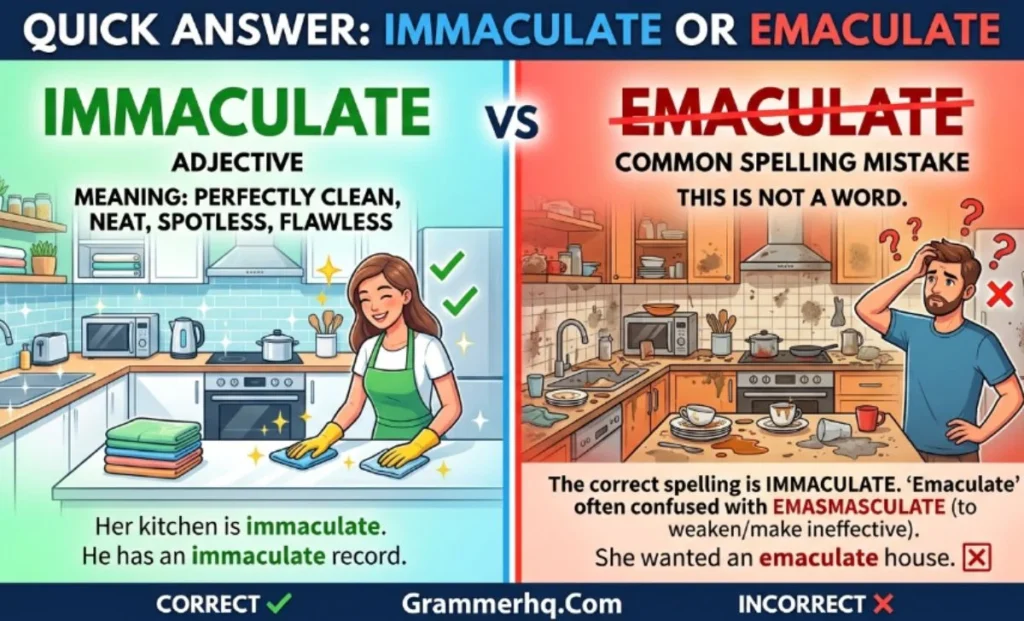
Immaculate is the standard spelling in modern English.
- ✅ immaculate — correct and commonly used
- ❌ emaculate — not the spelling to use for the modern adjective
- ⚠️ emaculate — an obsolete/historical verb found in older English
- ✅ emaciate — a different word meaning to make or become abnormally thin or weak
So, if you want to describe something as spotless, pristine, perfect, or without blemishes, use immaculate.
Example:
The hotel room was immaculate.
What Does Immaculate Mean?
Immaculate is an adjective used to describe something that is completely clean, perfect, or free from imperfections.
Depending on the context, it can describe physical cleanliness or a figurative lack of faults.
Immaculate Meaning
Common meanings include:
- perfectly clean
- spotless
- pristine
- flawless
- unblemished
- free from faults
For example:
Her white shoes were still immaculate after the long trip.
Here, immaculate means extremely clean and free from marks.
It can also describe something that is not physically clean:
The player has an immaculate record this season.
In this sentence, immaculate means without a fault or blemish.
Immaculate as an Adjective
The word immaculate functions as an adjective.
It can modify nouns such as:
- appearance
- room
- house
- clothing
- condition
- record
- performance
- reputation
For example:
The mechanic kept his workshop immaculate.
She arrived at the interview in an immaculate suit.
The team maintained an immaculate record.
What Does Emaculate Mean?
This is where the spelling becomes interesting.
Emaculate does appear in historical English sources, but it is not the ordinary modern word people should use when they mean spotless or flawless.
It has been recorded as an obsolete verb meaning to remove spots, stains, or blemishes.
Is Emaculate a Real Word?
Yes, in a historical or obsolete sense, emaculate has been recorded as a word.
That does not mean it is an acceptable replacement for immaculate in everyday modern English.
If you write:
The bathroom was emaculate.
Most modern readers will understand this as a misspelling of immaculate.
The natural modern sentence is:
The bathroom was immaculate.
Should You Use Emaculate Today?
Generally, no.
Unless you are studying historical English or working with an old text where the word appears, use immaculate when you mean:
spotless, clean, flawless, or without blemish.
This distinction is more accurate than simply saying that emaculate has never existed.
Immaculate vs Emaculate vs Emaciate
These three words can easily become confused, but they are not interchangeable.
| Word | Modern use | Meaning | Part of speech |
|---|---|---|---|
| immaculate | Common | spotless, flawless, unblemished | Adjective |
| emaculate | Obsolete/historical | to remove spots or blemishes | Verb |
| emaciate | Common | to make or become extremely thin or weak | Verb |
Immaculate
The chef kept the kitchen immaculate.
The kitchen was extremely clean.
Emaculate
This is mainly encountered in historical or obsolete usage rather than ordinary modern writing.
Emaciate
The disease caused the animal to become severely emaciated.
Here, emaciate relates to becoming extremely thin or weak. It has nothing to do with the meaning of immaculate.
This is an important distinction because emaculate and emaciate may look similar, but they belong to different words and meanings.
Why Do People Confuse Immaculate and Emaculate?
The confusion is understandable because the two spellings look and sound similar.
The problem becomes especially noticeable when someone has heard the word but has never seen it written.
Pronunciation Can Cause Confusion
The beginning of immaculate can be easy to mishear, particularly in fast speech.
The standard pronunciation is roughly:
ih-MAK-yuh-lət
The exact pronunciation varies slightly between accents, but the important spelling point is that the word begins with im-:
im + maculate → immaculate
The Spelling Is Easy to Misremember
People sometimes remove one of the letters in immaculate and produce forms such as:
- imaculate
- emaculate
- emmaculate
These forms may look plausible, but the standard spelling is:
immaculate
How to Spell Immaculate Correctly
A useful way to remember the spelling is to break it into parts:
im + maculate
→ immaculate
Pay particular attention to the beginning:
IMMA…
not:
EMA…
and not:
IMA…
An Easy Memory Trick
Think:
IM + MACULATE = IMMACULATE
The double m is part of the standard spelling.
If you are writing about something that is spotless or flawless, remember:
IMMACULATE = spotless
The Origin of Immaculate
The history of the word also helps explain its spelling and meaning.
Immaculate ultimately comes from Latin immaculatus, meaning “unstained” or “spotless.” It is related to the Latin word macula, meaning a spot, stain, or blemish.
That connection makes the modern meaning easier to understand:
macula → a spot or blemish
immaculate → without a spot or blemish
Over time, the word developed its broader modern senses of being perfectly clean, flawless, or free from faults.
Why the Origin Helps With the Spelling
Understanding the word’s structure is more useful than simply memorizing its letters.
When you see:
immaculate
you can connect it with the idea of something being without a stain or blemish.
That makes it easier to recognize the correct form when writing.
Immaculate in Everyday English
You will often see immaculate used to describe cleanliness, appearance, quality, or an unblemished record.
Immaculate Room
The hotel room was immaculate when we arrived.
The room was exceptionally clean and tidy.
Immaculate Appearance
He arrived at the ceremony looking immaculate.
Here, the word describes a polished, extremely neat appearance.
Immaculate Condition
The collector kept the vintage car in immaculate condition.
The car was preserved exceptionally well.
Immaculate Performance
The pianist gave an immaculate performance.
Here, immaculate means flawless rather than physically clean.
Immaculate Record
The goalkeeper finished the tournament with an immaculate record.
In this context, the word suggests a record without faults or blemishes.
These examples show why immaculate is more flexible than simply saying very clean.
Immaculate vs Similar Words
Several words are close in meaning to immaculate, but their uses are not always identical.
Immaculate vs Spotless
Spotless usually emphasizes physical cleanliness.
The kitchen was spotless.
Immaculate can mean spotless, but it can also describe something flawless or unblemished.
She has an immaculate professional record.
Immaculate vs Flawless
Flawless focuses mainly on the absence of mistakes or defects.
She delivered a flawless performance.
Immaculate can carry the same idea but also strongly suggests cleanliness or purity.
Immaculate vs Pristine
Pristine often describes something that is in its original, untouched, or exceptionally clean condition.
The beach remained pristine.
Immaculate vs Impeccable
Impeccable commonly means perfect or without fault, especially in behavior, judgment, taste, or performance.
He has impeccable manners.
Both words can suggest perfection, but their typical contexts differ.
Common Misspellings of Immaculate
Because the spelling is tricky, several incorrect forms appear from time to time.
| Incorrect | Correct |
|---|---|
| ❌ emaculate | ✅ immaculate |
| ❌ imaculate | ✅ immaculate |
| ❌ emmaculate | ✅ immaculate |
| ❌ immacualte | ✅ immaculate |
The most important thing to remember is the opening:
imma-
not ema- or ima-.
Common Forms
The related forms are also worth knowing:
- immaculate — adjective
- immaculately — adverb
- immaculateness — noun
For example:
The room was immaculately maintained.
A Note About the Immaculate Conception
You may also encounter Immaculate Conception, especially in religious or historical writing.
In this expression, immaculate refers to being free from stain or sin. It is a specific theological term and should not be confused with the everyday meaning of something simply being very clean.
This is a good example of how the same word can take on a more specialized meaning in a particular context.
FAQ,s
Is immaculate or emaculate correct?
Immaculate is the correct standard modern English spelling when you mean spotless, flawless, or without blemish.
Is emaculate a word?
Emaculate has been recorded as an obsolete English verb meaning to remove spots or blemishes. It is not the normal modern adjective used to mean “spotless.”
What does immaculate mean?
Immaculate means perfectly clean, spotless, flawless, or free from faults or blemishes.
Is emaculate the same as emaciate?
No. Emaculate is an obsolete word associated with removing spots or blemishes, while emaciate means to make or become extremely thin or weak.
How do you spell immaculate?
The standard spelling is:
I-M-M-A-C-U-L-A-T-E
Remember the double m near the beginning.
How do you pronounce immaculate?
It is commonly pronounced approximately ih-MAK-yuh-lət, although pronunciation can vary slightly by accent.
Can immaculate describe a person?
Yes. It can describe someone’s appearance, clothing, behavior, record, or other qualities depending on context.
She looked immaculate at the ceremony.
Is immaculate only used for cleanliness?
No. It can also mean flawless, perfect, or without blemish.
The athlete delivered an immaculate performance.
Final Verdict
If you are choosing between immaculate or emaculate for modern English writing, choose immaculate. It is the standard adjective for something that is spotless, pristine, flawless, or free from blemishes.
Emaculate does have a historical life as an obsolete verb, but it is not the word you normally want today. And if you were thinking of emaciate, remember that it has an entirely different meaning related to becoming extremely thin or weak.
Correct modern spelling: immaculate ✅
Read More Blogs: