In person and in-person are both correct, but they are not used in exactly the same way. The difference comes down to their grammatical role and, more specifically, whether the phrase is modifying a noun.
In person is normally used as an adverbial phrase when you mean physically present or face-to-face, while in-person is generally a compound adjective placed before a noun.
For example, you would say, “I want to talk to you in person,” but “We scheduled an in-person meeting.” The first describes how the talking happens; the second describes the type of meeting.
Once you understand this simple distinction, knowing when to use the hyphen becomes much easier.
Quick Answer
The short answer is:
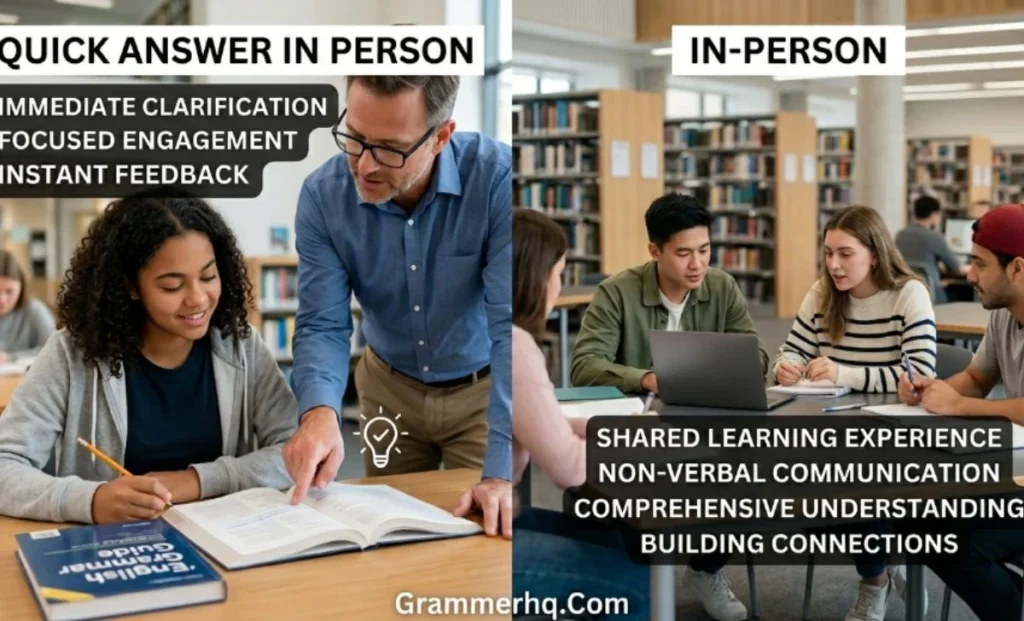
- In person = two words, usually used to describe how an action happens.
- In-person = hyphenated, usually used before a noun as a compound modifier.
Compare these sentences:
I would like to discuss this in person. ✅
I would like to have an in-person discussion. ✅
Both sentences are correct, but they use the expression differently.
| Form | Typical function | Example |
|---|---|---|
| in person | Adverbial phrase | We met in person. |
| in-person | Compound adjective | We had an in-person meeting. |
| inperson | Not standard | We had an inperson meeting. ❌ |
The key point is that the hyphen is not simply a matter of personal preference. It helps connect the words when they work together to modify a following noun.
What Does “In Person” Mean?
In person means being physically present rather than communicating through a phone, video call, message, email, or another person.
It usually functions as an adverbial phrase because it tells us how an action takes place.
For example:
I would rather speak with you in person.
Here, in person explains how the speaker wants to speak.
Other natural examples include:
She apologized to him in person.
We discussed the problem in person.
I finally met my online friend in person.
The manager wants to talk to you in person.
Notice that there is no hyphen in any of these sentences.
What Does “In-Person” Mean?
In-person is normally used as a compound adjective or compound modifier before a noun.
It describes something that happens with people physically present rather than remotely.
For example:
We have an in-person meeting tomorrow.
Here, in-person describes the noun meeting.
You can use it with many everyday nouns:
- in-person meeting
- in-person interview
- in-person class
- in-person appointment
- in-person event
- in-person training
- in-person consultation
- in-person discussion
Examples:
The company invited me to an in-person interview.
The doctor offers both online and in-person consultations.
Students can choose between online and in-person classes.
In each example, the hyphenated expression comes directly before a noun and works as a single descriptive unit.
In Person vs In-Person: What Is the Difference?
The easiest way to understand the difference is to look at what the phrase is doing in the sentence.
In Person
Use in person when the phrase describes how someone does something.
We met in person.
The phrase tells us how the meeting happened.
She spoke to the customer in person.
Again, in person describes how she spoke to the customer.
In-Person
Use in-person when the expression describes a noun.
We had an in-person meeting.
Here, in-person describes the meeting.
She attended an in-person interview.
Here, it describes the interview.
A useful comparison is:
We discussed the project in person.
versus:
We had an in-person discussion about the project.
The meaning is closely related, but the grammar is different.
Why Does In-Person Have a Hyphen?
The hyphen connects in and person when they work together as a compound modifier before a noun.
Consider:
an in-person interview
The words in and person work together to describe interview. The hyphen makes that relationship clear.
Without the hyphen:
an in person interview
the phrase is not normally written correctly in standard edited English.
However, when the phrase is not directly modifying a noun, the hyphen is generally unnecessary:
The interview was conducted in person.
This is why the following pair is useful to remember:
an in-person interview ✅
The interview happened in person. ✅
The grammatical position changes, so the punctuation changes with it.
“Meet in Person” vs “Meet In-Person”
This is one of the most common points of confusion.
The standard expression is:
Let’s meet in person. ✅
Not:
Let’s meet in-person. ❌
Why? In this sentence, in person describes how the meeting will happen. It is not modifying a noun.
But if you put the expression before a noun, use the hyphen:
Let’s schedule an in-person meeting. ✅
So compare:
Can we meet in person tomorrow?
and
Can we have an in-person meeting tomorrow?
Both are correct.
This simple contrast can help you recognize the correct form in many other sentences.
Common In-Person Expressions:
You will often see in-person before nouns in workplace, education, healthcare, and everyday communication.
In-Person Meeting
Our team has an in-person meeting on Monday.
This is common in workplaces where some employees work remotely.
In-Person Interview
The final candidates will attend an in-person interview.
This is particularly common in recruitment and hiring.
In-Person Class
The university offers both online and in-person classes.
Here, in-person distinguishes physical classes from online instruction.
In-Person Appointment
The clinic requires an in-person appointment for this service.
In-Person Training
New employees must complete an in-person training session.
In each example, the hyphenated form comes immediately before the noun it modifies.
Common Expressions With “In Person”
The unhyphenated form is equally common.
You can naturally say:
- meet in person
- speak in person
- talk in person
- discuss something in person
- see someone in person
- apologize in person
- explain something in person
- attend something in person
Examples:
I’d like to explain the situation in person.
She prefers to speak with clients in person.
We had only communicated online before, so it was nice to meet in person.
He decided to apologize in person rather than send a message.
These phrases describe an action rather than a noun.
Is “Inperson” Correct?
No. Inperson is not the standard spelling.
There are two standard forms:
in person — when used as a phrase
We talked in person. ✅
in-person — when used as a compound modifier before a noun
We had an in-person conversation. ✅
But:
We talked inperson. ❌
and:
We had an inperson conversation. ❌
The expression should not normally be written as one word.
British English vs American English
There is no major British-versus-American spelling difference here.
Both British English and American English use:
- in person
- in-person
The choice depends on the grammatical role of the expression, not on which variety of English you are using.
For example, both forms are standard in either variety:
I want to speak with you in person.
We arranged an in-person meeting.
This makes the expression different from spelling pairs such as colour/color, where regional conventions affect the spelling.
Common Mistakes With In Person and In-Person:
Understanding the rule becomes easier when you see the mistakes people commonly make.
1: “An in person meeting”
❌ We scheduled an in person meeting.
✅ We scheduled an in-person meeting.
The phrase is modifying meeting, so the hyphen is appropriate.
2: “Meet in-person”
❌ Let’s meet in-person tomorrow.
✅ Let’s meet in person tomorrow.
Here, the phrase describes how the meeting will happen.
3: “Inperson”
❌ The interview will be inperson.
✅ The interview will be in person.
It should not normally be combined into one word.
4: Using the Hyphen Everywhere
It is not necessary to write:
I want to talk to you in-person.
In standard usage, write:
I want to talk to you in person.
The hyphen is mainly needed when the expression acts as a compound modifier before a noun.
Easy Trick to Remember In Person vs In-Person
Here is the simplest practical rule:
Before a noun → usually “in-person.”
Describing an action → usually “in person.”
For example:
Before a noun:
an in-person interview
Describing an action:
We met in person.
Another way to remember it is to ask:
“Is in person describing a noun?”
If yes, the hyphenated in-person form is generally appropriate.
If it is explaining how an action happens, use in person.
This rule will cover most everyday writing situations.
In Person vs In-Person Examples:
| Sentence | Correct? | Why? |
|---|---|---|
| We met in person. | ✅ | Describes how we met |
| She spoke to him in person. | ✅ | Describes how she spoke |
| We had an in-person meeting. | ✅ | Modifies meeting |
| He attended an in-person interview. | ✅ | Modifies interview |
| They offer in-person classes. | ✅ | Modifies classes |
| Let’s meet in-person. | ❌ | Use the adverbial phrase |
| We had an in person meeting. | ❌ | Use the compound modifier |
| She attended an inperson class. | ❌ | Inperson is not standard |
These examples show why the two forms should not simply be treated as interchangeable spellings.
FAQ,s
1: Is it in person or in-person?
Both are correct, but they have different grammatical uses. In person is normally used as a phrase describing an action, while in-person is generally used before a noun as a compound modifier.
2: Is an in-person meeting correct?
Yes. An in-person meeting is correct because in-person describes the noun meeting.
3: Should I write “meet in person” or “meet in-person”?
Use meet in person. The phrase describes how the meeting takes place, so no hyphen is normally needed.
4: Is inperson one word?
No. Inperson is not the standard spelling. Use in person or in-person, depending on the sentence.
5: Is in-person an adjective?
Yes, in-person commonly functions as a compound adjective or compound modifier when it appears before a noun, as in an in-person interview.
6: Is in person an adverb?
It commonly functions as an adverbial phrase because it describes how an action occurs, as in We spoke in person.
7: Is in-person hyphenated?
Yes, when it is used as a compound modifier before a noun, such as an in-person appointment.
8: Is there a British or American difference?
No. The basic distinction is the same in British and American English. The choice depends on grammatical function rather than regional spelling.
Final Verdict
In person and in-person are both correct, but they belong in different grammatical positions. Use in person when you are describing how an action happens: “We discussed the issue in person.”
Use in-person when the expression comes before a noun and describes it: “We had an in-person discussion.”The easiest rule is to look at the word that follows.
If in-person directly modifies a noun, the hyphen usually belongs there. If the phrase describes an action, write in person without the hyphen. And remember that inperson is not the standard form.
Once you recognize this simple difference, choosing between the two becomes straightforward in emails, essays, workplace writing, and everyday English.
Read More Blogs: