Ever wondered whether insite or insight is the correct spelling? If you mean a deep understanding, clear perception, or a valuable realization, the answer is insight.
Although insite may look correct because it sounds the same, it is generally not the standard English spelling for this meaning. This mistake is especially common in emails, academic writing, business communication, and everyday English.
The word insight is a noun used to describe a deeper understanding of a person, situation, idea, or problem. InSite, however, may appear as a company, product, software, or brand name.
In this guide, you’ll learn the difference between insite and insight, their meanings, pronunciation, grammar, common mistakes, examples, and an easy memory trick to remember the correct spelling.
Quick Answer
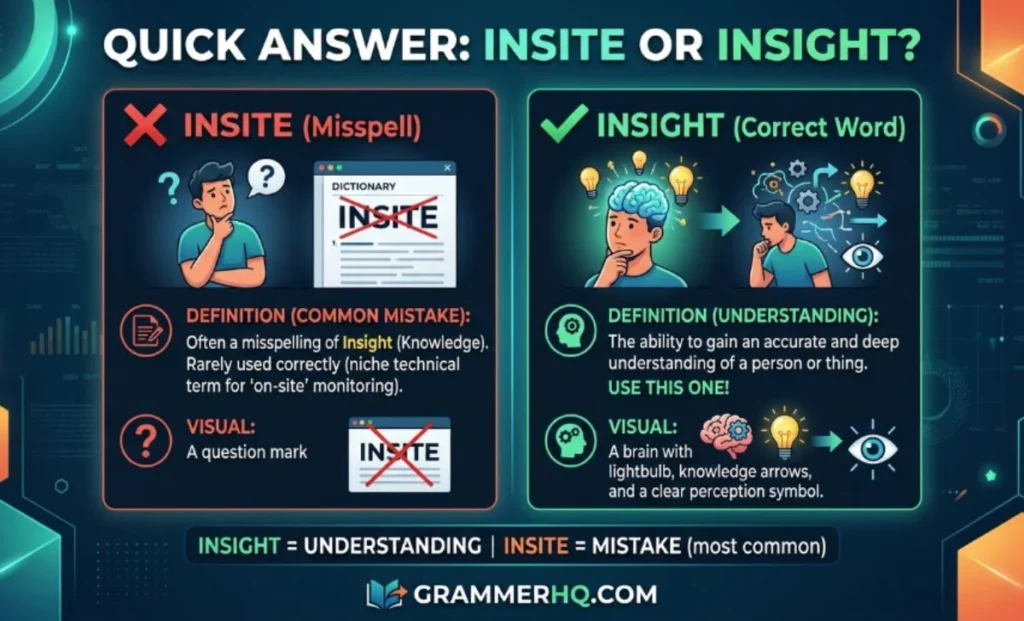
Insight is the correct spelling when you mean deep understanding, awareness, perception, or a clear realization.
Insite is generally a misspelling when used with this meaning. However, InSite may be correct when it is part of an official name or brand.
| Word | Correct in Standard English? | Meaning |
|---|---|---|
| Insight | ✅ Yes | Deep understanding or perception |
| Insite | ❌ Usually no | Usually a misspelling or proper name |
The Simple Rule
If you mean understanding, use insight.
The study provides valuable insight into human behavior.
Not:
❌ The study provides valuable insite into human behavior.
Quick Memory Formula
Insight = in + sight = seeing into something deeply
You are not talking about physical vision. You are talking about understanding what is beneath the surface.
What Does Insight Mean?
Insight is a noun that means a deep, clear, or accurate understanding of a person, situation, idea, or problem.
It can describe understanding that comes from:
- Experience
- Research
- Observation
- Analysis
- Reflection
- Knowledge
- Careful reasoning
For example:
Her years of teaching experience gave her valuable insight into student behavior.
The sentence does not mean she can physically see student behavior better. It means her experience helped her understand students more deeply.
Simple Definition
Insight: A deep and clear understanding of something, especially something that is not immediately obvious.
Examples
- The research provides valuable insight into language learning.
- Her experience gave her useful insight into leadership.
- The documentary offers fascinating insight into ancient history.
- The interview revealed new insight into the company’s strategy.
- The discussion gave me greater insight into the problem.
Is Insite a Word?
If you mean “deep understanding,” insite is not the standard English spelling.
For example:
❌ The article gave me useful insite into the topic.
The standard form is:
✅ The article gave me useful insight into the topic.
However, you may encounter InSite with a capital I as part of an official name. A business, software product, organization, platform, or other entity may choose that spelling as its brand name.
That does not make insite a general alternative spelling of insight.
The Important Distinction
insight → standard English word
InSite → potentially an official name
Therefore, if you are writing ordinary English and mean understanding, choose insight.
Insite vs Insight: Key Difference
The difference between these forms is straightforward.
Insight is a standard English noun.
Insite is generally not the standard spelling of that noun.
| Feature | Insight | Insite |
|---|---|---|
| Standard English noun | ✅ Yes | ❌ No |
| Means deep understanding | ✅ Yes | ❌ No |
| Used in formal writing | ✅ Yes | ❌ Usually no |
| Used in academic writing | ✅ Yes | ❌ Usually no |
| Used in business writing | ✅ Yes | ❌ Usually no |
| Can appear in a proper name | ✅ Yes | ✅ Yes |
| Standard spelling | insight | Not for this meaning |
The report offers valuable insight into customer behavior.
Example
Here, insight means understanding.
Writing insite in this sentence would be a spelling error.
Why Are Insite and Insight Confused?
The confusion is understandable because English spelling often cannot be determined from pronunciation alone.
1. They Can Sound the Same
Insight is pronounced approximately:
IN-site
That makes it easy to write the word as insite when you only hear it.
2. The Word Contains “Sight”
The correct spelling contains the familiar word sight:
in + sight = insight
The letters gh in sight are not pronounced separately, so writers may accidentally leave them out.
3. English Has Many Homophones
English contains many words that sound alike but have different spellings and meanings.
For example:
- right / write
- hear / here
- their / there
- site / sight
- cite / site
This makes spelling based only on pronunciation unreliable.
4. Brand Names Add to the Confusion
People may see InSite used by companies, software products, or organizations.
After seeing this spelling repeatedly, they may assume that insite is an accepted spelling of the common noun.
It is not the standard spelling when you mean deep understanding.
Insight Pronunciation
The standard pronunciation of insight is:
/ˈɪn.saɪt/
It has two syllables:
IN-site
British English
/ˈɪn.saɪt/
American English
/ˈɪn.saɪt/
The spelling remains insight in both varieties of English.
Because the pronunciation resembles “in sight,” it is easy to understand why writers sometimes mistakenly type insite.
How to Use Insight in a Sentence
Insight is a noun, so it commonly appears with verbs such as:
- gain
- provide
- offer
- give
- share
- develop
- reveal
- gain
- demonstrate
Common Patterns
gain insight
Reading widely can help you gain insight into different cultures.
provide insight
The study provides insight into language development.
offer insight
The book offers valuable insight into human psychology.
share insight
The expert shared her insight during the meeting.
develop insight
Experience can help people develop insight into their own behavior.
These patterns are especially common in academic and professional writing.
Insight Into: The Most Common Usage
One of the most natural constructions is:
insight into + noun
Examples include:
- insight into human behavior
- insight into customer needs
- insight into the problem
- insight into language acquisition
- insight into company culture
- insight into market trends
Examples
The study provides valuable insight into consumer behavior.
The interview offered new insight into the company’s culture.
The research gives scientists greater insight into human memory.
When you want to express a deeper understanding of a subject, insight into is a particularly useful and natural construction.
Insight On vs Insight About
You may also see insight on and insight about.
Insight On
Insight on can be used when referring to a specific topic.
The analyst shared her insight on the economy.
However, insight into is often more natural when the intended meaning is deeper understanding.
Insight About
Insight about can also be used in appropriate contexts.
She shared some personal insight about her experience.
For formal and academic writing, insight into is often the stronger choice when describing an understanding of a subject.
Quick Comparison
| Expression | Common? | Example |
|---|---|---|
| insight into | ⭐ Very common | insight into human behavior |
| insight on | ✅ Possible | insight on current trends |
| insight about | ✅ Possible | insight about her experience |
Is Insight a Noun or Verb?
Insight is primarily a noun.
It describes an understanding, realization, or perception.
Correct
The research provided valuable insight.
Incorrect
❌ The research insighted the problem.
Instead, use a suitable verb:
The research helped explain the problem.
The research revealed important information.
The research provided insight into the problem.
This is an important grammar point because some writers assume that insight can be used as a verb simply because many English nouns have related verb forms.
What Is the Plural of Insight?
The plural form of insight is:
insights
Singular
The report provides valuable insight.
Plural
The report provides several valuable insights.
The spelling changes simply by adding -s:
insight → insights
Do not write:
❌ insite
❌ insites
when you mean the standard English word.
Insight vs Understanding
Insight and understanding are closely related, but they are not always identical.
Understanding is a broad term for knowing or comprehending something.
Insight often suggests a deeper, more revealing, or less obvious understanding.
Compare:
I have a basic understanding of economics.
This means you know the basic concepts.
The study gave researchers valuable insight into why consumers make certain decisions.
This suggests a deeper understanding of something that may not be immediately obvious.
A useful way to think about the distinction is:
Understanding = knowing what something means
Insight = seeing something more deeply
Insight vs Incite vs Site vs Sight vs Cite
These words are easy to confuse because their spellings and pronunciations overlap.
| Word | Meaning | Example |
|---|---|---|
| Insight | Deep understanding | The report gave us valuable insight. |
| Incite | Encourage or provoke | The speech could incite anger. |
| Site | Place or location | The workers visited the construction site. |
| Sight | Vision or something seen | The mountain was an impressive sight. |
| Cite | Refer to a source | Students must cite their sources. |
Insight
The book gave me valuable insight into psychology.
Incite
The statement could incite conflict.
Site
The company selected a new site for the building.
Sight
The waterfall was an unforgettable sight.
Cite
Remember to cite your sources correctly.
Learning these differences can prevent several common English spelling mistakes.
Common Collocations With Insight
Certain words frequently appear with insight.
Popular Collocations
- valuable insight
- useful insight
- deep insight
- fresh insight
- important insight
- practical insight
- expert insight
- personal insight
- professional insight
- strategic insight
- customer insights
- market insights
- consumer insights
- actionable insights
- scientific insights
Examples
The consultant provided expert insight into the company’s challenges.
Customer surveys can generate valuable customer insights.
The researchers reported several important insights.
Learning these combinations can help you use the word naturally rather than simply knowing its dictionary definition.
Insight in Academic and Professional Writing
Insight is particularly useful in formal writing because it describes what research, evidence, experience, or analysis reveals.
Academic Writing
The findings provide valuable insight into language acquisition.
The research offers new insights into human behavior.
Business Writing
Businesses commonly use phrases such as:
- customer insights
- market insights
- consumer insights
- strategic insights
- actionable insights
For example:
The survey produced valuable customer insights that could influence future product decisions.
Scientific and Research Writing
The experiment provides new insight into the causes of the disease.
Here, insight communicates that the research has improved understanding of the subject.
Insight Synonyms
Depending on context, several words can have a similar meaning to insight.
Common Synonyms
- understanding
- awareness
- perception
- comprehension
- realization
- knowledge
- wisdom
- discernment
- intuition
- recognition
These words are related but are not always interchangeable.
For example, intuition can describe an understanding that comes without conscious reasoning, while insight usually emphasizes a clear or deep understanding.
Example
Her experience gave her valuable insight into the problem.
A possible alternative is:
Her experience gave her a deeper understanding of the problem.
The two sentences are similar, but insight can suggest a more revealing realization.
Common Mistakes With Insight
1: Writing Insite
❌ The research provided valuable insite.
✅ The research provided valuable insight.
2: Leaving Out “gh”
❌ insite
✅ insight
Remember that insight contains the complete word sight.
3: Using Insites as the Plural
❌ The report contains several useful insites.
✅ The report contains several useful insights.
4: Using Insight as a Verb
❌ The report insights customer behavior.
✅ The report provides insight into customer behavior.
5: Confusing Insight With Sight
❌ The study gave me better sight into the issue.
✅ The study gave me better insight into the issue.
Remember:
sight = seeing
insight = understanding
Easy Memory Tricks for Insight
Here are three simple ways to remember the correct spelling.
1: In + Sight
Break the word into two familiar parts:
IN + SIGHT = INSIGHT
The word contains sight, not site.
2: Think “See Inside”
Imagine that insight means being able to see inside an idea or problem.
You are not literally looking inside something. You are understanding what lies beneath the surface.
See deeper → understand better → insight
3: Use the Meaning Test
Ask:
“Do I mean deep understanding?”
If yes, choose:
INSIGHT
One-Line Reminder
If it means understanding, spell it INSIGHT.
Is Insight the Same in British and American English?
Yes.There is no British-versus-American spelling difference for insight.
| English Variety | Correct Spelling |
|---|---|
| British English | insight |
| American English | insight |
| Canadian English | insight |
| Australian English | insight |
Unlike:
- colour / color
- centre / center
- organise / organize
the spelling insight remains the same across these major varieties of English.
When Is InSite Correct?
InSite can be correct when it is an official name.
For example, an organization might choose InSite as its business name, or a software company might use InSite as a product name.
In those cases, the official spelling should be preserved.
The key distinction is:
insight = the standard English word meaning deep understanding
InSite = a proper name when officially used
Therefore, do not change an official brand name simply because it resembles a spelling mistake.
At the same time, do not use insite in ordinary English when you mean insight.
Real-Life Examples of Insight
Here are examples from different situations:
Travel can provide valuable insight into different cultures.
The teacher’s experience gave her insight into student behavior.
The report offers useful insight into changing consumer preferences.
The discussion gave me a new insight into the problem.
Researchers hope the findings will provide insight into human memory.
Good leaders combine experience, knowledge, and insight.
The documentary gave viewers fascinating insight into life in remote communities.
Customer feedback can provide actionable insights for businesses.
Reading different perspectives can give you greater insight into social issues.
These examples show that insight works naturally in everyday, academic, professional, and analytical English.
FAQs
1: Is “insite” the correct spelling?
No. When you mean deep understanding or awareness, the standard spelling is insight.
2: What is the difference between insite and insight?
Insight is the standard English noun meaning deep understanding or perception. Insite is generally a misspelling in ordinary English, although InSite may appear as an official name.
3: Is “insite” a real English word?
It is not normally used as the standard English word meaning “deep understanding.” It may appear as part of a company, product, software, or brand name.
4: What does insight mean?
Insight means a deep, clear, or accurate understanding of a person, situation, idea, or problem.
5: Is insight a noun?
Yes. Insight is primarily a noun.
6: What is the plural of insight?
The plural is insights.
7: How do you pronounce insight?
Insight is pronounced /ˈɪn.saɪt/, approximately “IN-site.”
8: Is insight spelled differently in British English?
No. Insight is spelled the same way in British and American English.
9: Should I say insight into or insight on?
Both can occur, but insight into is often the most natural choice when you mean deeper understanding of a subject.
10: Can insight be used as a verb?
No. Insight is primarily used as a noun. Use verbs such as understand, recognize, identify, explain, or analyze when you need a verb.
11: What are synonyms for insight?
Common synonyms include understanding, awareness, perception, realization, knowledge, wisdom, and discernment.
12: How can I remember the spelling of insight?
Remember:
in + sight = insight
If you mean deeper understanding, choose insight, not insite.
Conclusion
When choosing between insite or insight, the correct spelling for the standard English word is insight. It is a noun meaning deep understanding, awareness, perception, or a valuable realization.
You will commonly see it in phrases such as gain insight, provide insight, and insight into.Insite should not normally be used as an alternative spelling of insight.
It may, however, be correct when InSite is the official name of a company, product, software application, or other entity.The easiest way to remember the difference is to focus on the word sight:
IN + SIGHT = INSIGHT
So, if you mean understanding, use insight. This simple rule will help you avoid one of the most common spelling mistakes involving this word.
Read More Blogs: