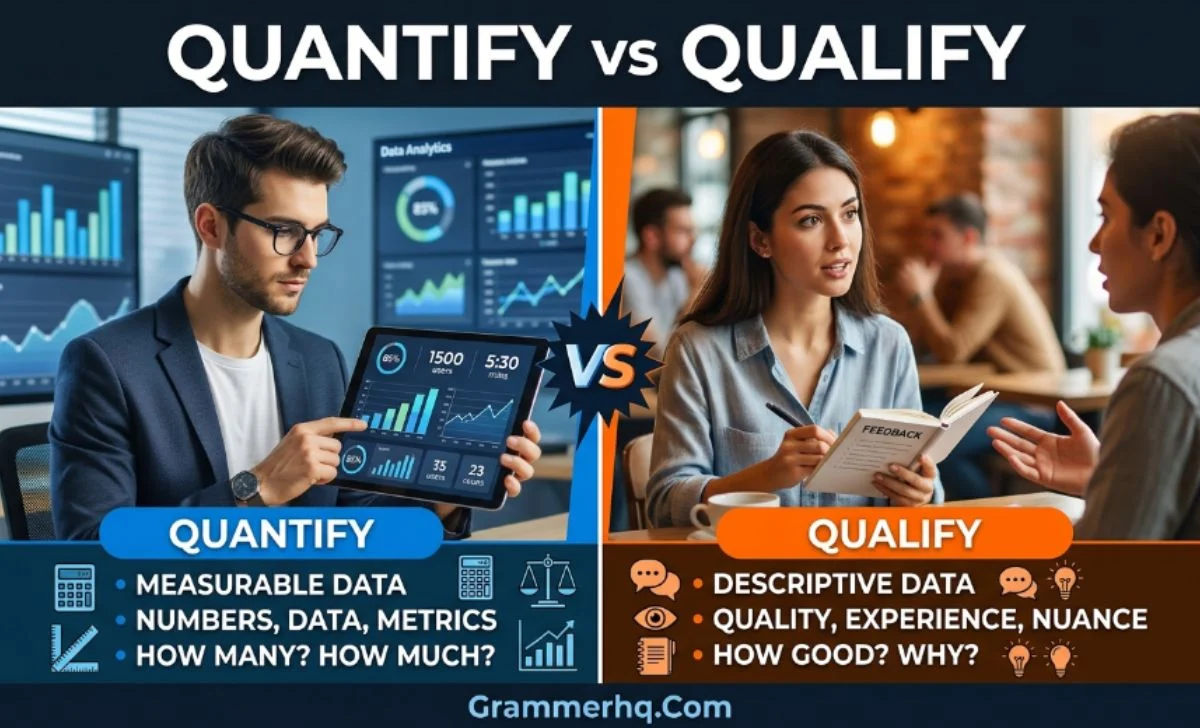
Quantify vs qualify can be confusing because both words are verbs and often appear in academic, business, and professional writing.
The key difference is simple: quantify means to measure or express something as an amount or number, while qualify can mean to limit or modify a statement, meet a requirement, or become eligible for something.
For example, you might quantify the cost of a project, but qualify your conclusion by adding an important condition. Once you understand these different uses, choosing between quantify and qualify becomes much easier.
Quick Answer
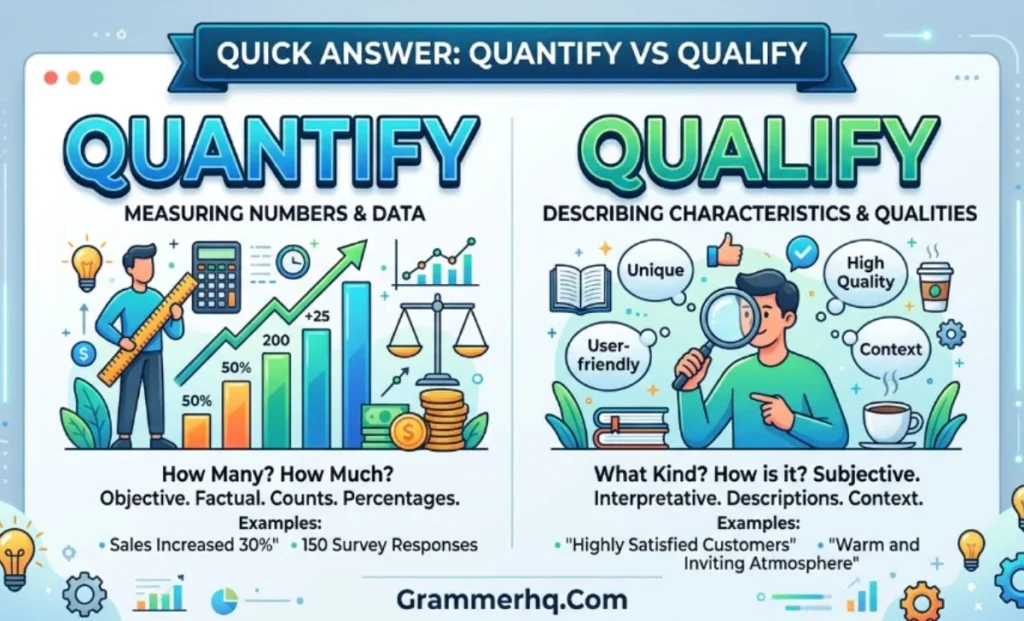
Quantify means to measure, calculate, or express the amount or size of something.
Qualify has several meanings. It can mean to limit or modify a statement, meet a requirement, become eligible, or advance to the next stage of a competition.
| Word | Main meaning | Example |
|---|---|---|
| Quantify | Measure an amount or number | We need to quantify the financial loss. |
| Qualify | Limit or modify a statement | She qualified her statement with an important exception. |
| Qualify | Meet a requirement | You must qualify for the program. |
| Qualify | Advance in a competition | The team qualified for the final. |
A useful rule is:
If you are measuring something, quantify it. If you are limiting a statement or meeting a requirement, qualify it.
What Does “Quantify” Mean?
Quantify means to determine or express the amount, size, extent, or number of something.
It is commonly used when something can be measured or represented with numerical information.
Examples of Quantify
- Researchers quantified the effects of sleep deprivation.
- The company is trying to quantify its annual losses.
- We need to quantify the amount of waste produced.
- The survey helped quantify customer satisfaction.
- It is difficult to quantify the impact of the new policy.
- The report quantified the increase in online sales.
In each example, the focus is on measuring or expressing something in a measurable way.
Quantify in Research and Data
You will often see quantify in academic and professional writing.
For example:
Researchers quantified the relationship between exercise and productivity.
The researchers are not simply describing the relationship. They are trying to measure its extent using data.
Similarly:
The company quantified the financial impact of the delay.
This means the company calculated or estimated the amount of financial impact.
What Does “Qualify” Mean?
Unlike quantify, the verb qualify has several distinct meanings. This is where many simple explanations become misleading.
Qualify a Statement
To qualify a statement means to limit, modify, or make it more precise by adding a condition or exception.
For example:
The manager qualified her recommendation by saying that the results were preliminary.
The manager did not completely withdraw the recommendation. She added information that limited or clarified its meaning.
Another example:
I agree with the proposal, but I would qualify that statement by adding one condition.
Here, qualify means to make the statement more specific or less absolute.
Qualify for Something
Qualify for can mean to meet the requirements needed to receive, enter, or participate in something.
For example:
She qualifies for financial assistance.
This means she meets the necessary conditions.
Another example:
You must have two years of experience to qualify for the position.
Here, qualify has nothing to do with measuring an amount.
Qualify as Something
Qualify as can mean to meet the necessary standard to be considered a particular type of person or thing.
For example:
Does this experience qualify as professional training?
The question is whether the experience meets the required definition or standard.
Qualify for a Competition
In sports and other competitions, qualify can mean to reach the next stage.
For example:
The team qualified for the World Cup.
This means the team met the conditions necessary to participate in the competition.
Quantify vs Qualify: Key Differences
The easiest way to understand the difference is to look at what each word is doing in a sentence.
| Feature | Quantify | Qualify |
|---|---|---|
| Basic idea | Measure | Limit, modify, or establish eligibility |
| Main focus | Amount, size, number, extent | Condition, qualification, precision, or eligibility |
| Often connected with | Data and measurement | Requirements and statements |
| Common phrase | Quantify the impact | Qualify the statement |
| Another common phrase | Quantify the cost | Qualify for the job |
| Competition use | Rare | Common |
| Example | Quantify the damage | Qualify for the final |
The two words are therefore not simple opposites.
A person can quantify a result and qualify a conclusion in the same piece of writing.
Quantify vs Qualify in Sentences
Seeing the words in similar contexts makes the difference clearer.
Quantify Examples
1. The researchers quantified the change in blood pressure.
The researchers measured the change.
2. We need to quantify the project’s total cost.
The goal is to calculate the amount of money involved.
3. The survey quantified customer demand.
The survey provided measurable information about demand.
4. The company quantified the damage caused by the outage.
The company estimated or calculated the extent of the damage.
Qualify Examples
1. The lawyer qualified his statement by adding an important exception.
The lawyer limited or clarified what he had said.
2. She qualifies for the scholarship.
She meets the scholarship requirements.
3. The athlete qualified for the final.
The athlete advanced to the next stage.
4. Does this experience qualify as work experience?
The question is whether it meets the required standard.
Quantify or Qualify? Use This Simple Test
When you are unsure which word to use, ask what you are trying to express.
If You Mean “How Much?” → Quantify
Use quantify when you want to measure an amount, size, number, cost, effect, or extent.
We need to quantify the increase in sales.
Think:
How much? → Quantify
If You Mean “With What Condition?” → Qualify
Use qualify when you add a condition, limitation, or exception to a statement.
I support the plan, but I would qualify that recommendation.
Think:
What condition or limitation? → Qualify
If You Mean “Am I Eligible?” → Qualify
Do I qualify for the discount?
Think:
Do I meet the requirements? → Qualify
If You Mean “Did I Reach the Next Stage?” → Qualify
The team qualified for the tournament.
Think:
Did I meet the conditions to advance? → Qualify
The Memory Trick
Quantify → quantity → amount or measurement
This is a useful memory clue.
For qualify, however, do not rely on the idea that it simply means “quality.” Qualify has several meanings, including limiting a statement and meeting a requirement.
Quantify vs Quantitative vs Qualitative
These related words are another common source of confusion.
| Word | Part of speech | Meaning |
|---|---|---|
| Quantify | Verb | To measure or express an amount |
| Quantitative | Adjective | Related to numbers or measurable amounts |
| Qualify | Verb | To limit, modify, or meet requirements |
| Qualitative | Adjective | Related to qualities, characteristics, or descriptions |
Quantitative Example
The study collected quantitative data about household income.
The information is numerical or measurable.
Qualitative Example
The researchers collected qualitative data through interviews.
The researchers focused on experiences, opinions, descriptions, or characteristics rather than primarily on numerical measurements.
Why Quantify Is Not the Opposite of Qualify
It is tempting to think:
quantify = quantitative
qualify = qualitative
But these words do not form a simple pair.
Quantify is a verb about measuring something.
Qualitative is an adjective describing information or analysis based on qualities or characteristics.
Likewise, qualify has meanings that have nothing to do with qualitative research.
For example:
She qualifies for the position.
This has nothing to do with qualitative data.
Common Mistakes With Quantify and Qualify
1: Using Qualify When You Mean Measure
❌ We need to qualify the number of visitors.
✅ We need to quantify the number of visitors.
The goal is to determine the amount, so quantify is correct.
2: Using Quantify When You Mean Limit a Statement
❌ The author quantified his claim by adding an exception.
✅ The author qualified his claim by adding an exception.
The author is modifying or limiting the claim, not measuring it.
3: Thinking Qualify Always Means “Describe Quality”
This is one of the biggest misconceptions.
Qualify can relate to a statement, requirement, professional status, or competition.
For example:
She qualified for the interview.
This means she met the requirements. It does not mean she described a quality.
4: Confusing Qualify With Qualitative
Qualify is a verb.
Qualitative is an adjective.
Compare:
The researchers qualified their conclusion.
The researchers conducted a qualitative study.
These sentences use completely different words for different purposes.
Quantify vs Qualify in Academic and Professional Writing?
Both words are useful in formal writing, but they serve different purposes.
In Research
The study quantified the effect of the treatment.
The researchers measured the effect.
The researchers qualified their conclusion because the sample size was limited.
The researchers added a limitation to their conclusion.
In Business
The finance team quantified the expected cost.
The team calculated the cost.
The director qualified the forecast by noting that demand could change.
The director added a condition to the forecast.
In Everyday Professional Communication
We need to quantify the amount of work involved before setting a deadline.
But:
I would qualify that recommendation because we do not have enough information.
These examples show why choosing the right verb matters. Quantify makes something measurable; qualify makes a statement more precise or establishes whether something meets a condition.
FAQ,s
Is quantify the same as measure?
Not always, but the meanings are closely related. Quantify specifically emphasizes determining or expressing an amount, size, extent, or number.
What is the easiest way to remember quantify?
Connect quantify with quantity. If you are asking “how much?” or trying to express something numerically, quantify is usually the right choice.
Does qualify mean describe quality?
Not necessarily. Qualify has several meanings. It can mean limiting a statement, meeting a requirement, being eligible, or advancing in a competition.
Can you qualify a statement?
Yes. To qualify a statement means to make it less absolute, more precise, or subject to a condition or exception.
Can you quantify an idea?
Yes, if the idea has an aspect that can be measured or represented numerically. For example, researchers can quantify the impact of an idea, behavior, or policy using measurable data.
What is the difference between quantify and quantitative?
Quantify is a verb meaning to measure or express an amount. Quantitative is an adjective describing something involving numbers or measurable quantities.
What is the difference between qualify and qualitative?
Qualify is a verb with several meanings, including limiting a statement or meeting a requirement. Qualitative is an adjective relating to qualities, characteristics, descriptions, or non-numerical information.
Is “quantify or qualify” correct?
Yes. Both words are correct English words, but they are used for different purposes. Choose quantify for measurement and qualify when you mean to limit or modify something or establish eligibility.
Conclusion
The difference between quantify vs qualify becomes simple once you focus on the action involved. Quantify means to measure or express an amount, number, size, or extent.
Qualify has several uses, including limiting a statement, adding a condition, meeting a requirement, or advancing in a competition.
Remember the core rule: if you are measuring something, quantify it; if you are limiting a statement or determining eligibility, qualify it.
Understanding these distinctions will help you use both words accurately in everyday, academic, and professional writing.
Read More Blogs:

Hi, I’m Amelia Parker, a grammar enthusiast and writer at GrammarHQ.com. I specialize in explaining spelling differences, confusing words, and common English mistakes through simple, practical, and easy-to-understand guides.