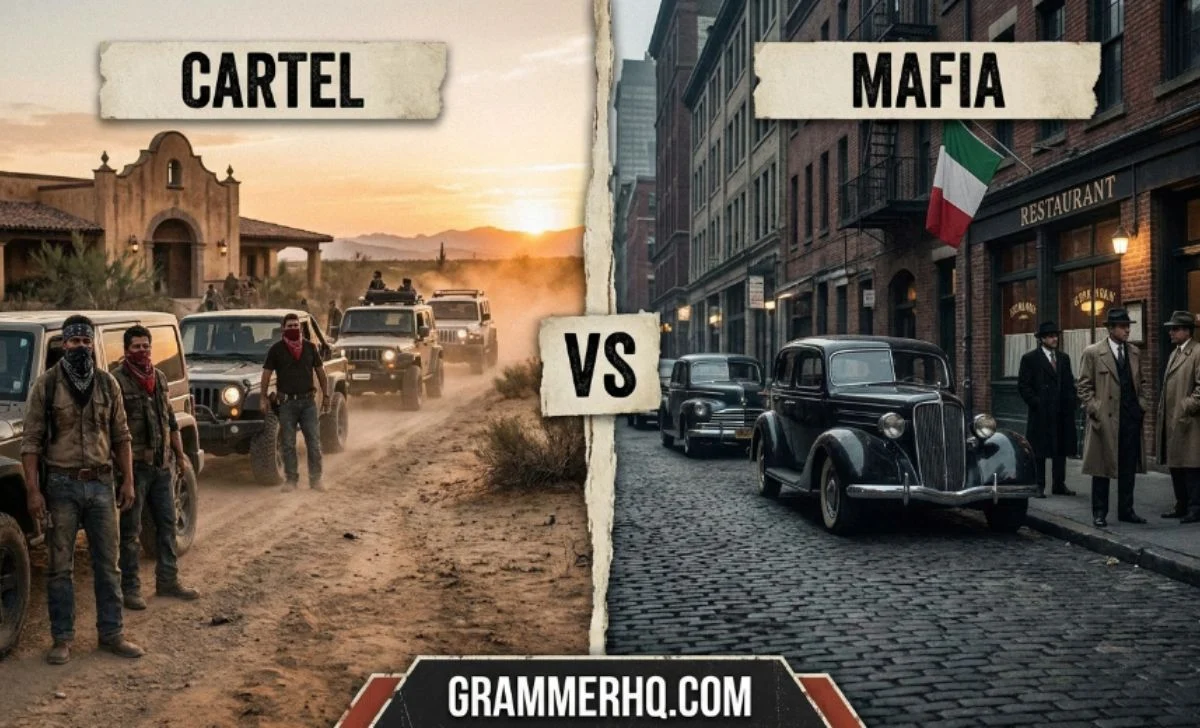
At first glance, cartel and mafia may seem interchangeable. News headlines often use both terms to describe powerful criminal groups involved in violence, smuggling, or illegal businesses.
But despite some similarities, these words describe different types of organizations with distinct structures, goals, and histories.
Understanding the difference matters because using the wrong term can change the meaning of what you’re saying.
A cartel usually exists to control a profitable illegal market most commonly drug trafficking while the mafia traditionally refers to secret criminal societies that gain power through extortion, protection rackets, corruption, and long-term control over communities and businesses.
This guide explains each term in plain English, compares them side by side, and uses real-world examples to clear up the confusion.
Quick Answer
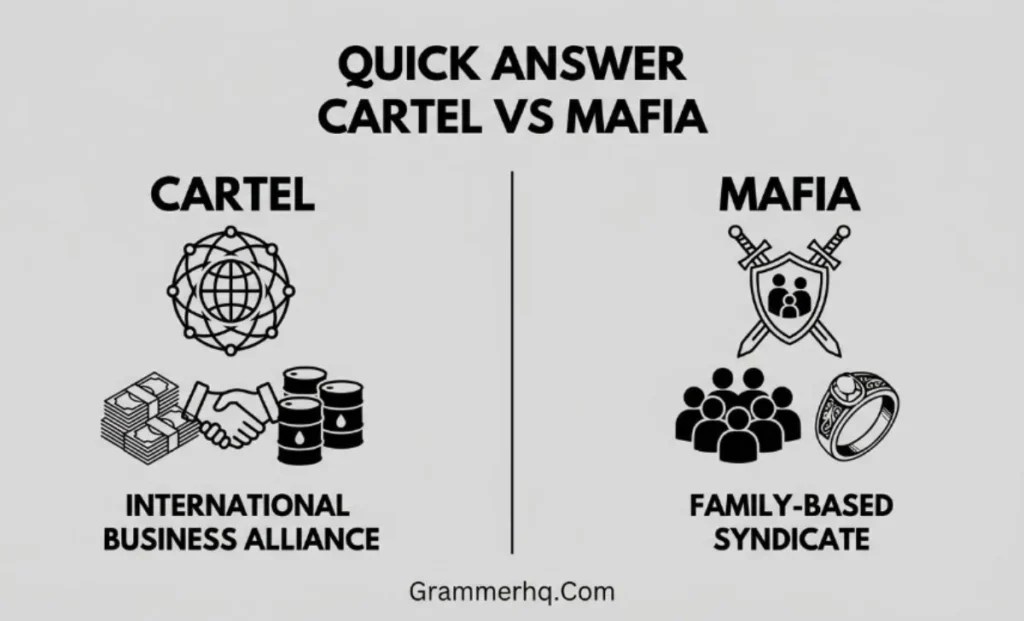
If you’re looking for the short answer, here’s the key difference.
| Cartel | Mafia |
|---|---|
| A criminal organization primarily focused on controlling illegal markets and maximizing profits. | A secret organized crime society that controls territory, businesses, and political influence through long-term criminal activities. |
| Often associated with drug trafficking. | Traditionally associated with extortion, racketeering, corruption, gambling, and organized crime families. |
| Usually business-oriented. | Often family-based with strict codes of loyalty and hierarchy. |
| Commonly linked with Latin America. | Originated in Italy and later spread to countries like the United States. |
In one sentence:
Every mafia is an organized crime group, but not every organized crime group is a mafia. Likewise, a cartel is a specific type of criminal organization focused primarily on controlling profitable illegal markets.
What Is a Cartel?
A cartel is an organization formed to control a market, eliminate competition, and maximize profits. In economics, the word can refer to businesses working together to influence prices.
However, in everyday conversation and news reporting, cartel almost always refers to a criminal organization involved in illegal trade, particularly drug trafficking.
Modern criminal cartels earn billions through activities such as:
- Drug production and trafficking
- Weapons smuggling
- Human trafficking
- Money laundering
- Fuel theft
- Illegal mining
- Cross-border smuggling
Unlike many traditional crime families, cartels operate much like multinational businesses. They often have specialized divisions responsible for logistics, transportation, finance, security, intelligence, and recruitment.
Why Are Drug Cartels So Powerful?
Several factors contribute to a cartel’s influence:
- Massive profits from illegal markets
- International trafficking networks
- Sophisticated logistics
- Access to weapons
- Corruption through bribery
- Ability to operate across multiple countries
Many cartels also compete violently with rival organizations to control trafficking routes, customers, and territories.
Real-Life Example
When international media report on large-scale cocaine trafficking networks operating across Latin America, they typically describe them as drug cartels because their primary objective is controlling the illegal drug trade rather than governing local communities through traditional organized crime structures.
What Is the Mafia?
The mafia refers to a type of organized crime society that follows a structured hierarchy, strict internal rules, and long-term loyalty among its members.
Unlike a cartel, which primarily exists to dominate profitable illegal markets, a mafia often seeks lasting influence over businesses, neighborhoods, public officials, and legitimate industries.
Historically, the mafia developed in Italy, especially Sicily, before similar organizations expanded into countries such as the United States.
Traditional mafia organizations commonly engage in:
- Extortion
- Protection rackets
- Illegal gambling
- Loan sharking
- Racketeering
- Fraud
- Money laundering
- Political corruption
Although many mafia groups have participated in drug trafficking, drugs are usually one source of income, not necessarily the defining purpose of the organization.
How Does the Mafia Operate?
Most mafia organizations have:
- A clear leadership hierarchy
- Initiation rituals
- Strict codes of secrecy
- Family or clan-based membership
- Long-term territorial influence
- Deep community connections
These characteristics distinguish traditional mafia groups from many modern criminal cartels.
Historical Example
Organizations such as Cosa Nostra became internationally known because of their long history, hierarchical structure, and influence over businesses and politics rather than focusing exclusively on a single illegal market.
Cartel vs Mafia: Side-by-Side Comparison
| Feature | Cartel | Mafia |
|---|---|---|
| Primary Goal | Control illegal markets and maximize profits | Control territory, businesses, and criminal influence |
| Origin | Economic term later associated with criminal organizations | Secret criminal societies originating in Italy |
| Structure | Business-like network | Family-based hierarchy |
| Main Activities | Drug trafficking, smuggling, money laundering | Extortion, racketeering, corruption, gambling, fraud |
| Membership | Often recruitment-based | Frequently family or oath-based |
| Geographic Association | Latin America | Italy, United States, and Europe |
| Decision Making | Profit-driven | Loyalty, tradition, and long-term influence |
| Public Image | Drug trafficking organizations | Organized crime families |
Why Do People Confuse Cartels and the Mafia?
The confusion is understandable because both groups:
- Operate outside the law.
- Generate enormous illegal profits.
- Use intimidation and violence.
- Corrupt public officials.
- Launder money.
- Build organized criminal networks.
However, the purpose of each organization is different.
A cartel’s success is usually measured by market control and profit, while a mafia’s power often comes from territorial influence, long-standing relationships, and organized criminal governance.
Think of it this way:
- A cartel behaves like an illegal multinational business focused on a product or market.
- A mafia behaves more like a long-established criminal institution that controls people, businesses, and territory over generations.
Common Mistakes People Make
Calling Every Criminal Group a “Mafia”
Not every organized crime group is a mafia. Many criminal organizations don’t follow the traditional family-based structure associated with mafia groups.
Assuming Every Cartel Sells Drugs Only
Although drug trafficking is the best-known activity, some cartels also profit from fuel theft, extortion, illegal mining, cybercrime, and human trafficking.
Believing the Terms Are Synonyms
They overlap in some activities, but they describe different organizational models with different histories, structures, and objectives.
Key Differences Between a Cartel and the Mafia
Although both are forms of organized crime, their history, structure, objectives, and methods are quite different.
Understanding these differences helps you use each term accurately instead of treating them as interchangeable.
1. Purpose and Primary Objective
The biggest difference lies in what each organization is trying to achieve.
A cartel exists mainly to control a profitable illegal market. Its success depends on dominating supply chains, eliminating competitors, and generating as much revenue as possible.
A mafia, by contrast, aims to maintain long-term power and influence. Money is important, but so is controlling territories, businesses, labor unions, public contracts, and political connections.
Simple example:
- A drug cartel wants to dominate the cocaine trade across multiple regions.
- A mafia family may control local businesses, construction contracts, gambling operations, and extortion networks within a city.
2. Organizational Structure
Both organizations have leadership, but they operate differently.
Cartels
Many modern cartels resemble multinational corporations.
They often include separate divisions responsible for:
- Production
- Transportation
- Logistics
- Security
- Finance
- Intelligence
- Recruitment
Leadership can change quickly if rival groups, arrests, or internal conflicts occur.
Mafia Organizations
Traditional mafia groups usually follow a rigid hierarchy.
A typical structure includes:
- Boss
- Underboss
- Consigliere (advisor)
- Capos (captains)
- Soldiers
- Associates
Promotion often depends on loyalty, trust, and long-term relationships rather than business performance alone.
3. Origins
Another major distinction is historical background.
Cartels
The word cartel originally came from economics, describing companies that cooperate to control prices or production.
Over time, the media increasingly used the term for criminal organizations dominating illegal markets.
Today, people usually associate criminal cartels with countries such as Mexico and Colombia.
Mafia
The word mafia has much older roots and is closely connected with Sicily during the nineteenth century. From there, mafia organizations expanded to other countries through migration and organized crime networks.
4. Criminal Activities
Although both commit serious crimes, their main revenue sources often differ.
Typical Cartel Activities
- Drug trafficking
- Weapons trafficking
- Human trafficking
- Smuggling
- Money laundering
- Fuel theft
- Illegal mining
- Cross-border logistics
Typical Mafia Activities
- Protection rackets
- Extortion
- Racketeering
- Illegal gambling
- Loan sharking
- Fraud
- Bid rigging
- Political corruption
- Money laundering
Notice that money laundering appears on both lists because many criminal organizations need ways to hide illegal profits.
5. Recruitment and Membership
Recruitment also varies considerably.
Cartels
Membership is generally based on operational needs.
People may be recruited because they have:
- Technical skills
- Military experience
- Logistics expertise
- Financial knowledge
- Local connections
Mafia
Traditional mafia groups place greater emphasis on:
- Loyalty
- Trust
- Family relationships
- Long-term commitment
- Internal codes of conduct
Some groups historically required formal initiation ceremonies before granting full membership.
6. Geographic Reach
Both organizations operate internationally today, but their historical centers differ.
Cartels are most commonly linked with:
- Mexico
- Colombia
- Central America
- South America
Traditional mafia organizations are historically associated with:
- Italy
- United States
- Parts of Europe
That said, organized crime has become increasingly global, and criminal networks often cooperate across borders.
Similarities Between Cartels and the Mafia
Despite their differences, there are several important similarities.
Both organizations:
- Operate illegally.
- Generate enormous criminal profits.
- Use intimidation and violence.
- Maintain organized leadership.
- Launder money.
- Corrupt officials through bribery.
- Hide their financial operations.
- Expand influence through fear and power.
These shared characteristics explain why many people mistakenly use the terms interchangeably.
Real-World Examples
Looking at historical examples makes the distinction much clearer.
Example of a Cartel
The Joaquín ‘El Chapo’ Guzmán case is frequently discussed in relation to large-scale drug trafficking organizations.
News coverage focuses on:
- International drug distribution
- Smuggling routes
- Massive financial networks
- Competition between rival trafficking organizations
The emphasis is usually on market control rather than governing communities.
Example of the Mafia
Figures such as Al Capone became famous because of organized crime operations involving illegal alcohol during Prohibition, gambling, extortion, and political corruption.
Likewise, organizations such as Cosa Nostra became known for their hierarchical structure, loyalty, and long-term influence over legitimate businesses.
Can a Cartel and the Mafia Work Together?
Yes. Criminal organizations sometimes cooperate when doing so increases profits.
For example, one group may control:
- Transportation routes
- Drug production
- Distribution networks
Another may provide:
- Local protection
- Money laundering services
- Corrupt business connections
- Financial operations
These partnerships are usually based on shared financial interests rather than permanent alliances.
Cartel vs Mafia: Which Term Should You Use?
Choosing the correct word depends on the context.
Use cartel when referring to organizations whose primary purpose is controlling illegal markets, especially drug trafficking or large-scale smuggling.
Use mafia when discussing traditional organized crime families or groups that exercise long-term influence through extortion, racketeering, corruption, and territorial control.
If you’re unsure, organized crime group or criminal organization is often the safest and most accurate general term because it doesn’t assume a specific structure or origin.
FAQ,s
Is a cartel the same as the mafia?
No. Although both are forms of organized crime, they are not the same. A cartel primarily exists to control illegal markets especially drug trafficking and smuggling while the mafia is a structured criminal society that traditionally focuses on territorial influence, extortion, racketeering, and long-term control over businesses and communities.
Which is more powerful: a cartel or the mafia?
There is no universal answer.
Some modern cartels generate enormous profits and operate across multiple countries, making them extremely powerful financially.
Traditional mafia organizations, on the other hand, may hold significant influence through political corruption, business infiltration, and long-established criminal networks.
Power depends on factors such as:
- Financial resources
- Geographic reach
- Organizational structure
- Corruption networks
- Ability to avoid law enforcement
Is every drug trafficking group a cartel?
Some drug trafficking operations are run by small criminal gangs or independent networks. The term cartel is generally used for large organizations that coordinate production, transportation, distribution, and market control on a much larger scale.
Why is the mafia called a “family”?
The word family doesn’t always mean biological relatives.
In organized crime, a “crime family” refers to a structured organization whose members are bound by loyalty, shared rules, and a chain of command.
While some members may be related, many join through trusted relationships rather than blood ties.
Can the mafia be involved in drug trafficking?
Although traditional mafia organizations were historically associated with activities such as extortion, gambling, and racketeering, many have also participated in international drug trafficking. However, drug trafficking is usually one income source among many, rather than the group’s sole purpose.
Are cartels legal in economics?
Yes depending on the context.
Outside criminal law, a cartel can refer to businesses that cooperate to control prices, production, or market share. In many countries, however, such arrangements violate competition or antitrust laws because they reduce fair market competition.
This economic meaning is different from the criminal use of the word commonly seen in news reports.
What is the safest general term to use?
If you are unsure whether a group is technically a cartel or a mafia, use broader terms like:
- Organized crime group
- Criminal organization
- Crime syndicate
- Organized criminal network
These expressions are more accurate when the group’s structure or activities are unclear.
Key Takeaways
If you only remember three things, make them these:
- A cartel is primarily a profit-driven criminal organization that seeks to control illegal markets such as drug trafficking or smuggling.
- The mafia is a traditional organized crime society known for hierarchical leadership, territorial influence, extortion, and long-term criminal operations.
- While both belong to the broader category of organized crime, they are not interchangeable terms.
Choosing the correct word makes your writing more precise and helps avoid common misunderstandings.
Conclusion
The confusion between cartel and mafia comes from the fact that both operate within organized crime and often engage in similar illegal activities. However, their histories, structures, and objectives are fundamentally different.
A cartel is built around controlling profitable illegal markets, whereas the mafia developed as a long-standing criminal institution with deep roots in territory, influence, and organized networks.
Understanding this distinction allows you to interpret news reports more accurately, use the right terminology in academic or professional writing, and recognize that not every criminal organization fits neatly into a single label.
When in doubt, consider the group’s primary purpose, organizational structure, and historical background before choosing the term.
Read More Blogs: