You’re reviewing an important document when one sentence suddenly makes you stop: “She is smarter then her brother.” Something feels off—but is it then or than?
If you’ve ever hesitated over these two words, you’re in good company. They’re among the most commonly confused words in English because they look similar, sound alike in many accents, and appear in everyday writing.
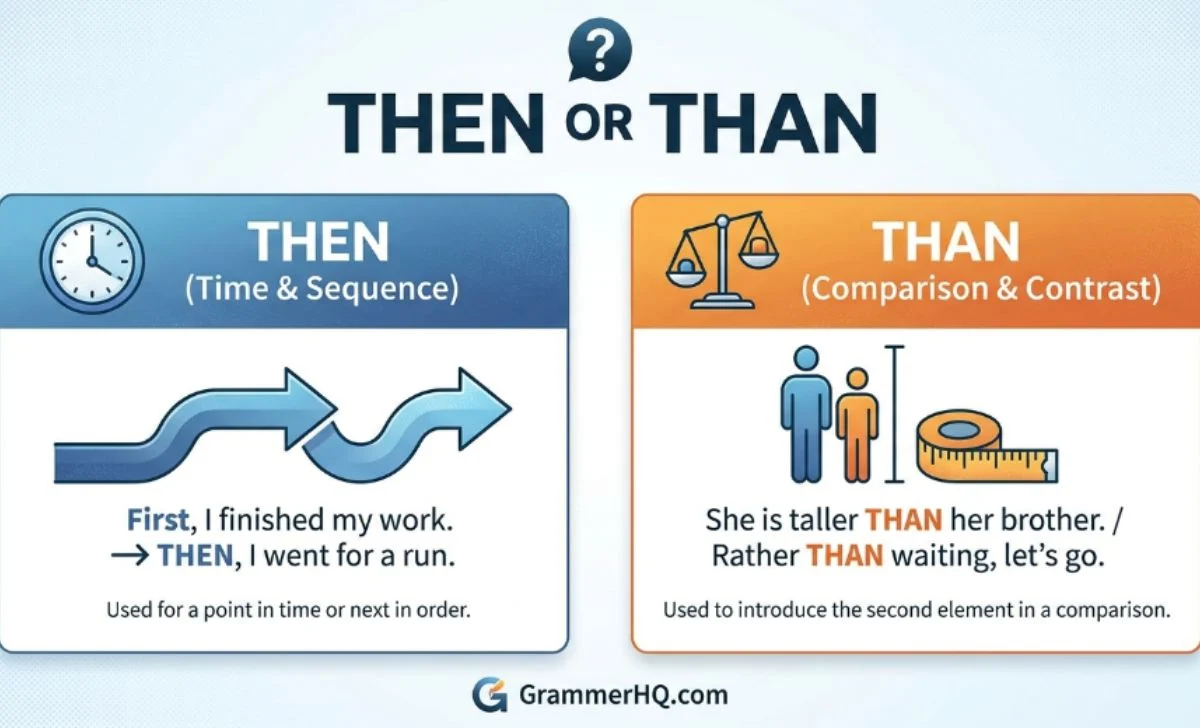
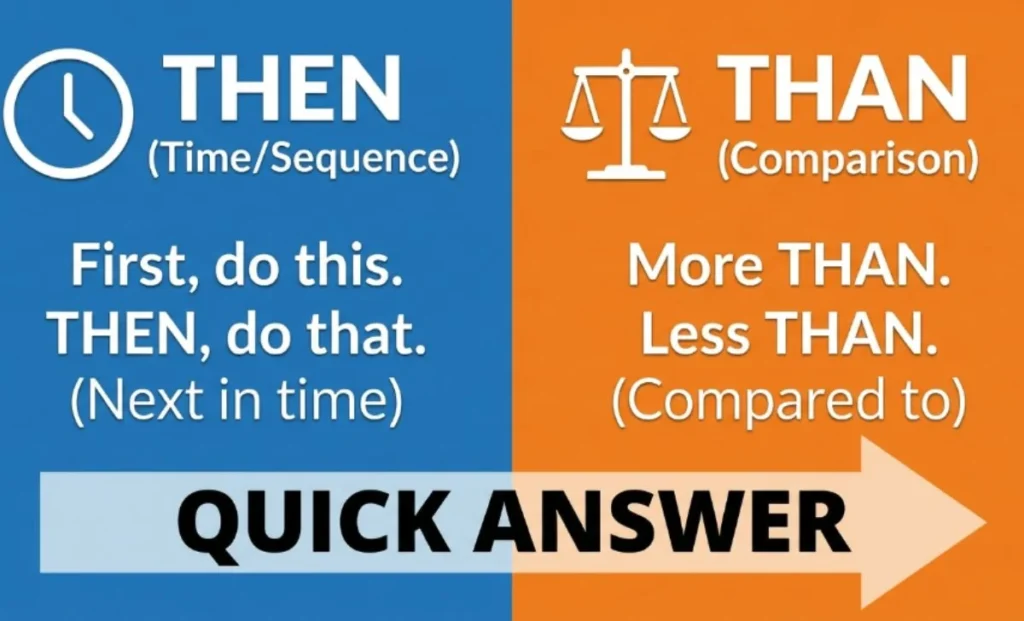
Here’s the simple rule: than is used to make comparisons, while then refers to time, sequence, or what happens next. Knowing this one distinction can instantly eliminate a common grammar mistake.
This guide explains the difference in clear, practical language. You’ll discover why people confuse these words, how to remember the correct one with an easy memory trick, how each word is pronounced and used, common mistakes to avoid, and plenty of real-life examples to help you write with confidence in any situation.
The difference between then and than is simple once you know what each word does. Than is used when comparing two or more people, things, ideas, or amounts. Then is used to talk about time, sequence, or what happens next. Although these words look and sound similar, they have completely different meanings and cannot replace each other. Remember this easy rule: if your sentence compares something, use than. If it shows the next step, a point in time, or the order of events, use then.
Quick Comparison
Then
Than
Refers to time or sequence
Used for comparisons
Means “next” or “after that”
Means “compared with”
We ate dinner, then went home.
This book is better than that one.
Shows order of events
Shows differences between two things
Easy Rule to Remember: Than = Comparison • Then = Time or Next Event
The correct word depends on what you want to say. Than is used when comparing two people, things, or ideas, while then is used to talk about time, order, or what happens next. A simple way to remember this is: if your sentence compares something, use than. If it describes the next step or a point in time, use then.
This spelling distinction made English easier to read and understand.
Why the Difference Exists Today
Modern English keeps these spellings separate because they perform different grammatical functions.
Than introduces comparisons.
Then refers to time or what happens next.
Although they share the same historical roots, centuries of language change gave each word its own role.
Their similar origin also explains why they still look and sound alike today.
When do people use these words?
Context
Correct Word
Comparing prices
than
Comparing people
than
Comparing sizes
than
Talking about the next step
then
Giving instructions
then
Referring to the past
then
The popularity of this search shows that even fluent English speakers occasionally pause to check which word is correct. Once you remember that than compares and then refers to time, the confusion quickly disappears.
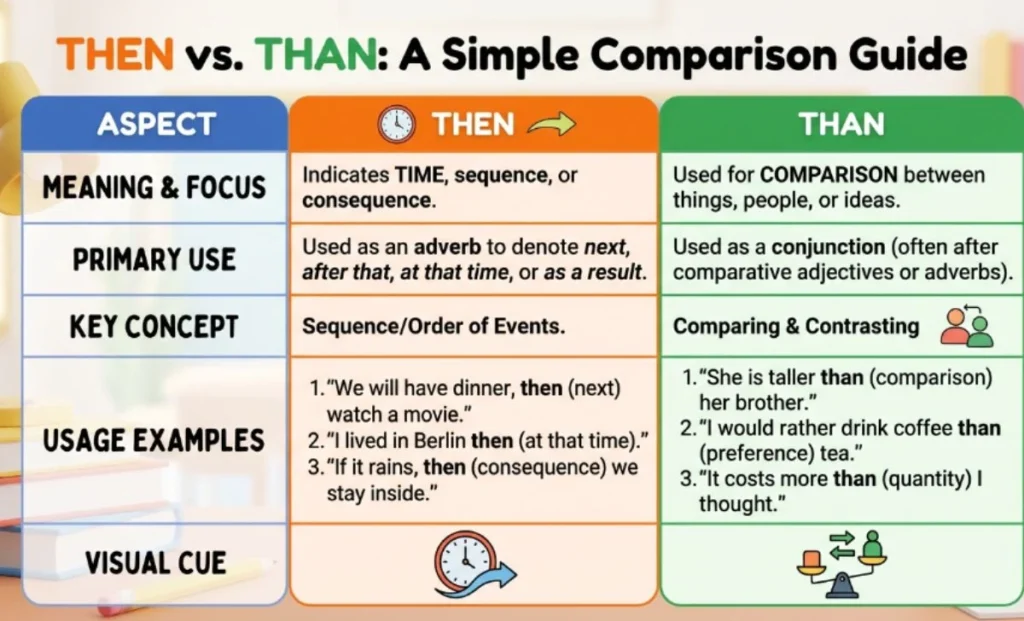
Then or Than Comparison Table
Feature
Then
Than
Meaning
Time, order, or sequence
Comparison
Part of Speech
Adverb, adjective, noun
Conjunction, preposition
Used For
What happens next
Comparing two things
Common With
First, next, afterward
Better, more, less, taller
Example
We ate, then left.
She is taller than me.
Shows Time?
✅ Yes
❌ No
Shows Comparison?
❌ No
✅ Yes
Same in UK & US?
✅ Yes
✅ Yes
FAQ,s
1. What is the difference between then and than?
Than is used to compare two people, objects, or ideas, while then refers to time, sequence, or what happens next.
Example:
My brother is older than me.
We finished dinner, then watched a movie.
2. Is it better then or better than?
The correct phrase is better than because better is a comparative adjective.
✅ This laptop is better than the old one.
❌ This laptop is better then the old one.
3. Can then ever replace than?
No. These words have different meanings and cannot replace each other.
Than compares.
Then describes time or sequence.
4. Why do people confuse then and than?
People confuse them because they look similar, sound similar in everyday speech, and differ by only one letter. Since both are correctly spelled words, spell check often doesn’t catch the mistake.
5. Which comes first, then or than?
Neither comes first alphabetically for grammar purposes. You choose the word based on meaning:
Use than for comparisons.
Use then for the next event or point in time.
6. Is then a conjunction?
Usually, then is an adverb that refers to time. In some sentence patterns, it can also help connect ideas, but its main job is showing sequence.
7. How can I remember the difference quickly?
Use this simple memory trick:
A in than = A for comparison.
E in then = E for the next event.
This trick works in almost every sentence.
Conclusion
The difference between then and than is simple once you understand what each word is meant to do. Than is used only for comparisons, while then refers to time, sequence, or the next step in a series of events.
Although these two words look and sound similar, using the wrong one can confuse your readers and change the meaning of your sentence.An easy way to remember the difference is this: Than contains A for comparison, and Then contains E for the next event. This small memory trick makes choosing the correct word much easier.
Whether you’re writing an email, essay, business report, blog post, or social media caption, using then and than correctly will make your writing clearer, more professional, and grammatically accurate. By following the explanations, examples, grammar rules, and practical tips in this guide, you can confidently use both words correctly in every writing situation.
Hi, I’m Amelia Parker, a grammar enthusiast and writer at GrammarHQ.com. I specialize in explaining spelling differences, confusing words, and common English mistakes through simple, practical, and easy-to-understand guides.