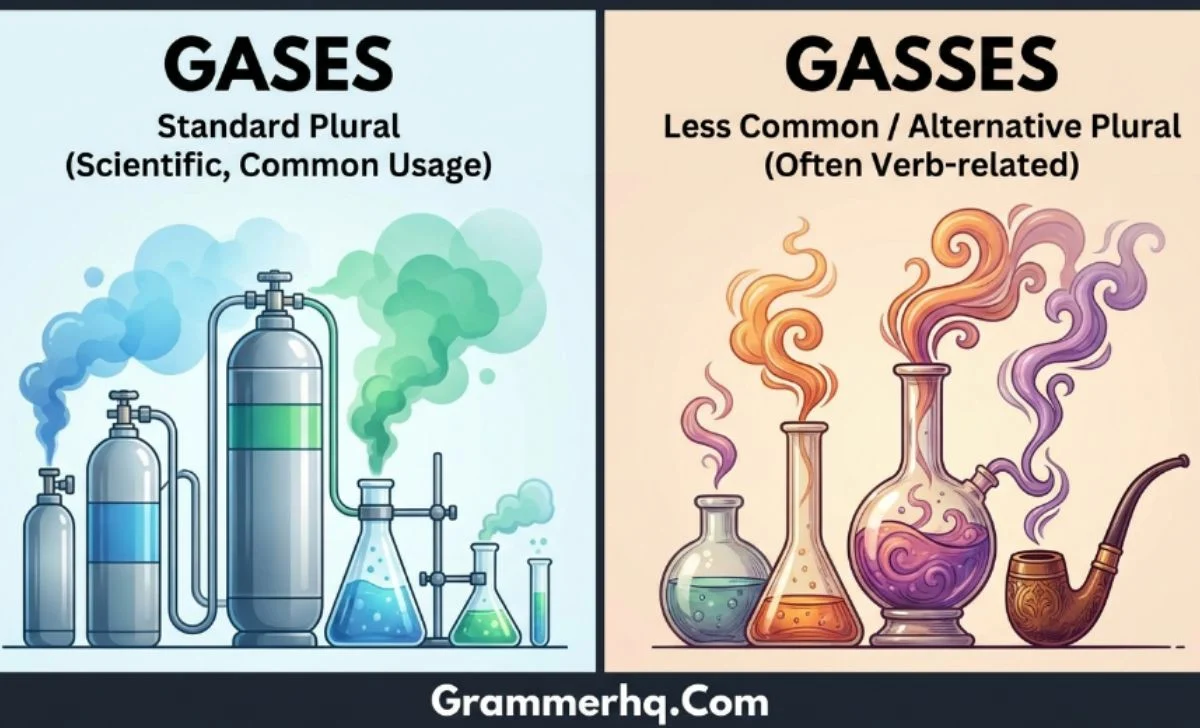
“Gases” or “gasses”—which spelling should you use? The extra s makes these words look almost identical, but they do not always serve the same grammatical purpose.
If you are writing about oxygen, nitrogen, greenhouse gases, or other substances, gases is the standard spelling you will normally want.
However, gasses is not simply a misspelling. It can be the verb form of gas, and some dictionaries also recognize it as an alternative plural.
The difference becomes much easier once you look at the word’s role in a sentence. Here is a clear guide to the meaning, grammar, pronunciation, spelling, and everyday use of gases vs gasses.
Quick Answer
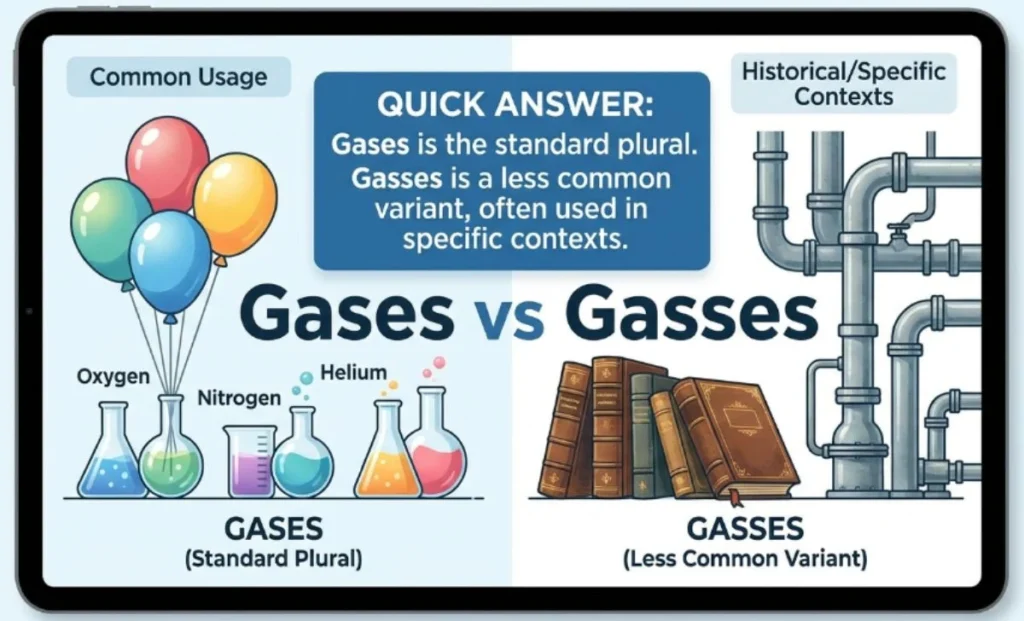
Gases is the standard and much more common plural of gas.
Oxygen and nitrogen are both gases.
Gasses is commonly used as the third-person singular present form of the verb gas.
The machine gasses the chamber before testing.
There is one important detail: gasses can also be used as a plural noun. Major dictionaries list it as an alternative plural of gas, but gases is the normal choice in modern general, scientific, and academic writing.
So, if you mean more than one gas, use gases unless you have a specific reason to use the less common gasses.
Gases vs Gasses at a Glance
| Word | Grammar | Main use | Example |
|---|---|---|---|
| gases | Plural noun | More than one gas | Several gases were detected. |
| gasses | Verb | Third-person singular of gas | The system gasses the chamber. |
| gasses | Plural noun | Alternative plural | Some sources use gasses instead of gases. |
| gassed | Past-tense verb | Past form of gas | The chamber was gassed. |
| gassing | -ing form | Ongoing action | The process is gassing the material. |
The safest everyday rule is simple:
Plural noun → gases
Verb → gasses
What Does “Gases” Mean?
Gases is the plural form of gas. In science, a gas is a state of matter that does not have a fixed shape or volume and expands to fill the available space.
For example, oxygen, hydrogen, and nitrogen are gases. Cambridge Dictionary uses these substances as examples of gases in its definition of gas.
Examples of Gases
You might come across these types of gases in science and everyday life:
- oxygen
- nitrogen
- hydrogen
- carbon dioxide
- helium
- methane
- water vapor
- noble gases
- greenhouse gases
For example:
Oxygen and nitrogen are the main gases in Earth’s atmosphere.
Scientists measured several gases released during the experiment.
Greenhouse gases can affect Earth’s climate.
In these sentences, gases is a plural noun because the word refers to more than one type or quantity of gas.
What Does “Gasses” Mean?
Gasses has a different grammatical role when it is used as a verb.
It is the third-person singular present form of “gas.” Depending on the context, gas as a verb can mean to fill, treat, expose, or supply something with gas.
Dictionary sources also record meanings involving giving off gas or using gas in a process.
Examples of “Gasses” as a Verb
The technician gasses the chamber before the test.
The process gasses the material under controlled conditions.
The battery sometimes gasses while charging.
Here, gasses describes an action. That is the key difference.
Compare:
The laboratory stores several gases.
Here, gases is a noun.
The machine gasses the chamber.
Here, gasses is a verb.
Is “Gasses” Also a Plural of “Gas”?
Yes. This is where many simple explanations become misleading.
Gasses is recognized as an alternative plural of gas by dictionary sources. Dictionary.com lists both gases and gasses as plural forms, while Cambridge also has an entry for gasses as a plural of gas.
However, that does not mean the two spellings are equally common.
Gases is the standard and preferred plural for most modern writing.
For example:
Scientists studied the different gases in the atmosphere.
is the natural choice for general, scientific, and academic writing.
You may occasionally see:
Scientists studied the different gasses in the atmosphere.
The second spelling is possible, but it is much less common.
Therefore, if you are unsure which plural to choose, gases is the better option.
Why Are “Gases” and “Gasses” So Easy to Confuse?
The confusion comes from English spelling patterns.
When people see gas, they may naturally expect the plural to become gasses, just as:
- class → classes
- pass → passes
- dress → dresses
But gas → gases is the standard spelling.
There is also a reason gasses looks perfectly believable: it is already a legitimate English form. It can function as a verb and is also recognized as an alternative plural.
That means a spell-checker may not flag gasses as an error—even when you actually meant the standard plural gases.
Dictionary.com explains that English has a long history of doubling consonants in certain inflected forms, but gases follows a different spelling pattern from forms such as gassed and gassing.
Why Is the Plural of Gas “Gases” Instead of “Gasses”?
English does not always form plurals by simply applying the same spelling pattern to every word.
The normal plural of gas is:
gas → gases
The spelling gases avoids creating unnecessary ambiguity while following the usual plural ending -es.
Compare these examples:
- gas → gases
- bus → buses
- class → classes
- box → boxes
- dish → dishes
The spelling gasses developed in other grammatical contexts, particularly in verb forms such as:
- gas → gasses
- gas → gassed
- gas → gassing
So the extra s is not random. It appears in established forms of the verb and in the less common alternative plural.
Are “Gases” and “Gasses” Pronounced the Same?
In normal speech, gases and gasses are pronounced very similarly, and this is another reason writers confuse them.
Both can be pronounced with the ending sound represented by -iz:
- gases → /ˈɡæsɪz/
- gasses → /ˈɡæsɪz/
Because the pronunciation does not reliably tell you which spelling is intended, context matters.
If you hear:
“The atmosphere contains several ___.”
you need to recognize that the word is being used as a plural noun. In standard writing, gases is the natural spelling.
If you hear:
“The machine ___ the chamber.”
the word is functioning as a verb, so gasses is appropriate.
In other words, listen for the grammar, not just the sound.
Gases vs Gasses in British and American English
This is not simply a case of American English vs British English.
The main distinction is grammatical function and usage preference, rather than a straightforward regional spelling rule.
Both gases and gasses are documented in English dictionaries. Cambridge, for example, lists gasses as a plural of gas, while Dictionary.com lists both plural forms.
For general writing, however, gases remains the safest and most widely recognized plural.
So whether you are writing for readers in the United States, United Kingdom, Canada, Australia, or elsewhere, gases is the best default when you mean more than one gas.
Gases vs Gasses in Science and Academic Writing:
Scientific writing strongly favors clear and conventional terminology.
You will commonly see phrases such as:
- greenhouse gases
- noble gases
- toxic gases
- atmospheric gases
- exhaust gases
- industrial gases
- gases in the atmosphere
- gases released during combustion
For example:
Carbon dioxide and methane are greenhouse gases.
The researchers analyzed the gases released during the reaction.
Noble gases are generally chemically unreactive.
In academic or scientific writing, gases is the better choice when you are referring to multiple gases.
Using gasses as a plural noun may not make the sentence impossible to understand, but it can look unusual to readers who expect the standard form.
Common Mistakes With Gases and Gasses
1: Using “gasses” as the normal plural
❌ The atmosphere contains many different gasses.
✅ The atmosphere contains many different gases.
Why?
You are talking about multiple gases, so gases is the standard choice.
2: Using “gases” as a verb
❌ The machine gases the chamber.
✅ The machine gasses the chamber.
Why?
Here, gas is being used as a verb, and gasses is the third-person singular present form.
3: Assuming “gasses” is always wrong
❌ “Gasses” is never a correct English word.
✅ Gasses is a legitimate English form. It can be a verb and can also occur as an alternative plural.
This distinction is important because dictionaries do recognize the word.
An Easy Trick to Remember Gases vs Gasses
Use this simple rule:
Things = gases.
Action = gasses.
If you are naming or counting different types of gas, choose gases:
Three gases were detected.
If someone or something is performing an action involving gas, gasses may be the correct verb:
The machine gasses the chamber.
One final reminder makes the rule even safer:
When “gasses” is being considered as a plural, “gases” is usually the better choice.
Gases vs Gasses in Example Sentences
Examples with “Gases”
- Oxygen and nitrogen are gases.
- The experiment produced several gases.
- Greenhouse gases contribute to climate change.
- The laboratory monitors toxic gases carefully.
- Some gases are invisible but can still be detected with specialized equipment.
Examples with “Gasses”
- The machine gasses the chamber before the experiment.
- The system automatically gasses the container.
- The battery gasses when it is exposed to certain conditions.
- The equipment gasses the material during processing.
- The technician checks how the device gasses the test chamber.
Compare Them Side by Side
The laboratory stores several gases.
Here, gases means multiple substances.
The machine gasses the laboratory chamber.
Here, gasses describes an action.
That one grammatical difference usually tells you which spelling you need.
Gases vs Gasses: Which One Should You Use?
If you are writing about more than one gas, use gases.
If gas is being used as a verb and the subject is third-person singular—such as the machine, the system, or the technician—gasses can be the correct form.
There is also a less common plural use of gasses, and dictionaries recognize it. But for everyday, professional, scientific, and academic writing, gases is the clear default.
A quick comparison:
- One gas → singular
- Several gases → standard plural
- The machine gasses → verb
- The machine gassed → past tense
- The machine is gassing → -ing form
When in doubt, remember:
More than one substance? → gases.
An action involving gas? → gasses.
FAQ,s
Is “gasses” a correct word?
Yes. Gasses is a correct English word. It is commonly used as the third-person singular present form of the verb gas, and dictionaries also recognize it as an alternative plural of gas.
Is “gases” the plural of “gas”?
Yes. Gases is the standard and most commonly used plural of gas.
One gas → several gases.
Can “gasses” be the plural of “gas”?
Yes. Some dictionaries recognize gasses as an alternative plural. However, gases is the preferred and much more common form in modern general writing.
What is the difference between gases and gasses?
Gases is normally a plural noun meaning more than one gas. Gasses is commonly a verb meaning that someone or something supplies, treats, fills, or exposes something to gas. Gasses can also be an alternative plural.
Is “gasses” a verb?
Yes. Gasses is the third-person singular present form of gas.
The machine gasses the chamber.
Are gases and gasses pronounced the same?
They are commonly pronounced the same or very similarly, which is why context and spelling are important when writing them.
Which is correct in scientific writing: gases or gasses?
Gases is the preferred choice when referring to multiple gases in scientific or academic writing.
The researchers measured three different gases.
Why is gas pluralized as gases?
The standard plural form is gases. English spelling does not require every word ending in s to double that consonant when forming a plural. The spelling gasses exists in other grammatical uses and as an alternative plural.
Is “gasses” British or American English?
It is not simply a British-versus-American spelling difference. Both forms are documented in English, but gases is the standard default for the plural in general writing.
What is the past tense of “gas”?
The past tense is gassed.
The technician gassed the chamber before the test.
The -ed form doubles the s, just as the present participle is gassing.
Conclusion
The difference between gases and gasses becomes simple once you look at their grammatical roles. Gases is the standard plural of gas and is the best choice for most general, scientific, and academic writing.
Gasses is commonly the third-person singular verb form of gas, although dictionaries also recognize it as an alternative plural. So if you mean more than one gas, choose gases by default.
If the word describes an action, gasses may be the form you need. When spelling is uncertain, let the sentence’s grammar guide you.
Read More Blogs:
- Meating vs Meeting: Meaning, Differences, and Correct Usage
- Cartel vs Mafia: What’s the Real Difference?