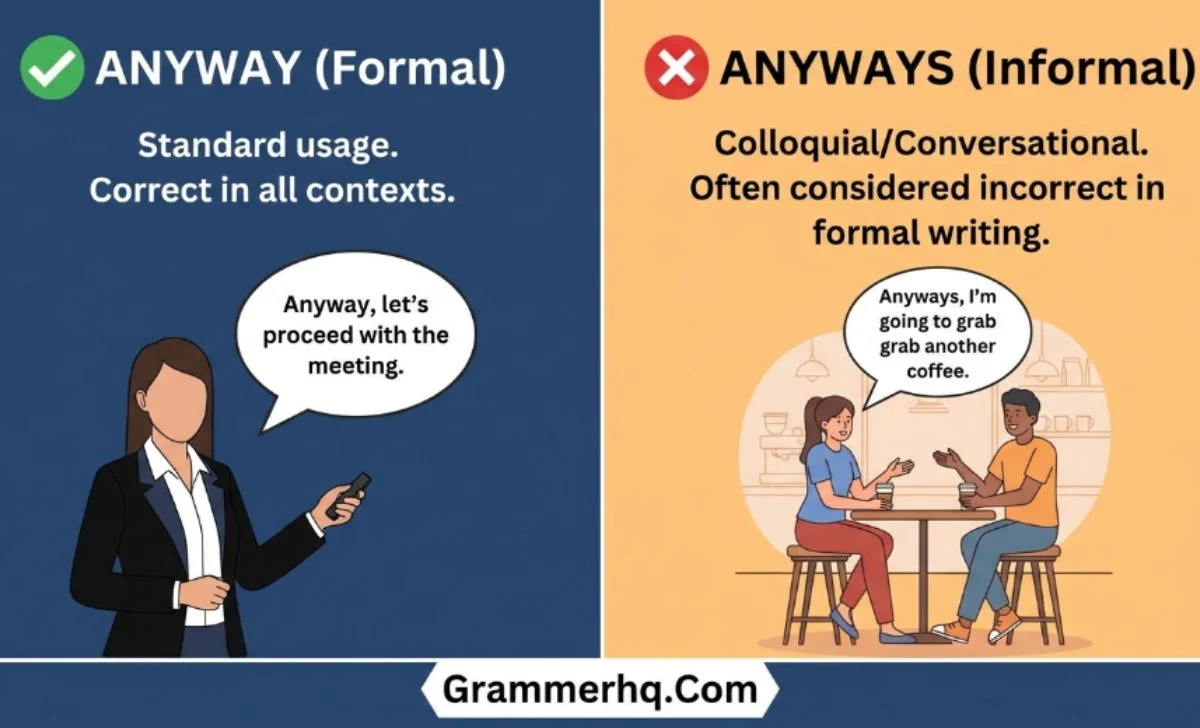
Anyway vs Anyways is a common English usage question, but the answer is clearer than it may seem.
Anyway is the standard English form and the safest choice for formal, academic, and professional writing, while anyways is an informal variant commonly used in casual American English.
Although both usually express the same basic idea, choosing the right form depends on your audience, tone, and context. There is also a third form, any way, which looks similar but has a completely different meaning and grammatical function.
Knowing the difference can help you write more naturally and avoid mistakes in emails, essays, conversations, and everyday messages. In this guide, you’ll learn exactly when to use anyway, anyways, and any way, with clear rules, practical examples, and easy tips to remember each form.
Quick Answer
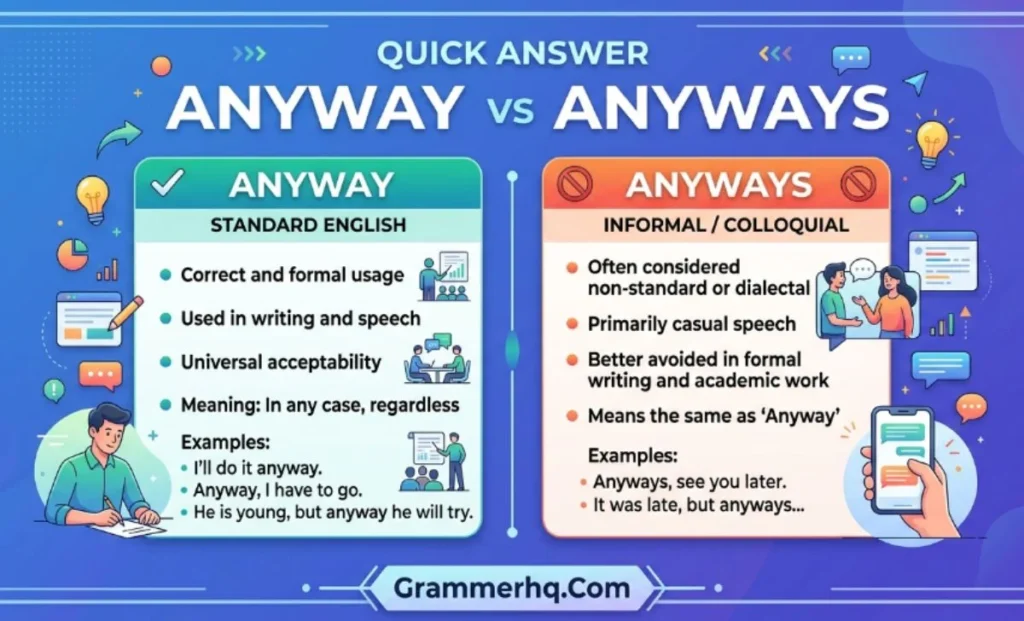
Anyway is the standard spelling and means “in any case,” “regardless,” or “despite that.” It can also work as a discourse marker when changing or returning to a topic.
Anyways has essentially the same meaning, but it is informal and is especially associated with US spoken English.
Cambridge lists it as an informal form of anyway, while Dictionary.com labels it a nonstandard variant. (Cambridge Dictionary)
| Word | Meaning | Usage | Best choice |
|---|---|---|---|
| anyway | in any case; regardless | Standard English | Formal and informal |
| anyways | usually the same as anyway | Informal | Casual conversation |
| any way | in any manner or by any method | Standard phrase | When referring to a method or manner |
Simple rule: When in doubt, use anyway.
What Does “Anyway” Mean?
Anyway is an adverb. Its meaning depends slightly on how it is used, but it commonly means “in any case,” “regardless,” or “despite what was mentioned.”
Cambridge also identifies uses where anyway changes the subject, returns to an earlier topic, or introduces a more important reason. (Cambridge Dictionary)
Anyway Meaning “Regardless”
Use anyway when something happens despite a previous fact or obstacle.
- It was raining, but we went anyway.
- I was tired, but I finished the report anyway.
- She knew it would be difficult, but she tried anyway.
Here, anyway is close in meaning to “despite that” or “regardless.”
Anyway as a Conversation Marker
In everyday speech, anyway can help a speaker move the conversation forward, return to an earlier point, or change the subject.
- Anyway, what were you saying?
- Anyway, let’s get back to the main question.
- Anyway, I need to leave soon.
In this use, anyway is often called a discourse marker because it helps organize conversation. Cambridge specifically identifies this conversational function. (Cambridge Dictionary)
Anyway Meaning “At Least”
Sometimes anyway limits or qualifies what someone has just said.
- I don’t think he was angry, anyway.
- We won’t be late, anyway.
This is another reason the word appears so naturally in everyday English.
What Does “Anyways” Mean?
Anyways generally carries the same basic meaning as anyway, but its register is different.
Cambridge lists anyways as an informal US form of anyway. Dictionary.com, meanwhile, describes it as a nonstandard variant. (Cambridge Dictionary)
You are most likely to encounter anyways in:
- Casual conversations
- Text messages
- Social media posts
- Informal dialogue
- Fictional speech
- Casual American English
For example:
Anyways, what are we doing tonight?
The sentence is understandable and natural in casual speech. However, Anyway, what are we doing tonight? is the safer version for standard written English.
Why “Anyways” Can Sound Different
The extra -s can make the word sound more conversational, relaxed, or sometimes dismissive.
Compare:
Anyway, let’s continue.
with:
Anyways, let’s continue.
The meaning is almost identical, but the second version has a more casual spoken feel.
Is “Anyways” a Correct Word?
Yes, but the answer needs some nuance.
Anyways is a real, dictionary-listed form, but it is not the standard choice for formal English.
Cambridge lists it as informal and specifically associates it with US English. Its learner dictionary also identifies anyways as a US spoken form. (Cambridge Dictionary)
Dictionary.com takes a stricter approach and labels anyways a nonstandard variant of anyway. (Dictionary.com)
So these statements are not equally accurate:
Too absolute:
“Anyways is not a word.”
More accurate:
“Anyways is an informal or nonstandard variant of anyway and is best avoided in formal writing.”
That distinction matters because English has many words and forms that are common in speech but are not preferred in formal edited writing.
Anyway vs Anyways in Formal Writing
For formal English, academic writing, business communication, and professional documents, use anyway.
For example:
Preferred:
The deadline was approaching, but we completed the project anyway.
Less suitable for formal writing:
The deadline was approaching, but we completed the project anyways.
The second sentence is easy to understand, but the first follows the standard form and sounds more polished.
In Academic Writing
Choose anyway when the word genuinely fits the sentence.
The evidence was limited, but the researchers continued the investigation anyway.
However, in very formal academic writing, you may sometimes want a more precise connector such as nevertheless, regardless, or in any case, depending on the meaning.
In Business Emails
Anyway is usually the safer option.
Anyway, I’ll send the revised document this afternoon.
For a highly formal email, you might choose a more specific transition:
In any case, I’ll send the revised document this afternoon.
The best choice depends on tone and context, not just grammar.
When Is “Anyways” Acceptable?
Anyways is most appropriate when you deliberately want an informal, conversational tone.
Casual Conversation
Anyways, what time are you leaving?
Text Messages
I was going to call you, but anyways, I’ll see you tomorrow.
Informal Dialogue
“Anyways, let’s forget about it.”
Fiction
A writer may use anyways in dialogue to make a character’s speech sound natural or casual.
The key point is register. A word can be common in everyday speech while still being a poor choice for formal writing.
So instead of thinking:
anyways = wrong
think:
anyways = informal; anyway = standard
That is a much more useful rule.
Any Way vs Anyway vs Anyways
This is where many people make the biggest mistake.
Although anyway, anyways, and any way look similar, any way has a different grammatical function.
Any Way — Two Words
Any way means “in any manner,” “by any method,” or “by whatever means.”
Examples:
- Is there any way to fix this?
- I’ll help in any way I can.
- You can solve the problem any way you like.
- Is there any way we can arrive earlier?
Here, any describes the noun way, so the two words stay separate.
Anyway — One Word
Anyway usually means “in any case,” “regardless,” or “despite that.”
Examples:
- I was tired, but I went anyway.
- Anyway, let’s move on.
- She didn’t agree, but she helped us anyway.
Anyways — One Word
Anyways normally has the same basic meaning as anyway, but it has an informal tone.
Example:
Anyways, I should get back to work.
So the three forms can be remembered like this:
any way = a manner or method
anyway = regardless / in any case
anyways = informal variant of anyway
Easy Trick to Remember “Any Way” vs “Anyway”
Try the “in the way” test.
If you can replace any with “in the” without changing the basic meaning, you probably need any way.
Example
I’ll help you in any way I can.
Try:
I’ll help you in the way I can.
The meaning still works, so any way is correct.
Another example:
You can arrange the furniture any way you want.
→ You can arrange the furniture in the way you want.
Again, any way is correct.
Now consider:
I was busy, but I answered the message anyway.
You cannot naturally replace any with in the.
Therefore, anyway is the correct form.
This simple test is useful because it focuses on meaning, rather than memorizing a spelling rule. Dictionary.com recommends essentially the same distinction. (Dictionary.com)
Anyway vs Anyways: Real-Life Examples
Anyway at the End of a Sentence
This is common when anyway means “despite that” or “regardless.”
- I didn’t really want to go, but I went anyway.
- It was expensive, but I bought it anyway.
- She was nervous, but she performed anyway.
- We might be late, but we’ll come anyway.
- He knew the answer was difficult, but he tried anyway.
Anyway at the Beginning of a Sentence
Here, it often works as a discourse marker.
- Anyway, let’s start the meeting.
- Anyway, where were we?
- Anyway, I have another question.
- Anyway, that’s not the main issue.
- Anyway, let’s get back to work.
Anyways in Casual English
- Anyways, what did you decide?
- Anyways, I’ll call you later.
- Anyways, let’s not worry about it.
- Anyways, I have to go now.
- Anyways, back to the original question.
These examples show why people sometimes search for anyway vs anyways: the two forms can perform the same job, but they do not have the same level of formality.
Any Way in a Sentence
- Is there any way to make this easier?
- I’ll support you in any way I can.
- You can contact us any way you prefer.
- Is there any way to change the appointment?
- Do it any way you think is best.
Anyway vs Anyways in American and British English
Anyway is standard in both American and British English.
Anyways is particularly associated with informal US English. Cambridge explicitly marks the word as US and informal. (Cambridge Dictionary)
That does not mean British speakers never use anyways. English usage is not divided into two perfectly separate systems, and informal forms can cross regional boundaries.
The safer rule is:
- American English: anyway is standard; anyways is informal.
- British English: anyway is the standard choice.
- Formal international English: use anyway.
- Casual speech: anyways may occur naturally.
If your goal is clear, professional English, anyway is the safest option regardless of your variety of English.
Anyway vs Anyways: Pronunciation
The words are pronounced differently because of the final sound.
Anyway: /ˈen.i.weɪ/
Anyways: /ˈen.i.weɪz/
The main difference is the /z/ sound at the end of anyways. Cambridge gives these pronunciations for the two forms. (Cambridge Dictionary)
You can think of them as:
anyway → EN-ee-way
anyways → EN-ee-wayz
Why Do People Say “Anyways”?
The extra -s is not simply the result of people randomly adding a letter.
Anyways has a history of use, and modern English speakers have continued to use it in informal speech. Today, dictionaries treat it differently in terms of register: Cambridge calls it informal, while Dictionary.com calls it nonstandard. (Cambridge Dictionary)
The important point for everyday writers is not necessarily where every historical form came from. It is knowing how the form is treated in modern standard English.
That gives you a practical rule:
Recognize “anyways,” but prefer “anyway” when you need standard or formal English.
Common Mistakes With Anyway, Anyways, and Any Way
1: Treating “anyways” as Always Wrong
❌ “Anyways is never a real English word.”
This is too absolute. Major dictionaries recognize the form, although they differ in how they label it. (Cambridge Dictionary)
Better:
Anyways is an informal or nonstandard variant of anyway.
2: Using “Any Way” When You Mean “Anyway”
❌ It was difficult, but I finished any way.
If you mean “despite the difficulty,” use:
✅ It was difficult, but I finished anyway.
3: Using “Anyway” When You Mean a Method
❌ I’ll help you in anyway I can.
Correct:
✅ I’ll help you in any way I can.
Here, the meaning is “in whatever manner I can.”
4: Using “Anyways” in Formal Documents
❌ Anyways, the results were inconclusive.
For formal writing:
✅ Anyway, the results were inconclusive.
Or, depending on the intended meaning:
✅ In any case, the results were inconclusive.
Which One Should You Use?
Use this simple decision guide:
Do you mean “regardless” or “in any case”?
→ Use anyway.
Do you mean “in any manner” or “by any method”?
→ Use any way.
Are you writing casually and intentionally using an informal American form?
→ Anyways can occur, especially in speech or informal dialogue.
Are you writing an essay, business email, report, application, or other formal document?
→ Choose anyway.
The Safest Rule
If you are still unsure, choose anyway.
It is standard, widely understood, and appropriate across formal and informal contexts.
Anyway vs Anyways: Quick Comparison
| Feature | Anyway | Anyways | Any way |
|---|---|---|---|
| Spelling | One word | One word | Two words |
| Main role | Adverb | Adverb | Phrase |
| Basic meaning | In any case; regardless | Usually the same as anyway | In any manner/method |
| Standard English | Yes | Informal/nonstandard depending on the authority | Yes |
| Formal writing | Recommended | Usually avoid | Recommended when meaning fits |
| Casual speech | Common | Common in some varieties | Common |
| American English | Standard | Informal, especially spoken | Standard |
| British English | Standard | Less standard | Standard |
FAQs
1: Is “anyways” a real word?
Yes. Anyways is recognized by major dictionaries, but it is treated as an informal or nonstandard variant of anyway. Cambridge labels it informal and US, while Dictionary.com labels it nonstandard. (Cambridge Dictionary)
2: Is “anyway” or “anyways” correct?
Anyway is the standard choice. Anyways is an informal variant that is common in casual speech, particularly in American English.
3: Is “anyways” grammatically correct?
It can be used in informal English, but it is not the preferred form for formal or standard edited writing. If you need the safest choice, use anyway.
4: Can I use “anyways” in formal writing?
It is better to avoid it in formal writing. Use anyway instead.
5: Is “anyways” American or British?
Cambridge identifies anyways as a US informal form. It can be encountered elsewhere, but anyway is the safer standard form in both American and British English. (Cambridge Dictionary)
6: What is the difference between “any way” and “anyway”?
Any way refers to a manner, method, or possible path:
Is there any way to solve this?
Anyway usually means “in any case” or “regardless”:
I was tired, but I went anyway.
7: Is “anyways” unprofessional?
In formal or professional writing, anyways can sound too informal. Anyway is the better choice when you want a polished, standard tone.
8: What is another word for “anyway”?
Depending on the sentence, possible alternatives include regardless, in any case, nevertheless, nonetheless, and anyhow. They are not interchangeable in every sentence, so choose the alternative according to the exact meaning.
9: Should I use “anyway” in an email?
Yes. Anyway is perfectly acceptable in an email, although very formal messages may sometimes benefit from a more precise transition such as in any case or nevertheless.
10: Why do people say “anyways”?
People use anyways as an informal variant of anyway, especially in casual conversation. It can also help signal a transition back to the main topic or a decision to move on from a side point. (Dictionary.com)
Conclusion
Anyway is the standard form and the safest choice for formal, academic, and professional English. Anyways is a recognized informal variant, particularly associated with spoken American English, so calling it simply “wrong” misses an important usage distinction.
Any way, meanwhile, is a separate two-word phrase used when you mean “in any manner” or “by any method.” When you are unsure, choose anyway. It is clear, standard, and natural in virtually every context.
Read More Blogs: