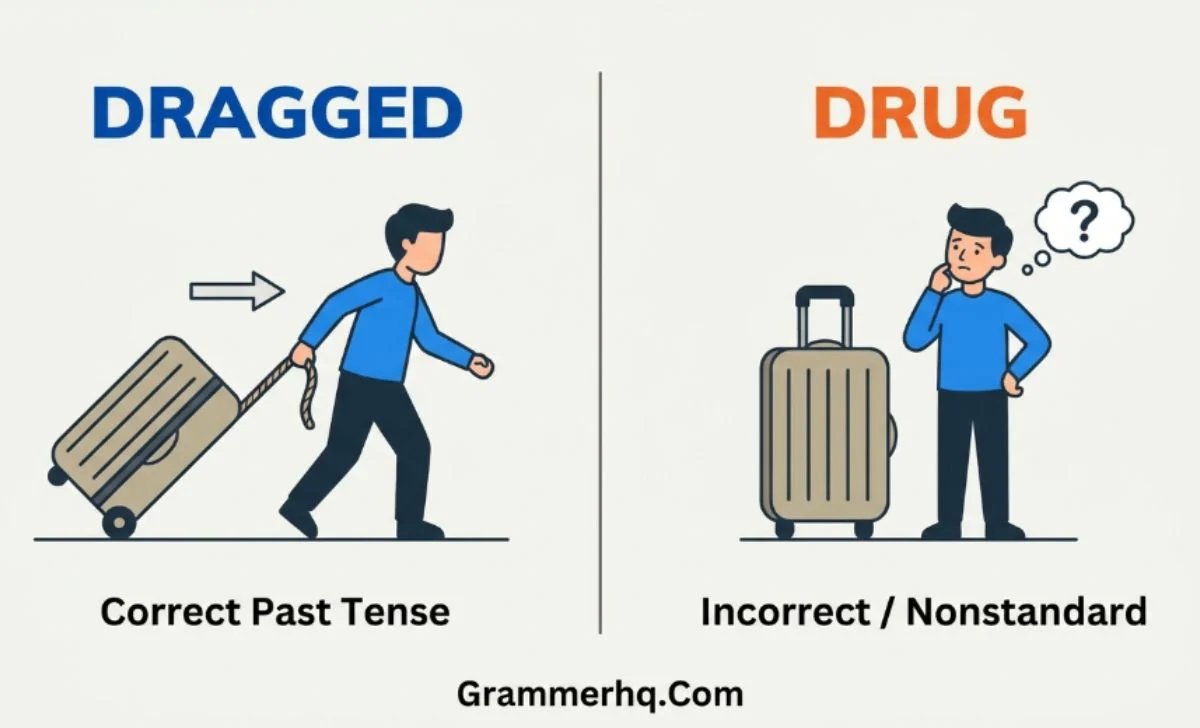
If you are unsure whether the past tense of drag is dragged or drug, you are not alone. The confusion comes from the fact that drug is also used as a regional form of the past tense of drag in some parts of the United States.
For standard English, however, dragged is the form you should use. It is the regular past tense and past participle of drag and works in formal writing, academic English, business communication, and everyday English.
Quick Answer
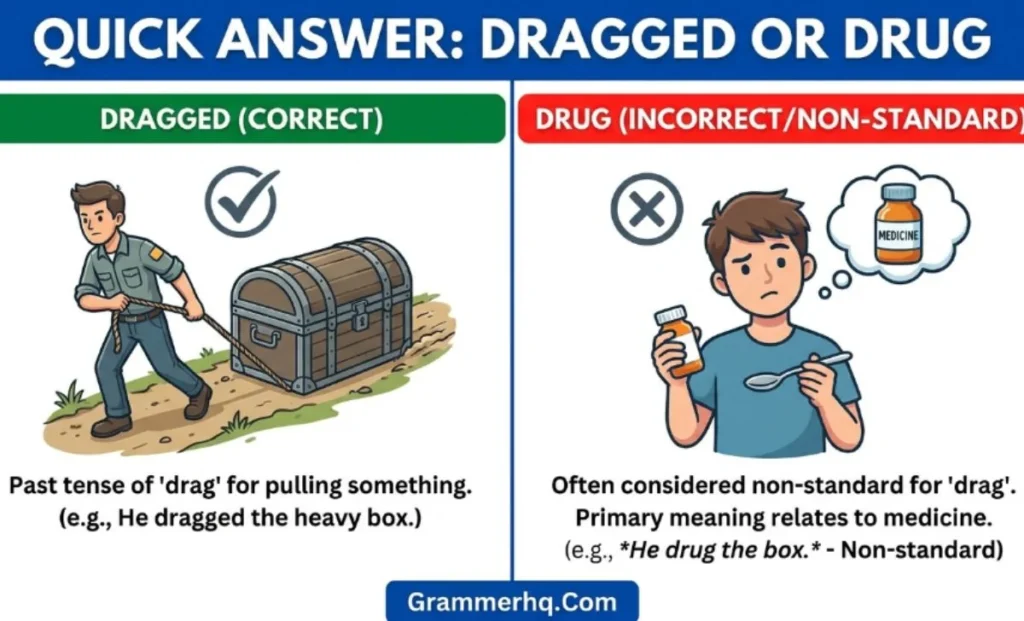
Dragged is the standard past tense and past participle of drag.
- Drag → dragged
- Drag → dragging
- Drag → drags
Drug can also appear as a past form of drag in some American regional dialects, but it is not the standard form used in general English.
So, if you are writing an essay, email, article, school assignment, or professional message, choose “dragged.”
Example: She dragged the heavy suitcase across the floor.
What Does “Dragged” Mean?
Dragged is the past tense of the verb drag, which means to pull something along a surface, usually with some effort.
Examples of “Dragged”
- Tom dragged the chair across the room.
- She dragged the box into the garage.
- The child dragged his backpack behind him.
- We dragged the table outside.
- The dog dragged the blanket across the floor.
The word can also be used figuratively.
The meeting dragged on for nearly three hours.
Here, dragged on means that the meeting continued for a long time and seemed slow or boring.
What Does “Drug” Mean?
The word drug has several meanings, which is one reason it can be confusing.
Most commonly, drug is a noun referring to a substance used as medicine or a substance that affects the body.
The doctor prescribed a new drug.
Drug is also the past tense and past participle of the verb drug, meaning to give someone a drug.
The patient was drugged before the procedure.
However, drug can also be used as a regional or dialectal past form of drag in parts of the United States.
So it would be inaccurate to say that drug is never used in connection with drag. The important distinction is that dragged is the standard form for general English.
Dragged vs. Drug vs. Drugged
These three words are easy to mix up, but they do not normally have the same grammatical role.
| Word | Use | Example |
|---|---|---|
| dragged | Standard past tense of drag | She dragged the bag home. |
| drug | Regional past form of drag in some U.S. dialects | He drug the box across the floor. |
| drugged | Past tense of drug | The doctor drugged the patient. |
The safest rule is simple:
drag → dragged
but
drug → drugged
when drug is being used as the verb meaning to administer a drug.
Why Do Some People Say “Drug” Instead of “Dragged”?
English has many irregular verbs, so speakers sometimes expect familiar patterns to apply to other verbs.
For example:
- dig → dug
- sing → sang
- ring → rang
In some American regional varieties of English, drug developed as a past form of drag. It is therefore heard in certain areas and in informal regional speech.
That does not make it the best choice for standard written English.
If you are learning English or want your writing to be understood as standard English, dragged is the better choice. It avoids regional ambiguity and is accepted across general English usage.
Is “Drug” American or British English?
Dragged is the standard form in both American and British English.
Drug can occur as a regional form in some American varieties, particularly in certain parts of the United States. It should not be treated as the normal British-English past tense of drag.
For international communication, dragged is the clear and reliable choice.
Which One Should You Use in Formal Writing?
Use dragged.
It is the best choice for:
- Academic essays
- School assignments
- Business emails
- Professional writing
- Websites and articles
- Formal reports
- General communication
You may encounter drug in regional speech, dialogue, or writing intended to reproduce a particular dialect. In those situations, the choice can be intentional.
For everyone else, there is no real advantage to choosing drug over dragged.
Common Mistakes With Dragged and Drug
1: Using “drug” as the normal past tense
❌ She drug the suitcase to the car.
✅ She dragged the suitcase to the car.
The first sentence may reflect regional dialect usage, but dragged is the standard form.
2: Confusing “dragged” with “drugged”
❌ He drugged the chair across the room.
✅ He dragged the chair across the room.
Drugged means that someone was given a drug. It does not normally mean that something was pulled along a surface.
Easy Way to Remember Dragged
Think of drag as a regular verb.
Just add -ed:
drag + ed = dragged
Compare:
- drag → dragged
- pull → pulled
- walk → walked
- move → moved
When you are unsure, remember:
Drag is regular, so its standard past tense is dragged.
Drag Verb Forms
Here are the standard forms of drag:
| Verb form | Word |
|---|---|
| Base form | drag |
| Third-person singular | drags |
| Present participle | dragging |
| Simple past | dragged |
| Past participle | dragged |
Example:
She drags the box every morning.
She is dragging it now.
She dragged it yesterday.
She has dragged it several times.
This pattern makes it clear why dragged is the standard past tense.
FAQs
1: Is “drug” the past tense of “drag”?
Dragged is the standard past tense of drag. Drug is also used as a regional or dialectal past form in some American English varieties.
2: Is “dragged” correct?
Yes. Dragged is the standard and widely accepted past tense and past participle of drag.
3: Can “drug” be used instead of “dragged”?
It can occur as a regional dialect form in parts of the United States, but dragged is the better choice for standard English.
4: What is the past participle of “drag”?
The standard past participle is dragged.
The box was dragged across the floor.
5: What is the difference between “dragged” and “drugged”?
Dragged means pulled something along a surface. Drugged means gave someone or something a drug.
6: Should I use “drug” in formal writing?
Generally, no. Use dragged in formal, academic, professional, and standard written English.
Final Verdict:
Dragged is the correct standard form to use in general English.
Drug is not simply a meaningless or misspelled word. It can function as a regional or dialectal past form of drag in some American English varieties. However, that usage is not the standard choice for formal or general-purpose writing.
So when you need the safest answer, remember:
Drag → Dragged
If you are writing for school, work, a website, or an international audience, dragged is the form to choose.
Read More Blogs:
- Worshipped vs Worshiped: Which Spelling Is Correct?
- Women vs Woman: Singular or Plural? Learn the Correct Usage