Have you ever seen someone described as a “clutz” and wondered whether it should actually be spelled “klutz”? The confusion is common because both words sound exactly the same in everyday speech.
The short answer is that klutz is the correct spelling, while clutz is simply a misspelling that appears because of pronunciation and typing mistakes.
In this guide, you’ll learn the correct spelling, pronunciation, word origin, differences between British and American English, common mistakes, memory tricks, and real-life examples so you’ll never confuse clutz and klutz again.
Clutz or Klutz – Quick Answer
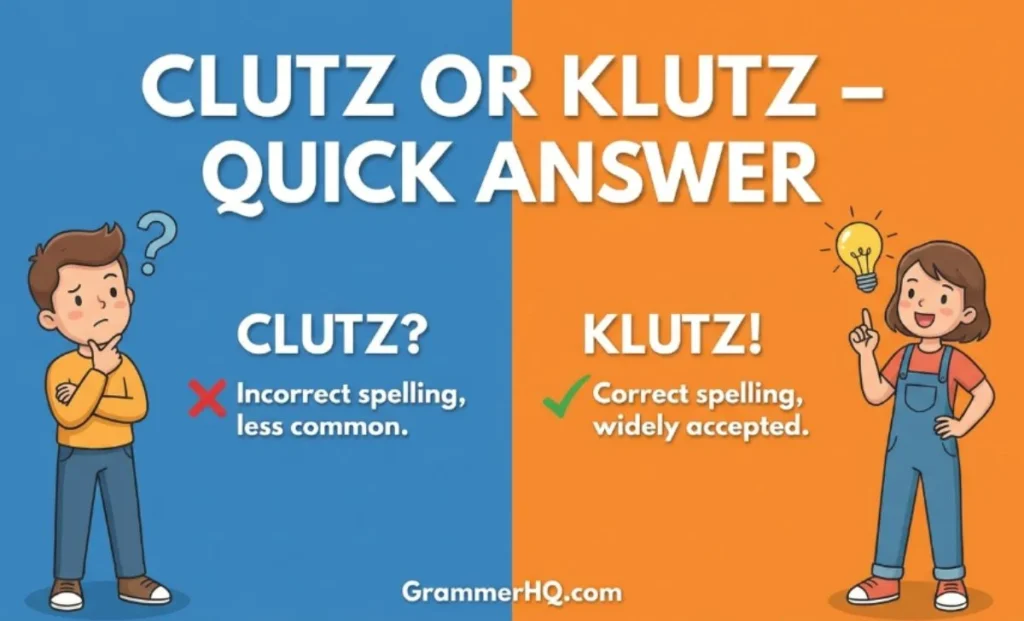
The correct spelling is klutz.
A klutz is an informal English noun that describes a person who is unusually clumsy or often drops, bumps into, or breaks things by accident.
Clutz is not the standard spelling. It is considered a common misspelling of klutz because both words are pronounced the same.
Correct Examples
- Sarah is such a klutz that she spilled coffee on her laptop.
- I felt like a klutz after dropping my phone twice.
- Everyone laughed when Tom admitted he was a complete klutz.
Incorrect Examples
- Sarah is such a clutz that she spilled coffee on her laptop.
- I can be a real clutz sometimes.
Quick Comparison
| Clutz | Klutz |
|---|---|
| ❌ Incorrect spelling | ✅ Correct spelling |
| Common misspelling | Standard English word |
| Not accepted in dictionaries | Listed in major dictionaries |
| Avoid in formal writing | Suitable in both casual and informal writing |
Pronunciation of Clutz or Klutz
Although clutz and klutz look different, they are pronounced exactly the same.
Pronunciation: /klʌts/
It sounds like:
KLUTS
The silent confusion comes from the first letter. English speakers hear the “k” sound, but since many English words begin with C instead of K, people sometimes assume the spelling should be clutz.
For example:
- “He’s such a klutz.”
- “I’m a complete klutz whenever I play sports.”
In spoken English, nobody can tell whether you’re thinking of clutz or klutz because both have the same pronunciation. The difference only appears in writing.
Pronunciation Tips
- The K is pronounced normally.
- The vowel sounds like the u in cup.
- The ending rhymes with nuts, cuts, and huts.
Remember that pronunciation does not determine correct spelling. Even though clutz sounds acceptable, dictionaries recognize only klutz as the standard spelling.
Why People Confuse Clutz or Klutz
Many English learners—and even native speakers—mistakenly write clutz instead of klutz. The confusion happens for several reasons.
They Sound Identical
The biggest reason is pronunciation. Since both spellings sound exactly alike, people often guess the spelling without checking a dictionary.
The Letter “C” Is More Common
Many English words begin with C, so writers naturally assume clutz looks more familiar than klutz.
For example:
- class
- clean
- clock
- clever
Because of these common patterns, clutz may seem correct even though it isn’t.
The Word Comes from Another Language
Klutz entered English from Yiddish, where words often begin with the letter K. Since English borrowed the word with its original spelling, the K remained.
Spellcheck Doesn’t Always Catch It
Some websites, usernames, informal posts, or older online content may use clutz, making people think it’s an acceptable alternative. Major dictionaries, however, recognize klutz as the correct spelling.
Fast Typing Causes Mistakes
Typing quickly can also lead people to replace K with C, especially because both letters can produce a similar sound in certain English words.
Understanding these reasons makes it much easier to remember that klutz is always the correct spelling in standard English.
Easy Trick to Remember Clutz or Klutz
A simple memory trick can help you remember the correct spelling forever.
Think of this sentence:
“Keep the K for Klumsy.”
Although klumsy is not a real English word, using the same K in your memory reminds you that klutz also starts with K.
Another easy trick is to remember where the word came from. Since klutz is borrowed from Yiddish, it kept its original K spelling instead of changing to C.
Memory Trick Examples
- Klutz = Keep the original spelling.
- Klutz = Knocking things over.
- If you think of someone dropping a glass or tripping over their own feet, remember they are a klutz, not a clutz.
The more often you connect the word with the letter K, the easier it becomes to spell correctly.
The Origin of Clutz or Klutz
The word klutz has an interesting history that explains why its spelling looks unusual.
It comes from Yiddish, a language historically spoken by many Ashkenazi Jewish communities in Central and Eastern Europe. In Yiddish, the word klots (or klotz) originally meant a block of wood or a wooden log.
Over time, the meaning changed. Instead of describing an object, people began using it to describe someone who moved like a block of wood—awkward, clumsy, or lacking coordination.
When the word entered American English during the late nineteenth and early twentieth centuries, it kept its original K spelling and gradually became klutz.
Today, klutz is widely used in everyday English to describe someone who is accident-prone or physically clumsy.
Timeline
| Period | Development |
|---|---|
| Yiddish | Klots/Klotz meant “block of wood.” |
| Early American English | The word was borrowed with its original K spelling. |
| Modern English | Klutz became the standard word for a clumsy person. |
Because the word came from another language, its spelling does not follow the patterns of many native English words. That is why people sometimes mistakenly write clutz.
British English vs American English Spelling
Unlike many English words, klutz has the same spelling in both British and American English.
Whether you are writing for readers in the United States, the United Kingdom, Canada, Australia, or New Zealand, klutz remains the correct spelling.
There is no British version that changes K to C.
Comparison Table
| Feature | American English | British English |
|---|---|---|
| Correct spelling | Klutz | Klutz |
| Incorrect spelling | Clutz | Clutz |
| Pronunciation | /klʌts/ | /klʌts/ |
| Meaning | Clumsy person | Clumsy person |
| Formal dictionaries | Accept klutz | Accept klutz |
Other Words That Change Between US and UK
Unlike klutz, these words have different spellings depending on the variety of English.
| American English | British English |
|---|---|
| Color | Colour |
| Favorite | Favourite |
| Organize | Organise |
| Center | Centre |
| Traveling | Travelling |
Klutz is not one of these words. Its spelling stays exactly the same everywhere.
Which Spelling Should You Use?
The answer is simple:
Always use klutz.
Whether you are writing an email, blog post, school assignment, social media caption, business message, or news article, klutz is the correct spelling.
If Your Audience Is in the United States
Use klutz.
If Your Audience Is in the United Kingdom
Use klutz.
If Your Audience Is in Canada, Australia, or New Zealand
Use klutz.
If You Write for an International Audience
Use klutz because it is the standard spelling recognized around the world.
Professional Advice
If you accidentally type clutz, edit it before publishing. Most professional writers, editors, teachers, and dictionaries recognize only klutz as the correct spelling.
Common Mistakes with Clutz or Klutz
Many writers make the same mistakes when using this word. Knowing these errors can help you avoid them.
1: Using Clutz Instead of Klutz
❌ She is such a clutz.
✅ She is such a klutz.
2: Assuming Both Spellings Are Correct
Some people believe clutz is simply the British spelling.
❌ British English uses clutz.
✅ Both British and American English use klutz.
3: Thinking Pronunciation Changes the Spelling
Because both versions sound identical, writers often spell the word based on what they hear.
❌ It sounds like clutz, so that must be correct.
✅ English pronunciation does not always match spelling. The correct written form is klutz.
4: Trusting Informal Online Posts
Social media posts, forums, and usernames sometimes use clutz, but that does not make it standard English.
Always check trusted dictionaries instead of relying on random online usage.
5: Forgetting the Word’s Origin
Many spelling mistakes disappear once you remember that klutz came from Yiddish and kept its original K.
Learning the history of the word makes it much easier to remember the correct spelling.
Clutz or Klutz in Everyday Examples
Understanding how klutz is used in real-life situations makes it easier to remember the correct spelling.
In Everyday Conversation
- Don’t give me that full cup—I’m a klutz.
- Jake is such a klutz that he trips over nothing.
- I felt like a klutz after dropping my keys three times.
In Emails
I accidentally attached the wrong file. Sorry—I was being a bit of a klutz this morning.
On Social Media
- I’m such a klutz 😂 I spilled my coffee all over my keyboard.
- Another day, another klutz moment!
In Formal Writing
Because klutz is an informal word, it is usually better to use alternatives such as clumsy, awkward, or accident-prone in formal or academic writing.
For example:
❌ The employee appeared to be a klutz.
✅ The employee appeared to be clumsy.
Clutz or Klutz – Google Trends & Usage Data
The spelling klutz is overwhelmingly more popular than clutz in online searches, books, newspapers, and dictionaries.
People usually search this topic because they:
- Hear the word in conversation.
- Are unsure whether it starts with C or K.
- Want to know the correct spelling before writing.
- Need the correct form for school or professional writing.
Popular Countries
| Country | Most Common Spelling |
|---|---|
| United States | Klutz |
| United Kingdom | Klutz |
| Canada | Klutz |
| Australia | Klutz |
| New Zealand | Klutz |
Search interest often increases when people encounter the word in books, movies, TV shows, or social media. Since the pronunciation is identical, many users search “clutz or klutz” simply to verify the correct spelling.
Clutz vs Klutz Comparison Table
| Feature | Clutz | Klutz |
|---|---|---|
| Correct spelling | ❌ No | ✅ Yes |
| Dictionary accepted | ❌ No | ✅ Yes |
| Pronunciation | /klʌts/ | /klʌts/ |
| Meaning | Intended to mean a clumsy person | A clumsy or accident-prone person |
| British English | ❌ Not standard | ✅ Standard |
| American English | ❌ Not standard | ✅ Standard |
| Suitable for formal writing | ❌ No | ⚠️ Informal word; use carefully |
| Word origin | None | Yiddish |
FAQ,s
1. Is it clutz or klutz?
Klutz is the correct spelling. Clutz is a common misspelling.
2. What does klutz mean?
A klutz is someone who is naturally clumsy or often has small accidents, such as dropping or bumping into things.
3. Is clutz a real word?
It appears occasionally in informal writing, but major English dictionaries do not recognize it as the standard spelling.
4. Why is klutz spelled with a K?
Because it comes from Yiddish, where the original word began with the letter K.
5. How do you pronounce klutz?
It is pronounced /klʌts/ and rhymes with cuts, nuts, and huts.
6. Is klutz used in British English?
Yes. Both British and American English use the spelling klutz.
7. Is klutz an offensive word?
Usually not. It is generally used as a light-hearted or humorous way to describe someone who is clumsy.
8. What is another word for klutz?
Common alternatives include clumsy person, accident-prone person, bungler, and butterfingers, depending on the context.
9. Can klutz be used in professional writing?
It is best suited to casual or conversational writing. In formal contexts, words like clumsy or awkward are usually more appropriate.
Conclusion
If you’ve been wondering whether to write clutz or klutz, the answer is straightforward: klutz is the correct spelling. Although both versions sound identical, only klutz is recognized by major English dictionaries and accepted in standard English.
The confusion comes from pronunciation and the word’s unusual Yiddish origin, but remembering that it always begins with K will help you avoid mistakes.
Whether you’re writing an email, article, school assignment, or social media post, choose klutz for accurate and professional writing.
Understanding its meaning, history, pronunciation, and correct usage will ensure you never confuse these spellings again.
Read More Bloogs:
- Canvas or Canvass: A Simple Guide to Correct English Usage
- Hoping or Hopeing ,Which Spelling Is Correct?GrammerHQ

Hi, I’m Amelia Parker, a grammar enthusiast and writer at GrammarHQ.com. I specialize in explaining spelling differences, confusing words, and common English mistakes through simple, practical, and easy-to-understand guides.