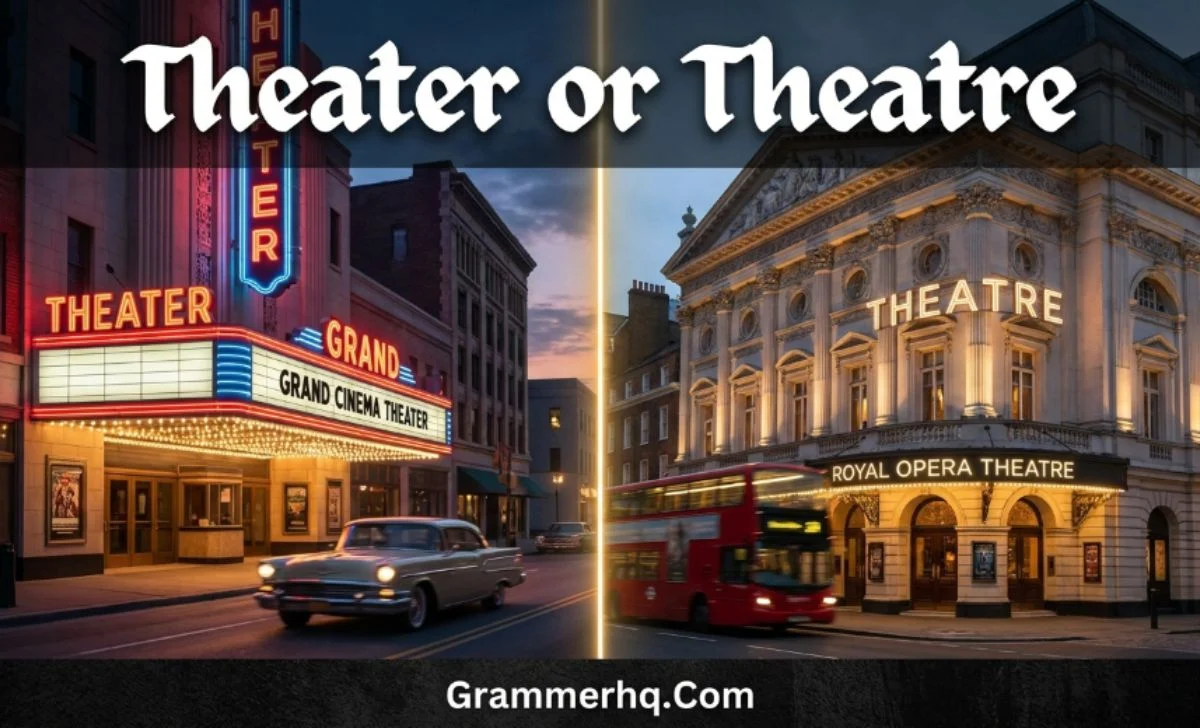
Theater and theatre are both correct English spellings, but they belong to different regional conventions. Theater is the usual spelling in American English, while theatre is preferred in British English.
The difference does not normally change the word’s core meaning: both can describe a place where performances take place and the art or practice of producing dramatic works.
However, real-world usage has a few details worth knowing. Americans commonly say movie theater, while British speakers generally say cinema.
You may also see operating theatre, theatre of war, musical theatre, and official names that retain their original spelling.
Understanding these distinctions helps you choose the right form for your audience without treating one spelling as “more correct” than the other.
Quick Answer
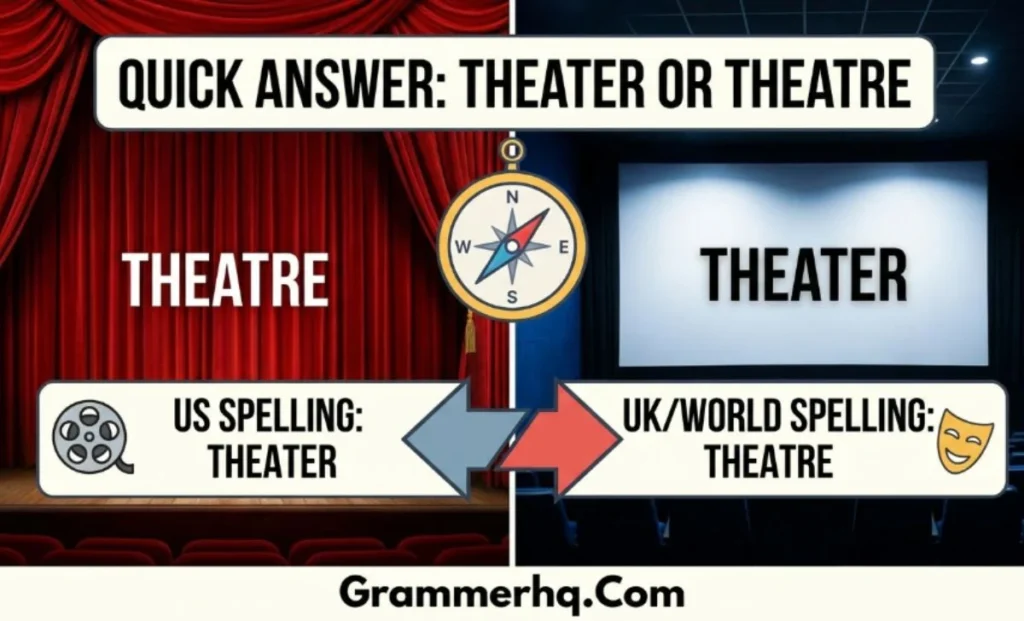
Theater is the standard American English spelling, while theatre is the standard British English spelling.
Both forms can refer to:
- A building or venue for performances
- The art of acting and producing plays
- Dramatic works or performances
- A broader setting or sphere of activity in certain expressions
At a glance
| Question | Answer |
|---|---|
| American English | theater |
| British English | theatre |
| Are both correct? | Yes |
| Do they normally have different meanings? | No |
| US movie venue | movie theater |
| UK movie venue | cinema |
| UK medical term | operating theatre |
| Official name | Keep the established spelling |
Cambridge Dictionary explicitly identifies theater as the US spelling of theatre, while its entries cover both the venue and performing-arts meanings.
The simple rule: Use theater for American English and theatre for British English, then stay consistent.
What Is the Difference Between Theater and Theatre?
The main difference is regional spelling, not a fundamental difference in meaning.
American English generally prefers the spelling theater, with -er at the end.
The theater was crowded on Saturday night.
British English generally prefers theatre, with -re.
The theatre was crowded on Saturday night.
The two sentences communicate essentially the same idea. The spelling tells the reader which regional form of English the writer is following.
This is similar to other American and British spelling differences such as:
- color / colour
- center / centre
- organize / organise
- favorite / favourite
So if your article, essay, or website follows American English, theater will normally fit better. If it follows British English, choose theatre.
What Does Theater or Theatre Mean?
The word has more than one use, which is why a good explanation should go beyond the simple US-versus-UK spelling rule.
1. A Building or Performance Venue
A theater or theatre can be a building, room, or other space where an audience watches a performance.
The new theater has comfortable seats and excellent acoustics.
The historic theatre reopened after renovations.
A venue might host plays, musicals, dance performances, concerts, or other public events.
Cambridge defines the word as a building, room, or structure where people can watch a performance or another activity.
2. The Performing Arts
The word can also describe the art or professional field of writing, acting in, directing, and producing plays.
She studied theater at college.
In British English:
She studied theatre at university.
Here, neither word refers to a particular building. The meaning is closer to the performing art or profession.
3. A Broader Sphere of Action
In some contexts, theater/theatre describes a setting in which important events occur.
For example:
The region became a major theater of military operations.
The expression theater of war refers to an area in which military events or operations take place. Cambridge and Merriam-Webster both recognize this broader sense.
4. Behavior Intended to Create an Effect
There is also a less obvious figurative use.
His apology was mostly theater.
Here, theater means behavior or a display designed to attract attention or create a particular impression rather than a literal performance in a theater building. Cambridge lists this as a separate sense of the word.
Theater vs Theatre in American and British English
The easiest way to remember the spelling is to connect it with the English variety you are writing.
American English: Theater
American English normally uses:
- theater
- theaters
- theater company
- community theater
- musical theater
- movie theater
Examples:
The community theater is looking for volunteers.
She wants to study theater at college.
We found a movie theater near the hotel.
British English: Theatre
British English normally uses:
- theatre
- theatres
- theatre company
- community theatre
- musical theatre
Examples:
The community theatre is looking for volunteers.
She wants to study theatre at university.
The theatre company announced its new production.
The difference is systematic: -er is the normal American form, while -re is the normal British form.
Theater or Theatre Pronunciation
The spelling difference does not mean the words have completely unrelated pronunciations.
Cambridge gives the UK pronunciation as approximately /ˈθɪə.tər/ and the US pronunciation as approximately /ˈθiː.ə.t̬ɚ/.
For English learners, a rough guide is:
- theater → THEE-uh-ter
- theatre → THEE-uh-tuh
Actual pronunciation varies by accent, so the exact sound you hear may differ from these simplified guides.
Is the pronunciation different?
There can be a noticeable regional difference, especially in the final syllable, but the words are clearly related forms. The important distinction for spelling is American theater vs British theatre, not two completely different words.
Movie Theater or Movie Theatre?
This is one of the most useful practical differences to understand.
American English: Movie Theater
In the United States, movie theater is the normal expression for a place where people watch films.
We went to the movie theater after dinner.
The new movie theater has twelve screens.
British English: Cinema
British English generally uses cinema for the same kind of venue.
We went to the cinema after dinner.
The cinema is showing the new film tonight.
So, if you are writing specifically for British readers, cinema will usually sound more natural than movie theatre.
This distinction matters because regional English differences are not always limited to spelling. Sometimes the preferred word itself changes.
Musical Theater or Musical Theatre?
Both spellings are correct.
American English
Musical theater
She has always loved musical theater.
British English
Musical theatre
She has always loved musical theatre.
The term describes a form of performance that combines elements such as acting, dialogue, music, singing, and dance.
The spelling should follow the surrounding variety of English.
For example, an American article might consistently use:
theater, color, center, organize
A British article might use:
theatre, colour, centre, organise
That consistency makes the overall writing style look deliberate rather than accidental.
Operating Theater or Operating Theatre?
This is an excellent example of why theatre does not always mean a place for entertainment.
In American English, the usual term is:
operating room
The patient was taken to the operating room.
In British English, operating theatre is commonly used:
The patient was taken to the operating theatre.
Merriam-Webster identifies theatre as the British form in this medical sense, while Cambridge also lists operating theatre as a UK usage.
So the meaning depends on the context.
Theater of War: What Does It Mean?
Another expression worth knowing is theater of war.
It does not mean a building where a war-related play is performed.
Instead, it refers to an area or region where military operations take place.
For example:
The country became an important theater of war during the conflict.
In American English, theater of operations is also used in military contexts.
This broader meaning is one reason a complete explanation of theater vs theatre should not limit the topic to acting and movie venues.
Is Theatre More Formal Than Theater?
Not as a general rule.
A common misconception is that theatre sounds more sophisticated, artistic, or formal, while theater is somehow less formal.
The real distinction is primarily regional.
For example:
- American formal writing → theater
- British formal writing → theatre
The spelling itself does not automatically determine the level of formality.
However, a specific organization, publication, or venue may deliberately choose theatre as part of its official name or branding. That is a naming choice, not proof that the spelling is inherently more formal.
Can Americans Use Theatre?
Yes.
Although theater is the standard American spelling, theatre can still appear in American English, especially in:
- Official names
- Names of venues
- Company names
- Institutional titles
- Artistic branding
- Historical names
For example, an American venue may officially use Theatre in its name.
That does not mean American English has suddenly adopted British spelling throughout the document. It simply means the proper name has its own established spelling.
What About Official Names?
Official names deserve special attention.
If a theater, theatre company, school, institution, or production has an established name, preserve that spelling.
For example:
The organization is called the National Theatre.
Do not change its name simply because your article follows American English.
The same principle applies to:
- Company names
- Venue names
- Institutional names
- Production titles
- Quoted names
Why does this matter?
Because proper names are identifiers. Changing their spelling can make the name inaccurate.
Think of it this way:
Regional spelling → adapt when appropriate.
Official name → preserve the original form.
That simple distinction prevents many unnecessary corrections.
Theater or Theatre: Common Mistakes
1: Calling One Spelling Incorrect
“Theatre is wrong because theater is the American spelling.”
Incorrect.
Theatre is correct in British English.
Likewise, saying theater is wrong because British English uses theatre is also incorrect.
2: Mixing Styles Without a Reason
For example:
The theatre is in the city center and the theater company performs every Friday.
This may look inconsistent if the writer intends to follow one regional style.
A consistent American version:
The theater is in the city center and the theater company performs every Friday.
A consistent British version:
The theatre is in the city centre and the theatre company performs every Friday.
3: Assuming Theater Means Movies Only
It can refer to live performances, dramatic arts, a venue, and broader contexts.
4: Assuming Theatre Means Plays Only
It can also appear in expressions such as operating theatre and theatre of war.
5: Changing an Official Name
Do not rewrite a proper name just to match your preferred spelling.
6: Using Movie Theatre Automatically for British English
For everyday British English, cinema is generally the more natural term for a movie venue.
Theater or Theatre in Everyday Sentences
Here are natural examples showing how the spelling works in context.
American English Examples
We went to the theater to see a new play.
The movie theater was crowded on Friday night.
She studied theater in college.
The theater company announced its next production.
He wants to become a professional theater director.
The city has invested in a new community theater.
British English Examples
We went to the theatre to see a new play.
She studied theatre at university.
The theatre company announced its next production.
He wants to work in theatre.
The city has invested in a new community theatre.
We went to the cinema to watch the latest film.
These examples show an important point: the spelling changes, but the underlying concept does not suddenly change.
Theater or Theatre: Which One Should You Use?
Use this simple decision guide.
Writing for an American Audience?
Choose theater.
Writing for a British Audience?
Choose theatre.
Writing about a British movie venue?
Cinema is usually the natural choice.
Writing an academic paper?
Follow the required English variety and style guide.
Referring to an official organization?
Keep its established spelling.
Writing for an international audience?
Choose a consistent variety of English and avoid switching between regional forms without a reason.
The goal is not to find one spelling that is “better.” The goal is to choose the form that fits your audience, context, and style.
Is Theater or Theatre More Correct?
Neither spelling is universally more correct.
Theater is the standard American English form, while theatre is the standard British English form. Major dictionaries recognize the relationship between the two forms, and both can be used for the venue and performing-arts senses of the word.
So if someone asks:
“Which one should I use?”
The best answer is:
Use theater for American English and theatre for British English.
Then consider context-specific vocabulary, such as movie theater in American English and cinema in British English.
Where Did Theater and Theatre Come From?
The spelling difference has a long history.
Merriam-Webster traces the word through Middle English theatre and earlier French and Latin forms to Greek theatron, meaning a place for viewing or watching.
The modern American theater and British theatre therefore are not unrelated words invented separately. They developed from the same historical word family.
The modern spelling distinction is largely a matter of regional English convention.
This is why both forms can exist today without one being a spelling mistake.
FAQs
1: Is theater or theatre correct?
Both are correct. Theater is standard American English, while theatre is standard British English.
2: Is theater American or British?
Theater is the standard American spelling.
3: Is theatre British or American?
Theatre is the standard British spelling, although it can appear in American proper names and other specific contexts.
4: Do theater and theatre mean the same thing?
They share the same core meanings, including a performance venue and the performing arts.
5: Is movie theater or movie theatre correct?
Movie theater is standard American English. British English generally uses cinema.
6: Is musical theater or musical theatre correct?
Both are correct. Use musical theater in American English and musical theatre in British English.
7: Is operating theater or operating theatre correct?
American English commonly uses operating room. British English commonly uses operating theatre.
8: Why are theater and theatre spelled differently?
They are regional forms that developed within different English spelling conventions.
9: Is theatre more formal than theater?
Not inherently. The spelling mainly reflects regional usage, although organizations may choose either form for branding or official names.
10: Should I change theatre to theater in an official name?
No. Keep the established spelling of the official name.
11: Can I use both theater and theatre in the same article?
You can when the context requires it—for example, when discussing British and American usage or quoting a proper name. Otherwise, choose one regional style and use it consistently.
Conclusion
Theater or theatre? Both are correct. The main difference is regional: theater is the standard American English spelling, while theatre is preferred in British English.
The two forms share the same core meanings, but related expressions can vary by region. Americans commonly say movie theater, while British speakers generally say cinema;
British English also commonly uses operating theatre where American English prefers operating room.
The safest rule is simple: match your spelling to your audience, follow the appropriate style, and stay consistent. If the word appears in an official name, preserve that name’s established spelling.
American English → theater.
British English → theatre.
Read More Blogs:
- Flier vs Flyer: Which Spelling Is Correct?
- Further or Farther: Difference, Meaning, Usage & Examples

Hi, I’m Amelia Parker, a grammar enthusiast and writer at GrammarHQ.com. I specialize in explaining spelling differences, confusing words, and common English mistakes through simple, practical, and easy-to-understand guides.