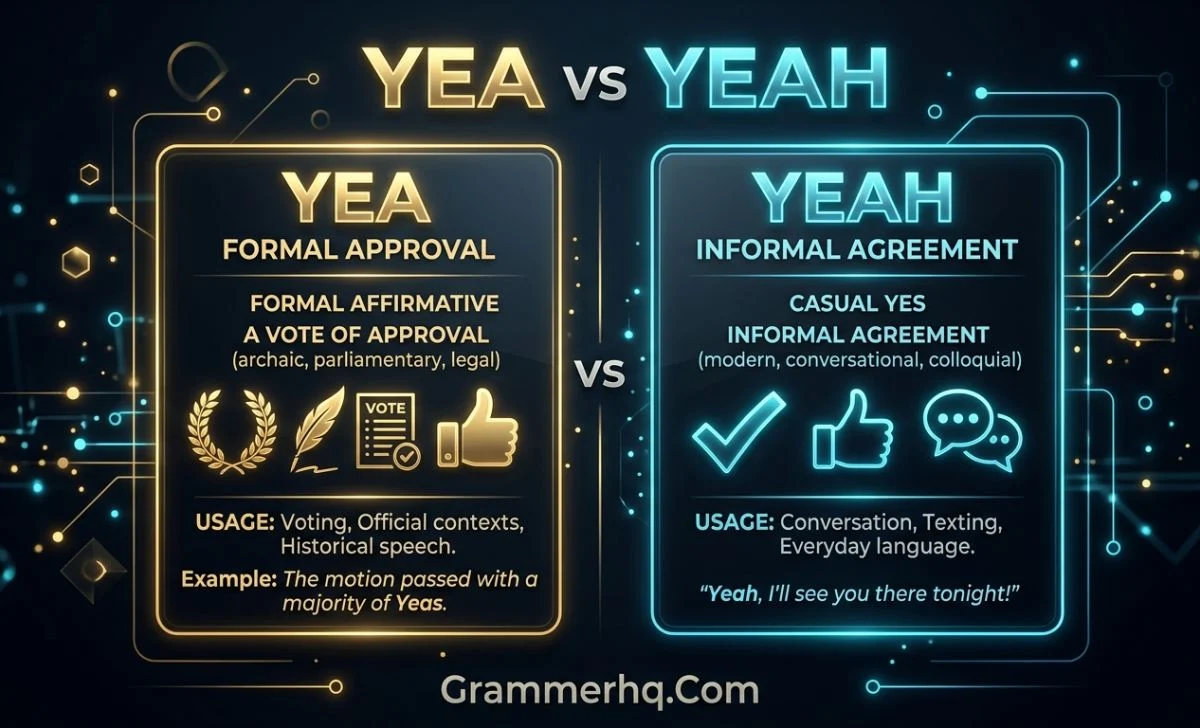
Yea vs Yeah can be confusing because the two words look and sound similar, but they have different uses in modern English.
Yeah is the informal, everyday way to say yes, especially in conversation and casual writing. Yea, however, is mainly used for an affirmative vote, as in “yea or nay.”
It can also mean “yes” or “indeed” in older or literary English.The key difference is that yea is not the formal version of yeah. If you want a formal or neutral alternative to yeah, use yes.
Use yeah for casual agreement, while yea is appropriate when referring to an affirmative vote or an older, traditional style of English.
Yea vs Yeah at a Glance
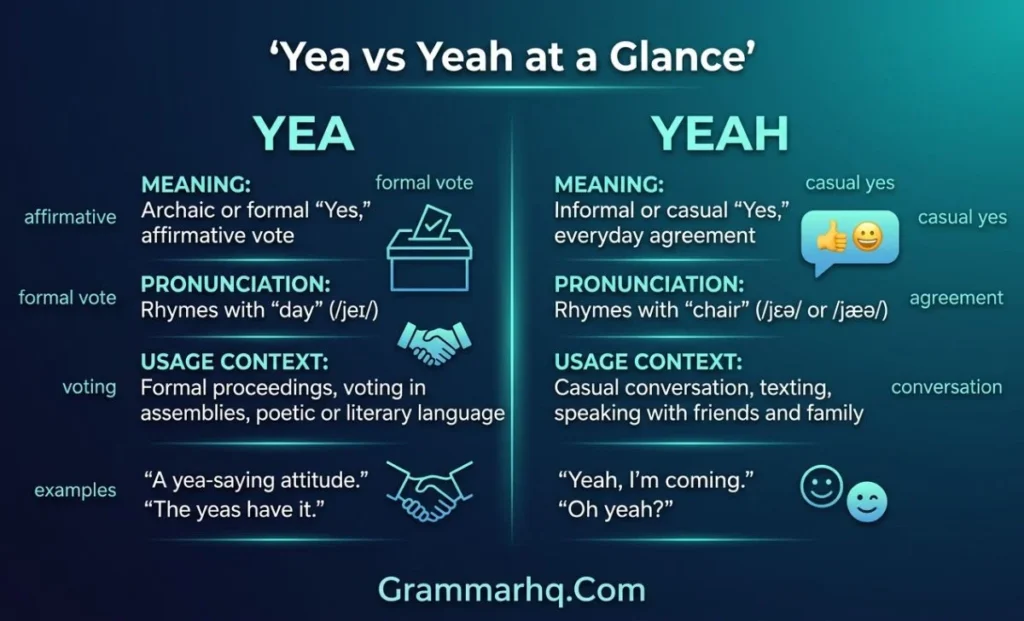
| Word | What it means | Where you usually see it | Pronunciation |
|---|---|---|---|
| Yeah | Informal “yes” | Everyday conversation and casual writing | /jeə/ |
| Yea | An affirmative “yes” or vote | Voting, traditional expressions, older usage | /jeɪ/ |
| Yes | Standard affirmative response | Neutral and formal English | /jes/ |
So, if someone asks:
“Are you coming with us?”
A natural reply is:
Yeah, I’ll be there.
If a committee is voting on a proposal, you might see:
The motion received 24 yeas and 8 nays.
And in a professional email:
Yes, I have reviewed the document.
That difference in context is more useful than thinking of yea and yeah as alternative spellings.
What Does “Yeah” Mean?
Yeah is an informal way of saying yes. It is one of the most common words in everyday spoken English and is also normal in texts, chats, social media, and informal dialogue.
For example:
- “Did you call Sarah?” — “Yeah, I called her this morning.”
- “Are you ready?” — “Yeah, let’s go.”
- “Do you want another cup of coffee?” — “Yeah, please.”
- “Can you help me with this?” — “Yeah, sure.”
The word feels natural because it reflects ordinary conversation. It is less formal than yes, but that does not make it incorrect.
When “Yeah” Sounds Natural
Imagine a friend sends you a message:
“Are you free tonight?”
You might reply:
“Yeah, after 7.”
Writing “Yea, after 7” would look unusual because yea does not normally function as the everyday spelling of yeah.
The same distinction appears in dialogue:
“Yeah, I know what you mean,” Maria said.
Here, yeah helps the dialogue sound conversational and natural.
“Yeah” Can Express More Than Simple Agreement
Context and tone can give yeah additional meanings.
Compare:
“Yeah, that’s right.”
This expresses agreement.
“Yeah, I know.”
This can acknowledge information.
“Yeah, right.”
Depending on tone and context, this can express doubt or sarcasm.
So yeah is not merely a casual spelling of yes. It is an established part of conversational English.
What Does “Yea” Mean?
Yea is a different word with a much narrower role in modern everyday English.
Its most familiar modern use is connected with voting. A yea is an affirmative vote—a vote in favor of a proposal or motion.
For example:
The committee voted yea on the proposal.
Or:
The final count was 31 yeas and 12 nays.
In this context, yea is exactly the word you want. Replacing it with yeah changes the established expression and makes the sentence look incorrect.
Yea Can Also Mean “Yes” or “Indeed”
Yea has another use that comes from older English. It can mean yes, indeed, or something similar in older, traditional, or literary language.
For example:
Yea, the task was more difficult than expected.
This sentence is understandable, but it has an old-fashioned or literary feel. It is not how most people would naturally say “yes” in everyday conversation today.
That distinction matters because saying “yea only means a vote” is also too narrow. Its history and dictionary usage extend beyond voting.
Yea Is Not the Formal Version of Yeah
This is the distinction that causes the most confusion.
It is tempting to think:
yeah = informal yes
yea = formal yes
But that rule is misleading.
A better rule is:
yeah = informal yes
yes = neutral or formal yes
yea = affirmative vote or older/specialized “yes”
Look at these examples:
Yeah, I agree with you.
Natural and informal.
Yes, I agree with you.
Natural and appropriate in formal or professional writing.
Yea, I agree with you.
Possible in an older or deliberately stylized context, but unusual in modern English.
So if you are writing a business email and want to replace yeah with something more professional, choose yes, not yea.
A Real-World Comparison
Suppose your manager asks:
“Have you finished the report?”
In a casual conversation with a coworker:
Yeah, I finished it this morning.
In a professional email:
Yes, I finished the report this morning.
If a committee is voting:
The committee voted yea.
The three words are all related to agreement, but they belong to different contexts.
Yea vs Yeah Pronunciation
The pronunciation provides another useful clue.
Yea is pronounced /jeɪ/, the same basic sound as yay.
Yeah has a different pronunciation, represented by Cambridge as /jeə/.
In simple terms:
Yea → “yay”
Yeah → casual “yes” sound
This is why yea and yay can sound identical even though their meanings are completely different.
For example:
The senator voted yea.
and:
Yay! We won!
The words sound alike, but the first relates to a vote and the second expresses excitement.
Yea vs Yeah vs Yes
When choosing between these words, context matters more than spelling.
Yeah: Casual Agreement
Use yeah in ordinary conversation and informal communication.
“Want to grab lunch?”
“Yeah, sounds good.”
Yes: Standard or Formal Agreement
Use yes when you want a neutral, professional, academic, or formal tone.
Yes, I received your application.
Yes, the data supports this conclusion.
Yea: Affirmative Vote or Older Usage
Use yea when talking about an affirmative vote or when an older/literary style is intentional.
The proposal passed with 40 yeas and 15 nays.
This three-way distinction gives you a much more reliable rule than simply calling yea “formal yeah.”
Yea or Nay: Why Is It “Yea”?
One of the most recognizable places you will encounter yea is the expression:
yea or nay
Here, yea means an affirmative vote, while nay means a negative vote.
You may also see:
- yeas and nays
- vote yea
- a yea vote
- the yeas have it
- yea or nay
For example:
Members were asked to vote yea or nay on the motion.
The clerk recorded 18 yeas and 7 nays.
The phrase belongs to voting language, so yeah is not the appropriate replacement.
❌ yeah or nay
✅ yea or nay
This is one of the easiest contexts in which to remember the difference.
Yea vs Yeah vs Yay
Adding yay to the comparison helps solve another common spelling problem.
| Word | Meaning | Example |
|---|---|---|
| Yea | Affirmative vote; older “yes” | The board voted yea. |
| Yeah | Informal “yes” | Yeah, I’ll come with you. |
| Yay | Excitement or celebration | Yay! We won! |
A simple memory rule is:
Yea = vote
Yeah = yes
Yay = excitement
Consider these three sentences:
The members voted yea.
Yeah, I agree.
Yay! Our team won.
Once you connect each spelling with its context, the difference becomes much easier to remember.
Common Yea and Yeah Mistakes
1: Using “Yea” for Everyday “Yes”
❌ Yea, I’ll call you later.
✅ Yeah, I’ll call you later.
If you mean casual “yes,” yeah is the natural choice.
2: Using “Yea” as a Formal “Yeah”
❌ Yea, I have reviewed your application.
✅ Yes, I have reviewed your application.
Use yes when you want a neutral or formal tone.
3: Using “Yeah” for an Affirmative Vote
❌ The motion received 20 yeah votes.
✅ The motion received 20 yea votes.
Voting terminology uses yea and nay.
4: Confusing “Yea” With “Yay”
❌ Yea! We finally won!
✅ Yay! We finally won!
Use yay for excitement or celebration.
When Should You Use “Yeah”?
Choose yeah when you are writing or reproducing natural, informal speech.
It works well in:
- casual conversations
- text messages
- chats
- informal social posts
- friendly emails
- fictional dialogue
- everyday questions and answers
For example:
“Did you see the new restaurant?”
“Yeah, I went there last weekend.”
You generally would not choose yeah in a formal academic sentence simply because yes is more appropriate for that register.
When Should You Use “Yea”?
Choose yea when the context involves:
- an affirmative vote
- “yea or nay”
- “yeas and nays”
- a yea vote
- older or literary English
Examples:
The council voted yea on the measure.
The final tally showed 27 yeas and 14 nays.
The historical text uses “yea” to mean “indeed.”
Outside these contexts, yea can sound noticeably old-fashioned to a modern reader.
Yea or Yeah in Formal Writing
If you are writing a:
- business email
- academic paper
- professional report
- application
- official response
- formal letter
and you simply need to express agreement, yes is normally the clearest choice.
For example:
Yes, I agree with the proposed changes.
That is neutral and professional.
But formal writing does not mean you should automatically use yea.
If you are documenting an actual vote, yea remains appropriate:
The committee recorded 22 yeas and 5 nays.
And if you are reproducing someone’s casual speech, yeah can be perfectly appropriate:
“Yeah, I’ll send it tonight,” he said.
The right word depends on what you are saying and why you are saying it, not simply whether the sentence is formal.
FAQs
Is “yea” the same as “yeah”?
No. Yeah is the common informal word for “yes.” Yea is mainly associated with affirmative votes and also has older or specialized uses.
Is “yeah” a correct English word?
Yes. Yeah is a standard English word, but it is informal and is most natural in everyday conversation and casual writing.
Is “yea” a formal word?
Not exactly. It can appear in formal contexts, especially voting, but it is not simply the formal equivalent of yeah. For a formal version of yeah, yes is normally the better choice.
Does “yea” mean “yes”?
Yes. In older or specialized usage, yea can mean “yes” or “indeed.” It is also used for an affirmative vote.
Is it “yea or nay” or “yeah or nay”?
The established expression is yea or nay. It refers to an affirmative or negative response, particularly in voting.
Is “yea” pronounced like “yay”?
Yes. Yea is pronounced like yay, while yeah has a different pronunciation.
What is the difference between yea, yeah, and yay?
Yea is mainly used for an affirmative vote or in older usage, yeah means informal “yes,” and yay expresses excitement or celebration.
Conclusion
Yea and yeah are both correct English words, but they belong to different contexts. Yeah is the natural informal form of “yes” in everyday English.
Yea is most commonly connected with affirmative voting, as in “yea or nay,” and can also appear in older or literary language. If you simply want a formal alternative to yeah, use yes.
Remember:
Yeah = casual yes
Yes = neutral/formal yes
Yea = affirmative vote or older/specialized “yes”
Yay = excitement
Read More Blogs
- Jibe vs Jive: What’s the Difference?
- Paid or Payed: Which Is Correct? Meaning, Rules & Examples
- Segue vs Segway: Which Word Is Correct?