If you’ve ever typed “I payed the bill” and stopped to wonder whether it should be paid, you’re not alone. The confusion makes sense: pay looks like a regular verb, so payed seems like the natural past-tense spelling.
But in ordinary English, the correct form is paid.
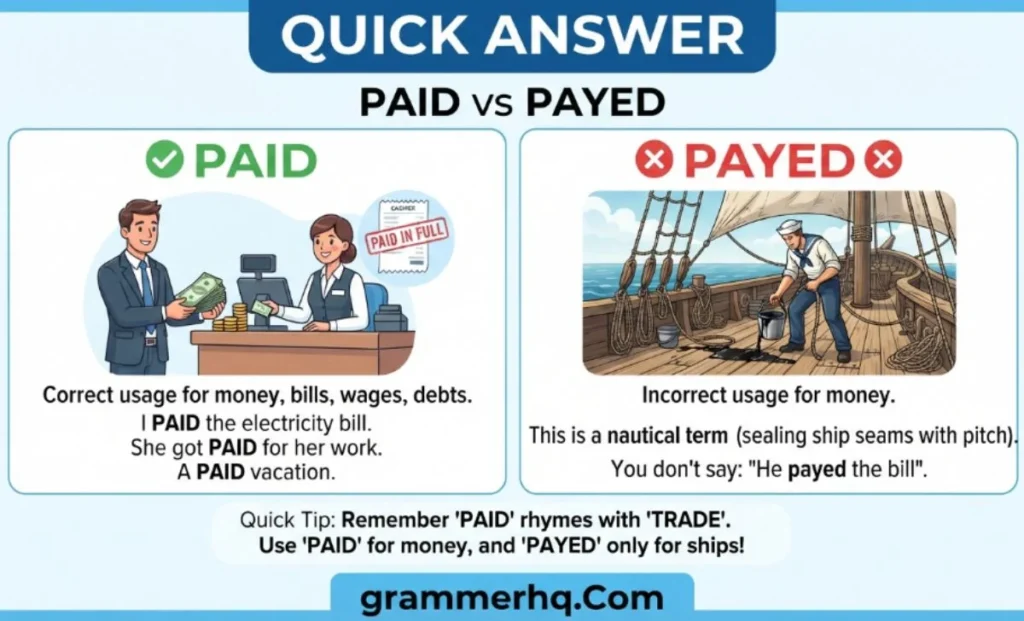
Paid is the past tense and past participle of pay. It works for money, bills, salaries, attention, respect, visits, consequences, and many common expressions.
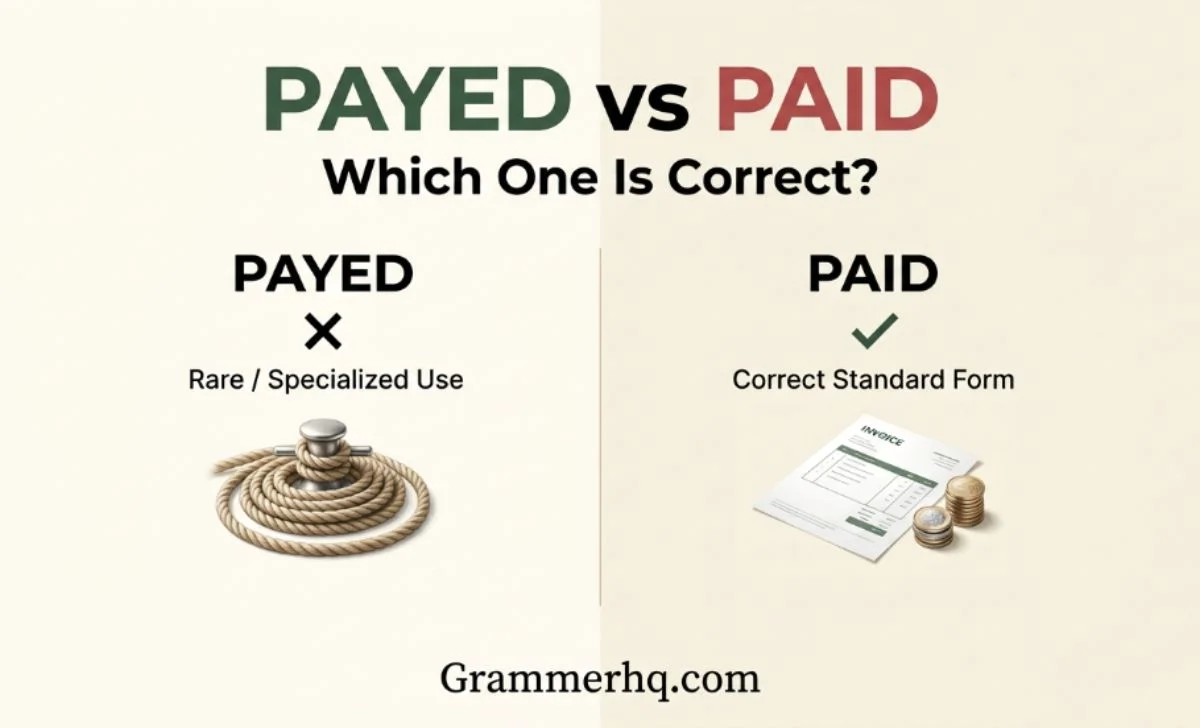
Payed is a real word, but it belongs to specialized nautical usage rather than everyday English. Cambridge lists paid | paid as the past forms of pay and specifically identifies payed as an incorrect ordinary past form.
Quick Answer
| Word | What it is | Where you use it | Example |
|---|---|---|---|
| paid | Past tense and past participle of pay | Normal English | I paid the bill. |
| payed | Rare specialized form | Mainly nautical terminology | The vessel was payed with waterproof material. |
The quick rule
Use “paid” for ordinary English. “Payed” is reserved for specific nautical meanings.
So if you’re writing an email, article, school assignment, text message, business report, or social post, paid is almost certainly the form you need.
What Does “Paid” Mean?
Paid is the past tense and past participle of the irregular verb pay. It is pronounced /peɪd/.
The most familiar meaning is financial: giving money for something, settling a bill, or compensating someone for work or services.
For example:
- I paid the electricity bill this morning.
- Maria paid for the groceries.
- The company paid its employees on Friday.
- We have already paid the invoice.
- He paid the full amount by credit card.
Cambridge gives the standard verb pattern as pay → paid → paid.
Paid Is Not Just About Money
This is where the rule becomes more useful.
You may think paid only belongs in sentences involving money, but pay has several non-financial meanings in everyday English. That’s why these expressions are also spelled paid:
- paid attention
- paid respect
- paid a visit
- paid a compliment
- paid tribute
- paid the price
- paid the penalty
For example:
The students paid attention during the safety demonstration.
We paid our respects at the memorial.
Her hard work finally paid off.
None of these sentences is about simply handing over money. Yet paid is still the correct form because each expression comes from the ordinary verb pay.
Cambridge’s dictionary and grammar resources document several of these broader uses of pay, including pay attention, pay tribute, and pay your respects.
What Does “Payed” Mean?
Here’s the part that causes most of the confusion:
Payed is a real word.
It isn’t simply a typo that somehow made its way into dictionaries. However, it is rare and specialized, and you normally encounter it in nautical or maritime writing.
That distinction matters because saying “payed is never a word” is too absolute.
In specialized nautical terminology, payed can describe treating or coating part of a ship with a waterproof substance. Historical and technical writing may therefore contain sentences such as:
The ship’s seams were payed with a waterproof compound.
That’s very different from:
We paid for the ship.
The first sentence uses a specialized maritime sense. The second uses the ordinary verb pay.
What About “Payed Out” a Rope?
This is a particularly tricky point.
You may come across payed out in older or specialized nautical writing when describing rope or cable being released. However, you should not turn that into a blanket rule that “nautical = payed.”
Modern dictionary usage also gives paid for the phrasal verb pay out, including the nautical sense of releasing rope or cable in a controlled way. Cambridge, for example, lists the form as paid | paid for pay something out.
So the safest lesson is:
“Payed” exists in specialized nautical vocabulary, but not every nautical use of “pay” automatically requires “payed.”
For ordinary modern writing, paid remains the correct choice.
Why Is It “Paid” Instead of “Payed”?
Because pay is an irregular verb.
With many regular verbs, the past tense is formed by adding -ed:
- walk → walked
- clean → cleaned
- work → worked
- call → called
That makes pay → payed look logical.
But English has plenty of irregular verb forms that don’t follow that simple pattern. For pay, the standard form is:
pay → paid → paid
So:
I pay the bill every month.
I paid the bill yesterday.
I have paid the bill already.
Cambridge’s grammar guide specifically lists pay → paid as an exception to the normal spelling pattern and says that the past simple and past participle are spelled with ai, not ay.
Paid or Payed: Real-Life Examples
The easiest way to understand the difference is to see it in context.
| Example | Correct form | Reason |
|---|---|---|
| I _ the rent yesterday. | paid | Ordinary financial payment |
| She has _ the invoice. | paid | Past participle |
| We _ for the tickets online. | paid | Payment for a purchase |
| He _ attention to the warning. | paid | Common expression |
| They _ their respects at the memorial. | paid | Established expression |
| Her extra effort _ off. | paid | Idiom |
| I _ my friend back last week. | paid | Returned money |
| The ship’s seams were _ with waterproof material. | payed | Specialized nautical usage |
The pattern is much clearer when you stop thinking “money = paid” and instead think “ordinary verb pay = paid.”
Common Expressions That Always Use “Paid”
A good way to avoid payed is to learn the common expressions in which paid naturally appears.
Paid Attention
Paid attention means gave something your focus or notice.
Please pay attention to the instructions.
In the past:
Please note: The students paid attention throughout the lesson.
Not:
❌ The students payed attention.
Paid Off
Paid off can mean that effort produced a successful result:
All those late nights studying paid off when she passed the exam.
It can also mean that a debt was completely settled:
He finally paid off his car loan.
Cambridge documents both meanings of pay off and uses paid for its past form.
Paid Back
Paid back means returned money that was owed:
I paid back the money I borrowed from my brother.
She promised to pay me back next Friday.
The past form is paid back, not payed back.
Paid For
Use paid for when someone has given money for a product, service, or expense:
I paid for the hotel room online.
My company paid for the training course.
This is one of the most common everyday uses of paid.
Paid in Full
This means that the entire amount owed has been settled:
Your account has been paid in full.
Paid a Visit
Use paid a visit when talking about visiting someone:
We paid a visit to our former teacher.
Paid the Price
This expression can be literal or figurative:
The business ignored the warning signs and eventually paid the price.
Again, paid is correct even though the sentence may have nothing to do with an actual financial payment.
Common Mistakes With Paid and Payed
“I Payed the Bill”
❌ I payed the bill yesterday.
✅ I paid the bill yesterday.
The sentence describes an ordinary payment, so the correct form is paid.
“She Payed Attention”
❌ She payed attention during the presentation.
✅ She paid attention during the presentation.
The established expression is pay attention, whose past form is paid attention.
“Have You Payed?”
❌ Have you payed the invoice?
✅ Have you paid the invoice?
After have, you need the past participle: paid.
“Did You Paid?”
This mistake is slightly different.
❌ Did you paid the bill?
✅ Did you pay the bill?
Why?
Because did already marks the past tense. The main verb stays in its base form:
did + pay
not:
did + paid
Compare:
I paid the bill yesterday.
but:
Did you pay the bill yesterday?
This small distinction is useful far beyond pay: it is a general rule for questions and negatives formed with did.
Is “Payed” a Real Word?
Yes—but that doesn’t make it interchangeable with “paid.”
Payed has legitimate specialized uses, especially in nautical terminology. In ordinary English, however, the standard past tense and past participle are paid. Cambridge’s grammar guidance explicitly says not to use payed as the ordinary past form of pay.
So these two statements can both be true:
“Payed” is a real word.
“Paid” is the correct word in almost every everyday sentence.
That’s the distinction worth remembering.
Paid or Payed in American and British English
There is no ordinary US-versus-UK spelling difference here.
Both varieties use:
pay → paid → paid
For example:
American English: I paid the bill.
British English: I paid the bill.
The specialized word payed does not become the standard everyday spelling in either variety.
Why Do People Write “Payed”?
The mistake is easy to understand.
English learners are accustomed to regular patterns such as:
- play → played
- stay → stayed
- delay → delayed
- enjoy → enjoyed
So when they see pay, they may naturally create payed.
There is another complication: paid and payed are pronounced alike in ordinary speech. If you’ve only heard the word, pronunciation gives you no clue about which spelling to choose.
And because payed actually exists in specialized vocabulary, a spell-checker may not always treat it as an invented word.
The better question is therefore not:
“Does payed exist?”
It does.
The better question is:
“Which form fits the meaning of my sentence?”
For everyday English, that answer is almost always paid.
An Easy Way to Remember Paid or Payed
Don’t memorize a complicated rule.
Remember this:
Everyday pay → PAID.
Specialized nautical use → PAYED may appear.
For example:
Paid
- paid the bill
- paid the rent
- paid for dinner
- paid attention
- paid respect
- paid a visit
- paid the price
- paid back a loan
- paid off a debt
Payed
- specialized maritime terminology, especially older or technical writing
If you’re writing something ordinary and you’re wondering whether to type paid or payed, choose paid.
Pay, Pays, Paying, Paid: The Complete Verb Pattern
The ordinary verb forms are straightforward once you see them together:
| Form | Example |
|---|---|
| pay | I pay my bills online. |
| pays | She pays her rent on time. |
| paying | They are paying for dinner. |
| paid | We paid yesterday. |
| paid | We have paid already. |
The key point is that paid serves as both the past simple and past participle. Cambridge lists exactly this pattern: paid | paid.
So for normal English, think:
pay → pays → paying → paid → paid
Paid or Payed: Which One Should You Use?
Here’s the practical decision:
Use paid for:
- bills
- rent
- salaries
- wages
- invoices
- taxes
- purchases
- services
- attention
- respect
- compliments
- visits
- consequences
- paid for
- paid back
- paid off
- paid in full
Use payed only when:
- you’re dealing with a specialized nautical meaning, and
- the context specifically supports that technical usage.
If you’re writing a normal sentence such as:
I _ the electricity bill yesterday.
the answer is paid.
If you’re writing:
She _ attention to the safety instructions.
the answer is also paid.
If you’re writing about a historical or technical shipbuilding process, payed may be appropriate—but that’s a very different use of the verb.
FAQs
1: Is “payed” a correct word?
Yes. Payed is a legitimate but rare form found in specialized nautical usage. It is not the normal past tense of pay.
2: Is “paid” the past tense of “pay”?
Yes. Paid is both the past simple and past participle of pay.
3: Is it “paid attention” or “payed attention”?
It is paid attention.
She paid attention to every detail.
4: Is it “paid off” or “payed off”?
Use paid off in ordinary English.
All her hard work paid off.
He paid off the loan.
Cambridge gives paid as the past form of pay off.
5: Is it “paid for” or “payed for”?
Use paid for.
We paid for the tickets online.
6: Why is “payed” in some dictionaries?
Because it has genuine specialized meanings. It is not simply a misspelling; it can occur in nautical terminology. However, that does not make it an alternative spelling of ordinary paid.
7: What is the past participle of “pay”?
The past participle is paid.
I have paid the invoice.
8: Is it “Did you pay” or “Did you paid”?
The correct form is Did you pay?
❌ Did you paid the rent?
✅ Did you pay the rent?
After did, use the base form pay.
Final Answer
If you’re talking about an ordinary payment or about attention, respect, a visit, a compliment, a consequence, a debt, or one of the many everyday expressions built with pay use paid.
Payed is a real word, but it belongs to a much narrower area of specialized nautical vocabulary.
So when you’re choosing between the two, remember:
I paid the bill. ✅
She paid attention. ✅
We paid for dinner. ✅
His hard work paid off. ✅
The ship was payed with waterproof material. ✅ specialized nautical use
For practically every normal sentence you’ll write, paid is the right choice.
Read More Blogs

Hi, I’m Amelia Parker, a grammar enthusiast and writer at GrammarHQ.com. I specialize in explaining spelling differences, confusing words, and common English mistakes through simple, practical, and easy-to-understand guides.