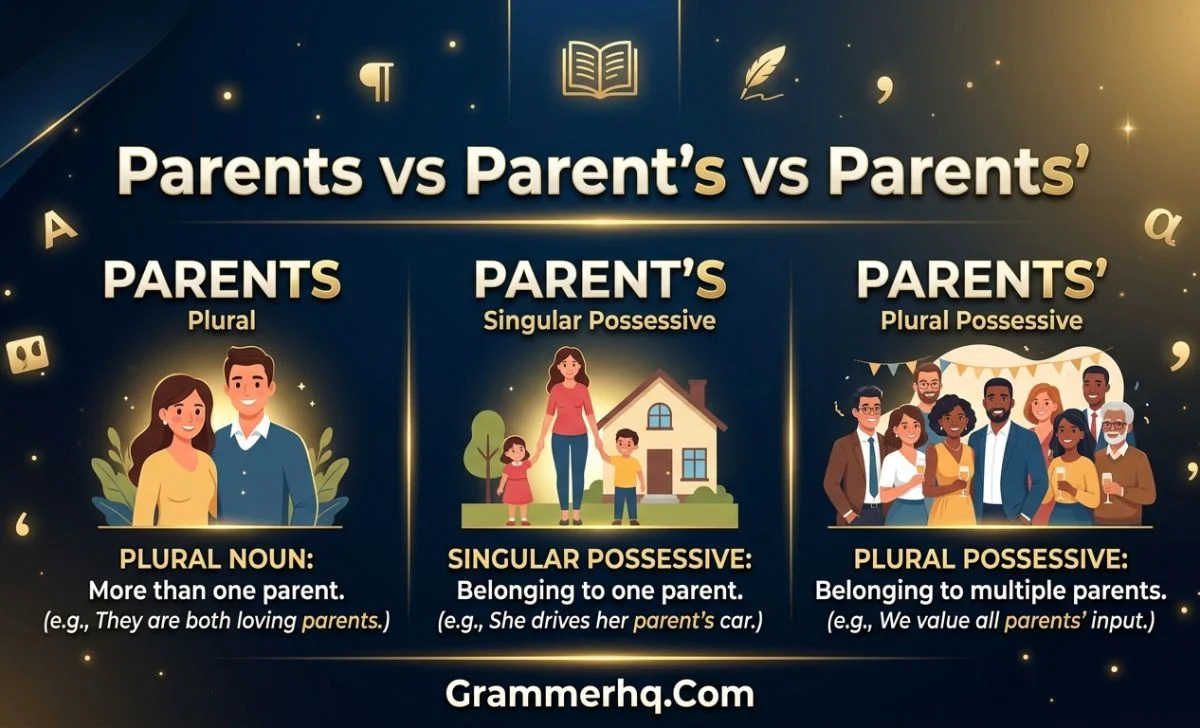
Parents vs parent’s can be confusing because the two forms look similar but have different meanings and grammatical jobs. The third form, parents’, adds another apostrophe rule that changes the meaning again.
Parents is the plural form of parent, parent’s shows possession or a relationship involving one parent, and parents’ shows possession or a relationship involving two or more parents.
The easiest way to choose the correct form is to ask two questions: Are you talking about one parent or more than one, and are you showing possession?
For example, “My parents are teachers” refers to more than one parent, while “My parent’s car” belongs to one parent and “my parents’ car” belongs to multiple parents.
Quick Answer
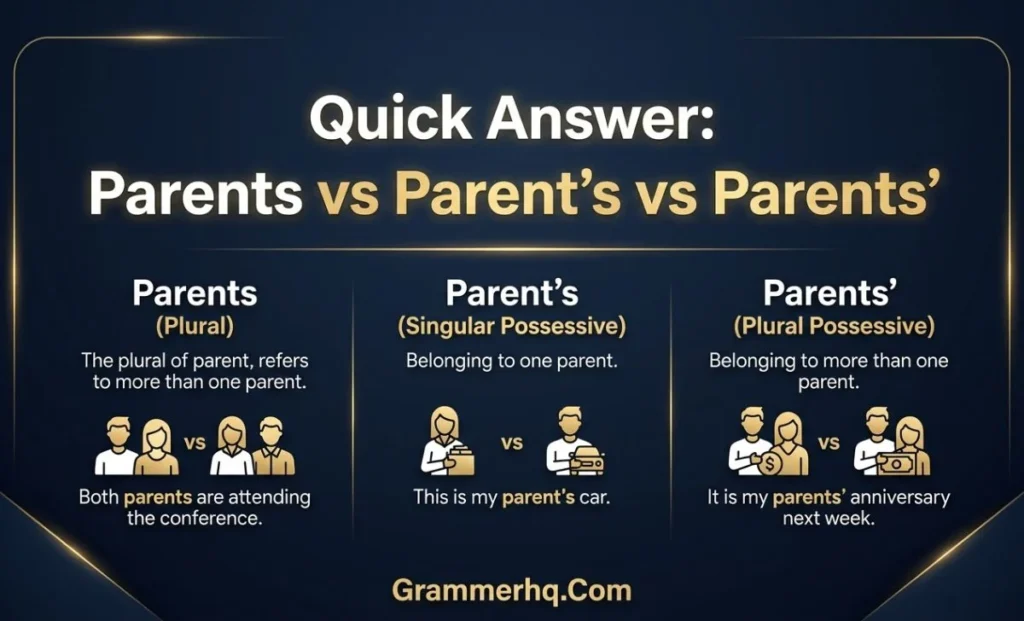
| Form | Meaning | Example |
|---|---|---|
| parents | More than one parent; no possession | My parents are home. |
| parent’s | One parent + possession or association | My parent’s car is outside. |
| parents’ | More than one parent + possession or association | My parents’ car is outside. |
Easy rule:
parents = plural
parent’s = one parent + possession
parents’ = multiple parents + possession
Parents vs Parent’s vs Parents’: The Basic Difference
The easiest way to understand these forms is to separate number from possession.
First, decide how many parents you mean:
- One parent → parent
- More than one parent → parents
Then ask whether the sentence shows possession or a close relationship:
- No possession → parent / parents
- Possession or association → parent’s / parents’
This gives you four useful forms:
| Form | Number | Possessive? | Example |
|---|---|---|---|
| parent | One | No | The parent called. |
| parent’s | One | Yes | The parent’s bag is here. |
| parents | More than one | No | The parents called. |
| parents’ | More than one | Yes | The parents’ bags are here. |
This same pattern works with many regular nouns in English.
Parents = Plural, Not Possessive
Parents is simply the plural of parent. It refers to two or more parents and does not need an apostrophe.
Examples:
- My parents live nearby.
- Her parents attended the ceremony.
- The parents arrived early.
- Many parents joined the school event.
The apostrophe should not be added just because a word is plural. Apostrophes have other grammatical jobs, including forming possessives.
Parent’s = Singular Possessive
Parent’s means that something belongs to, comes from, or is closely associated with one parent.
The structure is:
parent + ’s = parent’s
Examples:
- The parent’s signature is required.
- I found the parent’s phone on the desk.
- The parent’s decision surprised the teacher.
- We discussed the parent’s concern.
So, if the sentence involves one parent and a possessive relationship, parent’s is the correct form.
Parents’ = Plural Possessive
Parents’ is used when something belongs to, comes from, or is associated with more than one parent.
The structure is:
parents + ’ = parents’
Examples:
- We visited my parents’ house.
- The school values the parents’ feedback.
- Both parents’ signatures are required.
- The parents’ meeting starts at 6 p.m.
Because parents already ends in s, you add only an apostrophe to make the regular plural possessive. This is the standard pattern for plural nouns ending in s.
The Apostrophe Rule Behind Parent’s and Parents’
The apostrophe is not simply decoration. Its position tells the reader whether the possessive noun is singular or plural.
Singular: Add ’s
For a singular noun such as parent, add ’s:
parent → parent’s
Examples:
- child → child’s
- teacher → teacher’s
- student → student’s
- parent → parent’s
So:
The parent’s name is on the form.
The sentence refers to one parent.
Plural Ending in S: Add Only the Apostrophe
When a regular plural already ends in s, place the apostrophe after the s:
parents → parents’
Examples:
- teachers → teachers’
- students → students’
- parents → parents’
- players → players’
So:
The parents’ names are on the form.
The sentence refers to multiple parents.
This singular-versus-plural possessive distinction is a standard English apostrophe rule.
Why Is “Parents’s” Wrong?
A common mistake is adding ’s to parents:
parents’s ❌
The correct form is:
parents’ ✅
Why? Because parents is already a regular plural ending in s. Its possessive form is made by adding the apostrophe after the existing s.
The pattern is:
parent → parent’s
parents → parents’
Parents vs Parent’s vs Parents’: Real-Life Examples
The difference becomes much easier when you see the forms in everyday situations.
School Forms
The parent’s signature is required.
This means one parent needs to provide a signature.
Both parents’ signatures are required.
This means signatures from multiple parents are required.
Family Conversation
My parents are visiting this weekend.
Here, parents is simply plural.
We are staying at my parents’ house.
Here, parents’ shows that the house is associated with the parents.
Work or School Communication
The parent’s concern was discussed with the teacher.
One parent has a concern.
The parents’ concerns were discussed at the meeting.
Multiple parents have concerns.
Notice how the apostrophe position helps the reader understand the number of people involved.
Parent’s House vs Parents’ House
These two phrases can both be correct, but they do not necessarily mean the same thing.
Parent’s house
We went to my parent’s house.
This points to the house of one parent.
Parents’ house
We went to my parents’ house.
This normally refers to the house associated with multiple parents, often both parents.
The difference is only one apostrophe, but that apostrophe carries useful grammatical information.
Parent’s Signature vs Parents’ Signatures
This is another common situation, especially in school documents.
A parent’s signature is required.
One parent must provide a signature.
The parents’ signatures are required.
Multiple parents must provide signatures.
The noun signature does not determine the apostrophe. The important question is how many parents the possessive form refers to.
Parents’ Meeting: Why Is the Apostrophe There?
You may also see phrases such as parents’ meeting, parents’ evening, or parents’ association.
Here, the apostrophe indicates a connection with parents rather than necessarily describing literal ownership.
For example:
The parents’ meeting starts at 6 p.m.
The meeting is associated with or intended for parents.
English possessives can express a close relationship or association, not only physical ownership. Cambridge gives examples such as a teachers’ conference, where the conference is connected with teachers.
That is why thinking of the apostrophe only as meaning “owns” can sometimes be too narrow.
Common Mistakes With Parents, Parent’s, and Parents’
1. Using Parent’s as a Plural
My parent’s are here. ❌
My parents are here. ✅
The sentence refers to more than one parent and does not show possession.
2. Leaving Out the Apostrophe
My parents house is nearby. ❌
My parents’ house is nearby. ✅
The house is associated with multiple parents, so the plural possessive parents’ is needed.
3. Using Parent’s for Multiple Parents
The parent’s opinions were recorded. ❌
The parents’ opinions were recorded. ✅
If the opinions belong to multiple parents, use parents’.
4. Writing Parents’s
The parents’s meeting is tomorrow. ❌
The parents’ meeting is tomorrow. ✅
The plural parents already ends in s, so only an apostrophe is added.
5. Adding an Apostrophe Just to Make a Plural
Two parent’s attended. ❌
Two parents attended. ✅
Apostrophes are not normally used to form ordinary noun plurals.
How to Choose the Correct Form in 5 Seconds
When you’re unsure, use this two-question test.
1: How many parents?
One?
Use parent.
More than one?
Use parents.
2: Are you showing possession or association?
No?
Use parent or parents.
Yes?
Use parent’s or parents’.
So the final formula is:
One + no possession = parent
One + possession = parent’s
More than one + no possession = parents
More than one + possession = parents’
Once you separate number from possession, the apostrophe becomes much easier to place.
Parents vs Parent’s vs Parents’: Quick Comparison
| Form | What it tells you | Example |
|---|---|---|
| parent | One parent | A parent called the school. |
| parent’s | One parent + possession/association | The parent’s phone rang. |
| parents | More than one parent | The parents called the school. |
| parents’ | More than one parent + possession/association | The parents’ phones rang. |
A Simple Memory Trick
Think of the s and apostrophe as clues:
parent’s → one parent
parents’ → multiple parents
And remember:
The apostrophe does not make “parents” plural. The word is already plural.
FAQs
Is “parents” correct without an apostrophe?
Yes. Parents is the normal plural form of parent. Use it when referring to more than one parent without showing possession.
Is “parent’s” singular or plural?
Parent’s is the singular possessive form. It normally refers to something belonging to or associated with one parent.
Is “parents’” singular or plural?
Parents’ is the plural possessive form. It refers to something belonging to or associated with two or more parents.
What is the difference between parent’s and parents’?
Parent’s refers to one parent, while parents’ refers to multiple parents.
The parent’s car = one parent
The parents’ car = multiple parents
Is “parents’s” correct?
No, not as the regular possessive form of parents. Because parents already ends in s, the standard plural possessive is parents’.
Should I write “parents” or “parent’s”?
It depends on the sentence.
My parents are teachers. ✅
Here, parents is plural.
My parent’s job is demanding. ✅
Here, parent’s is singular possessive.
Neither form is automatically correct without context.
Should I write “parents” or “parents’”?
Both can be correct.
The parents arrived.
The parents’ cars were outside.
Use parents for the plural noun and parents’ for the plural possessive.
Is there a US vs UK difference?
No significant difference exists in the basic apostrophe rule for these forms. Parent’s is the singular possessive, and parents’ is the regular plural possessive in both American and British English.
Conclusion
The difference between parents, parent’s, and parents’ is easier once you look at two things: number and possession.
- Parents = more than one parent
- Parent’s = one parent + possession or association
- Parents’ = more than one parent + possession or association
So, write “My parents are home” when you simply mean multiple parents. Write “My parent’s car” when the car is associated with one parent, and “My parents’ car” when it is associated with multiple parents.
The apostrophe may be small, but its position gives the reader an important clue about your meaning.
Read More Blogs

Hi, I’m Amelia Parker, a grammar enthusiast and writer at GrammarHQ.com. I specialize in explaining spelling differences, confusing words, and common English mistakes through simple, practical, and easy-to-understand guides.










