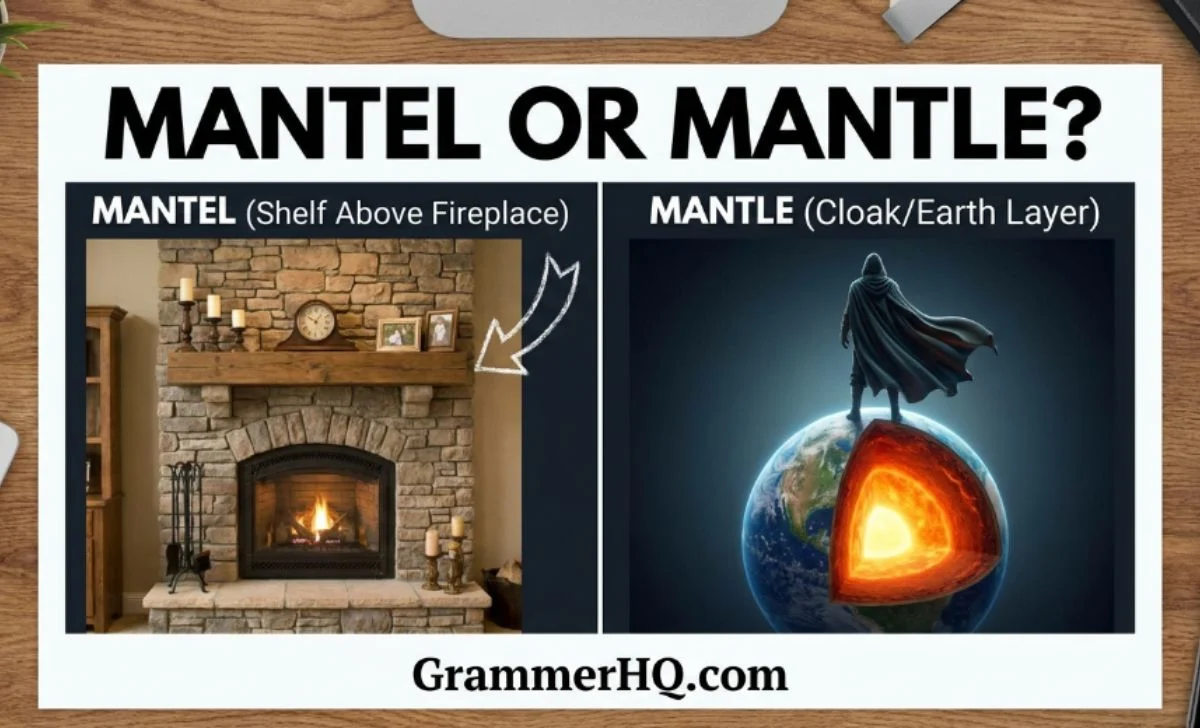
If you’ve ever paused mid-sentence wondering whether to write mantel or mantle, you’re not alone. These two words are pronounced exactly the same way — /ˈmæn.təl/ — but they mean completely different things.
Mixing them up is one of the most common homophone errors in English, and even professional writers, journalists, and published authors get it wrong on a regular basis.
This guide clears up the confusion for good. We’ll cover clear definitions, real examples, the history of how these two spellings split apart, a memory trick that actually works, common mistakes to avoid, and a quiz at the end so you can test yourself.
Quick Answer

- Mantel = the shelf or structure above a fireplace. Nothing else.
- Mantle = everything else — a cloak, a layer of the Earth, a symbolic role of authority, a general covering, or even a verb meaning “to cover.”
If you’re decorating for the holidays and hanging stockings, you’re using the mantel. If you’re talking about clothing, geology, leadership, or any kind of covering — it’s mantle.
Pronunciation
Here’s the part that trips people up in the first place: both words are pronounced identically.
- Mantel: /ˈmæn.təl/
- Mantle: /ˈmæn.təl/
There is no difference in sound at all, which is exactly why this pair falls into the “homophone” category — same pronunciation, different spelling, different meaning. You cannot tell them apart by ear; you can only tell them apart by context and by what the sentence is actually describing.
What Does “Mantel” Mean?
Mantel is a noun with exactly one job in modern English: it refers to the shelf and decorative frame built above and around a fireplace opening. It can also refer more specifically to the beam, stone, or arch that serves as a structural support (a lintel) for the masonry above the fireplace, though in everyday use people usually just mean “the shelf where you put things.”
Examples:
- She arranged the family photos neatly on the mantel.
- The stockings were hung from the mantel with care.
- A carved wooden mantel was the centerpiece of the living room.
- They mounted the TV just above the mantel.
- The antique clock had sat on that mantel for three generations.
- Fresh pine garland was draped along the mantel for Christmas.
Because mantel has only this one meaning, it’s actually the easier of the two words to master. If your sentence involves a fireplace, a hearth, or a shelf used for decoration in that context — you almost certainly want mantel, not mantle.
One small wrinkle: in American English, some publications and casual writers do use “mantle” to describe the fireplace shelf, and dictionaries acknowledge this usage exists. But it’s considered non-standard, and if you want to be seen as a careful writer — especially in professional, architectural, or design writing — mantel is the correct and expected spelling.
What does mantle of the earth mean
Mantle is a far more versatile word, and this is where most of the confusion comes from. It can refer to any of the following:
1. A cloak or loose garment
Historically, a mantle was a loose, sleeveless cloak, often worn by royalty, clergy, or nobility to signify status.
- The queen wore a velvet mantle over her gown.
- He wrapped the mantle tightly against the cold.
- The knight’s mantle bore the crest of his house.
2. A layer of the Earth (geology)
In earth science, the mantle is the thick layer of the planet between the crust and the core.
- Molten rock rises from the Earth’s mantle toward the crust.
- Scientists study seismic waves to understand the mantle‘s composition.
- Volcanic activity is often linked to movement within the mantle.
3. A symbolic role, responsibility, or authority
This is one of the most common modern uses — mantle as a metaphor for taking on a position, duty, or legacy.
- She took on the mantle of team captain after graduation.
- The new CEO now carries the mantle of leadership.
- He reluctantly accepted the mantle of responsibility for the whole department.
- The mantle of the throne passed from father to son.
4. A general covering, often used poetically
- Snow mantled the rooftops overnight.
- A mantle of fog settled over the valley.
- A thick mantle of dust covered the abandoned house.
5. Used as a verb
Less commonly, mantle functions as a verb meaning “to cover” or “to cloak.”
- The fresh snow mantled the entire garden by morning.
- Darkness slowly mantled the city as the sun set.
6. Biology and mechanical uses
Mantle also has specialized meanings — it refers to the outer body wall of a mollusk (like a snail or octopus) that secretes its shell, and to the woven mesh hood used in old gas lamps to produce brighter light.
- The mantle of the octopus expanded and contracted as it swam.
- The old gas lamp needed a new mantle to glow properly.
Notice that mantle can function as both a noun and a verb, and across at least five distinct fields — fashion, geology, leadership, poetry, and biology — while mantel is only ever a noun with one single meaning.
Where the Confusion Comes From: A Brief History
Both words trace back to the same Latin root: mantellum, meaning “cloak” or “covering.” This word entered Old English as mentel, referring to a garment.
Over the following centuries, English absorbed a related but separate sense of mantellum through Anglo-French — this one referring to a beam or stone that supported the masonry above a fireplace. For a long stretch of history, mantle and mantel were treated as interchangeable spelling variants of essentially the same word family, since both ultimately meant “something that covers or supports.”
Gradually, English writers began to specialize the two spellings:
- Mantle stayed attached to the original sense of a cloak, covering, or symbolic garment — and later extended naturally to Earth’s covering layer (the geological mantle) and to symbolic “covering” of responsibility or authority.
- Mantel became the preferred spelling for the solid, architectural structure around a fireplace, likely influenced by the French spelling pattern used in construction and design terminology.
By the time modern style guides were formalized, dictionaries like Merriam-Webster and the Chicago Manual of Style had settled on mantel exclusively for the fireplace shelf, while mantle retained every other sense of the word. Despite this, because the words are pronounced identically, the overlap in casual usage never fully disappeared — which is why you’ll still occasionally see “mantle” used for a fireplace shelf in less formal writing, especially in American newspapers and blogs.
Memory Trick
Here’s the easiest way to remember the difference for good:
Mantel has an -EL, just like shELf. Both words end the same way, and both refer to the same physical object — a shelf.
If you can remember that mantel and shelf share that “el” ending, you’ll never mix it up again.
Alternative trick: Mantle covers almost everything — cloaks, roles, Earth’s layers, coverings in general. Think of the letter M in mantle as standing for “Many meanings.” Mantel, by contrast, only ever means one thing: the fireplace shelf.
Mantel vs. Mantle: Side-by-Side Comparison
| Mantel | Mantle | |
|---|---|---|
| Part of speech | Noun only | Noun and verb |
| Core meaning | Fireplace shelf/structure | Cloak, Earth’s layer, symbolic role, covering |
| Number of distinct meanings | One | Several (fashion, geology, leadership, poetry, biology) |
| Common phrase | “on the mantel” | “mantle of leadership” |
| Field of use | Interior design, architecture | Literature, science, everyday metaphor |
| Pronunciation | /ˈmæn.təl/ | /ˈmæn.təl/ (identical) |
Common Mistakes to Avoid
- ❌ He put his keys on the mantle. → ✅ He put his keys on the mantel.
- ❌ She accepted the mantel of responsibility. → ✅ She accepted the mantle of responsibility.
- ❌ The Earth’s mantel is thousands of kilometers thick. → ✅ The Earth’s mantle is thousands of kilometers thick.
- ❌ The princess wore a beautiful mantel to the ball. → ✅ The princess wore a beautiful mantle to the ball.
- ❌ Snow mantelled the trees overnight. → ✅ Snow mantled the trees overnight.
FAQs
Is “mantle” ever correct for a fireplace shelf? Some American dictionaries note that “mantle” is occasionally used this way in casual or journalistic writing, and it isn’t strictly wrong in that context. However, “mantel” remains the standard, preferred spelling in professional and formal writing, especially in interior design, architecture, and real estate contexts.
Can “mantel” ever mean anything other than a fireplace shelf? No. Unlike mantle, mantel has exactly one accepted meaning in modern English: the shelf or structure above a fireplace.
What’s the plural form of each word? Mantels (fireplace shelves) and mantles (cloaks, coverings, or roles) — both simply add “-s.”
Is “mantelpiece” the same as “mantel”? Yes, essentially. “Mantelpiece” is a slightly more formal or British-leaning term for the same fireplace shelf and surrounding structure that “mantel” describes in American English.
Which word is used in the phrase “mantle of the Earth”? Always mantle — this refers to the geological layer between the Earth’s crust and core, and has nothing to do with the fireplace-related word.
Mantel or Mantle?
Test yourself — fill in the blank with the correct word.
- She lit candles and placed them on the _______.
- The knight wore a crimson _______ over his armor.
- Geologists drilled deep to study the Earth’s _______.
- He inherited the _______ of family leadership.
- The clock on the _______ chimed at noon.
- A thick _______ of dust covered the old furniture.
- They hung the wedding photo above the _______.
- The queen’s ceremonial _______ was trimmed with fur.
Answers: 1. mantel 2. mantle 3. mantle 4. mantle 5. mantel 6. mantle 7. mantel 8. mantle
Related Word Pairs You Might Also Confuse
If mantel and mantle tripped you up, these commonly confused word pairs are worth reviewing next:
- Compliment vs. Complement
- Discreet vs. Discrete
- Principal vs. Principle
- Stationary vs. Stationery
- Affect vs. Effect
- Elicit vs. Illicit
- Precede vs. Proceed
Final Takeaway
The rule is simple once it clicks: mantel is only ever about fireplaces — one meaning, one context.
Mantle covers everything else — cloaks, Earth’s layers, symbolic roles, general coverings, and even a verb form.
When in doubt, remember the trick: mantel and shelf both end in “-el,” and that’s the one you want whenever a fireplace is involved.
Read More Blogs: