
Push or Pull 2026 is a simple guide to understanding the difference between these two common actions and how they are used in physics and everyday English.
A push generally moves an object away from the source of the force, while a pull generally moves it toward the source. Although the difference seems simple, many people confuse these terms or use them incorrectly in different contexts.
Understanding push and pull makes it easier to describe movement, force, and everyday actions clearly.
Quick Answer
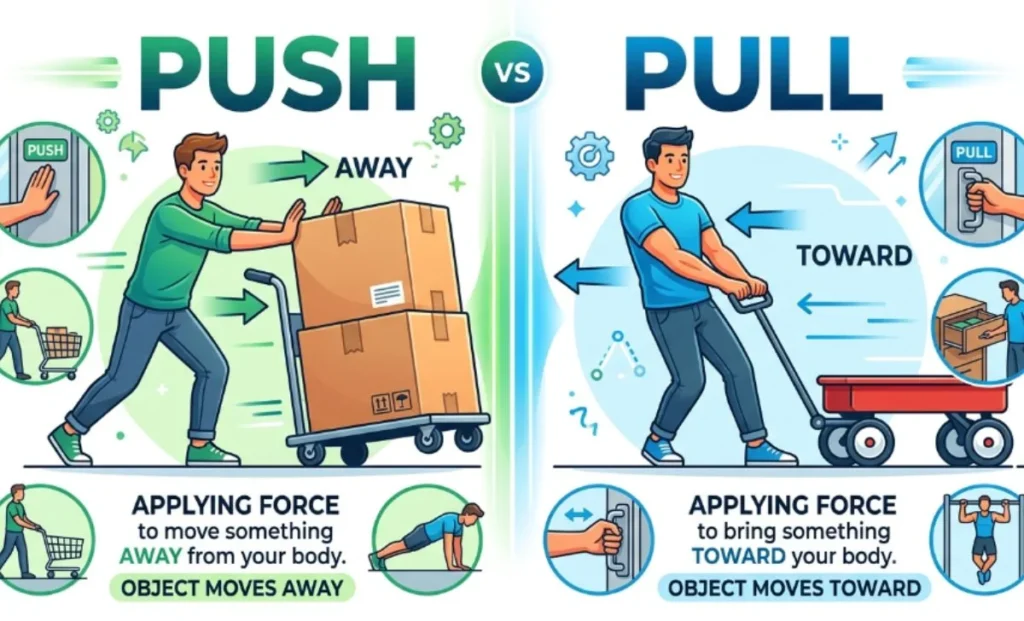
The difference between push and pull is mainly based on the direction in which a force is applied.
- Push means applying force to move or try to move something away from the source of the force.
- Pull means applying force to move or try to move something toward the source of the force.
- In everyday English, we use push and pull for many actions involving doors, drawers, carts, buttons, ropes, and other objects.
Correct Examples
- ✅ Push: Please push the door open.
- ✅ Pull: Pull the door toward you to open it.
- ✅ He pushed the shopping cart down the aisle.
- ✅ She pulled her suitcase behind her.
- ✅ Push the button to start the machine.
- ✅ Pull the rope to ring the bell.
Easy Way to Remember
If you apply force away from yourself, you usually push. If you apply force toward yourself, you usually pull.
Push = away
Pull = toward
What Does Push or Pull Mean?
Push or pull means applying force on an object to change its movement, shape, or direction. These are basic concepts in physics and daily life.
Common Meanings
- Push: Move something away from the body
- Pull: Move something toward the body
Simple Usage Examples
- Push a chair under the table
- Pull a suitcase while traveling
The Origin of Push or Pull
The idea of push and pull comes from early physics studies about motion and force. Scientists observed how objects move when force is applied in different directions. Over time, these actions were classified as basic mechanical forces.
Word History
- “Push” comes from old English meaning to press forward
- “Pull” comes from old English meaning to draw back
Why the Confusion Happens
People confuse them because both involve force and movement, but direction makes them different.
British English vs American English
Push and pull are written the same in both British and American English. However, usage examples may differ slightly in daily language.
Comparison Table
- Push: Same meaning in UK/US
- Pull: Same meaning in UK/US
- Usage: Universal in physics and daily life
Push or Pull vs Other Variations
Comparison Table
| Term | Meaning | Usage | Region |
|---|---|---|---|
| Push | Force away | Physics & daily life | Global |
| Pull | Force toward | Physics & daily life | Global |
| Force | Any push or pull action | Science | Global |
Which One Should You Use?
US Audience
Use simple terms like push and pull in daily communication.
UK Audience
Same usage, especially in education and physics.
International Writing
Both terms are standard and universally understood.
Academic Writing
Always define force direction clearly.
Social Media Usage
Use simple examples for better engagement.
Common Mistakes with Push or Pull
Frequent Errors
- Confusing direction of force
- Using push when pulling an object
- Not identifying movement correctly
Corrected Examples
- Pulling a door instead of pushing it
- Pushing a cart forward instead of pulling
Push or Pull in Everyday Examples
Everyday Conversation
“Please push the door open.”
“I had to pull the chair closer to the table.”
News Writing
“The rescue team pushed the debris aside.”
“Workers pulled the damaged vehicle away from the road.”
School Writing
“Students learn about push and pull in basic science.”
“A push moves an object away, while a pull brings it closer.”
Business Writing
“The company pushed the new update to its users.”
“The team pulled the report from the database.”
A Push or Pull Is Called a Force
A force is a push or pull that acts on an object and can change its motion, direction, or shape.
- Every time you open a door, kick a ball, or pull a suitcase, you are applying a force.
- In physics, force is measured in newtons (N). A force can make an object start moving, stop, speed up, slow down, or change direction.
- Understanding force is one of the basic concepts for explaining motion and everyday physical interactions.
Difference Between Push and Pull in Physics
In physics, push and pull describe two common ways a force can act on an object.
- A push generally moves an object away from the source of the force, while a pull generally moves an object toward the source of the force.
- Both a push and a pull can change an object’s speed, direction, or shape, depending on how the force is applied.
- Understanding the difference between push and pull helps explain how objects move in everyday situations and scientific experiments.
Related Grammar Rules
Understanding push and pull becomes easier when you know how these action verbs work in English grammar.
- Both push and pull are regular verbs, so their forms change according to tense while following standard English verb patterns.
- They can be used as verbs (“Push the door.”) or as nouns (“Give the box a push.”).
- Learning their correct usage, verb forms, and common expressions helps you communicate more naturally and avoid mistakes in both writing and everyday conversation.
FAQ,s
What is push or pull in simple words?
A push moves or tends to move an object away from the source of the force, while a pull moves or tends to move it toward the source of the force.
Is a push or pull a force?
Yes. In basic physics, a force is commonly described as a push or pull that can change an object’s motion, direction, or shape.
What is an example of a push?
Pushing a door open, moving a shopping cart, or kicking a ball are examples of a push.
What is an example of a pull?
Pulling a rope, opening a drawer, or pulling a suitcase are examples of a pull.
What is the difference between push and pull?
A push generally moves an object away from the source of the force, while a pull generally moves it toward the source of the force.
Where do we use push and pull in daily life?
We use pushes and pulls when opening doors, moving furniture, pulling drawers, kicking balls, and handling everyday objects.
Are push and pull part of physics?
Yes. Pushes and pulls are fundamental examples of forces studied in physics, particularly when explaining how forces affect the motion of objects.
Conclusion
A push or pull is a simple way of describing how a force acts on an object. A push generally moves an object away from the source of the force, while a pull generally moves it toward the source.
Although these actions seem simple, understanding the difference between push and pull helps explain movement in physics and everyday life.
From opening doors and moving objects to playing sports, pushes and pulls are part of many activities we do every day.
Read More Blogs: