People often get confused between tying and tieing when writing emails, school assignments, or social media posts.
Both words look similar, and many writers wonder which spelling is correct. Is it tying or tieing? Why does the spelling change?
This confusion usually happens because English spelling rules are not always straightforward. Some verbs simply add -ing, while others change their spelling before taking the ending.
Understanding the correct form helps you avoid common spelling mistakes and improve your writing.
In this guide, you’ll learn the correct spelling, pronunciation, grammar rule, history, usage examples, and an easy trick to remember the difference between tying and tieing.
Quick Answer
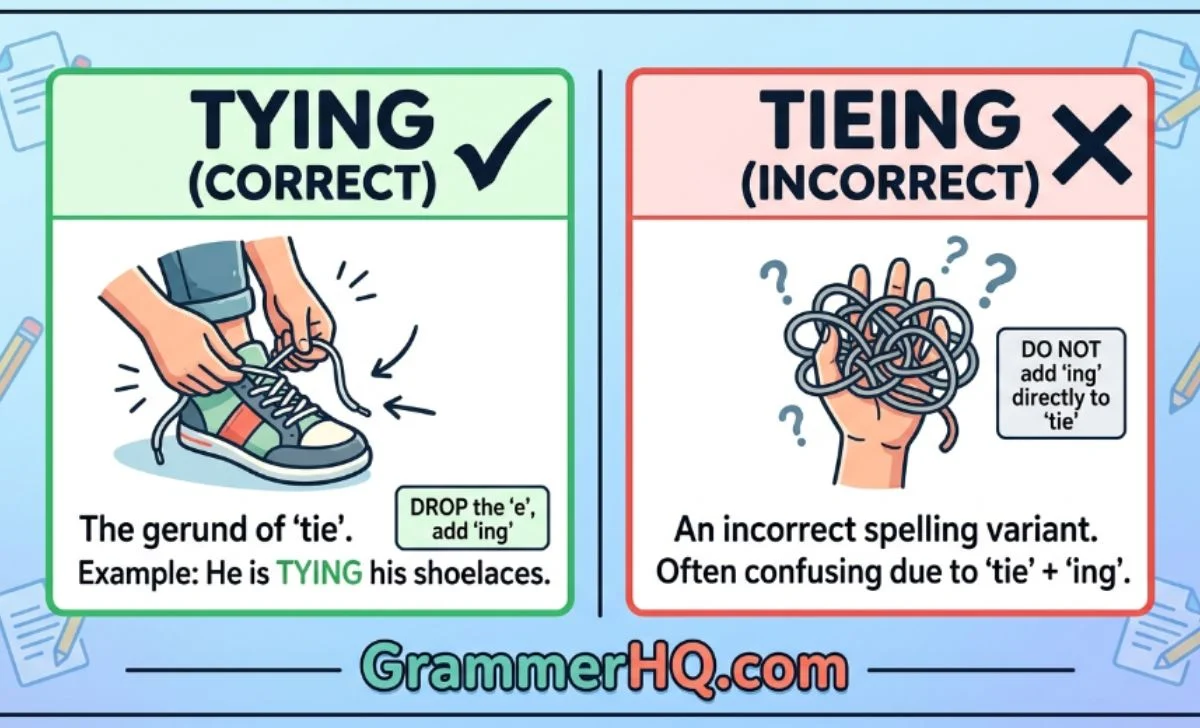
The correct spelling is tying.
❌ Tieing — Incorrect in modern standard English
✅ Tying — Correct present participle and gerund form of tie
Examples:
- She is tying her shoelaces.
- He spent the afternoon tying fishing knots.
- We are tying ribbons around the gifts.
The verb tie follows a special spelling rule. When a verb ends in -ie, the ie changes to y before adding -ing.
Tie → Tying
Similar examples:
- Lie → Lying
- Die → Dying
Pronunciation of Tying or Tieing
The word tying is pronounced:
/ˈtaɪ.ɪŋ/
It sounds like:
“TYE-ing”
The pronunciation remains almost identical to the base verb tie.
Interestingly, even people who mistakenly write tieing usually pronounce it exactly the same as tying. Because both spellings sound alike, spoken English does not reveal which spelling is correct.
This similarity often causes confusion among English learners and native speakers alike.
Why People Confuse Tying or Tieing
Several factors explain why writers mix up these spellings.
1. Similar Pronunciation
Both forms sound the same when spoken. Since pronunciation offers no clue, writers rely only on spelling rules.
2. Regular Spelling Expectations
Most English verbs simply add -ing.
Examples:
- Walk → Walking
- Jump → Jumping
- Play → Playing
Many people naturally assume:
Tie + ing = Tieing
However, verbs ending in -ie follow a different grammar rule.
3. Lack of Knowledge About Verb Forms
Many writers are unfamiliar with present participles, gerunds, and verb conjugation rules. As a result, they use the incorrect spelling.
4. Typing and Autocorrect Errors
Fast typing, social media writing, and informal communication can also produce accidental spelling mistakes.
Easy Trick to Remember Tying or Tieing
Use this simple memory trick:
If a verb ends in “ie,” change “ie” to “y” before adding “-ing.”
Examples:
| Base Verb | Correct -ing Form |
|---|---|
| Tie | Tying |
| Die | Dying |
| Lie | Lying |
Think:
“Drop IE, add Y, then add ING.”
Once you remember this rule, you will never write tieing again.
The Origin of Tying or Tieing
The verb tie originated in Middle English during the fourteenth century. Linguists believe it developed from Old English and Scandinavian language influences related to fastening, binding, or securing objects.
Over time, English spelling evolved to improve readability. Words ending in -ie adopted a special spelling pattern when forming present participles.
Instead of producing awkward combinations such as tieing, English changed ie to y.
This spelling convention eventually became standard in dictionaries, grammar guides, academic writing, and professional communication.
Today, major dictionaries recognize tying as the accepted spelling.
British English vs American English Spelling
Unlike many other spelling differences, there is no disagreement between British English and American English regarding this word.
Both varieties use tying.
Examples:
- British English: She is tying her scarf.
- American English: He is tying his necktie.
Comparison Table
| Feature | British English | American English |
|---|---|---|
| Correct spelling | Tying | Tying |
| Accepted in formal writing | Yes | Yes |
| Use of “tieing” | No | No |
| Grammar rule | Same | Same |
Unlike words such as travelling/traveling or cancelled/canceled, this spelling remains identical across English-speaking countries.
Which Spelling Should You Use?
You should always use tying, regardless of your audience.
For American Audiences
Use tying in:
- Academic writing
- Business emails
- Journalism
- Professional documents
For British and Commonwealth Audiences
Use tying in:
- School assignments
- Newspapers
- Government documents
- Formal reports
For Global Audiences
If you write for international readers, websites, or blogs, tying remains the safest and most professional choice.
Avoid using tieing, as many readers may consider it a spelling error.
Common Mistakes with Tying or Tieing
Here are frequent mistakes writers make.
| Incorrect | Correct |
|---|---|
| I am tieing my shoes. | I am tying my shoes. |
| She keeps tieing ribbons. | She keeps tying ribbons. |
| He enjoys tieing knots. | He enjoys tying knots. |
| They were tieing the packages. | They were tying the packages. |
Other Commonly Confused Words
Writers who confuse tying often also struggle with:
- Lie vs Lying
- Die vs Dying
- Affect vs Effect
- Practice vs Practise
- Breath vs Breathe
Learning grammar rules helps eliminate these common spelling mistakes.
Tying or Tieing in Everyday Examples
Understanding real-world usage makes learning easier.
In Emails
✅ I am currently tying together the final details of the project.
In News Writing
✅ Volunteers spent hours tying relief packages for distribution.
In Social Media
✅ Just finished tying my hiking boots and heading to the mountains!
In Formal Writing
✅ Researchers observed participants tying standardized knots.
In Daily Conversation
✅ She is tying a ribbon around the birthday gift.
In Sports
✅ The athlete paused briefly before tying his shoelaces.
Tying or Tieing – Google Trends & Usage Data
Usage data consistently shows that tying overwhelmingly dominates online searches and published writing.
Popularity by Country
Countries where tying is widely used include:
- United States
- United Kingdom
- Canada
- Australia
- New Zealand
Search interest in tieing mainly comes from users checking whether the spelling is correct.
Large language databases, dictionaries, grammar checkers, and educational websites strongly favor tying.
In modern English usage:
- Tying = Standard and accepted
- Tieing = Rare and generally considered incorrect
This pattern remains consistent across academic, professional, and digital contexts.
Tying vs Tieing Comparison Table
| Feature | Tying | Tieing |
|---|---|---|
| Correct spelling | ✅ Yes | ❌ No |
| Standard English | ✅ Yes | ❌ No |
| Formal writing | ✅ Accepted | ❌ Avoid |
| Dictionaries | ✅ Listed | Rarely accepted |
| Academic usage | ✅ Recommended | ❌ Incorrect |
| Professional communication | ✅ Recommended | ❌ Avoid |
FAQs
Is it tying or tieing?
Tying is the correct spelling in standard English.
Is tieing a real word?
Modern dictionaries generally treat tieing as nonstandard or incorrect. Use tying instead.
Why is tying spelled with a y?
English grammar rules state that verbs ending in -ie change ie to y before adding -ing.
What is the present participle of tie?
The present participle of tie is tying.
How do you spell tying correctly?
Spell it as T-Y-I-N-G.
Why do people write tieing?
People often assume all verbs simply add -ing without changing spelling.
Is tying used in both British and American English?
Yes. Both British and American English use tying.
Conclusion
The confusion between tying and tieing is common, but the rule is simple once you understand it. In modern English, tying is the correct spelling and should always be used in formal, academic, and everyday writing.
The spelling tieing is generally considered incorrect because verbs ending in -ie change those letters to y before adding -ing. This same pattern appears in words like lying and dying.
Whether you write for American, British, or global audiences, choosing tying ensures clarity and professionalism.
Remember the simple rule: drop “ie,” add “y,” then add “ing.” Following this grammar rule will help you avoid one of the most common English spelling mistakes.
Read More Blogs: