
Both spellings are correct. Baptized is the standard spelling in American English, while baptised is preferred in British English (and in Australia, New Zealand, and most Commonwealth countries).
The meaning, pronunciation, and usage are identical only the spelling convention changes depending on your audience.
If you’ve ever paused mid-sentence wondering which one to type, you’re not alone. This guide breaks down the difference, the history behind it, real example sentences, grammar rules, and a simple trick so you never second-guess yourself again.
Quick Comparison Table
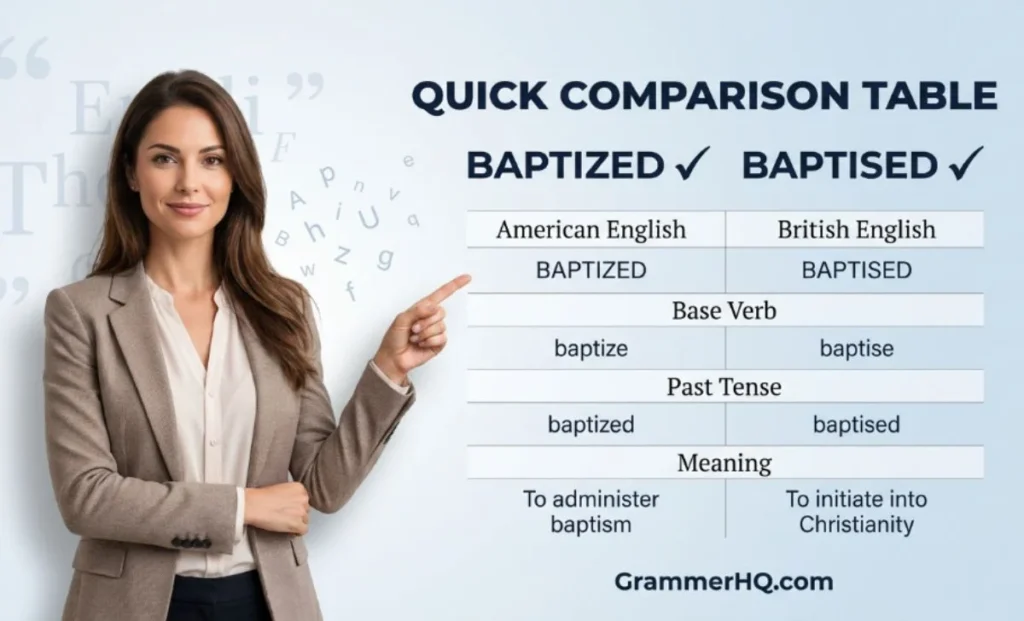
| Baptized | Baptised | |
|---|---|---|
| Dialect | American English | British English |
| Common regions | US, Canada, Philippines | UK, Australia, New Zealand, Ireland |
| Verb form | baptize | baptise |
| Present participle | baptizing | baptising |
| Past tense/participle | baptized | baptised |
| Meaning | Identical | Identical |
What Does “Baptized/Baptised” Actually Mean?
Dictionary Definition
According to Merriam-Webster, to baptize means to administer the Christian rite of baptism to someone traditionally by dipping them in water or sprinkling water on them as part of their formal admission into the Christian church.
Beyond the literal religious sense, the word also carries a figurative meaning: to purify, initiate, or formally “welcome” someone or something into a new role or experience (for example, “she was baptized into the world of investment banking”).
Word Origin — The Greek Root
The word traces back to the Ancient Greek baptizein, meaning “to dip” or “to immerse.” It entered English through Latin and Old French, and by the time of early English Bible translations, “baptise/baptised” spellings were already common long before American spelling conventions split off.
American English vs British English: Why Two Spellings Exist
The -ize vs -ise History
This isn’t a one-off quirk — it’s part of a much bigger pattern. Words like organize/organise, realize/realise, and criticize/criticise follow the same American (-ize) vs British (-ise) split.
American lexicographer Noah Webster standardized the “-ize” ending in his 19th-century dictionaries to simplify and “Americanize” English spelling, which is why “baptize” became the dominant US form.
Here’s the twist most articles miss: the Oxford English Dictionary actually treats “-ize” as the older, etymologically correct ending (since it comes from the Greek “-izein”) even in British English.
This is why you’ll sometimes see “Oxford spelling” use “baptize” in formal UK academic or publishing contexts, even though “baptise” remains far more common in everyday British writing.
Regional Usage Patterns
Corpus and language-tracking data consistently show a clear geographic split: American, Canadian, and Philippine English strongly favor baptized, while British, Australian, New Zealand, and Irish English lean toward baptised.
If your audience is regional, matching this convention makes your writing feel native rather than translated.
How to Choose the Right Spelling for Your Writing
Use this quick checklist:
- Writing for a US audience or publication? → Use baptized
- Writing for UK, Australian, or NZ audience? → Use baptised
- Following AP Stylebook or Chicago Manual of Style? → Use baptized (both favor American spelling)
- Following Oxford or Cambridge style guides? → Baptize/baptized is technically preferred, though baptise/baptised is widely accepted
- Unsure of your audience? → Pick one spelling and stay consistent throughout the entire document
Real Example Sentences
Literal (religious) use:
- The infant was baptized at St. Mary’s Church on Sunday morning.
- Many new converts were baptised in the river during the revival.
Figurative use:
- The young CEO was baptized into the harsh realities of running a startup.
- After her first courtroom trial, she felt truly baptised into the legal profession.
Grammar Rules You Need to Know
Passive Voice Is the Norm
You’ll almost always see “was baptized” rather than “baptized” in active voice, because the focus is usually on the person receiving the rite, not who performed it.
- ✅ She was baptized last spring.
- ✅ I was baptised as an infant.
Prepositions: Into, As, In
- Baptized into a church or faith (baptized into the Catholic Church)
- Baptized as a specific name or identity (baptized as a Methodist)
- Baptized in water, a river, or a location (baptized in the Jordan River)
Common Mistake: The Object Must Be a Person
A frequent learner error is applying the verb to an object instead of a person:
- ❌ The priest baptized the church.
- ✅ The priest baptized the baby in the church.
Other Word Forms
| Form | Word |
|---|---|
| Verb (base) | baptize / baptise |
| Noun (the ritual) | baptism |
| Adjective | baptismal (e.g., “baptismal font”) |
| Person performing it | baptizer / baptiser |
| Related but distinct term | christen (naming someone, often at baptism) |
Note: “christen” and “baptize” overlap but aren’t identical — christening specifically emphasizes giving a name, while baptism emphasizes the religious rite itself.
Similar British vs American Spelling Pairs
Once you understand this pattern, dozens of other word pairs make sense instantly:
- Organize / Organise
- Realize / Realise
- Criticize / Criticise
- Recognize / Recognise
- Apologize / Apologise
Memory Trick to Never Confuse Them Again
Notice that both baptiSed and Britain share the letter S. If you’re writing for a British audience, remember the shared “S” — baptiSed for the UK. Everywhere else, default to “z” — baptiZed.
Common Mistakes to Avoid
- Mixing both spellings within the same document
- Using “baptized” for a non-person object or entity
- Assuming one spelling is “wrong” — both are standard, just regional
- Forgetting that derived forms (baptizing/baptising, baptizer/baptiser) follow the same regional rule
FAQs
Is “baptised” a real word?
Yes. It’s the standard British English spelling and is fully correct — not a typo or misspelling.
Does spellcheck flag one of these as wrong?
It depends on your language setting. A document set to “English (US)” will flag “baptised,” while “English (UK)” will flag “baptized.” Neither is actually incorrect — it’s a settings issue, not a grammar issue.
Is baptized the same as christened?
They’re closely related but not identical. Baptism refers to the religious rite itself; christening often specifically refers to the naming ceremony that frequently happens alongside baptism, especially for infants.
What’s the noun form of baptized/baptised?
Baptism — spelled the same way in both American and British English (only the verb forms differ).
Which spelling should I use in an academic paper?
Match whichever English variant your style guide or institution requires (AP/Chicago → baptized; Oxford/Cambridge → either, with baptize being technically preferred).
Final Verdict
There’s no “correct” winner between baptised and baptized only a correct choice for your audience. Use baptized for American readers and baptised for British, Australian, or Commonwealth readers, and stay consistent once you’ve picked one.
Read More Blogs
- Seamless vs Seemless: Which Spelling Is Correct?
- Crummy vs Crumby: Meaning, Difference & Correct Usage
- Babies vs Babys: Which Is Correct?