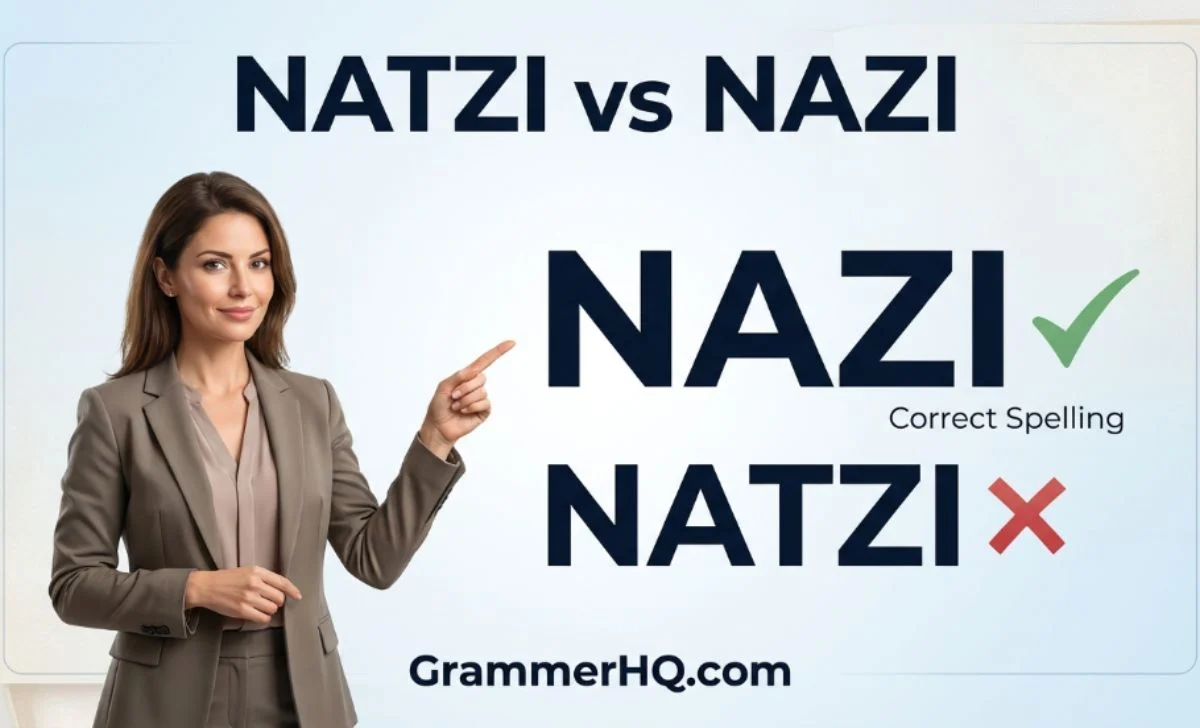
Natzi or Nazi — which one is spelled correctly? Every day, thousands of people type “natzi” into a search bar, get quietly corrected by autocorrect, and move on without ever learning why the mistake happens or where the real word actually came from.
The Natzi or Nazi mix-up is one of the most common spelling mistakes in English, but unlike “definately” or “recieve,” this one has a backstory involving a schoolyard nickname, a rival political insult, and a word a political party never even wanted for itself.
Quick Answer
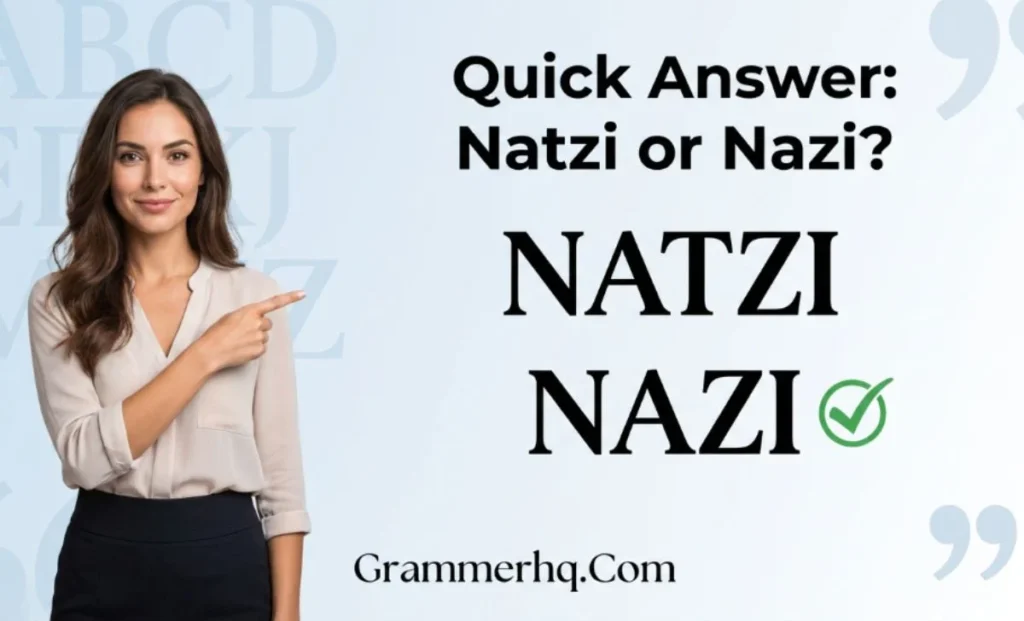
Nazi is the correct spelling. Natzi is not a word in any dictionary — it’s a phonetic misspelling caused by how the German “z” sounds to English speakers. If you’re writing about history, grammar, or anything else, “Nazi” is the only form that’s ever correct.
Nazi vs. Natzi: At a Glance
| Nazi | Natzi | |
|---|---|---|
| In the dictionary | Yes — Wiktionary, Oxford, Merriam-Webster | No |
| Grammatically correct | Yes | No |
| Used in historical/academic writing | Yes | Never |
| Origin | German | None — a typo of “Nazi” |
Why Do People Type “Natzi” Instead of “Nazi”?
A few grammar sites claim it’s because “T” and “Z” sit close together on a keyboard. That’s not actually true on a standard QWERTY layout, T is on the top row and Z is on the bottom, nowhere near each other.
The real reason is phonetic. In German, the letter “z” is pronounced like the English “ts” — so “Nazi” sounds closer to “NAHT-see” than “NAY-zee.” English speakers who hear that “ts” sound naturally reach for a “t” when spelling it, even though German writes it with a single “z.”
It’s the same reason people misspell “pizza” as “pizsa” when they’ve only ever heard it, never seen it written.
The Real Origin of “Nazi”
This is where almost every other article on this topic stops short — usually with a vague “it’s short for National Socialist” and nothing else. The documented story is stranger and more interesting than that.
It Really Is a Shortening of “Nationalsozialist”
“Nazi” is recorded from 1930 as an abbreviation of the German pronunciation of Nationalsozialist, built on the earlier German habit of shortening “Sozialist” to “Sozi.”
Because the “Nati-” in “national” is pronounced roughly like “Nazi” in German, the shortened form clicked phonetically as well as visually, according to Wiktionary’s etymology entry.
But There’s a Second, Older Story — and It’s the Part Nobody Mentions
Before the Nazi Party existed, “Nazi” was already a word in rural Bavaria and Austria. As linguist and word-origin researcher languagehat documents, it was a pet form of the name “Ignatz” (the German version of Ignatius), a name especially popular in that region.
Colloquially, calling someone “Nazi” was a way of calling them an awkward, clumsy oaf — roughly the German equivalent of calling someone a country bumpkin.
Opponents of the party noticed the coincidence — you could pull “Na” and “zi” straight out of “NationalSOzialist,” and it happened to double as an existing insult — and used it as a deliberate dig starting around the 1920s.
The party itself avoided the term for years and preferred “National Socialists” instead — “Nazi” was, from the start, other people’s word for them, not their own.
A fun linguistic side note, explored in this essay on the word’s history: the Spanish name “Ignacio” comes from the same root as “Ignatz,” and its diminutive is “Nacho.” So “Nazi” and “nacho” are, genuinely, distant linguistic cousins — one of those etymology facts that’s almost too strange to believe.
The Symbol Connected to the Word
For reference (since it comes up in related searches): the swastika — known in German as the Hakenkreuz — is the symbol associated with the party’s flag and imagery from the 1920s onward. It’s an ancient symbol from multiple cultures that the party adopted, and it’s now inseparably associated with this specific historical period.
How Do You Actually Pronounce “Nazi”?
Dictionaries list more than one accepted pronunciation, depending on region — see Wiktionary’s pronunciation guide and Vocabulary.com’s entry:
| Region | IPA | Sounds Like |
|---|---|---|
| American English | /ˈnɑːtsi/ | “NAH-tsee” |
| American English (variant) | /ˈnætsi/ | “NAT-see” |
| British English | /ˈnɒtsi/ | “NOT-see” |
The first version is considered closest to the original German pronunciation and is the more commonly used form today. There is no pronunciation for “Natzi” listed anywhere — because it isn’t a word to begin with.
Nazi in Other Languages
- In German, the word is simply the source word itself — a clipped form of Nationalsozialist (“National Socialist”).
- In Spanish, it’s spelled identically (“nazi”) and pronounced /ˈnaθi/ in Spain and /ˈnasi/ in Latin America, following each region’s normal pronunciation rules for “z.”
Other Common Misspellings
If you’ve searched “natzi,” you’re not alone — these variations show up in search data too:
| Misspelling | Correct Form |
|---|---|
| Nazzi | Nazi |
| Natzee | Nazi |
| Nazy | Nazi |
| Nasi | Nazi |
(Small catch: “nasi” is also a real, unrelated word in Malay/Indonesian meaning “rice” — so context matters if you’re searching that one specifically.)
From Historical Term to Internet Slang
The word didn’t stay locked in a history book. Since the 1960s, “nazi” (often lowercase) has been used informally to describe someone who enforces rules with excessive, nitpicky strictness “grammar Nazi,” “soup Nazi,” “parking Nazi.”
You’ll hear it in casual conversation: “Sorry, I know I’m being a total grammar Nazi right now, but it’s ‘fewer,’ not ‘less.'”
Worth knowing before you use it that way: this usage is widely considered informal and, depending on the audience, can come across as tone-deaf or in poor taste given what the original term refers to. It’s common, but not universally welcomed a useful thing to know before dropping it into a work email.
FAQs
Is it spelled “Nazi” or “Natzi”?
“Nazi” is correct. “Natzi” is a misspelling and won’t be found in any standard dictionary.
Is “Natzi” a real word?
No. It has no separate meaning — it’s purely a misspelling of “Nazi,” almost always caused by how the word sounds rather than how it’s written.
What’s the plural — “Nazis” or “Natzis”?
“Nazis.” Since “Natzi” isn’t a real word, it has no correct plural form either.
Where did the word “Nazi” actually come from?
It’s a German shortening of Nationalsozialist (“National Socialist”), which also happened to overlap with an existing Bavarian nickname for “Ignatz” that meant something like “clumsy fool.” Political opponents used the term deliberately in the 1920s to mock the party — it wasn’t a name the party chose for itself.
What is Hitler’s German name?
Adolf Hitler — that was his actual, full name in both German and English; there isn’t a separate “German version” of it. He was born in Braunau am Inn, Austria, in 1889.
Is calling someone or something “Nazi” (like “grammar Nazi”) offensive?
It’s common in casual speech, but many people consider it insensitive given the term’s historical weight — it’s worth reading the room before using it that way.
How do you pronounce “Nazi” — American vs. British?
Americans typically say /ˈnɑːtsi/ (“NAH-tsee”), while British English tends toward /ˈnɒtsi/ (“NOT-see”). Both are considered correct; neither includes the “t” sound implied by the misspelling “Natzi.”
What does “Nazi” mean in German?
It’s the clipped, colloquial form of Nationalsozialist — someone belonging to or supporting the National Socialist movement.
Key Takeaways
- Nazi is the only correct spelling; Natzi is a common phonetic misspelling, not an alternate form.
- The word comes from a German shortening of Nationalsozialist — but it overlapped, likely deliberately, with an older Bavarian nickname meaning “clumsy fool.”
- The party itself avoided the term; it was popularized by opponents as an insult.
- Pronunciation varies slightly by region (American /ˈnɑːtsi/ vs. British /ˈnɒtsi/), but never includes a “t” sound before the “z.”
- Modern slang use (“grammar Nazi”) is common but can read as insensitive depending on context.
Read More Blogs
- Trys or Tries: Which Is Correct? Spelling, Meaning, Rules & Examples
- Storey vs Story: What’s the Difference? UK vs US English
- Tearing or Taring: What Is the Difference?