Lay or Lie is one of the most confusing verb pairs in English grammar, and many learners—even native speakers—struggle to use them correctly.
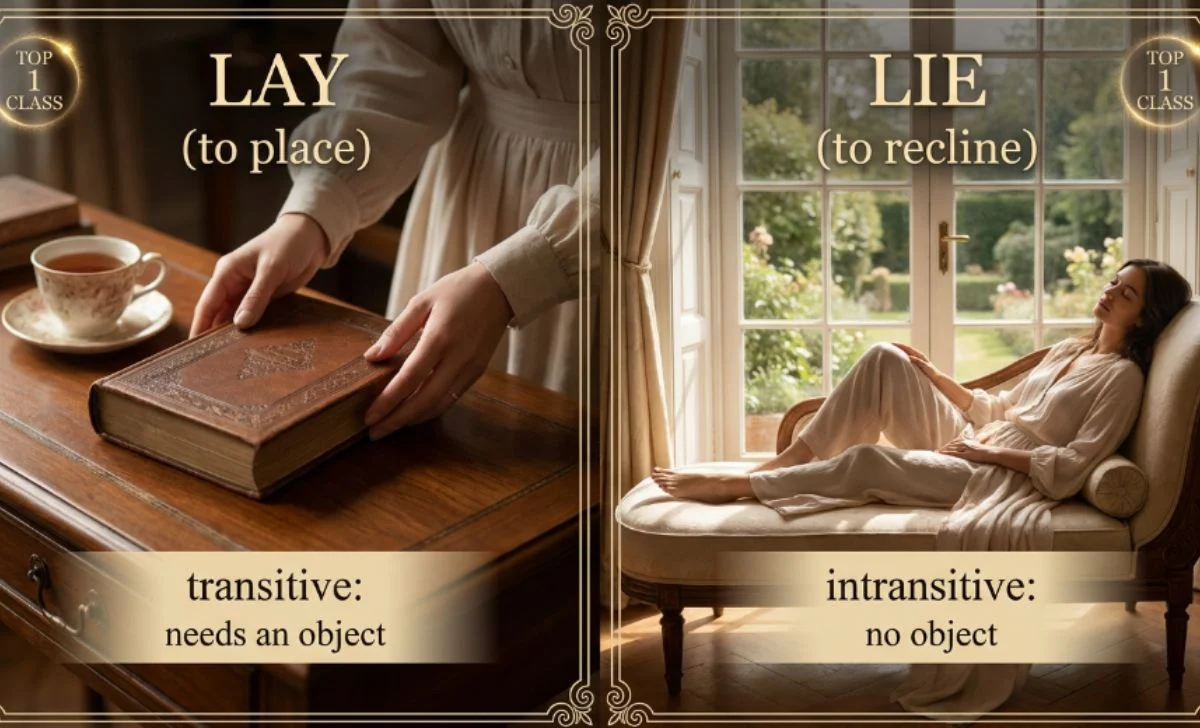
The simple rule is easy to remember: lie means to rest and does not take a direct object, while lay means to put or place something and always requires one.
Most confusion happens because the past tense of lie is lay, making the two verbs easy to mix up. In this guide, you’ll learn the correct meanings, verb forms, pronunciation, grammar rules, common mistakes, memory tricks, and practical examples that make the difference easy to understand.
Whether you’re writing an email, preparing for an exam, or improving your English, this article will help you choose the correct verb with confidence every time.
Quick Answer
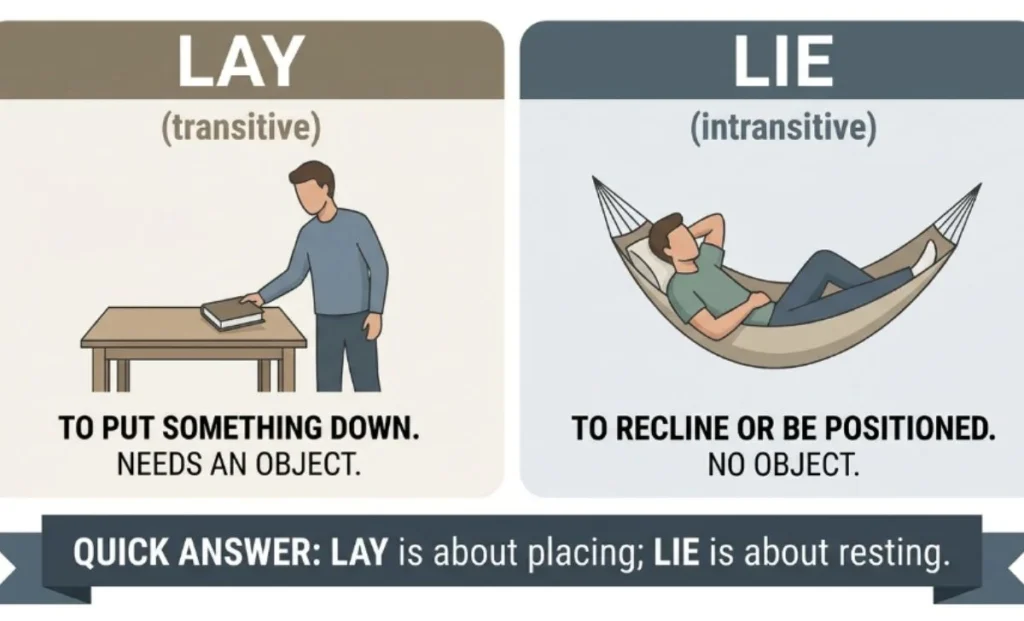
The difference between lay and lie depends on whether an object receives the action.
- Lie means to rest or recline. It does not need an object.
- Lay means to put or place something somewhere. It does need an object.
Quick Comparison
| Word | Meaning | Needs an Object? | Example |
|---|---|---|---|
| Lie | To rest or recline | ❌ No | I need to lie down for a while. |
| Lay | To put or place something | ✅ Yes | Please lay the book on the table. |
Examples
- I want to lie on the sofa after work. ✅
- Please lay your keys on the desk. ✅
- The cat likes to lie in the sun. ✅
- She laid the blanket on the floor. ✅
The easiest way to remember the difference is this:
- Lie = You do it yourself.
- Lay = You do it to something else.
Pronunciation of Lay or Lie
Both words are easy to pronounce, but learners sometimes confuse them because they are short and often appear together in grammar lessons.
- Lay is pronounced /leɪ/ and sounds like “day,” “say,” or “play.”
- Lie is pronounced /laɪ/ and rhymes with “my,” “sky,” and “try.”
Pronunciation Guide
| Word | IPA | Sounds Like |
|---|---|---|
| Lay | /leɪ/ | day, play, say |
| Lie | /laɪ/ | my, sky, try |
Although their spellings are different, learners often mix them up because both are common verbs used in similar situations. The confusion becomes greater when studying verb tenses, since the past tense of lie is lay.
Pronunciation Examples
- Please lay the papers on my desk.
- I’m going to lie down for a few minutes.
- The baby lay peacefully in the crib yesterday.
- Dogs often lie near their owners.
Why People Confuse Lay or Lie
Many English learners—and even native speakers—struggle with lay and lie because the two verbs are closely connected in meaning but follow different grammar rules.
The biggest reason for the confusion is that the past tense of “lie” is “lay.” As a result, the word lay can be either a present-tense verb meaning to place something or a past-tense form of lie, depending on the sentence.
Another reason is that both words relate to position or movement. One describes placing an object, while the other describes resting yourself, making it easy to choose the wrong verb.
Common Reasons for Confusion
- The past tense of “lie” is “lay.”
- Both words describe position or movement.
- They are short, similar-looking verbs.
- Many people learn them through memorization instead of understanding the grammar rule.
Confusing Examples
❌ I’m going to lay down for a nap.
✅ I’m going to lie down for a nap.
❌ Please lie the book on the table.
✅ Please lay the book on the table.
Once you remember that lay needs an object while lie does not, choosing the correct word becomes much easier.
Easy Trick to Remember Lay or Lie
The simplest memory trick is to focus on whether something receives the action.
Memory Trick
- Lay = Place something.
- Lie = Rest yourself.
Ask yourself one question:
“Am I placing something, or am I resting?”
If you’re placing an object, use lay.
If you’re resting yourself, use lie.
Easy Formula
- Lay + Object = Correct
- Lie + No Object = Correct
Examples
- Lay the phone on the table. ✅ (Object: phone)
- Lie on the couch after dinner. ✅ (No object)
- She laid the towel on the chair. ✅
- The child likes to lie on the grass. ✅
Another helpful way to remember is:
If you can point to the thing being placed, use “lay.” If no object is being placed, use “lie.”
This simple rule works in most everyday situations and helps you avoid one of the most common grammar mistakes in English.
The Origin of Lay or Lie
The verbs lay and lie have been part of the English language for hundreds of years. They come from different Old English verbs, which is why they have different meanings and grammar rules today.
- Lay comes from the Old English verb lecgan, meaning “to place or put something.” It has always been a transitive verb, which means it requires a direct object.
- Lie comes from the Old English verb licgan, meaning “to recline, rest, or be in a horizontal position.” It has always been an intransitive verb, meaning it does not take a direct object.
Although these words have different origins, their forms changed over time. The biggest source of confusion is that the past tense of lie is lay, while lay has its own past tense, laid.
Verb Forms Comparison
| Base Form | Present | Past | Past Participle | Present Participle |
|---|---|---|---|---|
| Lie (to recline) | lie | lay | lain | lying |
| Lay (to place) | lay | laid | laid | laying |
Examples
- Every night, I lie on the bed before sleeping.
- Yesterday, I lay on the beach for two hours.
- She has lain on the sofa all afternoon.
- He laid his jacket on the chair before leaving.
Understanding these verb forms explains why lay and lie often seem confusing, even to experienced English speakers.
British English vs American English Spelling
Unlike pairs such as colour/color or centre/center, lay and lie are not spelling variants. The spelling is exactly the same in both British English and American English.
The difference is grammatical, not regional. Whether you are writing for readers in the United States, the United Kingdom, Canada, Australia, or New Zealand, you should use the same grammar rules.
British vs American Comparison
| Feature | British English | American English |
|---|---|---|
| Lay spelling | Lay | Lay |
| Lie spelling | Lie | Lie |
| Meaning | Same | Same |
| Grammar rules | Same | Same |
| Verb forms | Same | Same |
Examples Used in Both Varieties
- Please lay your bag on the floor.
- The dog likes to lie by the fireplace.
- She laid the documents on the desk.
- He lay awake thinking about tomorrow.
Whether you are writing an academic paper, a business email, or a social media post, the rules for lay and lie remain the same.
Which Spelling Should You Use?
Since lay and lie are different verbs—not different spellings—you should choose the word based on its meaning, not your audience’s location.
Use lie when someone or something is resting without acting on an object.
Use lay when someone is placing or putting something somewhere.
Choose the Correct Word
| Situation | Correct Word | Example |
|---|---|---|
| Resting on a bed | Lie | I need to lie down. |
| Putting a book on a table | Lay | Lay the book here. |
| Past tense of lie | Lay | Yesterday, I lay on the couch. |
| Past tense of lay | Laid | She laid the keys on the shelf. |
Advice for Different Audiences
- US English writers: Follow the standard grammar rule for lay and lie.
- UK English writers: Use the same grammar rule.
- Canadian, Australian, and other English users: The same rule applies.
- Students and English learners: Focus on whether the verb has a direct object instead of trying to memorize every tense first.
Quick Decision Guide
Ask yourself this question:
“Is something being placed?”
- Yes → Use lay.
- No → Use lie.
This simple question helps you choose the correct verb in almost every everyday situation.
Common Mistakes with Lay or Lie
Many people use lay and lie incorrectly because the verbs look similar and their past tenses are easy to confuse. Learning the most common mistakes can help you avoid them in everyday writing and speaking.
Mistake 1: Using lay instead of lie
❌ I’m going to lay down for a nap.
✅ I’m going to lie down for a nap.
Why?
You are resting yourself, so no object is involved. Use lie.
Mistake 2: Using lie instead of lay
❌ Please lie the book on the table.
✅ Please lay the book on the table.
Why?
The book is the object being placed, so use lay.
Mistake 3: Confusing the Past Tense
❌ Yesterday, I laid on the sofa all afternoon.
✅ Yesterday, I lay on the sofa all afternoon.
Why?
The past tense of lie is lay, not laid.
Mistake 4: Using the Wrong Past Form of Lay
❌ She lay the keys on the desk yesterday.
✅ She laid the keys on the desk yesterday.
Why?
The past tense of lay is laid.
Quick Error Guide
| Incorrect | Correct | Reason |
|---|---|---|
| Lay down for a nap. | Lie down for a nap. | No object. |
| Lie the bag here. | Lay the bag here. | “Bag” is the object. |
| I laid on the bed yesterday. | I lay on the bed yesterday. | Past tense of lie is lay. |
| She lay the blanket down. | She laid the blanket down. | Past tense of lay is laid. |
Tips to Avoid Mistakes
- Use lie when no object follows the verb.
- Use lay when you are placing something.
- Remember: Lie → Lay → Lain
- Remember: Lay → Laid → Laid
Lay or Lie in Everyday Examples
Understanding grammar is easier when you see real-life examples. Here is how lay and lie appear in different situations.
Everyday Conversation
- I’m going to lie down after lunch.
- Please lay your phone on the table.
- The children lay on the grass yesterday.
- She laid the groceries on the kitchen counter.
In Emails
- Please lay the signed documents on my desk before you leave.
- You may lie down if you are feeling unwell during the meeting.
News Writing
- The rescue workers laid supplies near the affected area.
- Several boats lay along the river after the storm.
On Social Media
- Can’t wait to lie on the beach this weekend!
- Just laid out my clothes for tomorrow.
In Formal Writing
- The researcher laid the evidence before the committee.
- The patient was asked to lie still during the examination.
More Everyday Examples
| Situation | Correct Sentence |
|---|---|
| Home | Lay the remote on the coffee table. |
| Office | Please lay the report on my desk. |
| Travel | I’m going to lie on the beach all afternoon. |
| School | The teacher laid the books on each student’s desk. |
| Hospital | The doctor asked the patient to lie flat. |
| Sports | The player lay on the ground after the tackle. |
These examples show that the correct choice depends on whether the verb acts on an object or simply describes someone resting.
Countries Where the Topic Is Popular
- United States
- United Kingdom
- Canada
- Australia
- India
- Pakistan
- Philippines
These countries have large English-speaking or English-learning populations, making lay vs lie a common grammar search.
Common Search Queries
- lay or lie
- lay vs lie
- difference between lay and lie
- when to use lay and lie
- lay or lie grammar
- lay vs lie examples
- lie down or lay down
- lay and lie verb forms
Usage Comparison
| Word | Primary Meaning | Common Use |
|---|---|---|
| Lay | Put or place something | Everyday conversation, business writing, education |
| Lie | Rest or recline | Daily speech, health, travel, storytelling |
Although both words are common in modern English, many users search for them together because they want a simple explanation, easy examples, and a reliable grammar rule they can remember.
FAQs
What is the difference between these two verbs?
One means to put or place something somewhere, while the other means to rest or recline. The first always needs an object, but the second does not.
Examples:
- She laid the keys on the table.
- The baby lies quietly in the crib.
Which phrase is correct when talking about resting?
When you are talking about your own body, the correct expression is lie down. Use lay down only when you are placing an object somewhere.
Examples:
- I want to lie down after dinner.
- Please lay down the towels before the guests arrive.
Why do so many people mix them up?
The confusion happens because the past tense of one verb looks exactly like the present tense of the other. This unusual pattern makes mistakes common, even among native speakers.
Examples:
- Yesterday, she lay on the sofa all afternoon.
- He laid the books on the shelf before leaving.
Which form should you use when talking about yesterday?
If someone rested yesterday, use lay. If someone placed an object yesterday, use laid.
Examples:
- We lay on the beach until sunset.
- They laid fresh flowers on the table.
Is the grammar different in American and British English?
No. Both varieties follow the same grammar rules. Only pronunciation and some vocabulary differ, not the use of these verbs.
Examples:
- The cat lies near the fireplace.
- She laid her coat on the chair.
What is an easy way to remember the correct choice?
Think of this simple rule: if something is being placed, use the placing verb; if someone is resting, use the resting verb. Checking for a direct object makes the choice much easier.
Examples:
- Please lay the newspaper on my desk.
- I’ll lie here until I feel better.
Do native English speakers make mistakes too?
Yes. Because the verb forms overlap, many native speakers occasionally choose the wrong one in everyday conversation. Careful writing usually follows the correct grammar.
Examples:
- The dog lay under the tree all afternoon.
- She laid the phone beside the laptop.
Conclusion
Understanding lay or lie becomes much easier once you know one simple rule. Use lie when someone is resting and no object is involved. Use lay when you are placing or putting something somewhere, because it always needs a direct object.
Although their verb forms can seem confusing—especially since the past tense of lie is lay—practice and real-life examples make the difference easier to remember.
Whether you’re writing an email, an academic paper, a social media post, or simply speaking English, choosing the correct verb improves your grammar and makes your writing more natural.
Keep the memory trick in mind, review the examples, and you’ll confidently use lay and lie correctly every time.
Read More Blogs:
- Affect or Effect: Which One Is Correct? A Complete Breakdown
- Stationary or Stationery: Which Is Correct?