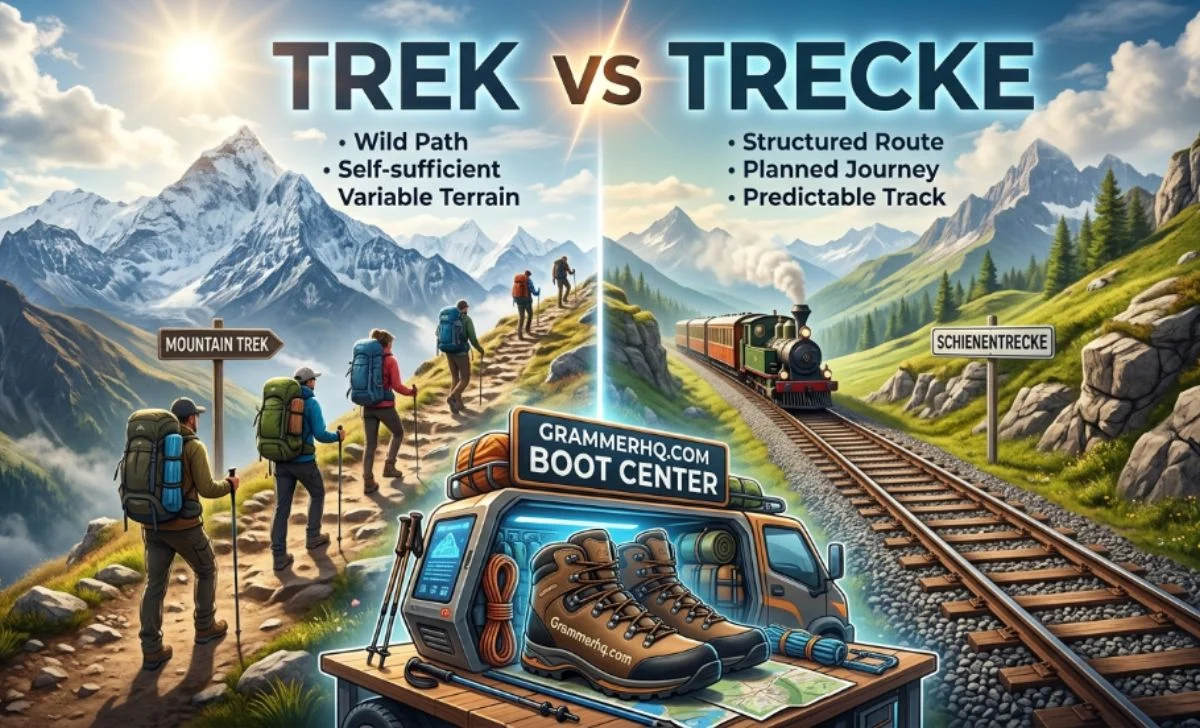
Have you ever written Trek vs Trecke and wondered which spelling is actually correct? You are not alone. These two forms look similar, but they do not have the same status in standard English.
Trek is a real and commonly used English word, especially when talking about a long or difficult journey, hike, or trip.
Trecke, on the other hand, is generally not the standard English spelling and is often the result of a spelling mistake or confusion with another word.
Understanding the difference can help you avoid errors in writing, schoolwork, and everyday communication.
In this guide, we will explain Trek vs Trecke, clarify which form you should use, and provide simple examples to make the correct spelling easy to remember.
Quick Answer
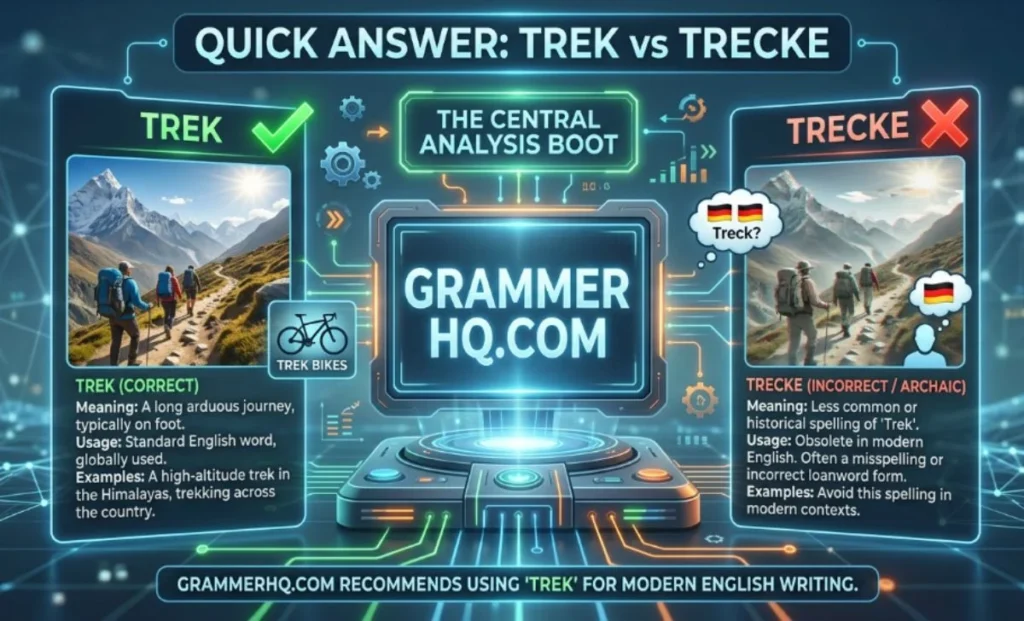
Which spelling should you use?
| Spelling | Standard English? | Use it? |
| Trek | Yes | ✅ Yes |
| Treck | No, for this meaning | ❌ No |
| Trecke | Not the standard English form | ❌ No |
If you mean a long, difficult, or tiring journey, trek is the correct choice.
Example:
We went on a challenging trek through the mountains.
This spelling works in schoolwork, professional writing, travel articles, emails, and everyday English.
What Does Trek Mean?
Trek as a noun
As a noun, trek means a long or difficult journey, especially one made on foot.
For example:
The mountain trek took almost six hours.
It was a long trek from the village to the campsite.
The word does not have to describe an actual hiking expedition. English speakers can also use it informally for any journey that feels long or tiring.
Getting to the new office is quite a trek from my house.
Cambridge and Oxford both describe trek as a long walk or journey, particularly one involving difficult terrain or considerable effort.
Trek as a verb
As a verb, trek means to travel or walk a long distance, usually with some difficulty.
The hikers trekked across the valley before sunset.
We trekked through the forest for several hours.
This gives the word a sense of effort and distance that an ordinary walk may not communicate.
Why Do People Confuse Trek and Treck?
The spelling looks believable
The confusion is easy to understand. English contains many familiar words ending in -ck, including back, check, deck, and neck. Because trek has the same final /k/ sound, adding a c can seem logical.
But English spelling is not always predictable from pronunciation.
The important point is that trek is an established English spelling with its own history. Changing it to treck does not create a standard variant.
Related forms create another trap
The mistake can continue when endings are added.
Correct forms include:
- trek
- treks
- trekked
- trekking
- trekker
So these are incorrect in standard English:
- ❌ trecked
- ❌ trecking
- ❌ trecker
Merriam-Webster and Oxford record the standard forms trekked and trekking.
Is Trecke a Correct English Word?
Why the answer needs a little context
Trecke deserves separate attention because it is not simply another spelling of trek.
The form trecke is recorded in Central Franconian, where it has meanings connected with actions such as pulling, drawing, going, or marching. That is a different linguistic context from the English noun and verb trek.
Therefore, finding trecke somewhere online does not mean it is an accepted English spelling.
If your sentence is in standard English and you mean a long or difficult journey, use trek.
❌ We planned a three-day trecke.
✅ We planned a three-day trek.
This distinction is especially useful for writers who encounter unfamiliar words in multilingual dictionaries or search results.
Trek vs Treck: What Is the Difference?
A simple spelling rule
For standard English, there is no need to choose between two accepted spellings.
Trek is the word you want.
❌ The group went on a difficult treck.
✅ The group went on a difficult trek.
The same rule applies when you add common endings:
| Incorrect | Correct |
| treck | trek |
| trecked | trekked |
| trecking | trekking |
| trecker | trekker |
Remembering the base word makes the other forms much easier.
Trek vs Hike vs Journey
How are these words different?
These words overlap, but they are not always interchangeable.
Trek often suggests a long, demanding, or memorable journey, especially on foot.
Hike is a broader everyday term for walking outdoors, often for exercise or recreation.
Journey is the broadest word and can describe travel by foot, car, train, plane, or other means.
Compare these examples:
We went for a short hike in the woods.
They completed a difficult trek across the mountains.
Their journey to the remote village took two days.
The right word depends on what you want to emphasize: outdoor walking, difficulty and distance, or travel in general.
Is Trek British or American English?
The spelling is the same
There is no British-versus-American spelling difference here.
British and American English both use trek. Cambridge lists the word in both UK and US English with the same spelling.
So you should not change trek to treck when writing for an American audience, and you do not need a different spelling for British readers.
Where Did the Word Trek Come From?
Its history goes beyond modern English
The history of trek helps explain why its spelling should be learned rather than guessed.
Merriam-Webster traces the word through Afrikaans and Dutch, with connections to Dutch trecken, meaning “to pull,” “haul,” or “migrate.” The dictionary records the English verb from the 19th century and the noun from the same period.
Oxford also identifies South African Dutch and related Dutch forms in the word’s history.
So although treck may look familiar because of English spelling patterns, the established English word is trek.
How to Remember the Correct Spelling
Use the “one K, then double K” trick
Start with:
TREK
When you add -ed or -ing, the final k is doubled:
trek → trekked → trekking
A quick memory line is:
One K for trek; two Ks for trekked and trekking.
This simple pattern helps prevent both treck and trecking from slipping into your writing.
Common Mistakes With Trek
Check these forms before you publish
Writers commonly make mistakes when they remember the sound but not the spelling.
Incorrect:
We went trecking in the Himalayas.
Correct:
We went trekking in the Himalayas.
Incorrect:
They trecked across the valley.
Correct:
They trekked across the valley.
Incorrect:
It was a difficult trecke.
Correct:
It was a difficult trek.
These corrections follow the standard dictionary forms of the word.
FAQs
1: Is trek or treck correct?
Trek is the standard English spelling when you mean a long or difficult journey or walk. Treck is normally a misspelling in this context.
2: Is trecke an English spelling of trek?
No. Trecke is not the standard English spelling for this meaning. It can occur in other linguistic contexts, but English uses trek.
3: Is it trekking or trecking?
The correct spelling is trekking, with two k letters.
4: Is it trekked or trecked?
The correct past-tense form is trekked.
5: Is trek a noun or a verb?
It can be both. You can go on a trek (noun) or trek across a region (verb).
6: Is trek the same as hike?
Not exactly. A hike can be any recreational walk outdoors, while a trek often suggests greater distance, difficulty, or effort.
7: Is trek spelled differently in British English?
No. Trek is used in both British and American English.
Final Verdict
The correct choice is clear
If you are describing a long, difficult, or tiring journey, use trek. Treck is not the standard modern English spelling, and trecke should not be used as an English alternative.
The safest forms to remember are:
trek → trekked → trekking
Whether you are describing a mountain adventure, a long walk to a remote village, or simply a tiring trip across town, trek is the spelling you can confidently use in standard English.
Read More Blogs:
- Crummy vs Crumby: Meaning, Difference & Correct Usage
- Seamless vs Seemless: Which Spelling Is Correct?