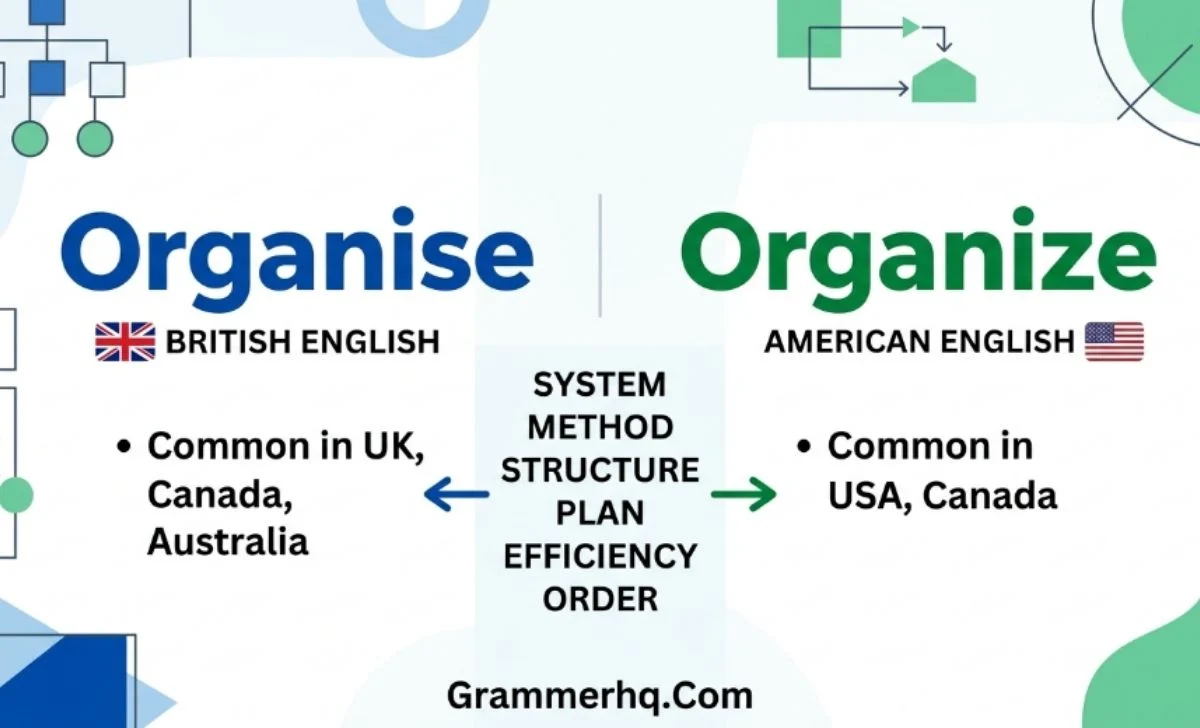
Confused about organise or organize? You may have seen both spellings and wondered which one is actually correct. The answer is simple: both are correct, but they belong to different English spelling conventions.
Organise is the common British English spelling, while organize is the standard American English spelling. Both words have the same meaning: to arrange, plan, or manage something in an orderly way.
The real challenge is knowing which spelling to use and when. This guide explains the difference between organise and organize, their pronunciation and word forms, British and American usage, common mistakes, and practical examples.
By the end, you will know exactly which spelling fits your writing and how to use it confidently.
Quick Answer
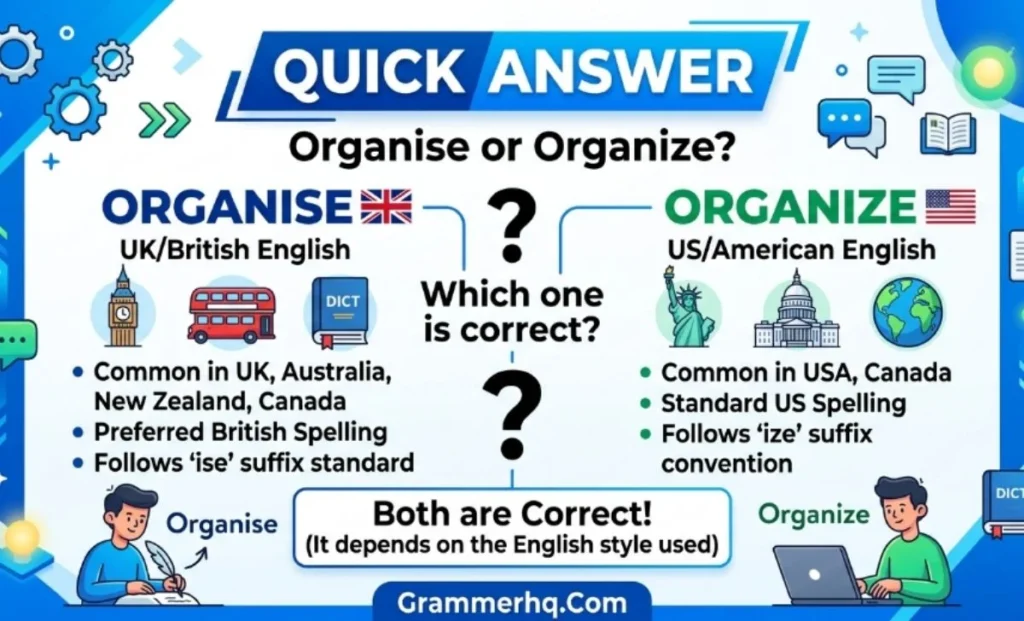
Organise and organize are two spellings of the same verb.
- Organise → British English spelling
- Organize → American English spelling
Both mean to arrange, plan, or manage something systematically.
Examples
British English:
We need to organise the meeting before Friday.
American English:
We need to organize the meeting before Friday.
The meaning does not change. Only the spelling differs.
Simple rule: Use the spelling that matches the English variety you are writing in, and keep that style consistent throughout your text.
What Does Organise or Organize Mean?
Organise/organize is a verb that means to put things, people, information, or activities into a planned or orderly arrangement.
It can also mean to arrange an event, manage a group, or prepare something efficiently.
Common meanings
- To arrange things in an orderly way
- To plan an event or activity
- To manage people or resources
- To structure information clearly
Examples
- Please organise these files by date.
- She organized a charity event.
- I need to organize my study schedule.
- They organised the documents into separate folders.
- The team is organizing a training session.
The verb is common in everyday English as well as academic, business, and professional writing.
Organise vs. Organize: What Is the Difference?
There is no difference in meaning or pronunciation between the two spellings.
The main difference is the spelling convention associated with different varieties of English.
| Spelling | Common English Variety | Example |
|---|---|---|
| organise | British English | We will organise the event. |
| organize | American English | We will organize the event. |
The same pattern appears in several other words:
- realise / realize
- recognise / recognize
- apologise / apologize
- analyse / analyze
However, spelling conventions can vary by country and style guide, so the safest approach is to follow the standard used by your intended audience.
How Do You Pronounce Organise and Organize?
Both words are pronounced the same way in standard English.
The pronunciation is approximately:
OR-guh-nize
The final sound is a /z/ sound, even when the word is spelled organise.
Why does this matter?
Learners sometimes assume that -ise must be pronounced with an /s/ sound. In organise, however, the ending is pronounced with a /z/ sound.
So:
- organise → /ˈɔːɡənaɪz/
- organize → /ˈɔːrɡənaɪz/
The exact pronunciation can vary slightly between accents, but the spelling difference does not create a different word.
Organise or Organize: Word Forms
The spelling difference continues in related forms.
| Word Form | British English | American English |
|---|---|---|
| Base verb | organise | organize |
| Third person | organises | organizes |
| Past tense | organised | organized |
| Past participle | organised | organized |
| -ing form | organising | organizing |
| Noun | organisation | organization |
| Adjective | organisational | organizational |
Examples
British English:
The manager organised the files and is now organising the meeting.
American English:
The manager organized the files and is now organizing the meeting.
Notice that the spelling pattern remains consistent.
Organise in British English
Organise is a common spelling in British English.
You will commonly see it in writing from the United Kingdom and in publications or style systems that follow British spelling conventions.
Examples
- We need to organise the conference.
- She organised all the documents.
- The students are organising a school event.
- The company has improved its organisation.
If your publication follows British English, organise is the natural choice.
Organize in American English
Organize is the standard spelling in American English.
It is widely used in American schools, businesses, newspapers, websites, and other forms of writing.
Examples
- We need to organize the conference.
- She organized all the documents.
- The students are organizing a school event.
- The company has improved its organization.
If your publication follows American English, use organize.
Which Spelling Should You Use?
The answer depends on your target audience and chosen style of English.
For a US audience
Use:
organize, organized, organizing, organization
For a UK audience
Use:
organise, organised, organising, organisation
For academic writing
Follow the spelling conventions required by your university, teacher, publisher, or style guide.
For business writing
Match the spelling style used by your company or target market.
For international websites
Choose one spelling system based on your primary audience. The most important thing is to maintain consistency.
Is Organise or Organize Used in IELTS?
Both organise and organize can be used in IELTS writing, provided the spelling is used correctly and consistently.
IELTS accepts different varieties of standard English. You do not need to change every British spelling into an American spelling or vice versa.
The key rule
Do not switch randomly between spelling systems.
For example, using:
organise + colour + centre
follows a British-style pattern.
Using:
organize + color + center
follows an American-style pattern.
Consistency makes your writing clearer and more professional.
Organise or Organize: Common Examples
Here are practical examples showing how the two spellings work.
Planning an event
British:
We will organise a meeting next week.
American:
We will organize a meeting next week.
Managing files
British:
Please organise the documents by category.
American:
Please organize the documents by category.
School activities
British:
The students organised a science exhibition.
American:
The students organized a science exhibition.
Business
British:
The company is organising a training session.
American:
The company is organizing a training session.
The meaning remains exactly the same.
Common Mistakes With Organise and Organize
The most common problem is not choosing one spelling over the other. It is using different spelling conventions without a reason.
1: Treating one spelling as universally correct
❌ Organise is always correct.
❌ Organize is always correct.
Both statements are too broad.
The appropriate spelling depends on the English variety being used.
2: Changing spelling halfway through a document
For example:
We will organise the event and organize the guest list.
If both forms appear simply because the writer is switching between British and American conventions, the document lacks consistency.
3: Forgetting related forms
If you choose British English, remember the related forms:
organise → organised → organising → organisation
For American English:
organize → organized → organizing → organization
Organise vs. Organize: Easy Memory Trick
Use this simple rule:
S = British spelling
Z = American spelling
So:
organise → British
organize → American
You can also remember the pattern through similar words:
- realise → realize
- recognise → recognize
- apologise → apologize
- organise → organize
This trick helps you recognise the spelling pattern quickly when writing.
Why Are There Two Spellings?
The two spellings developed within different English spelling traditions.
The -ize form has a long history in English and is used in American English as the standard spelling. British English commonly uses -ise, although -ize also exists in some British dictionaries and style systems.
This is an important detail: British English is not universally limited to -ise spellings. Some British publishers and dictionaries accept or prefer -ize in certain words.
Therefore, the simplest learner-friendly rule is:
organise is the common British form; organize is the standard American form.
The difference is one of spelling convention, not meaning.
Organise or Organize Synonyms
The best synonym for organise or organize depends on what you mean in a particular sentence. The word can describe arranging things, planning an activity, or managing people and resources.
When You Mean “Arrange”
Use these alternatives when you are putting things into a particular order:
- arrange
- sort
- order
- structure
Example:
She organized the files.
You could also say:
She arranged the files.
When You Mean “Plan”
For planning an event, activity, or task, suitable alternatives include:
- plan
- prepare
- schedule
- coordinate
Example:
They organized a meeting for Monday.
A natural alternative is:
They scheduled a meeting for Monday.
When You Mean “Manage”
When organise/organize refers to managing people, activities, or resources, you can use:
- manage
- coordinate
- administer
- handle
Example:
She organized the team effectively.
Another option is:
She managed the team effectively.
Remember that synonyms do not always have exactly the same meaning. Choose the alternative that best matches the context of your sentence.
Organise or Organize: Noun Forms
The noun also changes spelling between British and American English.
British English
organisation
The organisation supports local schools.
American English
organization
The organization supports local schools.
The pronunciation and basic meaning remain the same.
The same spelling difference appears in related adjectives:
- British: organisational
- American: organizational
Is Organise the American Spelling?
No.
Organise is commonly associated with British English.
Organize is the standard American spelling.
So if you are writing specifically for an American audience, choose organize.
If you are following British English conventions, organise is the usual choice.
Is Organize the British Spelling?
Organize is also found in British English, particularly in dictionaries and publishing styles that retain the -ize ending.
However, organise is the more familiar British spelling for many learners and is widely used in British English.
Therefore, do not assume that every British writer must use -ise. Always follow the style guide you are using.
FAQs
1: Is organise or organize correct?
Both are correct. Organise is commonly used in British English, while organize is the standard American spelling.
2: What is the meaning of organise and organize?
Both mean to arrange, plan, structure, or manage something in an orderly way.
3: Is organise British English?
Yes. Organise is the common British English spelling.
4: Is organize American English?
Yes. Organize is the standard American English spelling.
5: Is organise wrong in American English?
It is not the standard American spelling. American English normally uses organize.
6: What is the past tense of organise?
The British form is organised. The American form is organized.
7: What is the noun form?
The British form is organisation, while the American form is organization.
8: Is organize accepted in British English?
Yes. Some British dictionaries and style systems use or accept the -ize spelling.
9: Which spelling should I use for SEO?
Use the spelling that matches your target audience and content strategy. If your site targets British readers, organise may be more appropriate; for American readers, use organize. Most importantly, use your chosen spelling consistently.
10: Can I use both organise and organize?
You can encounter both forms in English, but within a single piece of writing, it is best to follow one consistent spelling convention unless you are discussing the two forms themselves.
Final Verdict:
Organise and organize mean the same thing. The main difference is their spelling convention.
- Organise → common British English spelling
- Organize → standard American English spelling
- Organised → British
- Organized → American
- Organisation → British
- Organization → American
If you are writing for a UK audience, choose organise. If you are writing for a US audience, choose organize.
The most important rule is simple: know your audience, choose your English variety, and stay consistent.
Read More Blogs:
- Modeling or Modelling: Which Spelling Is Correct?
- Smokey or Smoky: What’s the Difference?
- Storey vs. Story: What’s the Difference?