Have you ever typed “trys” and then wondered if it actually looks right? It is a surprisingly common mistake because many English verbs form their third-person singular simply by adding -s: work works, help helps, and play plays.
That makes try trys seem logical. But try follows a different spelling rule. Because it ends in a consonant y, the y changes to i before -es is added.
The correct form is therefore tries, not trys. Once you understand this small rule, words such as cries, studies, and carries become much easier too.
Quick Answer
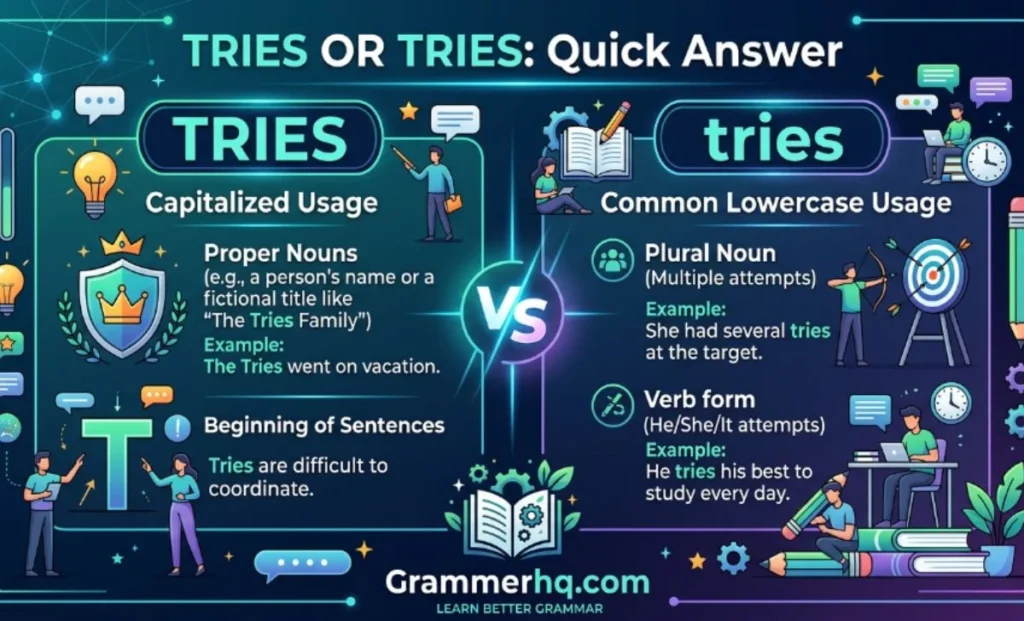
Tries is the correct spelling in standard English. Trys is a misspelling. Tries can be the third-person singular present form of the verb try (She tries again) or the plural of the noun try (He made three tries). The spelling follows the rule consonant – y – ies.
Correct: She tries her best.
Incorrect: She trys her best.
What Does “Tries” Mean?
Tries has two main grammatical uses: it can function as a verb or a noun.
“Tries” as a Verb
As a verb, tries is the third-person singular present form of try.
It can mean to make an effort, attempt something, or test something.
She tries to finish her work before lunch.
Here, tries means makes an effort.
The technician tries a different solution.
In this sentence, tries means tests or uses another solution.
The form depends on the subject:
- I try
- You try
- We try
- They try
- He tries
- She tries
- It tries
That is why she tries is correct, but she trys is not.
“Tries” as a Noun
Try can also be a noun meaning an attempt or effort. Its plural form is tries.
Give it another try.
He passed after three tries.
This is an important distinction because tries is not exclusively a verb.
“Tries” in Rugby
In rugby, a try is a scoring play. The plural is tries.
The team scored four tries during the match.
So you may encounter tries in sports journalism, match reports, and rugby statistics as well as in everyday English.
Why Is “Trys” Wrong?
The spelling trys looks logical if you simply add -s to try. However, English spelling changes when a word ends in a consonant + y.
Look at the ending:
tr + y
The letter immediately before y is r, which is a consonant.
For words ending in consonant + y, the usual spelling pattern is:
change y to i + add -es
Therefore:
try → tries
The same pattern appears in:
- cry → cries
- fly → flies
- study → studies
- carry → carries
- worry → worries
- reply → replies
- copy → copies
So:
❌ He trys to help.
✅ He tries to help.
The important thing is to understand the pattern rather than memorize tries as an isolated spelling.
The Complete Consonant + Y Rule
The y-ending rule has two sides, and learning both prevents a lot of mistakes.
Consonant + Y → IES
When a word ends in a consonant + y, change the y to i and add -es.
| Base Word | Letter Before Y | Correct Form |
|---|---|---|
| try | r | tries |
| cry | r | cries |
| fly | l | flies |
| study | d | studies |
| carry | r | carries |
| worry | r | worries |
| reply | l | replies |
| copy | p | copies |
The shortcut is:
Consonant + Y → IES
So:
try → tries
Vowel + Y → Just Add S
This is the part learners often overlook.
If the letter before y is a vowel, keep the y and simply add -s.
| Base Word | Letter Before Y | Correct Form |
|---|---|---|
| play | a | plays |
| stay | a | stays |
| enjoy | o | enjoys |
| obey | e | obeys |
| delay | a | delays |
| destroy | o | destroys |
Compare:
try → tries
but:
play → plays
Why? Because r is a consonant, while a is a vowel.
The Rule to Remember
Consonant + y → ies
Vowel + y → s
This simple test works for a large group of common English words.
Try, Tries, Tried, and Trying
Many spelling mistakes happen because learners know try but are unsure how its other forms work.
| Form | Use | Example |
|---|---|---|
| try | Base form | I try every day. |
| tries | Third-person singular | She tries every day. |
| tried | Past tense | She tried yesterday. |
| trying | -ing form | She is trying now. |
Try
Use try with I, you, we, and they in the simple present.
They try to solve the problem.
It also follows to:
I want to try again.
Tries
Use tries with he, she, or it in the simple present.
He tries to stay calm.
The software tries to reconnect.
Tried
The past tense is tried, not tryed.
She tried to call me yesterday.
Trying
The -ing form is trying, not triing.
We are trying to improve the process.
Learning this word family makes the spelling pattern much easier to remember.
Is “Trys” Ever Correct?
In ordinary standard English, trys should not be used as the third-person singular form of try or as its plural noun.
If the sentence means:
She ___ to help.
the correct answer is:
She tries to help.
If the sentence means:
He made three ___.
the correct answer is:
He made three tries.
What About “Try’s”?
Try’s is different from tries.
An apostrophe can indicate possession:
The try’s importance became clear after the match.
Here, try’s means something belonging to or associated with the try.
But try’s is not the plural of try.
❌ I made three try’s.
✅ I made three tries.
It is also not the normal verb form:
❌ She try’s to help.
✅ She tries to help.
What Does Ngram Data Tell Us About “Trys”?
Google Ngram Viewer can compare how often words and phrases appear in Google’s digitized book corpus. If you compare tries with trys, the standard spelling tries is the form associated with normal English usage, while trys is extremely marginal.
However, Ngram data should be treated as supporting evidence, not a grammar authority. A rare spelling can appear because of names, OCR errors, unusual historical texts, or other nonstandard material.
For that reason, the strongest conclusion does not come from frequency alone. Standard English dictionaries and the established consonant + y → ies spelling rule support tries as the correct form.
That distinction matters: being found somewhere in a corpus does not automatically make a spelling standard English.
Trys vs. Tries in British and American English
Unlike spelling pairs such as colour/color or organise/organize, tries does not have a British-American spelling difference.
| English Variety | Correct Spelling | Example |
|---|---|---|
| British English | tries | She tries again. |
| American English | tries | She tries again. |
| Canadian English | tries | She tries again. |
| Australian English | tries | She tries again. |
The standard spelling remains tries across these varieties.
How Do You Pronounce “Tries”?
Tries has one syllable and is pronounced with the same vowel sound found in try.
It rhymes with words such as cries, flies, and pries.
The spelling changes from try to tries, but the pronunciation remains closely related.
Common Mistakes With Try and Tries
1. “He trys”
❌ He trys to call every day.
✅ He tries to call every day.
2. “Tryed” for the past tense
❌ She tryed to fix it.
✅ She tried to fix it.
3. “Triing” for the -ing form
❌ I am triing to understand.
✅ I am trying to understand.
4. “Tries” after “to”
❌ I want to tries again.
✅ I want to try again.
After to, use the base form try.
Why Do English Learners Confuse “Trys” and “Tries”?
The confusion is understandable because English has many verbs that simply take -s:
- work → works
- help → helps
- read → reads
- run → runs
- play → plays
A learner may therefore apply the same pattern:
try + s = trys
The problem is that try belongs to the consonant + y group.
A quick check solves the problem:
Look at the letter before Y.
If it is a consonant:
try → tries
If it is a vowel:
play → plays
This approach is more useful than memorizing dozens of unrelated spellings.
Try and Tries in Real-Life English
Here are examples you might actually encounter in everyday writing and conversation:
- Work:She tries to answer every customer within a day.
- School:Daniel tries to finish his homework before dinner.
- Technology:The app tries to reconnect automatically.
- Email:He tries to keep his emails short and clear.
- Conversation:Give it another try before you give up.
- Attempts:The lock opened after three tries.
- Rugby:The team scored five tries in the match.
- Personal effort:She failed once but tries again every morning.
These examples show how naturally tries appears across different contexts.
Try or Tries? A Quick Cheat Sheet
| Situation | Correct Form | Example |
|---|---|---|
| Base verb | try | I try my best. |
| He/she/it | tries | She tries her best. |
| Past tense | tried | She tried yesterday. |
| -ing form | trying | She is trying now. |
| One attempt | try | Give it a try. |
| Multiple attempts | tries | He made three tries. |
| After “to” | try | I want to try. |
| Incorrect spelling | trys ❌ | Avoid it in standard English. |
A Simple Memory Trick for “Tries”
Don’t memorize tries by itself.
Remember this:
Consonant before Y? Change Y to I and add ES.
try → tries
cry → cries
study → studies
Then remember the exception to that pattern:
Vowel before Y? Keep Y and add S.
play → plays
enjoy → enjoys
obey → obeys
So when you see a word ending in -y, simply look one letter to the left.
That tiny habit can prevent many spelling mistakes.
Try or Tries? Test Yourself
Choose the correct answer.
1. She ___ to finish the project today.
A. try
B. trys
C. tries
2. I want to ___ one more time.
A. tries
B. try
C. trys
3. He succeeded after three ___.
A. try
B. trys
C. tries
4. The system ___ to restart automatically.
A. try
B. trys
C. tries
5. They ___ different methods every week.
A. tries
B. try
C. trys
Answers:
- C — tries
- B — try
- C — tries
- C — tries
- B — try
The biggest clue is the subject: he, she, and it use tries, while I, you, we, and they use try.
FAQs
1: Is “trys” a correct spelling?
No. Tries is the standard spelling. Trys is a misspelling when you mean the third-person singular form of try or the plural noun.
2: Is it “he trys” or “he tries”?
It is he tries.
He tries to help whenever he can.
3: Is “tries” a noun or a verb?
It can be both. As a verb, tries means makes an effort or attempts. As a noun, tries means multiple attempts.
4: What is the past tense of “try”?
The past tense is tried.
She tried to solve the problem.
5: What is the plural of “try”?
The plural is tries.
He made several tries.
6: Is “try’s” the plural of “try”?
No. The plural is tries. Try’s can be a possessive form when an apostrophe is grammatically required.
7: Is it “try” or “tries” after “to”?
Use try after to.
I want to try again.
Not:
I want to tries again.
8: Why does “try” become “tries”?
Because try ends in a consonant + y. The standard spelling rule changes y to i and adds -es.
9: Is “tries” spelled differently in British English?
No. Tries is the standard spelling in British, American, Canadian, and Australian English.
Conclusion
When choosing between trys or tries, the correct spelling is tries. It is the third-person singular form of the verb try and the plural form of the noun try.
The easiest way to remember it is to check the letter before y: consonant + y ies, while vowel + y s. That gives you try tries, but play plays.
Keep the related forms tried and trying in mind, and remember that try’s is not the plural. Once you learn the rule instead of memorizing one word, this common spelling mistake becomes much easier to avoid.
Read More Blogs: