Have you ever typed shinning when you meant shining? You are not alone. These two words look almost identical, but that extra n changes the meaning completely.
Shining is the word you need when something gives off or reflects light, looks bright, or represents excellence. Shinning is also a real English word, but it comes from the verb shin and refers to climbing something by using your hands and legs.
The good news is that the difference is easy to remember once you connect each word to its base verb.
In this guide, you will learn exactly when to use shining, when shinning is correct, how to pronounce both words, common mistakes to avoid, and a simple memory trick that makes the difference easy to remember.
Quick Answer
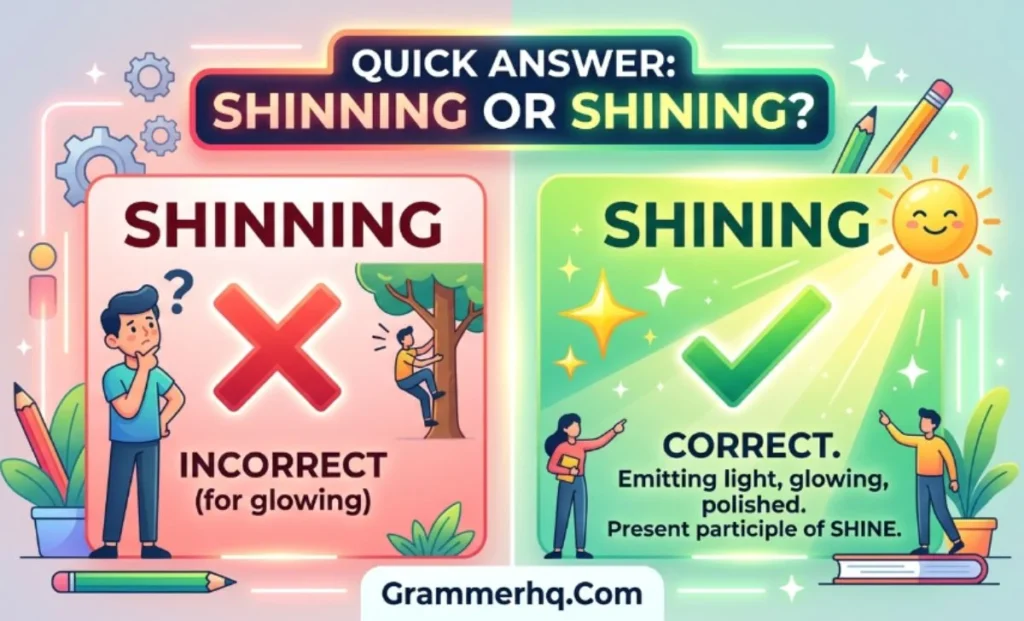
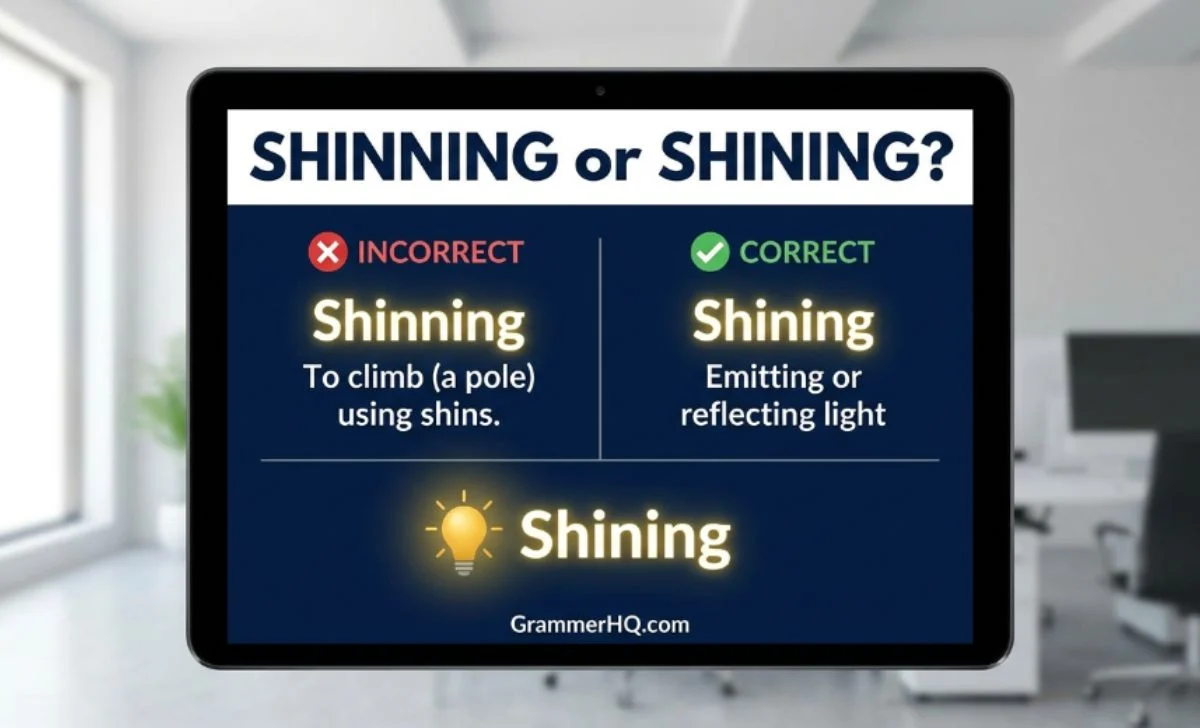
Shining is correct when you mean giving off or reflecting light, looking bright, or being excellent or impressive.
Shinning is a real but uncommon word meaning climbing something by using your hands and legs. It is the present participle of the verb shin.
| Word | Meaning | Example |
|---|---|---|
| Shining | Giving off or reflecting light; excellent or impressive | The stars are shining. |
| Shinning | Climbing using the hands and legs | The boy was shinning up the tree. |
The easiest rule
Light or brilliance → shining
Climbing → shinning
So, if you want to say that the sun is bright, write:
✅ The sun is shining.
Not:
❌ The sun is shinning.
What Does Shining Mean?
Shining is the present participle of the verb shine. It can describe something that sends out or reflects light. It can also describe someone or something that is excellent or worthy of admiration.
Examples of Shining
- The sun is shining brightly.
- The stars were shining in the night sky.
- Her eyes were shining with happiness.
- The polished silver was shining under the lights.
- She is a shining example of determination.
- He has a shining career ahead of him.
The word can therefore be used both literally and figuratively.
Literal meaning
When shining refers to light, it means something is producing or reflecting brightness.
The moon was shining over the lake.
Figurative meaning
When shining describes a person, achievement, or quality, it can mean excellent or impressive.
She is a shining example of hard work.
What Does Shinning Mean?
Shinning is the present participle of the verb shin. As a verb, shin means to climb something such as a tree or pole by using your hands and legs.
For example:
- The boy was shinning up the tree.
- The sailor was shinning up the mast.
- The climber was shinning up the pole.
This word is legitimate English, but it is much less common than shining in ordinary writing and conversation. In American English, shinny is also used for this climbing sense.
If you are simply talking about climbing, however, climbing is usually the more familiar word:
The boy was climbing the tree.
Shining vs Shinning: Pronunciation
The two words also sound different.
| Word | IPA | Easy Pronunciation |
|---|---|---|
| Shining | /ˈʃaɪ.nɪŋ/ | SHY-ning |
| Shinning | /ˈʃɪn.ɪŋ/ | SHIN-ing |
Cambridge gives shining as /ˈʃaɪ.nɪŋ/ and shin as /ʃɪn/; the climbing form shinning therefore follows the sound of shin.
Easy pronunciation trick
Think:
shine → SHYNE → shining → SHY-ning
but:
shin → SHIN → shinning → SHIN-ing
The vowel sound is different, so shining and shinning are not simply two spellings of the same word.
Why Do People Confuse Shinning and Shining?
The confusion is easy to understand because the words differ by only one letter.
1. They Look Almost Identical
Shining and shinning contain nearly the same letters. When typing quickly, it is easy to add an extra n.
2. People Know Shine but Not Shin
Most English learners are familiar with shine, but the verb shin is much less familiar.
That makes this distinction easy to miss:
shine → shining
shin → shinning
3. English Has Many Double-Consonant Patterns
Learners may remember that some verbs double their final consonant before -ing. That can lead to the incorrect assumption that:
❌ shine → shinning
But the correct form is:
✅ shine → shining
4. Shinning Is a Real Word
Spell-checkers and dictionaries may recognize shinning, which can make the confusion even worse.
The important point is that shinning is not an alternative spelling of shining. They come from different verbs and have different meanings.
The Grammar Rule: Shine vs Shin
The simplest way to understand the spelling is to start with the base verb.
| Base Verb | -ing Form | Meaning |
|---|---|---|
| shine | shining | Giving off or reflecting light; being excellent |
| shin | shinning | Climbing with the hands and legs |
Shine → Shining
Use shining when the base verb is shine.
The sun is shining.
The diamond is shining under the light.
She is shining in her new role.
Shin → Shinning
Use shinning when the base verb is shin.
The boy was shinning up the tree.
The difference becomes much easier once you identify the base verb first.
Shinning vs Shining: Comparison
| Feature | Shining | Shinning |
|---|---|---|
| Base verb | Shine | Shin |
| Main meaning | Giving off or reflecting light | Climbing using hands and legs |
| Pronunciation | SHY-ning | SHIN-ing |
| Common in everyday English? | Yes | No, relatively uncommon |
| Example | The moon is shining. | He was shinning up the pole. |
Remember this:
Shine = Light = Shining
Shin = Climbing = Shinning
British vs American English
There is no British-American spelling difference between shining and shinning for these meanings.
Both varieties use:
- Shining for light, brightness, and excellence.
- Shinning for the climbing action.
However, American English also uses shinny for the climbing verb.
| Meaning | British English | American English |
|---|---|---|
| Giving off or reflecting light | Shining | Shining |
| Climbing with hands and legs | Shinning | Shinning / Shinny |
So, unlike words such as colour/color or organise/organize, this is not a British-versus-American spelling issue.
Shining or Shinning in Real-Life Examples
Everyday English
✅ The sun is shining today.
❌ The sun is shinning today.
Describing Eyes
✅ Her eyes were shining with happiness.
This is a natural use of shining because it describes a bright or happy appearance.
Describing an Object
✅ The polished car was shining in the sunlight.
Describing Excellence
✅ She is a shining example of dedication.
Here, shining is figurative and means excellent or admirable.
Describing Climbing
✅ The boy was shinning up the tree.
Here, shinning is correct because the verb means climbing with the hands and legs.
Another Climbing Example
✅ The sailor was shinning up the mast.
Incorrect vs Correct Examples:
| ❌ Incorrect | ✅ Correct | Why? |
|---|---|---|
| The stars are shinning tonight. | The stars are shining tonight. | The stars give off or reflect light. |
| The sun is shinning brightly. | The sun is shining brightly. | The sentence is about light. |
| Her eyes were shinning with happiness. | Her eyes were shining with happiness. | Shining can describe bright or happy eyes. |
| The diamond was shinning. | The diamond was shining. | The diamond is reflecting light. |
| The boy was shining up the tree. | The boy was shinning up the tree. | The action means climbing. |
| She is a shinning example of courage. | She is a shining example of courage. | Shining can mean excellent or admirable. |
Common Mistakes to Avoid
1: Writing Shinning for Light
❌ The moon is shinning.
✅ The moon is shining.
The base verb is shine, so the correct form is shining.
2: Thinking Shinning Is Always Wrong
❌ “Shinning is not an English word.”
That is incorrect.
Shinning is a legitimate form of shin, meaning to climb using the hands and legs.
3: Treating Shinning as Another Spelling of Shining
They are not interchangeable.
Shining and shinning come from different verbs and have different meanings.
4: Using Shinning in Everyday Situations
If you mean light, brightness, beauty, or excellence, shining is almost certainly the word you want.
5: Forgetting the Base Verb
When unsure, go back one step:
Is the verb shine?
→ shining
Is the verb shin?
→ shinning
This simple check solves most spelling problems.
Easy Memory Trick:
Here is the fastest way to remember the difference:
If it is about LIGHT, use SHINING. If it is about CLIMBING, use SHINNING.
You can make it even shorter:
Shine → Light → Shining
Shin → Climb → Shinning
For example:
☀️ Sun → shining
🌙 Moon → shining
💎 Diamond → shining
🌳 Tree climbing → shinning
Once you connect the extra n with the different base verb shin, the spelling becomes much easier to remember.
Which Word Should You Use?
In normal everyday English, shining is the word you will usually need when talking about brightness, light, appearance, or excellence.
Shinning, on the other hand, is used for the much less common action of climbing by gripping something with your hands and legs.
When to Use Shining
Choose shining when your sentence is related to:
- Light or brightness
- Reflected light
- Bright-looking eyes
- Beauty or appearance
- Excellence or achievement
- Admiration
- Figurative brilliance
For example, you can say, “The sun is shining brightly,” or “She is a shining example of dedication.”
When to Use Shinning
By contrast, shinning is appropriate when someone is climbing a tree, pole, mast, or another object by gripping it with their hands and legs.
For example:
- The boy was shinning up the tree.
- The sailor was shinning up the mast.
- The climber was shinning up the pole.
Because this climbing sense is uncommon in modern everyday English, shining will be the correct choice in most situations.
The easiest rule to remember is: if the sentence is about light or excellence, choose shining. If it describes the specific action of climbing with the hands and legs, shinning can be correct.
Practice Quiz:
Choose the correct word in each sentence.
1. The stars were _____ brightly.
A. Shinning
B. Shining
2. The boy was _____ up the tree.
A. Shining
B. Shinning
3. Her eyes were _____ with happiness.
A. Shining
B. Shinning
4. The sailor was _____ up the mast.
A. Shining
B. Shinning
5. The polished table was _____ under the light.
A. Shinning
B. Shining
6. Correct the sentence:
The moon was shinning beautifully.
7. Correct the sentence:
The child was shining up the tree.
Answers
- B — Shining ✅
- B — Shinning ✅
- A — Shining ✅
- B — Shinning ✅
- B — Shining ✅
- The moon was shining beautifully. ✅
- The child was shinning up the tree. ✅
FAQs
1: Is shinning a real word?
Yes. Shinning is a real English word. It is the present participle of shin, a verb meaning to climb something by using your hands and legs. It is uncommon compared with shining.
2: Which is correct: shinning or shining?
Both are correct, but they have different meanings.
Shining means giving off or reflecting light, looking bright, or being excellent.
Shinning means climbing by using your hands and legs.
3: Why do people spell shining as shinning?
The two words look very similar, and learners may incorrectly double the n before adding -ing. The confusion is also increased because shinning is a real word, although it has a different meaning.
4: Is shinning the same as shining?
No. They are different words.
Shining comes from shine.
Shinning comes from shin.
Their meanings and pronunciations are different.
5: Is shinning common in modern English?
It is a valid word, but it is relatively uncommon. In ordinary conversation, people are much more likely to say climbing when describing this action.
6: Can I use shinning in formal writing?
Yes, if you genuinely mean the specific climbing action described by the verb shin. If you mean brightness or excellence, use shining.
7: Is there a British vs American spelling difference?
No major spelling difference exists for shining and shinning. American English also has shinny as a form of the climbing verb.
8: How do I remember shinning vs shining?
Remember:
Shine → Shining → Light
Shin → Shinning → Climbing
If you are talking about the sun, stars, brightness, reflection, or excellence, choose shining.
If someone is climbing by gripping something with their hands and legs, shinning can be correct.
Key Takeaways
- Shining is the correct word for light, brightness, reflection, and figurative excellence.
- Shinning is a real but uncommon word meaning climbing with the hands and legs.
- Shining comes from shine.
- Shinning comes from shin.
- Shining is pronounced SHY-ning.
- Shinning is pronounced SHIN-ing.
- British and American English use the same basic spellings for these meanings.
- American English also uses shinny for the climbing sense.
- If you are talking about light, shining is almost always the word you need.
Conclusion
The difference between shinning and shining is only one letter, but that letter changes the meaning.Use shining when something gives off or reflects light, looks bright, or represents excellence.
Use shinning when you mean the less common action of climbing by gripping something with your hands and legs.
The easiest way to remember the difference is simple:
Shine → Shining → Light
Shin → Shinning → Climbing
So, if you are writing about the sun, stars, a diamond, someone’s bright eyes, or a shining example of excellence, choose shining.
Read More Blogs

Hi, I’m Amelia Parker, a grammar enthusiast and writer at GrammarHQ.com. I specialize in explaining spelling differences, confusing words, and common English mistakes through simple, practical, and easy-to-understand guides.