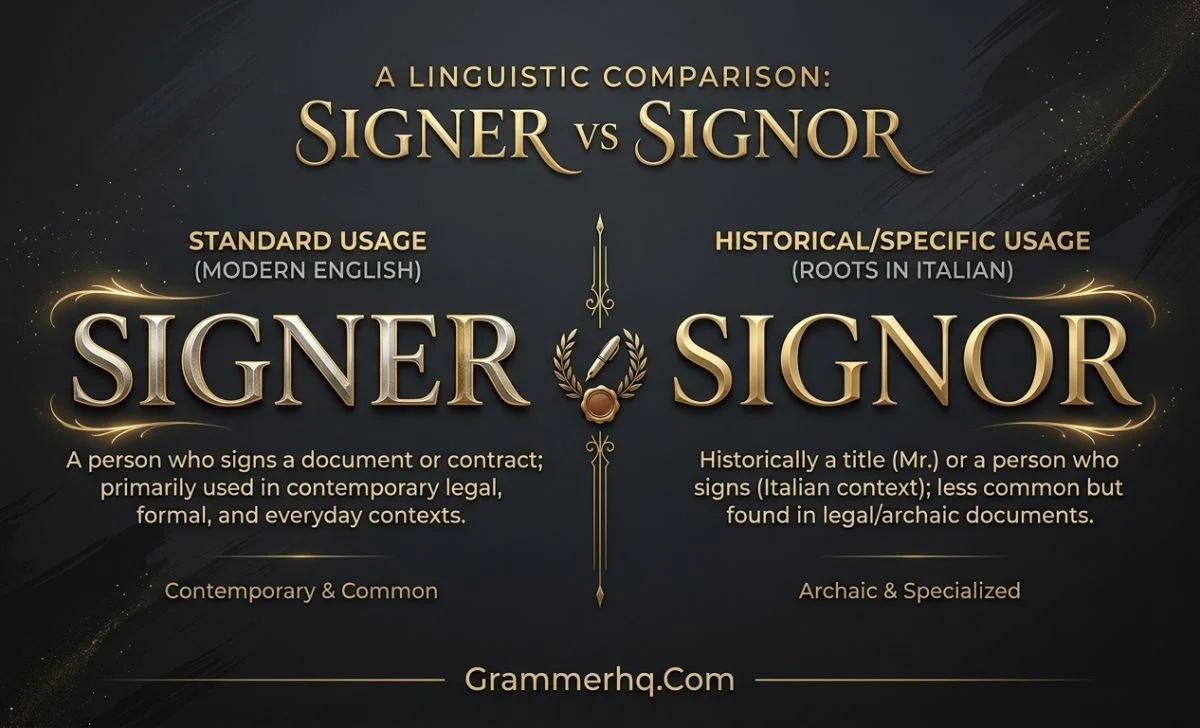
Signer and signor look almost identical, but they do not mean the same thing. A signer is a person, organization, or country that signs an official document, and the word can also refer to someone who uses sign language.
A signor, on the other hand, is an Italian title of respect similar to Mr. and is normally used before a man’s name or as a form of address.
So, if you mean someone who signs a contract, form, or agreement, use signer. If you mean an Italian title of respect, use signor.
Quick Answer
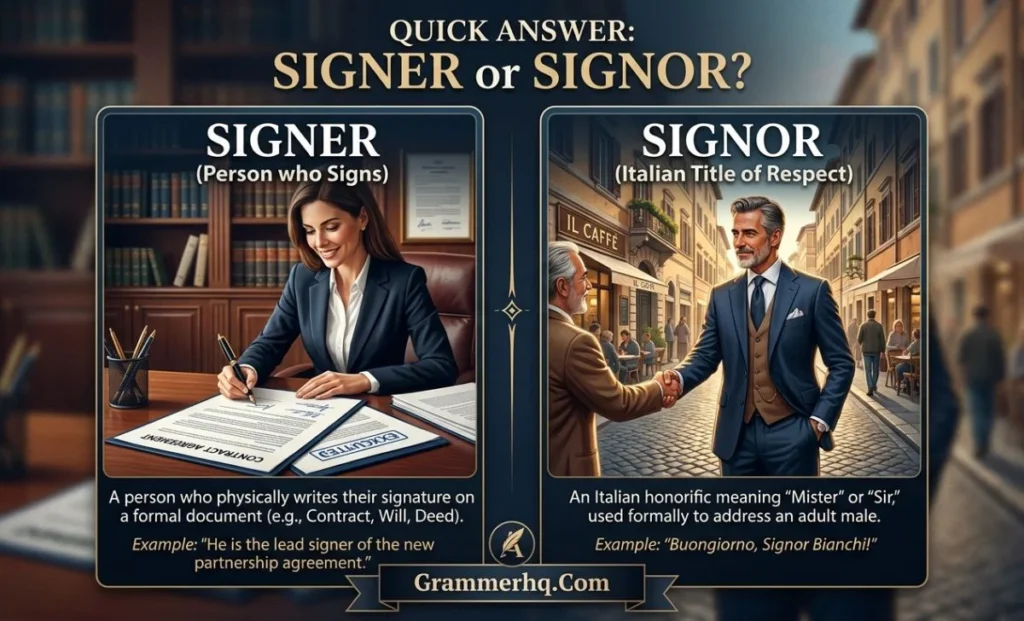
Signer is correct when you mean someone who signs something.
The signer completed the contract.
Signor is correct when you mean an Italian title similar to Mr.
Signor Rossi arrived before the meeting.
There is also another established meaning of signer: a person who uses sign language.
Easy way to remember
Signer → someone who signs.
Signor → an Italian title of respect.
Signer or Signor: The Key Difference
| Word | Meaning | Typical use | Example |
|---|---|---|---|
| signer | Someone who signs, or a person who uses sign language | Contracts, forms, petitions, sign language | The signer approved the agreement. |
| signor | An Italian title of respect for a man | Names, formal address, Italian contexts | Signor Rossi joined the discussion. |
The two words are therefore not alternative spellings of one another. Their meanings, pronunciation, and uses are different.
What Does “Signer” Mean?
Signer is a noun formed from the verb sign. In its most common sense, it identifies someone who has signed an official document or agreement.
Cambridge Dictionary defines a signer as a person, organization, or country that has signed an official document and lists signatory as a synonym in this sense.
1. A person who signs a document
A signer may be someone who signs a:
- contract
- agreement
- application
- petition
- legal document
- business form
- financial document
For example:
Every signer must provide a valid form of identification.
The final page requires the signer’s signature.
Each signer agreed to the terms before submitting the contract.
This is also why authorized signer is a common phrase in banking and business.
Maria is an authorized signer on the company account.
Here, signer refers to a person who has permission to sign on behalf of an individual, business, or organization.
2. A person who uses sign language
There is another important meaning that is easy to miss.
Signer can also mean a person who uses sign language. Cambridge Dictionary recognizes this meaning separately from the document-related sense.
For example:
The interpreter worked with several signers during the event.
The study examined how signers use facial expressions and body movement.
So signer does not always have something to do with a written signature. The surrounding context determines which meaning is intended.
What Does “Signor” Mean?
Signor is an Italian title of respect. In English, it is generally used in reference to an Italian man and is comparable to Mr.
when placed before a name. Collins also records signor as a noun meaning a man or gentleman in addition to its title use.
For example:
Signor Rossi will meet us at noon.
We spoke with Signor Bianchi after the ceremony.
It can also be used without a name:
Thank you, signor.
The important point is that signor has nothing to do with signing a document.
Signer or Signor Pronunciation
The spelling can make these words look related, but they sound different.
Signer
Cambridge gives the pronunciation as:
/ˈsaɪ.nər/ in British English
/ˈsaɪ.nɚ/ in American English
A simple approximation is:
SY-ner
Signor
English dictionaries give pronunciations along the lines of:
see-NYOR
Collins lists English and Italian pronunciations for signor.
The difference becomes much clearer when you hear the words aloud:
signer → the person who signs
signor → an Italian title
How to Use “Signer” in Real-Life Writing
Signer is especially useful when the focus is on who signed something.
Legal and business documents
The signer agreed to all terms of the contract.
The document must be dated by the signer.
Banking
Only an authorized signer can approve the transaction.
Applications and forms
The signer must complete every required section.
Petitions
Hundreds of petition signers supported the request.
Cambridge’s examples also show signer in contexts involving official documents, contracts, and petitions.
How to Use “Signor” in a Sentence
Signor normally appears in formal or cultural contexts involving an Italian man.
Before a name
Signor Romano welcomed the visitors.
We met Signor Conti at the restaurant.
As a form of address
Good evening, signor.
The word may be capitalized when it functions as a title before a name, much like other personal titles. The exact capitalization can depend on how the title is used in a sentence and the style being followed.
Common Mistakes With Signer and Signor
Because the words differ by only one letter, they are easy to mix up.
Mistake 1
❌ The signor signed the contract.
If you mean the person who signed the contract, use signer.
✅ The signer signed the contract.
Mistake 2
❌ We need an authorized signor for the bank account.
The correct business term is:
✅ We need an authorized signer for the bank account.
Mistake 3
❌ I met Signer Rossi yesterday.
If Rossi is an Italian man’s name and you are using the Italian title, write:
✅ I met Signor Rossi yesterday.
The reason is simple
Signer describes a person connected with signing.
Signor is a title or form of address.
“Authorized Signer” or “Authorized Signor”?
The correct expression is authorized signer when you mean someone who has permission to sign.
For example:
John is an authorized signer on the business account.
The bank requires an authorized signer to approve the transfer.
Using signor here changes the meaning because signor is not the standard word for a person who has signing authority.
This distinction matters in banking, contracts, business forms, and other official documents.
Signer vs Signatory vs Signee
Signer, signatory, and signee can look like interchangeable terms, but context matters.
Signer
A general term for a person or other party that signs something.
Every signer must review the agreement.
Signatory
A more formal term for a person, organization, or country that has signed an agreement. Cambridge specifically defines signatory in relation to signing an agreement.
The countries became signatories to the agreement.
Signee
Signee is used in some contexts for a person who signs or is the recipient of a signed agreement or document. Because its usage can vary, signer or signatory is often the clearer choice when you simply mean a party that signed.
For ordinary writing, signer is usually the straightforward choice.
Signor vs Signore: Are They the Same?
Signor and signore are closely related Italian forms, but they are not simply two random spellings.
Signore is the fuller Italian form, while signor is a shortened form commonly used before a name. English dictionaries recognize signor as an English word borrowed from Italian. Collins traces it to Italian signore.
For example:
Signor Ferrari arrived early.
The related plural form is signori in Italian. Collins also lists signors as an English plural form.
Where Does “Signor” Come From?
The two words also have different histories.
Signer is directly connected with the English verb sign and refers to someone who performs the action.
Signor entered English from Italian. Collins identifies it as a reduced form of signore and traces the Italian word ultimately to Latin senior.
So their similar appearance should not lead you to assume that they are related in meaning.
Signer or Signor: Which One Should You Use?
Use this quick guide:
| If you mean… | Use |
|---|---|
| A person who signed a contract | signer |
| A person who signs a form | signer |
| Someone authorized to sign a bank account | signer |
| Someone who signed a petition | signer |
| A person who uses sign language | signer |
| An Italian title similar to Mr. | signor |
| A formal title before an Italian man’s name | signor |
The simplest rule
If the person signs, use signer.
If you are using an Italian title similar to Mr., use signor.
FAQs
Is “signer” or “signor” correct?
Both are correct words, but they have different meanings. Signer refers to someone who signs or, in another sense, someone who uses sign language. Signor is an Italian title of respect.
Is signor another word for signer?
No. Signor does not mean a person who signs a document. Use signer for that meaning.
What does signer mean?
A signer can be a person, organization, or country that has signed an official document. The word can also refer to someone who uses sign language.
What does signor mean in English?
Signor is an Italian title of respect for a man, roughly equivalent to Mr. when used before a name.
Is “authorized signer” correct?
Yes. Authorized signer is the standard expression for someone who has authority to sign a document, account, or transaction.
What is the plural of signor?
The plural can be signors in English or signori in Italian usage.
Is signer the same as signatory?
They overlap, especially when referring to someone who has signed an official document. Signatory is often used in more formal contexts, particularly for agreements.
Conclusion
Signer and signor are both correct words, but they belong in very different contexts.
Use signer for someone who signs a document, contract, form, or petition. The word can also describe someone who uses sign language.
Use signor for an Italian title of respect similar to Mr., especially before a man’s name.
The easiest way to remember the difference is:
A signer signs. A signor is addressed.
Read More Blogs